Highland Staff

Apr 022016
 

Welcome to “Tips From Sticks-In-The-Mud Woodshop.” I am a hobbyist, not a professional, someone who loves woodworking, just like you do. I have found some better ways to accomplish tasks in the workshop and look forward to sharing those with you each month, as well as hearing your problem-solving ideas.

I’m not sure whether this problem occurs because of reaching a “certain age,” or whether it’s something inherent in the design of these thumbscrews.  Whatever the cause, I hadn’t owned this Dewalt scroll saw long before I realized that loosening these blade-holding devices was going to be a challenge for me.

It might be me.  I’ve never been strong.  Once, when I was in high school, we were running track during PE and the coach asked someone to go inside and get a calendar to time me.

OK, so I have emotional scars.  I didn’t let that hold me back.  Being an athlete was never on my radar.

Now, there are at least a dozen ways to get around this challenge:

  • You could booger up the thumbscrew with a pair of water pump pliers.
  • You could replace the screw with a bolt you brazed a “T” onto.
  • You could buy a wingnut with a bigger grip.
  • Or, you could take the approach I took, which was to make a little wooden wrench that acts as a cheater bar.

Regardless of the approach, resist the temptation to over-do your leverage, lest you strip threads or otherwise break a crucial part of the saw.

Here’s how I made my little wrench:
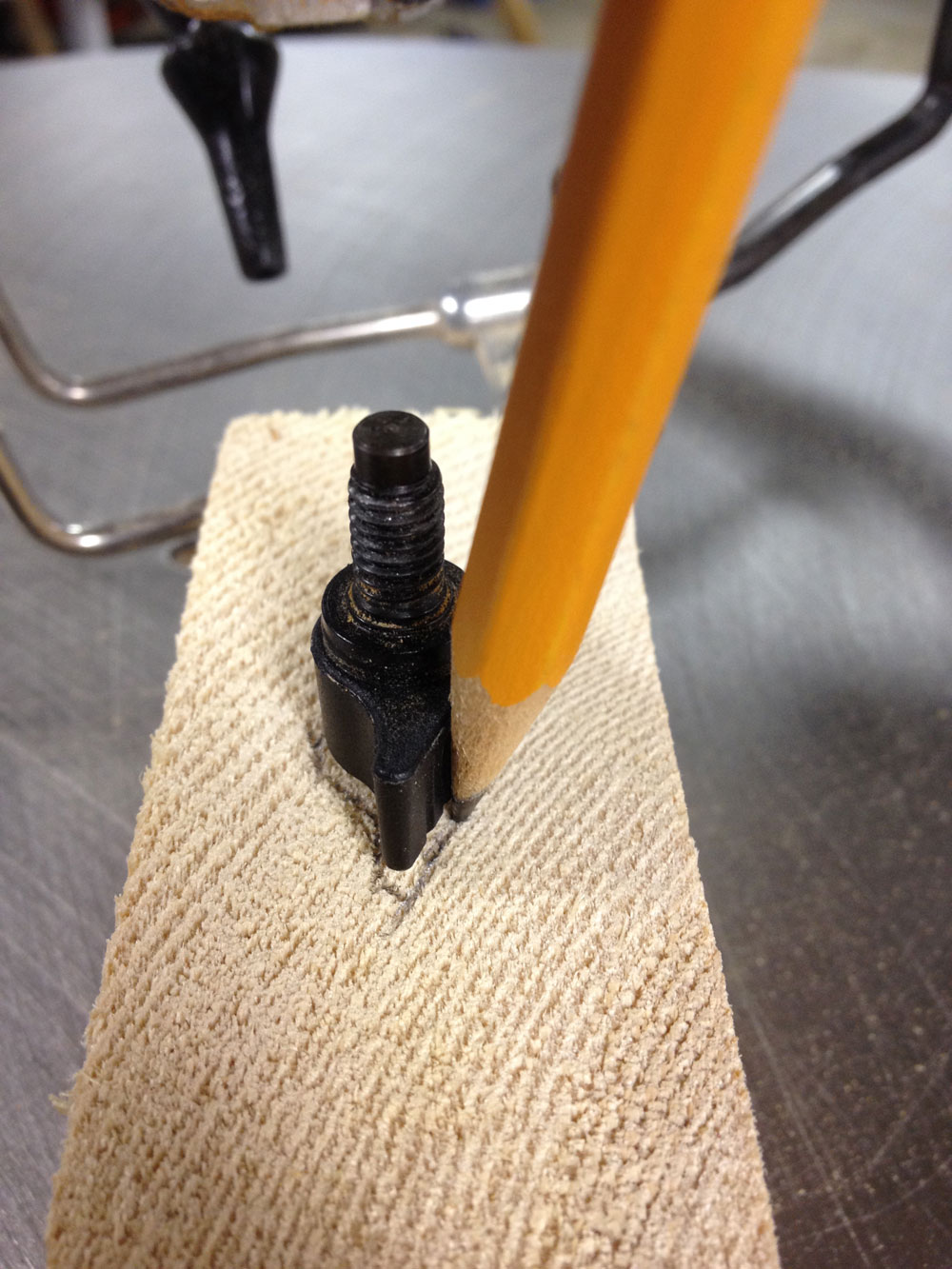
I started by removing the thumbscrew from the saw, drawing the outline of its head on a scrap spruce block. You want some degree of accuracy here. The fit needn’t be too tight, or it’s hard to get on and off. But, you don’t want it sloppy, either.
I started by removing the thumbscrew from the saw, drawing the outline of its head on a scrap spruce block. You want some degree of accuracy here. The fit needn’t be too tight, or it’s hard to get on and off. But, you don’t want it sloppy, either.

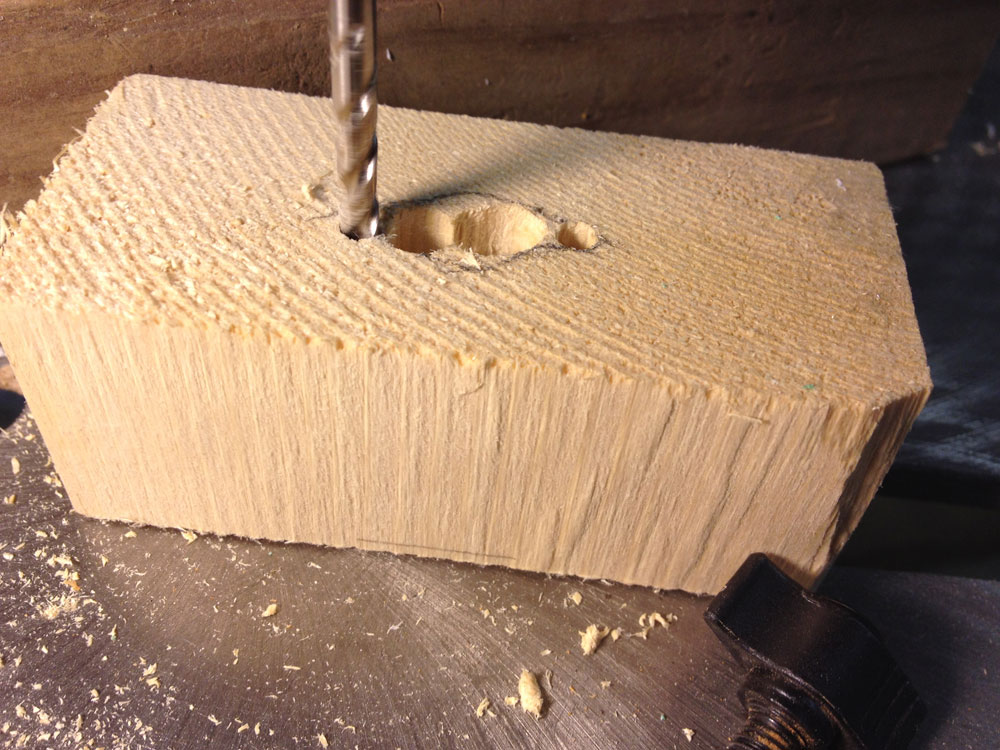
A few passes into the outline on the drill press removed the bulk of the material...

A few passes into the outline on the drill press removed the bulk of the material…
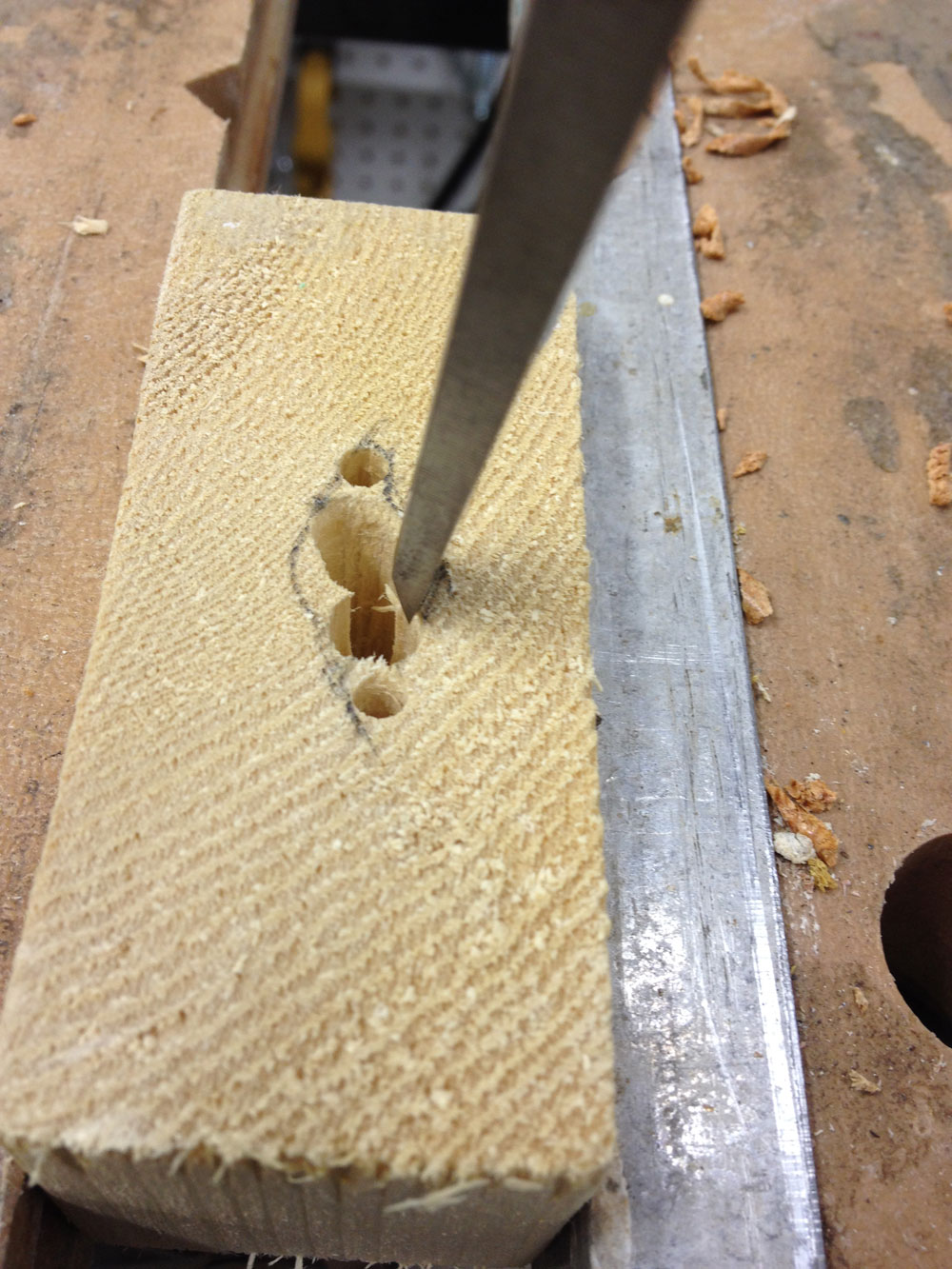
... leaving light work for a 1/4" chisel.

… leaving light work for a 1/4″ chisel.
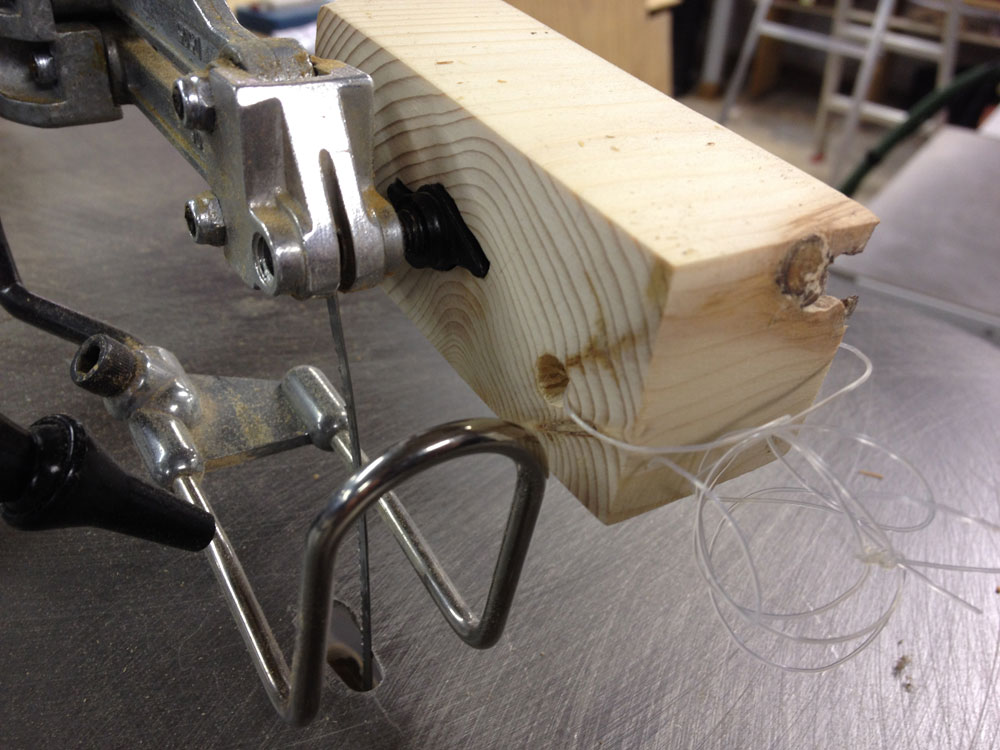
The final product. If you want you can sand the block smooth, put on some stain and some finish. Or, paint it to match your brand of scroll saw.

The final product. If you want you can sand the block smooth, put on some stain and some finish. Or, paint it to match your brand of scroll saw. I put a piece of fishing line on mine to hang it from the saw so it’s never far away.
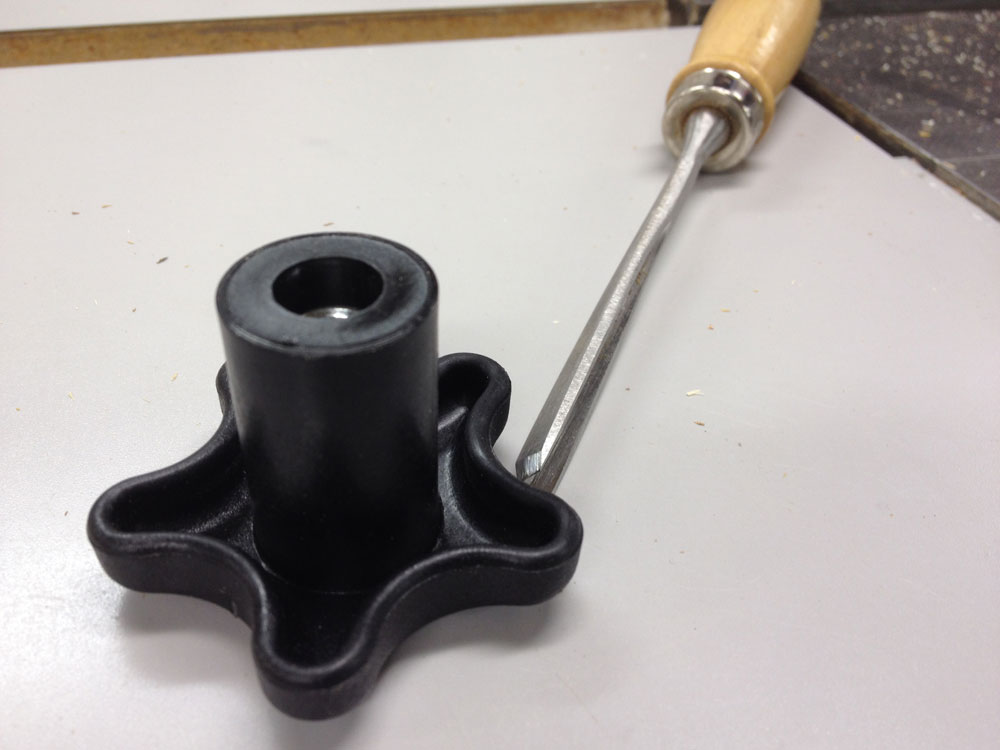
If you have a thumbscrew that’s more of a “knob” than a “wingnut,” the 1/4" chisel probably isn’t going to allow you to fit the wood to those round tips. All is not lost, there is an opportunity here! Just click on this link to purchase a set of carving gouges. Any opportunity to buy a new tool!

If you have a thumbscrew that’s more of a “knob” than a “wingnut,” the 1/4″ chisel probably isn’t going to allow you to fit the wood to those round tips. All is not lost, there is an opportunity here! Just click on this link to purchase a set of carving gouges. Any opportunity to buy a new tool!


Jim Randolph is a veterinarian in Long Beach, Mississippi. His earlier careers as lawn mower, dairy farmer, automobile mechanic, microwave communications electronics instructor and journeyman carpenter all influence his approach to woodworking. His favorite projects are furniture built for his wife, Brenda, and for their children and grandchildren. His and Brenda’s home, nicknamed Sticks-In-The-Mud, is built on pilings (sticks) near the wetlands (mud) on a bayou off Jourdan River. His shop is in the lower level of their home.Questions and comments on woodworking may be written below in the comments section. Questions about pet care should be directed to his blog on pet care, www.MyPetsDoctor.com. We regret that, because of high volume, not all inquiries can be answered personally.
Apr 012016
 

This weekend, Atlanta is hosting a bunch of woodworkers in town for The Woodworking Show. Highland Woodworking is sharing a booth with SawStop, so if you’re at the show, be sure to stop by and say hello!

A few of the show-going woodworkers are also taking advantage of our store’s nearby location and checking it out for the 1st time (or 30th).  We got a great write-up from Jay Bates of Jay’s Custom Creations who visited the store yesterday and got a behind-the-scenes tour from store owner, Chris Bagby. If you haven’t been to the store yet, Jay got some great photos, so be sure to check them out in the link below.

Apr 012016
 

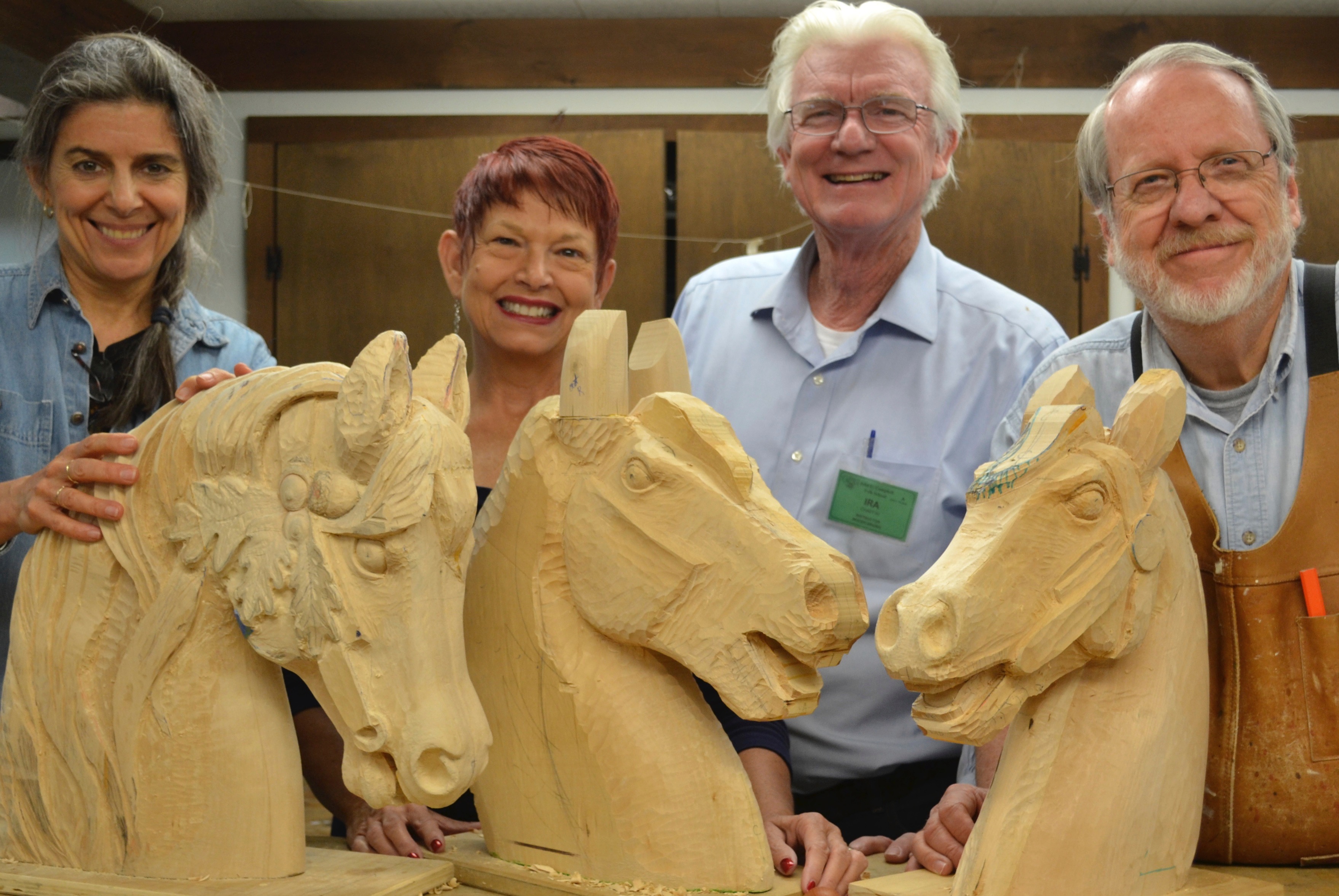
A few years ago I went up to John Campbell Folk School for a class on carving where we were tasked with carving the head of a full size carousel horse. The instructor was excellent and brought several beautiful carousel horses for us to go by.

He gave us a pattern for the head and a roughed out block of basswood and said, all right, go ahead. And we’re sitting there saying go ahead where? We were finally able to get rolling on the task, which turned out to be a long week of eight hour days taking off little chips of wood, then stepping back and trying to see what to take off next or if we had gone too far.

Me and My Classmates

Me and My Classmates (Instructor right center)

If you have never done carving in stone or wood, the problem is once you cut something off, it is gone.  You can’t put it back like you can with clay. In fact, we laughed the whole class about looking for a “wood-put-er-backer-on-er”, i.e. something to put the wood back on after it was gone. We never did find one.

Summer time in Georgia is peach time. Every year I go down to Middle Georgia to a peach packing house and watch them sort and grade peaches. They have this wonderful machine which sorts, grades and labels the peaches with a computer and a camera. The machine takes a photo of each peach as it literally flies by, kicks out the bad ones, sticks a label on the rest and then directs each one to the proper tray for packing.

The Peach Packing House

The Peach Packing House

While sitting there in one of their rocking chairs, eating peach ice cream and watching that machine photograph and sort those peaches, it came to me — a solution to the “wood-put-er-backer-on-er” problem. About two years ago, I contacted the company which manufactures the peach machine and proposed to them a combination machine for carving. My idea was to set up a modification of their sorting machine and combine it with a 3-D printer. The computer/camera records the shape of each chip as it falls off the carving. Then using the 3-D printer, any chip can be reproduced and put back on the work, one chip at a time. The beauty of my machine is you don’t actually have to keep each chip because it is recorded in the computer and you can just “rewind” to a particular spot in the carving process and the 3-D printer simply adds the chips back onto your work. What genius!  Course, there is a limit to how far back you can go and with current technology and memory, it is about 500 chips.  Naturally it doesn’t work for sanding since those particles are too small and really eat up memory.

The peach machine company has promised to deliver the prototype by July 1st this year and I cannot wait for you to see it.  I have a photo, but for marketing purposes we are not ready  to publish it yet.  Price is going to be determined by the demand , but right now the initial price point is in the $16,000 range. A price that high is going to limit sales, but I am positive we can pull that down as we start marketing and demand begins to build.  Eventually I think we are looking at about $4500 each which is still a lot of money unless you need one. On the other hand, my Oneway lathe cost more than that.

I see endless possibilities.  The same problem exists for lathe work, but we will need a lot more memory and a really, really fast camera to record all those chips.  Being able to “rewind” enough to make a real difference could be a problem.

I do need a catchy name for it and if you have something I can use, post it in the comments. What about “PEBOE” or “Backer-on-Er”?

Look for it in the Fall Edition of the Highland catalog.

Mar 302016
 

The spokeshave can be a very valuable tool to have in your kit, and I have a technique of sorts that you may wish to try, especially if you are struggling or have ever struggled with this tool.

Before I share the tip, lets briefly go over a few things that in my mind are mandatory if you expect to get a good result from the spokeshave.

First, the blade needs to be as wickedly sharp as you can muster, but this doesn’t mean you need to spend 10 hours at the sharpening/honing stones. I hone the bevel first on a 1000-grit water stone, using my Lie-Nielsen Honing Guide, and stop as soon as I can feel a burr on the back of the blade. I shift over to my 8000-grit water stone and take a few passes on it, stopping when the cutting bevel is polished like a mirror. The back of the blade is handled without a honing guide, but I rest the portion farthest from the cutting edge on a thin ruler that I place on the 8000-grit water stone. This slight elevation focuses the stone to work out at the cutting edge. You can stop on this side when you feel the burr is gone, and you have a mirror-polished band at the cutting tip.

With this, we have what is awfully close to a razor sharp blade, and takes all of a minute or so. To set the blade to a good starting point, I like to rest the sole of the spokeshave on a board I know to be flat and insert the blade so the cutting edge is also touching the board. Some like to apply a little pressure on the back edge of the blade, while applying pressure with the thumbscrews or screwdriver (or possibly other methods), depending on your spokeshave. I don’t usually apply this pressure, as I’d rather start with a shave that isn’t cutting, than start with one that cuts too deep.

So that is the basic setup.

With my spokeshave setup exactly as I described above, I was working on a piece that had some reversing-grain the other day, and I had what I’ll call a couple of struggles. I got a great surface on all but a couple of little spots, but when I went in to clean those up I started to get some chatter which left some parallel wavy lines on the surface. I tried everything including skewing the spokeshave to the point where the body was almost perpendicular to the standard orientation, but this didn’t resolve all issues. I decided to change my approach a bit, and I tried to add absolutely nothing extra to the weight of the spokeshave while I was using it. I was using a super-light touch, and I noticed it was providing a nice smooth improved surface, but there were still a few little blips.

I tried one last thought, which was to just barely keep the “toe” (spokeshave body section just in front of the cutting edge) engaged with the wood, but an almost imperceptible lift of the rear of the tool. I found I was able to micro-adjust my cut from the full cut, to nothing at all, based on how much of this little lift I employed. I kept my thumbs on the “toe” area, which seemed to make the control that much better.

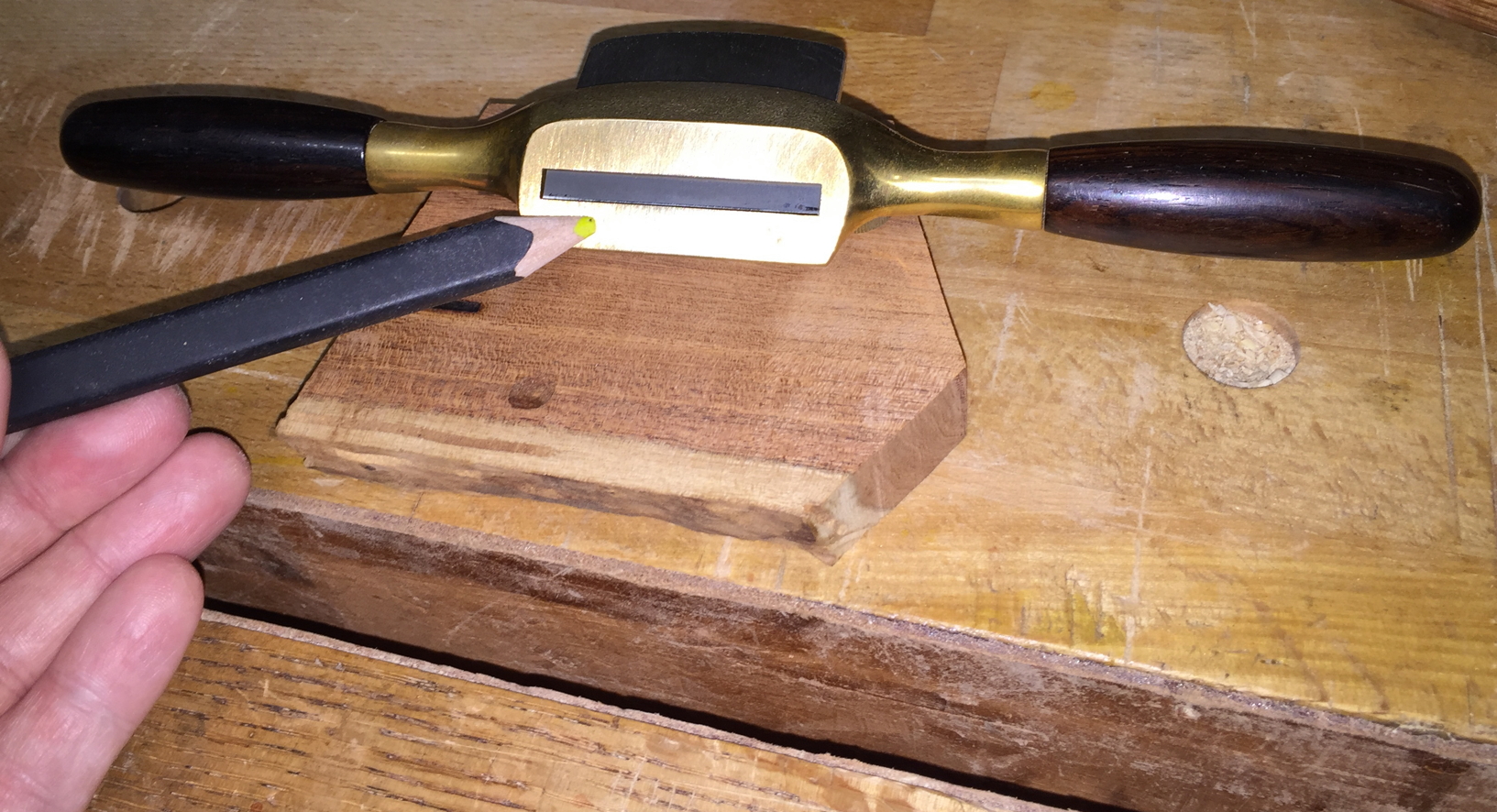
Touching a colored pencil against the “toe” of the spokeshave.

Touching a colored pencil against the “toe” of the spokeshave.

This is a very touch-oriented technique, as you can probably tell, but it was like I had some crazy magic going on. The surface was as close to flawless as I can recall obtaining with my spokeshave, even on my previous “best day.”

I expect I’ve probably “used” this technique before, without having the conscious aspect that I do now. I find it interesting that we can perform a certain task, at a decently high level, but really not completely understand how we accomplish this. While this isn’t really a great analogy, it might be like trying to teach someone to throw a baseball, which to many seems like a “so what” statement. If you ever coach really little children, you might find out just how much thought it takes to convey all of what is going on during a throw.

I hope you enjoyed this article and find it helps you obtain better control and results from your spokeshave. Please let me know if you have any questions or comments.


Lee Laird has enjoyed woodworking for over 30 years. He is retired from the U.S.P.S. and worked for Lie-Nielsen Toolworks as a show staff member, demonstrating tools and training customers. You can email him at LeeLairdWoodworking@gmail.com or follow him on Twitter at twitter.com/LeeLairdWW

Mar 292016
 

166031

Peter Galbert was at Highland all last week teaching his Windsor Chair class. After so many years learning his craft, Pete’s brain is full of useful nuggets like this one on how to maximize a bottle of Old Brown Glue.

The problem: constant re-heating of the glue bottle was causing the unused glue to get clumpy and unusable before you can actually use all of the contents of the bottle.

The solution: empty the glue into an old ice cube tray you aren’t using anymore, and put the ice cube tray in the refrigerator (not the freezer!) The cold turns the glue into gelatin-like cubes that you can store individually in a ziploc bag in the refrigerator and then easily pull out, one at a time. One cube is usually enough for the glue-up of a single chair! Thanks, Peter!

Mar 262016
 

getwoodworkingweek2016

Thanks to everyone who submitted their blogs, videos, and social media updates for #GetWoodworking Week this year! Our main goal is to promote woodworking to our community and get new people interested in it.  It also acts as a reminder to people who may have not gotten into their shops for awhile to go out and make something.

Here is a round-up of some of the highlights of this year’s #GetWoodworking Week:

Blogs

Wilbur Pan – The problem with buying a Japanese saw, 2016 edition

Ethan Frei- GetWoodworking: How I Got Started

Matt Cremona- What’s Matt Up To This Week

Stephany Wilkes (West by Midwest)- Build Up, Beginning WoodworkerThe Accidental Aesthetic Anarchist

Steve Johnson (The Down to Earth Woodworker)- The Luckiest Woodworker, The Goal is More Woodworkers, Right?, Marketing to Potential New Woodworkers

Justin Starr- A Reason To #Getwoodworkingweek

Jim Ashley (The Wood Lab)- Thoughts When Starting Out

Videos

Manhattan Wood Project – Cedar Plank Porch Gardens

Manhattan Wood Project – Finding Decent Wood at a Good Price

Dominic Bender – 14 Ways to make a Tealight Holder

Instagram

All she can do until the glue dries. #getwoodworkingweek #woodworkaustralia #woodworking #shopfriend #plattcavecreations

A photo posted by Tony Platt (@plattcavecreations) on

Guess I am participating in #GetWoodworkingWeek Finally got my Stanley no.5 tuned up. A photo posted by @davidclyell on

Blizzard outside, so I’ll work on my #getwoodworkingweek project. I need a bench stat!

A photo posted by @lynchnathaniel on


Feeling groovy. #woodworking humor #getwoodworkingweek


A photo posted by Nathan Merrill (@merrillrx) on

Hickory up front, oak in the back. #woodworking #dowoodworking #mallet #hickory #oak #danishoil #getwoodworkingweek A photo posted by Colin Gregory Beckstrand (@colinwalin) on


My first attempt at spoon carving #woodworking #spoon #getwoodworking #maker


A photo posted by Cale Blalock (@cabwoodworking) on

Mar 242016
 

Ancestry dot-com has 2 million subscribers worldwide. Sounds like a lot. But if their subscription base were U.S. only, it would be only 6/10ths of 1 percent of the population. Since their subscription base is worldwide, the paid subscription service represents only 4/10,000ths of 1 percent of worldwide population. These are market share numbers that are essentially non-existent. By contrast, 16.6% of the world’s population owns an iPhone.

In a recent survey, it was found that 5.5 million people in the United States participate in woodworking. Two years ago Popular Woodworking reported that 10 million people participate in the woodworking hobby in the U.S. and there are a little over 202,000 professional woodworkers. Even if we use the smaller of the two hobbyist numbers, about 3 times the number of people participate in woodworking as the number that subscribe to Ancestry.com worldwide… and yet Ancestry advertises on television and conducts an ongoing and active marketing campaign to attract new members. We woodworkers do essentially nothing to attract new “subscribers.”

Okay, “nothing” is a little harsh. There are a lot of individual efforts to attract new woodworkers… clubs, magazines, on-line publications, classes, retail establishments, manufacturers, and yes, the laudable Get Woodworking Week. But these are scattered, uncoordinated, and under-funded efforts. Sorry, still sounds harsh, doesn’t it? But it’s true.

Now consider this… while the size of the industry is hard to nail down precisely, one report lists the U.S. sales of woodworking equipment at $712 million. Keep in mind, even if this number is close to correct, it is only “equipment.” It is highly likely that hand tools, portable power tools, supplies, and wood are not included in this number. But for now, let’s play small ball and pretend the U.S. woodworking market represents $712mm in annual revenue… I actually think the market is 8 times that big… or bigger.

Now let’s pretend that a “woodworking marketing consortium” could be organized and its sole objective… its mission statement… is to reach potential “new” woodworkers. If each manufacturer, reseller, and supplier paid in 3/10ths of 1% of sales (that’s 3/10ths of a penny for each dollar of sales), the budget of the consortium would be $2,136,000. $2+million dollars would buy a lot of marketing directed at new potential woodworkers.

So let’s try to come at the number from a little different direction. If the recent survey conducted is correct, and 5.5 million people are hobbyist woodworkers, and each woodworker spends on average $1,000 a year on woodworking supplies, tools, wood, and equipment, that is a whopping $5.5 billion in annual sales. At 3/10ths of 1 percent, the “Consortium” would raise $16.5 million for marketing. How many woodworkers could we lure into the hobby with that kind of money to spend?

About this time you might be wondering how I picked “3/10ths of 1 percent” as a fair hypothetical contribution for manufacturers and sellers? Well, on average, companies spend from 3 to 5% on their own marketing. I simply took the low end of that scale and imagined “selling” the concept to a company as “Consider contributing 1% of your annual marketing budget.” Thus if a company has $10mm in annual sales, and a $300,000 budget for marketing, their contribution to this effort would be $3,000. Seems like a small “ask” for such a potentially large reward.

Now we can do a little exercise in “sales projection.” A direct marketing campaign that generates a 3% response rate is considered “successful.” An outstanding campaign might generate up to a 5% response rate. A campaign is not usually considered to be a “failure” unless it generates less than 1/2 of 1 percent response rate. For the sake of conservatism, we will project a 1/2 of 1 percent “hit” rate for our new “Bring In New Woodworkers” marketing campaign.

Our budget for the marketing campaign is $2mm. We are going to use the smallest numbers throughout our hypothetical. We spend about $200,000 doing a deep data analysis and development of a list of potential “targets” for our campaign. That leaves $1.8mm for the campaign itself. Our advertising, in whatever form it might take, costs $10 per impression, a high number, but remember, we are being conservative. That means we can reach 180,000 potential new woodworkers. And now if we assume the worse and project that just 1/2 of 1 percent of those reached get interested and become woodworkers, we will have brought 900 new woodworkers into the hobby.

If those 900 new woodworkers each spend $1,000 during their first year of participating in the hobby, we will generate almost one million dollars of new revenue for the manufacturers and resellers that ponied up the $2mm in “joint” marketing fees. That doesn’t sound like a great return on investment (ROI), but remember, we are talking about woodworkers who might spend $1,000 per year on tools and supplies for the rest of their lives! That means that in about two years, there is a 100% ROI.

In my life I have found that the only thing that makes something impossible is a lack of imagination. “Get Woodworking Week” is a great concept. Perhaps there is a way to take it up a notch.

getwoodworkingweek2016-hashtag


Steven Johnson is retired from an almost 30-year career selling medical equipment and supplies, and now enjoys improving his shop, his skills, and his designs on a full time basis (although he says home improvement projects and furniture building have been hobbies for most of his adult life).