Highland Staff

Nov 182014
 

A conversation between Bob Rummer, Ken Rummer and Don Burnham

BOB: I just became a Grandpa. As I am working in my shop to complete a rocking chair, hopefully before my grandson enters pre-school, it strikes me that I have some critical Grandpa responsibilities. I am using a plane that belonged to my Grandfather, chisels that were used by my great-grandfather, and skills and methods I learned from my father. Now it is up to me to influence the next generation. What are the rules? What important lessons do I need to share? Should I get the Playskool workbench for his first birthday? Where could I go wrong? At times like this I turn to my big brother for advice–

KEN: Well, I’m still a newbie grandpa myself, with just a shim and a shaving’s head start. We may have to put our heads together on this.

CLICK HERE to read what Bob, Ken and Don think their Grandpa responsibilities ought to be:

We would love feedback from readers on this topic. How were you impacted by your grandpa in the workshop? What do you see as your responsibility to pass on the love of the craft? Add your thoughts to the comments below.

Nov 122014
 
big-divider-1d

Big Dividers on a 4 by 8 Sheet of Plywood

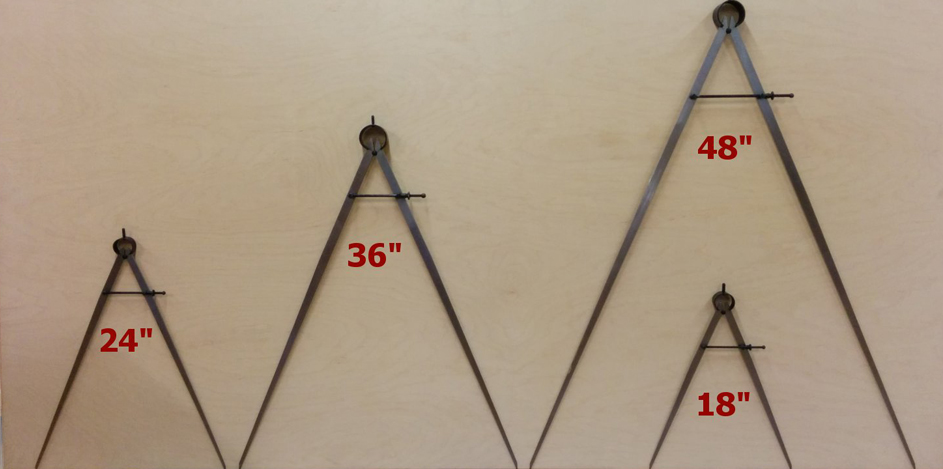
Highland is selling large dividers and I got one this week to try it out. I think it is a test, because everybody knows that the only thing you can do with these things is draw, in this case, a very big circle.  The pair I have opens to 24-1/4 inches for a circle diameter of 48-1/2 inches and that is the next to small size.  The big one opens to 50 inches for a 100 inch (that is over 8 feet, Ralph!) circle.  They come with no pencil holder on the end, just two really sharp points, but you can tape a pencil, a pen, a very large crayon or a six inch paint brush to the end of the leg and you are right where you want to be.

I kept trying to think what I might use these things for and I started to do some research.  I suppose you could use them to do the navigation for a very large ship.  If you need to lay out rafters on a roof, you could step the 24 inch spacing for marking.  I remember in geometry learning how to set off a perpendicular to a line with only a divider.  When we lay out batter boards for a house, we could use this to make sure the house is square, though a 3, 4, 5 triangle would probably be better.  If I were a cooper, I could draw the top of my barrel with this tool.  If I were a wheelwright, I could step off the circumference of the felloes in my wagon wheel to see what length the steel rim needs to be.  How about painting a sign for the Lottery advertising a $100,000,000 prize?  How about making a decorative sunburst?   How about an arch for a kitchen entry inside your house? You can do a One-Centered Arch., a Two-Centered Gothic Arch, a Three-Centered Basket Handle Arch, a Four Centered Tudor Arch, a Segmental Arch,  a Pointed Segmental Arch, a Pseudo Three Centered Arch, and a Pseudo Four Centered Arch, all with dividers and a square.  How about an eyebrow dormer for your house?  How about a Traditional Tangent Handrail?

By Hand & Eye --  Walker and Tolpin

By Hand & Eye — Walker and Tolpin

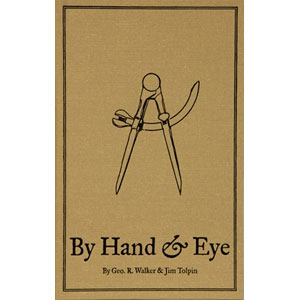
Now if you want to see what a divider can really do in construction and woodworking, get yourself a copy of “By Hand and Eye” by Walker and Tolpin from Lost Art Press. Note the cover imprint if you want a sense of what this book is all about.  The main premise of the book is proportion. Our eye moves to proper proportion and we can learn to see good design in furniture and columns and buildings. It is amazing when you are able to quantify what you are seeing in design and much of it only requires dividers. Go to Section III of the book and learn a huge amount about constructing elements with a straight edge and a compass/divider.  You can also go to George Walker’s web site to see animated constructions of the elements. Join with the ancient Egyptians and the Masons and the Greeks and the Romans and the classical furniture makers of England and France and start using these ancient and wonderful tools.

Now I know you can design all this stuff in Sketch-Up, but let me see you find a printer big enough to make yourself a Four Centered Tudor Arch pattern to trace on the sheetrock for your kitchen wall. You can do it all with one of these honking compaii plus a straight edge. Besides, what kind of fun would it be to do it on a computer ?!!

I might even start a woodworking book publishing company and use it for a logo.

And you thought I was stumped.

Nov 112014
 

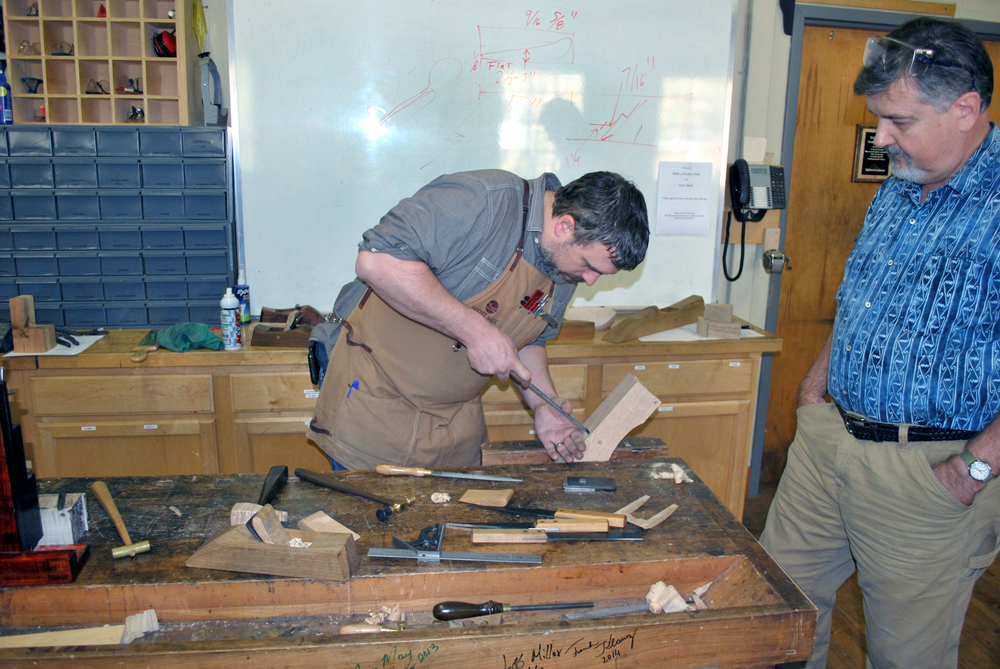
This weekend I had a wonderful opportunity to take a plane making class with Scott Meek of Scott Meek Woodworks. Scott designs and crafts fabulous wooden hand planes and was going to be teaching us his process for making a wooden smoothing plane. We started off the class by going over some differences between wooden planes and metal planes before heading to our benches and opening up the wrapped pieces of wood that Scott had brought us.

Part of our discussion at the beginning of class, and a topic that flowed through the entire weekend, was the idea that when you have the opportunity to do so, you should purchase the best tools you can. Scott gets a lot of flak on the internet because his planes cost quite a bit of money, comparable to a Lee Valley or Lie Nielsen plane and sometimes even more expensive. You might think, looking at them, that the money is not worth it, or that they are overpriced for what they are. After taking a class from Scott, and seeing everything that goes into making his tools, I think they are worth every penny.

Scott is obsessively attentive to every detail of his planes; each one is painstakingly handmade by him, all by himself. The only thing he doesn’t make by hand is the iron and the chip breaker. He is a craftsman, like many of us, and he puts the same effort and attention into his planes that we devote to our bowls, or our furniture, or our boxes.

When you buy a tool like a Scott Meek hand plane, or a Lie Nielsen chisel or plane, or a Woodpeckers straight edge, or some other tool brands that are made to last, you aren’t buying just a tool, you are buying something that is designed to last a lifetime and beyond. The plane I made in Scott’s class will be with me for the rest of my woodworking life, and because of that, the expense, spread out over so many years, is worth every penny to me. I could go on and on about tools and such, and I might in another post, but for now, let”s move on to the class at hand.

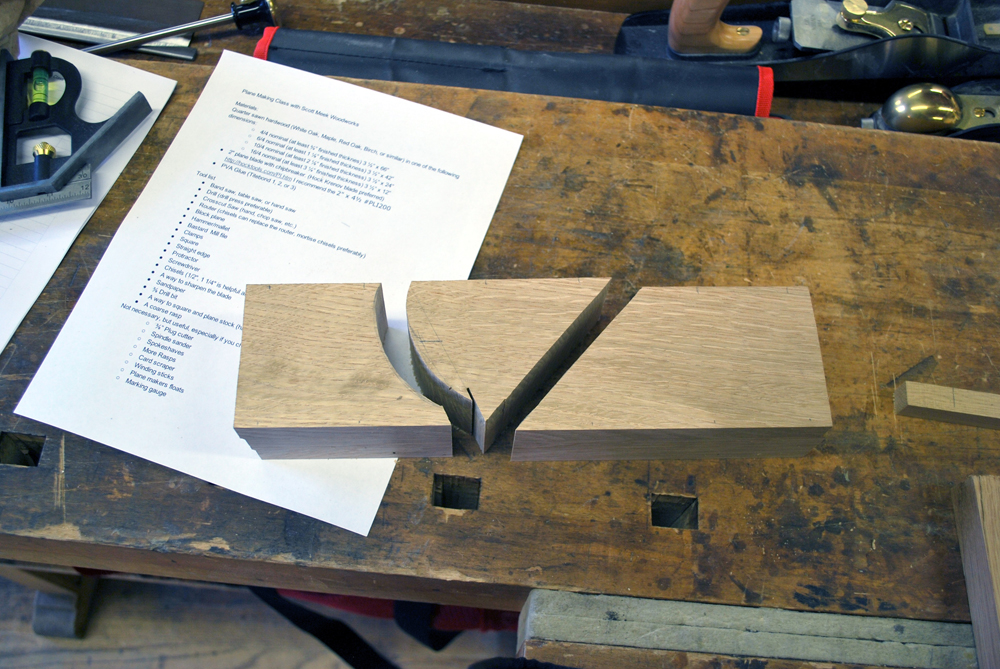
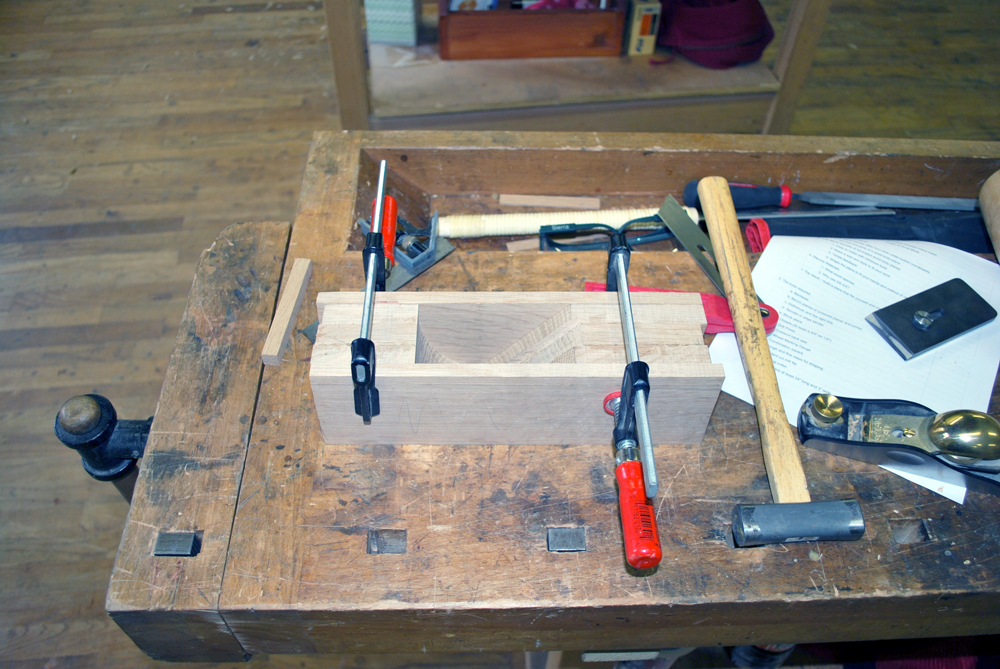
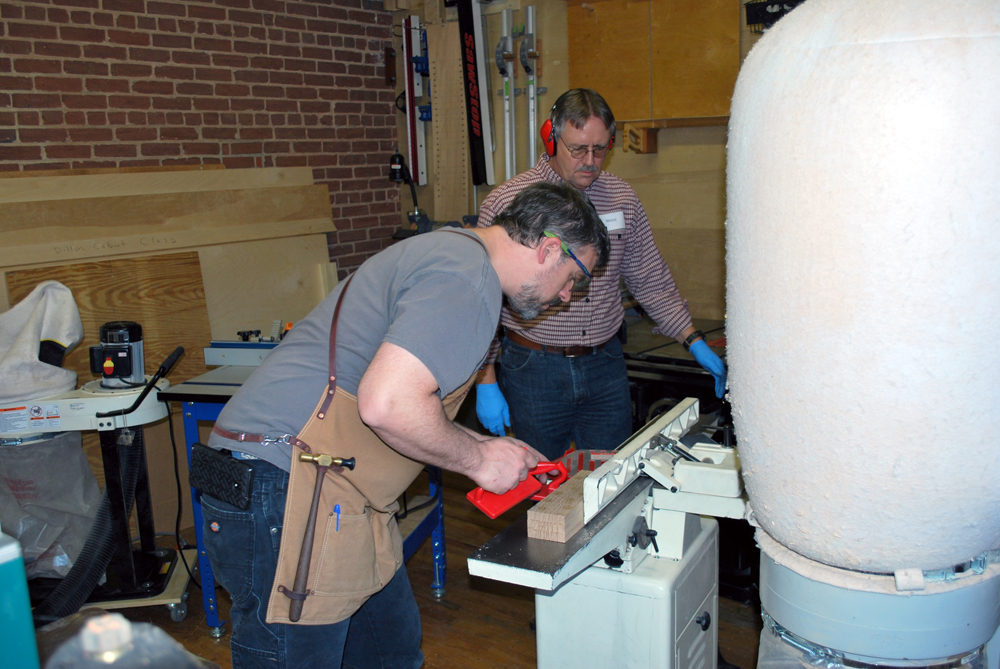
Our planes were going to be made out of quarter sawn white oak, so we spent some time discussing grain orientation and how exactly we wanted to lay out the plane within the blank of wood. We squared it up using the jointer and the planer and then took it back to our bench. Once we had our block set, we moved on to bed angle, incorporating the wear ramp, and exactly how we were going to make our first cuts.

Made some Cuts.

Made some Cuts

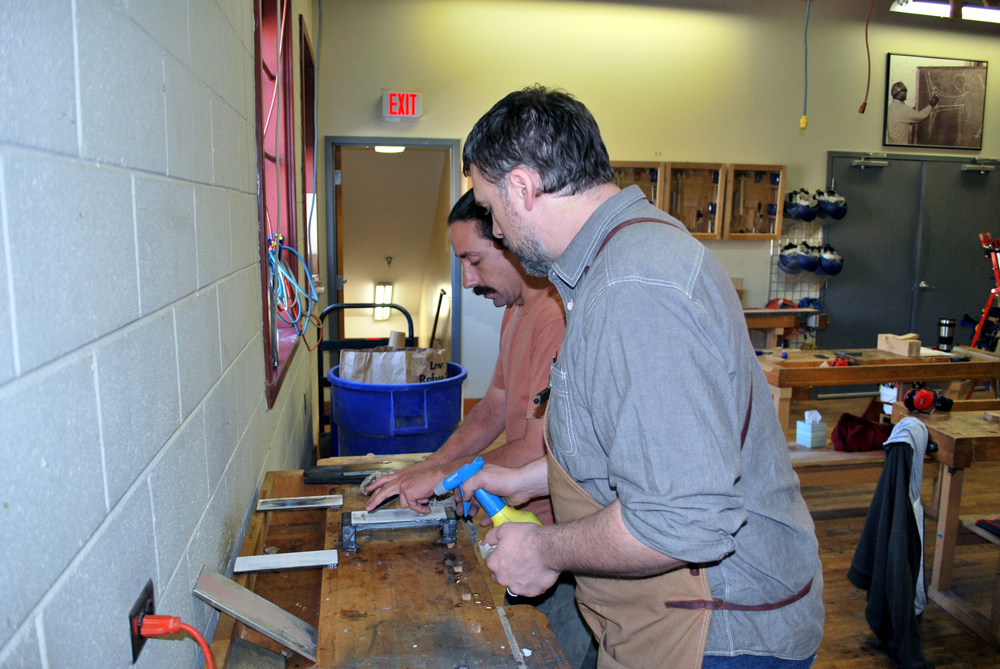
We made our first cuts and started work on truing the bed angle, sanding the wear ramp and creating the slot for the chip breaker to fit. Once we had those steps taken care of, we moved over to truing up the faces of our cheeks. We broke out the power tools once again and trued up the cheeks. All throughout the process we discussed tool choice and alternate methods of doing the various steps and then we worked on flattening and sharpening our blades. Scott was an excellent instructor, taking time to work with each of us and answer any questions we had. He worked at our pace and moved us through the steps with ease.

Sharpening.

Sharpening

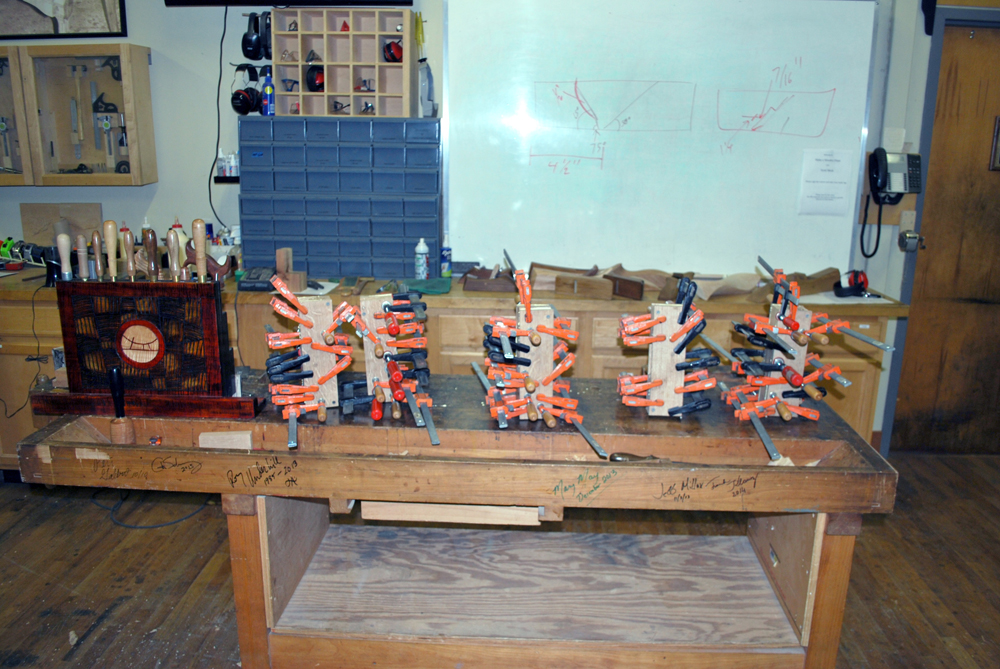
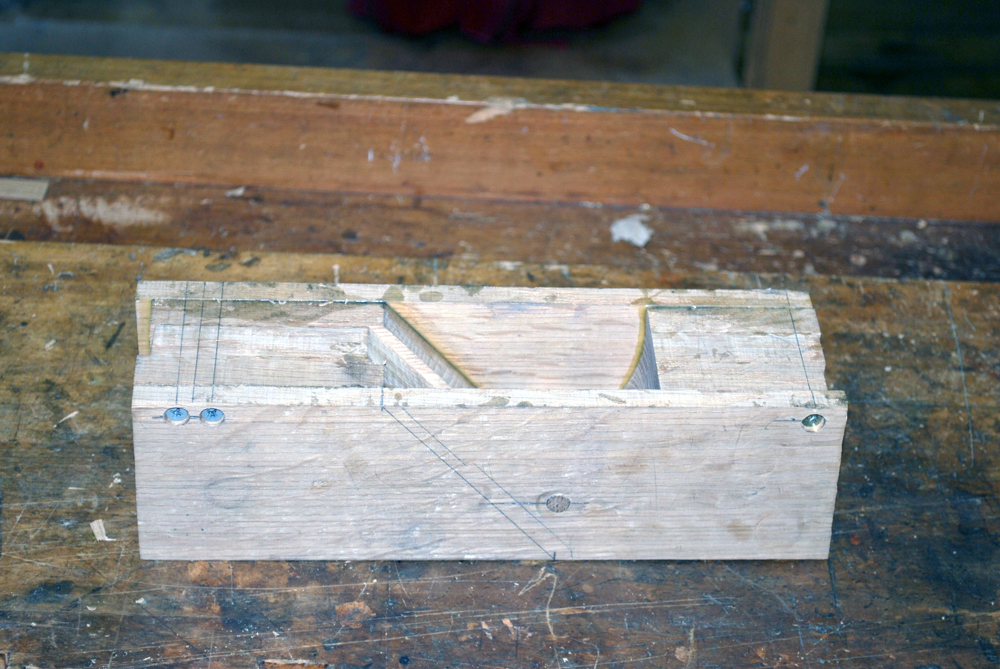
After getting our cheeks all cleaned up, we set them up with the internal plane parts and began our first dry assembly of the plane. Using screws and clamps we got the plane dry fit and assembled and ready to set the cross pin. Scott went over his method of crating the pin and discussed some other ways of creating the tenons for the pin; my favorite alternate method being turning the pins. However not having a lathe handy at the time, we cut the cross pins using Scott’s method and moved on to positioning the hole for the cross pin. Once we had the cross pin cut, the hole in the cheeks and everything lined up we were set to get the plane glued up. We took some glue, a whole mess of clamps and some handy dandy Scott Meek branded glue spreaders (also known as business cards) and got our planes all glued up. After the glue up we ended the first day of class.

Getting ready to glue up.

Getting ready to glue up

All glued up.

All glued up

Day two of the class came on early, we hit the ground running and worked hard through the day. We walked into class and un-clamped our glue ups right away. Once we had the clamps off, we started cleaning up our squeeze out and getting things ready to start making our wedges. Scott went over designing the wedge and shaping it before we cut it out on the band saw and shaped it on the orbital sander. All the while as tools were in use we each took turns working on our sharpening skills as well.

Glued up.

Glued up

Once we had our wedges, we worked on truing the sole and the cheeks so that we could begin opening the mouth of the plane. The mouth opening is one of the most intense and crucial parts of the process, and ensuring it is done properly can be a bit nerve wracking. One of our class members, Shannon, had the mouth of his plane open up on the Jointer as he was truing the sole, this was a nerve wracking moment since he didn’t know if it opened up too far or not but he got lucky and the mouth opened up perfectly for him. Shannon was the first to take shavings with his new plane.

At the Jointer.

At the Jointer

Opening the Mouth.

Opening the Mouth

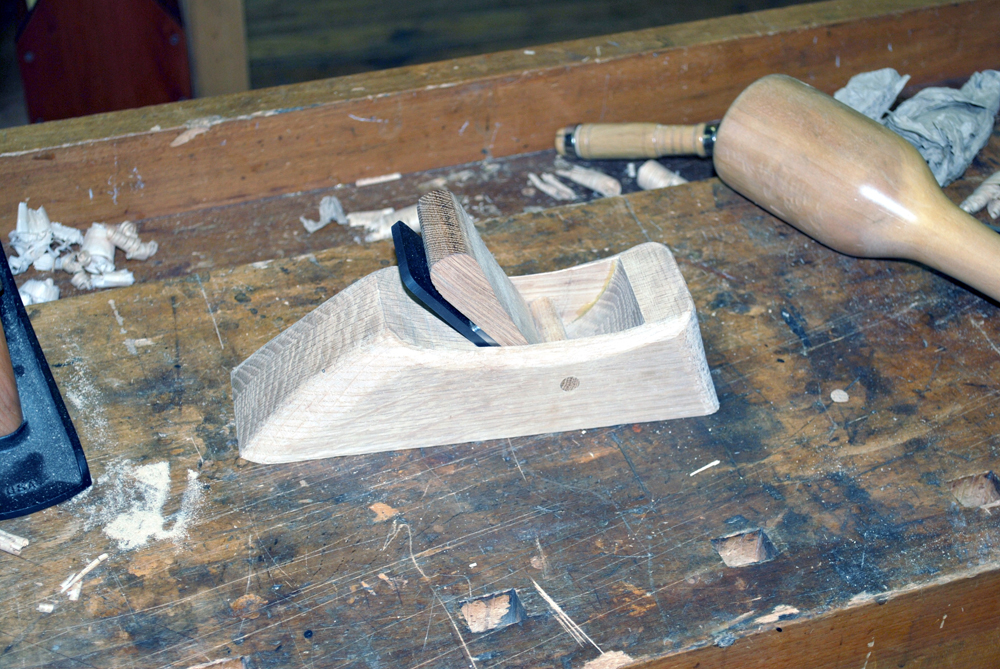
We broke for lunch and once we were back some of the class finished opening the mouths of their planes while others got to work on shaping the bodies. Scott discussed his design aesthetics for shaping the planes and we got to cutting, rasping, sanding and making the planes our own personal creations. This was my favorite part as it allowed us to truly shape the plane to our own hands.

All shaped up.

All shaped up

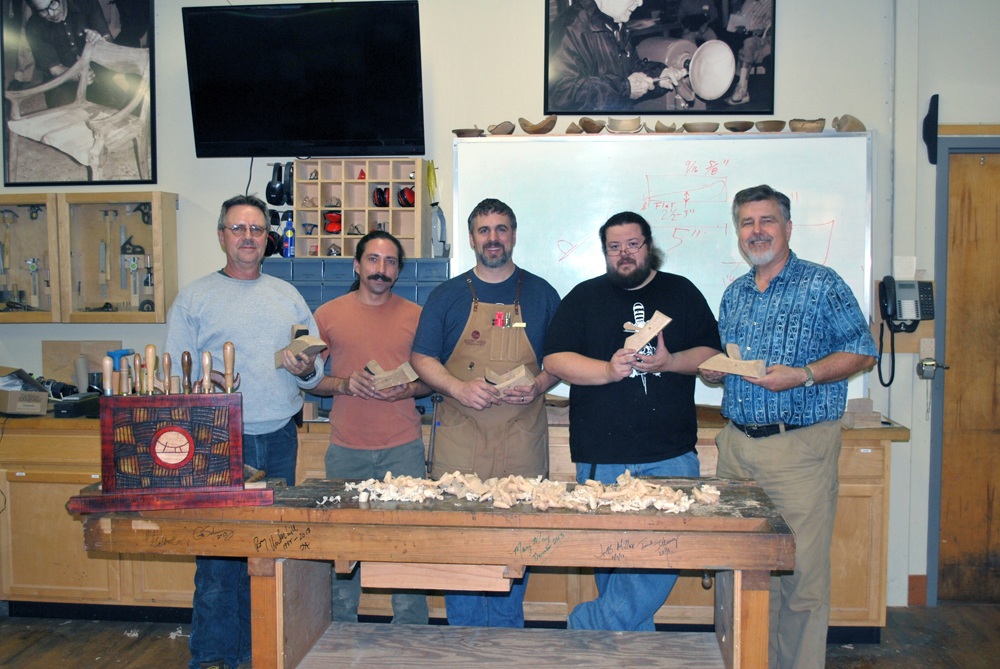
I will tell you all, that first moment you make shavings from a tool you created with your own hands is indescribably good. Pushing that plane across the wood and watching it work the way it is supposed to fills you with pride. You made that, and it works exactly like it should. The class was absolutely wonderful, I learned a whole bunch, and found a love for the hand tools that are the root of the hobby that I am so passionate about. Scott was an excellent teacher, patient and understanding. He worked with the four of us to make something amazing. We all walked out of that class with a skill we had not come in with, and a tool we could use to make even more. Class photo I’ve said it before, and I will say it again, as a woodworker, the classes that I have taken at Highland have been indispensable to my growth in this hobby, and this passion. Highland offers the opportunity to learn from masters of the craft, opportunities that you really can’t find anywhere else. If you get a chance, and I recommend you do, take a look at the class calendar at Highland. It is filled with amazing learning opportunities to elevate your skills to the next level.


Matthew York has been a woodturner since 2004 and has been interested in woodworking since he was a teenager. He currently lives in downtown Atlanta and has a small shop in his basement. He is an avid woodworker and is always available to talk about the craft. He can be contacted at fracturedturnings@gmail.com or visit his website at fracturedturnings.com. You can also follow him on twitter at @raen425

Nov 062014
 

I was riding around with a contractor one time and we saw a sign advertising “Ten Famous Nails”.  I immediately wondered who would celebrate 8d, 10d, 10d brite finish, double head form nails and all the rest.  I could think of many more than ten nails and had a vision of bins full of nails like the candy bins in the M&M store we found in Las Vegas one time.

Course it really wasn’t those kinds of nails, but it reminds me of lists like that which I have always liked.  Try this carpentry list and see how many of these numbers you can identify without looking them up:
16″.  19.2”.  1.618.  73.  3.141593.  1.414.  16.97.


How did you do?  Ok, there’s one trick one in there, but all the rest are good ones.   Here you go:

a.  16 inches.  Easy one.  Standard spacing for wall studs in residential construction.  Noted by little red blocks on your carpentry tape.

b.  19.2 inches.  Still pretty easy but much more uncommon.  That is the little black diamond on your tape measure and is the spacing for floor trusses in particular.  Designed to save material when framing and is known as “five bays in eight feet”.  If you set floor trusses on 19.2” spacing then five times 19.2 equals 96 inches or eight feet.  Your sheets of flooring will fit.

c.  1.618.  A ratio, known as the golden mean and called phi.    Mathematically it is (a +b)/a = a/b.   In rectangles, it is the ratio of longer side to the shorter side and we   perceive that as beautiful.  Works on beautiful faces, buildings, drawers in desks, and in the  Fibonacci number series where every number is the sum of the previous two numbers.

d.  73.  From Sheldon on  “The Big Bang Theory”

Sheldon: What is the best number? By the way, there’s only one correct answer.

Raj: 5,318,008?

Sheldon: Wrong! The best number is 73. [Short silence] You’re probably wondering why.

Leonard & Howard: No no, we’re good.

Sheldon: 73, is the 21st prime number, its mirror 37 is the 12th and its mirror 21 is the product of multiplying, hang on to your hats, 7 and 3. Did I lie?

Leonard: We did it! 73 is the Chuck Norris of numbers!

Sheldon: Chuck Norris wishes! In binary, 73 is a palindrome, 1001001, which backwards is 1001001, exactly the same. All Chuck Norris gets you backwards is Sirron Kcuhc!

Sorry ‘bout that.


e.  Pi.  Redneck joke.  Pi are square?  Everybody knows pi are round.  Cornbread are square.

f.  1.414.  If you have an equilateral triangle then the hypotenuse is 1.414 times each leg.

g.  16.97.  When you lay out rafters on a house, you use a run of 12 inches and whatever pitch you have.  When you lay out the hip rafter, you use a run of 16.97 inches with the same pitch since the hip runs at 45 degrees from the corners of the building and the diagonal of a 12” square is 16.97 inches.


Guess that is not ten famous numbers, but hey it’s close.  If you insist, we can add c, e and i, but you will have to Google those (hey, that’s another one!).   And if you really want to get technical, remember the old Indian Chief SOH-CAH-TOA for your trig functions.  After all these years as an engineer, I still use him.


Got any more?


Nov 052014
 

As a woodworker, I’ve found we are often defined as either a “Hand tool” woodworker or a “Power tool” woodworker. There are others, like myself, who straddle the line between the two. These “Hybrid” woodworkers tend to mix the flavors of hand and power tool work for efficient shop time as well as other considerations. Since I’ve started incorporating more hand tools in my work, I’ve been building out my tool chest, incorporating various tools that enhance my work. One of the cornerstones of hand tool work are the hand planes, and some of the best wooden bodied hand planes on the market today are made by Scott Meek.

meek smooth plane classOn Saturday the 8th and Sunday the 9th Scott will be at Highland Woodworking offering a class on How to make your own Smoothing plane. In the two day class, you will spend time learning the fundamentals of putting together a wooden hand plane and you’ll leave the class with your very own wooden smoothing plane. After this class you can head back to your shop with your own completed tool and you can use it in your everyday shop life. But not only will you gain a new tool, you will gain new skills. With those skills you can build other planes, bringing more tools into your shop and hopefully, a sense of accomplishment as you make your own tools.

I first met Scott at the Woodworking in America show this past September. We stood and talked for a bit and I was able to use some of his fine hand planes. With a wooden plane you get far more tactile feedback from the wood you are planing. Since there is no metal body to absorb the vibrations and the sensations from the surface, you are really connected to the wood you are working with. Between your hands and your work is a solid piece of wood that lets you feel the surface you are creating far better than metal bodied planes do. A few weeks ago I got to meet Scott again at the Highland Woodworking open house, where I got to test drive his planes some more as well as talk to him some about their construction and the evolution of their design. I also got to watch as woodworking legend Frank Klausz worked with Scott’s planes. His verdict was the same as mine, that Scott makes exceptional tools.

On Saturday I am looking forward to learning how to make exceptional tools like Scott’s hand planes. I personally have my eye on taking the skills I learn in that class back to my shop and crafting a jointer plane of my own. I like the idea of crafting my own tools; of taking the skills I have as a woodworker and using those to create something with both form and function. I hope, if you are able, that you look to join me at the class over at Highland Woodworking. I think it will be a phenomenal opportunity and teach a set of skills that will only grow after you return to your shop.


Matthew York has been a woodturner since 2004 and has been interested in woodworking since he was a teenager. He currently lives in downtown Atlanta and has a small shop in his basement. He is an avid woodworker and is always available to talk about the craft. He can be contacted at fracturedturnings@gmail.com or visit his website at fracturedturnings.com. You can also follow him on twitter at @raen425

Nov 032014
 

For this month’s Wood News Online we received the following Ask the Staff question from Joe Tomeo:

I would like to know if a steel used for knife sharpening is the same tool as a burnisher that is used to sharpen a card scraper?

Read our answer in the comments below and feel free to leave your own answer in the comments section!

Oct 302014
 

I’ve been doing this whole woodworking thing for a few years now, and if there is one thing I have learned, and seen preached across the woodworking world as a whole, it is that sharp tools are important. If you have ever had the chance to use a really sharp tool versus a really dull tool, you will know exactly what I am talking about. If you are a newer woodworker, maybe you don’t. Either way, keeping your tools sharp is one of the key components to being a safe and effective woodworker.

I recently took a class with Frank Klausz and he shared an anecdote from his youth as an apprentice cabinetmaker that I think illustrates the importance of sharp tools. When he was a young apprentice he would often wait until his Master had left the shop for the day and then experiment with the Master’s planes, using them and feeling how different they were from his own. He would then work at sharpening his planes so that they were as sharp as those of the Master cabinetmaker. It was a night and day difference and taught him the value of sharp tools.

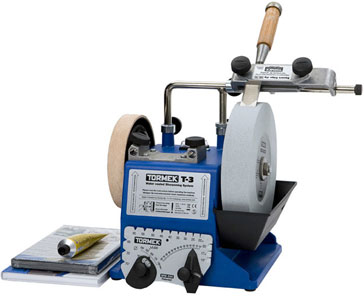
The reason I’m talking about having sharp planes and other tools and how important they are is that I recently got to work with a Tormek T3 grinder. The Tormek sharpening system is a brilliant little tool, and I was able to bring one into my shop for a few days and test it out.

Setting up the Tormek was relatively simple. It comes with an 8″-diameter 220-grit grindstone that can be temporarily graded to 1000 grit for fine honing by utilizing an optional “stone grader”. Also included is a “square edge jig” that makes it easy to precisely sharpen chisels and plane irons. It also has a leather stropping wheel on the other side that makes final honing very quick and easy. Tormek also sells several different accessories that allow you to use the T-3 to accurately grind different types of tools including gouges, knives, scissors, axes and even planer and jointer knives.

One thing I do recommend is that you fill the water tray after you place it beneath the stone; otherwise you might overfill it like I did and get your bench all wet, but lesson learned. The Tormek is a slow speed sharpening wheel and it also functions as a whetstone, which means your tools don’t get excessively hot which can harm the steel. The system itself was a breeze to use and allowed me to grind my tools to a rather satisfying sharpness.

Currently the T3 has been discontinued by Tormek and they are making way for a new system, which will allow the crafty woodworker to take advantage of the fact that Highland currently has some T3’s still in stock. These T3s are going to be moving fast so if you want a new sharpening system that is simple to use and allows you to sharpen your tools to razor sharp angles in just a few minutes I would recommend checking out the Highland website, the T3s won’t be around for long and they have a really great price.


Matthew York has been a woodturner since 2004 and has been interested in woodworking since he was a teenager. He currently lives in downtown Atlanta and has a small shop in his basement. He is an avid woodworker and is always available to talk about the craft. He can be contacted at fracturedturnings@gmail.com or visit his website at fracturedturnings.com. You can also follow him on twitter at @raen425