Highland Staff

Mar 232016
 

Spoiler Alert… This is not going to be what you think… it is, instead, to get you to think.

It Starts With You

It is often said, “All Politics is Local.”   There is some truth, I suppose, to that statement.  If you could corner a committed supporter of any candidate and drill down to the “Why?” it would likely boil down to one issue or topic that that person feels strongly about and with which their preferred candidate aligns.

Now imagine that you are a totally undecided voter.  No, really.  Undecided.  And you wander into a rally and one of the candidates is making a speech.  What must that candidate do or say that could turn you from “undecided” to “committed?”

I would contend that it would have to be a “gestalt” experience and several things would need to happen.  Later, if asked why you support that candidate, you would probably distill it down to one “hot-button” issue, but in reality, it was a lot of things that swayed you to support one candidate over another.

As you entered the rally were you greeted warmly and treated as a welcome guest?  Was there a “vibe” of excitement and enthusiasm permeating the event?  Does the candidate appeal to you in any non-verbal ways, meaning does he or she seem “real,” “friendly,” “sincere,” or “likeable?”  Did you like the music?  And finally, did the candidate say something that resonated or hit a “hot button?”

Now let’s imagine that you are a non-woodworker.  No, really.  You know nothing about woodworking.  And you wander into a woodworking store, a club gathering, a show, or other woodworking event.  What would make you turn into a hobbyist woodworker?  What would sway you from undecided to committed?

Were you greeted warmly and treated as a welcome guest?  Was there a “vibe” of excitement and enthusiasm permeating the event?  Do the people there appeal to you in any non-verbal ways, meaning do they seem “real,” “friendly,” “sincere,” or “likeable?”  Do the people say anything that resonates or hits your “hot buttons?”

If we want to get more people involved in woodworking, it really does start with you.  Are you a friendly emissary?  Do you reach out and welcome new woodworkers?  Do you smile and say nice things to people you run into in woodworking stores, shows, or other events?  Do you go out of your way to tell people what a wonderful hobby and pastime woodworking is?  Are you helpful?  Do you actively look for ways to share your knowledge and experience?  Do you invite non-woodworkers to your shop?  Do you offer to help them build something?  Think about it.

Beware The Club

Clubs are great.  Woodworking clubs are great places to share, learn, make new friends, and just generally feel like a part of something bigger.  But clubs can turn bad.

Clubs can become exclusionary.  Clubs can be, well, too “clubby.”  Clubs can be secretive, elitist, and unwelcoming to new members.  I could give you countless examples of “clubs gone bad,” but instead let’s delve into the concept of “club” in a more general way.  And just to make sure that I step on less than all ten toes, let’s take it temporarily out of the realm of woodworking.

A golf club (aka “country club”) is a prime example of the fine line that clubs must traverse.  Clubs need new members in order to be vibrant.  But clubs must also be “private” (read “exclusionary”) or there would be no reason to join.

Of course a golf club offers some things a public course does not… lockers, club storage, preferred tee times, a manicured course, and clean showers along with other accouterment, but let’s be real… for many members, membership means never having to play on a “public” course with the great unwashed masses of “other” golfers.  It is this “exclusionary” aspect that makes many of them cough up the annual dues and pay the monthly fees.

So how does a private golf club walk the fine line balance of exclusion and welcoming openness?  Well, they try all kinds of things.  They have events to which the public is invited.  They encourage “guest” play.  Perhaps there is a restaurant at the club that is also open to the public and provides entre to the atmosphere.  But in the end, it really comes down to something the club itself cannot do… it comes down to the individual members.

My first round of golf at my club was a disaster.  In an effort (I suppose) to make me feel “welcome,” the Pro Shop manager hooked me up with a threesome that was just about ready to tee off.  Introductions and handshakes all around on the first tee… so far, so good.  Unfortunately, my cart-mate turned out to be perhaps the biggest ass I have ever met.  He was self-centered, arrogant, condescending, and worked hard (it seemed) to make me feel as unwelcome as possible.  He might as well have just been forthright and said, “You are not rich, you are not influential, so you have no value to me.”

On the ninth hole I feigned an engrossing email on my phone; on the green I told my cart mate, “You guys go ahead and tee off on number ten… I’ve got an issue I need to deal with and don’t want to hold you up.”  I grabbed my clubs and headed to the bar.

Nursing an adult beverage and contemplating the money I had wasted on a membership to a club where I was, so far, made to feel decidedly unwelcome, I barely noticed the fellow that sat on the bar stool next to me.  After a few minutes the fellow asked, “Are you a new member?”  When I replied, “Yes,” an enormous smile came forth, as did his hand, and he boomed,  “Welcome aboard!”

We chatted a bit, he asked me if I had played the course yet, and I told him just the front nine.  He grabbed his hat and said, “Come on, you’re gonna love the back nine.”  He was friendly, helpful, and genuinely interested that I “like” the club.  Now, some years later, I am still a member.  I stay away from the stuck-up guys that prefer “exclusive” to “welcoming.”  The friendly and welcoming fellow is still my friend.  Were it not for him, I would have asked for a refund on my initiation fee and joined another club.

The point here is pretty simple… which guy are you?  Okay, I expect you to pretty quickly answer, “I’m the warm friendly welcoming guy.”  But are you?  Read on McDuff…

Code Words & Secret Handshakes

In today’s electronic world a chat room or message board is much like a club.  Usually only members can “post” (membership benefits) but anyone can “read”  (guest privileges). Pretend for a moment that you know nothing about woodworking but you think it might be an interesting, fun hobby.  So you “wander in” to visit a few woodworking chat boards.

How welcome and inviting is it if the language is foreign and incomprehensible?  Now I know that woodworkers are not generally lazy, and most all are very welcoming and inviting to “new” woodworkers, but when we use acronyms and other shorthand in our posts, we are not creating a welcoming environment to those who don’t “speak the language.”

When you type a post and say you always “make T’s for M&T’s on the TS” we all know what you mean… but a newbie has no idea what a mortise and tenon joint is, let alone our shorthand M&T.

On the off chance an interested potential new woodworker should land on a message board and read one of your posts, are you being “exclusive” or “welcoming?”  Our shorthand might as well be code words reserved strictly for the initiated and experienced.

My other beef with the electronic clubs (aka message boards) is any requirement to register before you can to ask a question.  Some even have a requirement to register before you can see pictures that have been posted.  What’s next?  A super-duper secret handshake before a visitor can participate?

Surly Storekeepers

I’ve written about this before, but the problem still persists.  I have been fortunate of late to be helping a young man who is building his first woodworking shop.  He has told me stories of asking questions in stores and being made to feel like, his words, not mine, “An outsider,” “Unwelcome,” and “Idiot.”  I only wish he could visit Highland Woodworking… he certainly would feel like “family” there.

Why do some clerks and shopkeepers feel it necessary to treat non-woodworkers or “newbies” like second-class citizens?  Do they need to feel some intellectual superiority?  Do they actually have contempt for people less knowledgeable than them?  Or do they simply want only to cater to other members of the club?  Shopkeepers and clerks, if you want to be surly, go get a job at the Department of Motor Vehicles.

All Woodworking Is Local
When it comes right down to it, initiatives like “Get Woodworking Week” are useful exercises, but getting new people interested in the hobby of woodworking really is a local proposition… whether it is chatting up your pastime with someone at the local pub, being helpful to someone in a store, taking a moment to spell out words in a clear and easy-to-understand way in chat rooms or on message boards, or simply being a constant and vocal champion, it really comes down to individual interactions.  Think about it.

getwoodworkingweek2016-hashtag


Steven Johnson is retired from an almost 30-year career selling medical equipment and supplies, and now enjoys improving his shop, his skills, and his designs on a full time basis (although he says home improvement projects and furniture building have been hobbies for most of his adult life).

Mar 212016
 

Editor’s Note: This week, March 20-26, 2016, is Get Woodworking Week, a chance to promote our craft to the online community at large and encourage everyone to get some time in their shop, or create a shop!  The purpose of the week is to get people off their couches and into their shops to try their hand at woodworking or to pick up the craft again if it has been a while since they have tried it. #GetWoodworking

getwoodworkingweek2016-hashtag

I am the luckiest woodworker alive. That may sound a little over the top, but it’s true. Recently a young man interested in starting to learn woodworking stumbled onto my YouTube channel; from there found his way to Highland Woodworking’s site; from there he found and read about a hundred past issues of Wood News Online, and somehow, through all of this, figured out that I live close by.

He contacted me via email, and after a few exchanges, we got together. He is setting up shop in his basement, and I have been fortunate to help a little. Wow, what fun!

This young man is gainfully employed, super smart, full of energy, good with his hands, and has had some experience with carpentry and other tangential trades from remodeling various areas of his house.

When he found me, he had already figured out that a table saw would be a good place to start, and sparing no expense, he bought a SawStop and fitted it with an Incra Positioning System including the extension table router set-up. He had also purchased a top-of-the-line dust collector.

The first time we got together we spent most of the time discussing the layout of his shop. Based on our discussion, he produced a deluxe drawing on his computer and emailed it to me. We discussed his blueprint, made a few tweaks, and he got to work arranging and installing everything. He did a magnificent job. His “plumbing” of the ducts for his dust collector was as neat, straight, and well done as any I have ever seen. The wall mounted dust collector looks like photos of it could be used in the instruction manual.

A couple of weeks ago he called and we discussed Festool… at length. A couple of days later he placed an order with Highland for a Festool CT-36 and an ETS-EC 150 EQ sander. Later that same week he called saying he had received his Festool stuff, loves it, and now wants to get a Domino machine… which one should he get? The construction of his basement shop continues. He has built a sound-dampening wall around the dust collector and is putting up a partition to separate the “shop area” from the rest of the basement. He’s doing it right.

His next project, I think, is to build a Roubo-style workbench. After that he is going to make an outfeed table for the SawStop. Then some cabinets for one wall and a mobile stand for his jointer. Then… well, who knows?

So why am I the luckiest woodworker alive? Simple… because every time I see this new woodworker, every text I get, every phone call, I can sense the excitement and energy he has for his new hobby… and I get to enjoy that excitement vicariously.

When he buys something, it’s almost like I am getting a new tool, too. When he learns how to use a new tool, it’s like I am learning, too. Now I don’t doubt for even one minute that my “usefulness” to him will wane… and that’s okay. What little bit of advice I can give him now will soon be overshadowed by his own knowledge and experience. He will surpass me in talent and ability and he will build beautiful things. I know he will. I just want to remember the joy of being new to woodworking as seen through his eyes. And I want to find another “newbie” to help… the rewards are amazing.

Steven Johnson is retired from an almost 30-year career selling medical equipment and supplies, and now enjoys improving his shop, his skills, and his designs on a full time basis (although he says home improvement projects and furniture building have been hobbies for most of his adult life).
Mar 102016
 

Highland Woodworking and our WEB TV show, The Highland Woodworker were recently featured on Fine Woodworking’s Shop Talk Live, where both organizations were introduced as new partners with Fine Woodworking. In this episode, Charles Brock, host of The Highland Woodworker, discusses his woodworking background and how both Highland Woodworking and Fine Woodworking had an influence on his woodworking beginnings in the late 1970’s. They also discuss the origins of The Highland Woodworker (the idea all started over a pizza) and how Chuck was able to get Highland Woodworking on board. The whole podcast is a great listen, but if you want to go straight to the interview with Chuck and the Shop Talk guys, you can fast forward to 33:50 of the podcast.

As an added bonus, the most recent episode of The Highland Woodworker features a “Finer Points” segment with one of Shop Talk Live’s hosts, Matt Kenney, who discusses how to cut dovetails on a tablesaw.

mattkenneyfww

Mar 032016
 

I recently received my new Lie-Nielsen Honing Guide and a couple of their available accessory jaws, which I discussed in my The Plane Facts: The Lie-Nielsen Honing Guide article posted last week.

If you, like many of us, have previously been using one of the inexpensive guides with a honing board, you will need to make another board. The dimensions of the Lie-Nielsen Honing Guide are different enough that each 5-degree incremental angle stop on previous boards will not work (but feel free to measure what you have, to confirm for yourself).

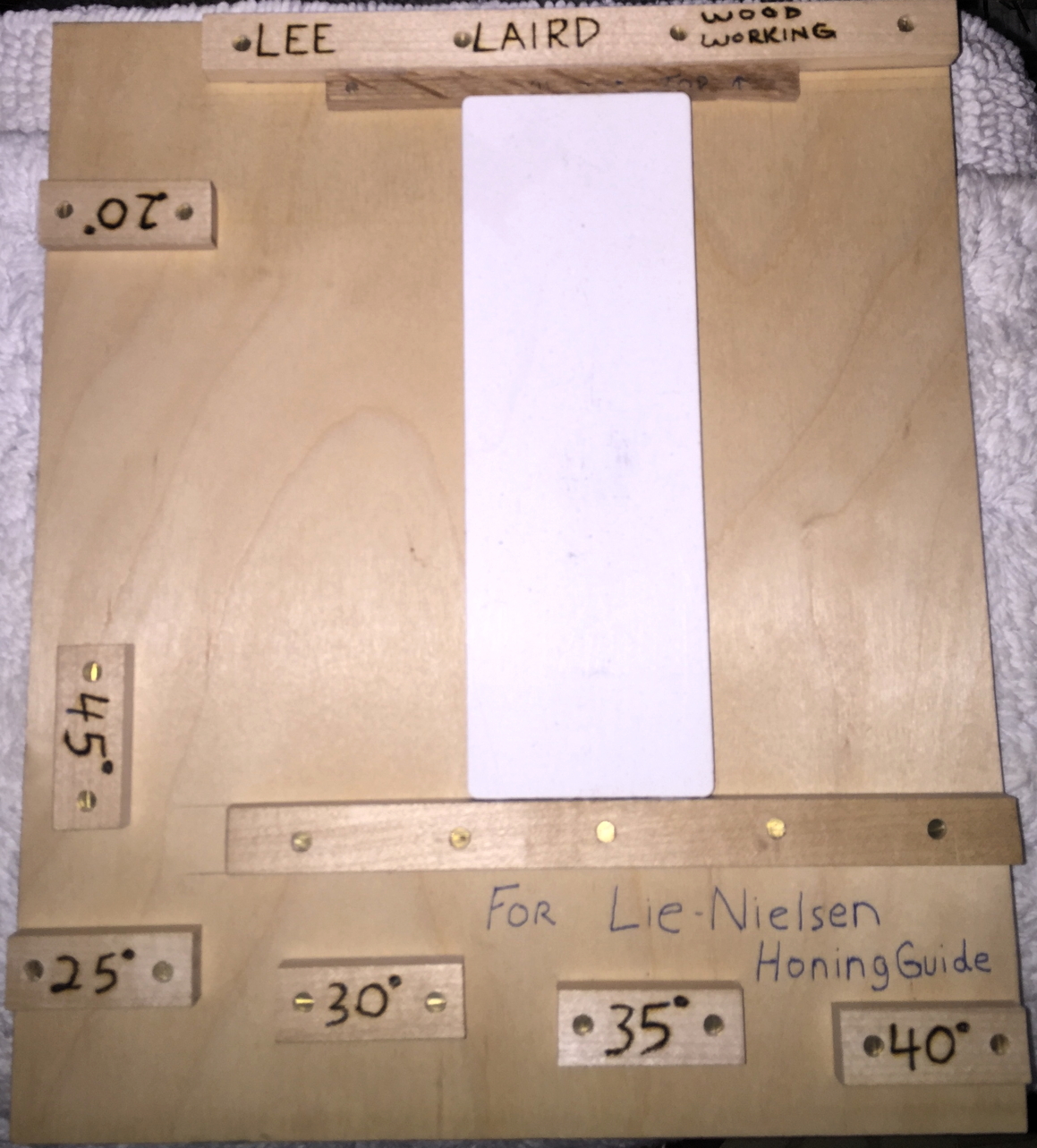
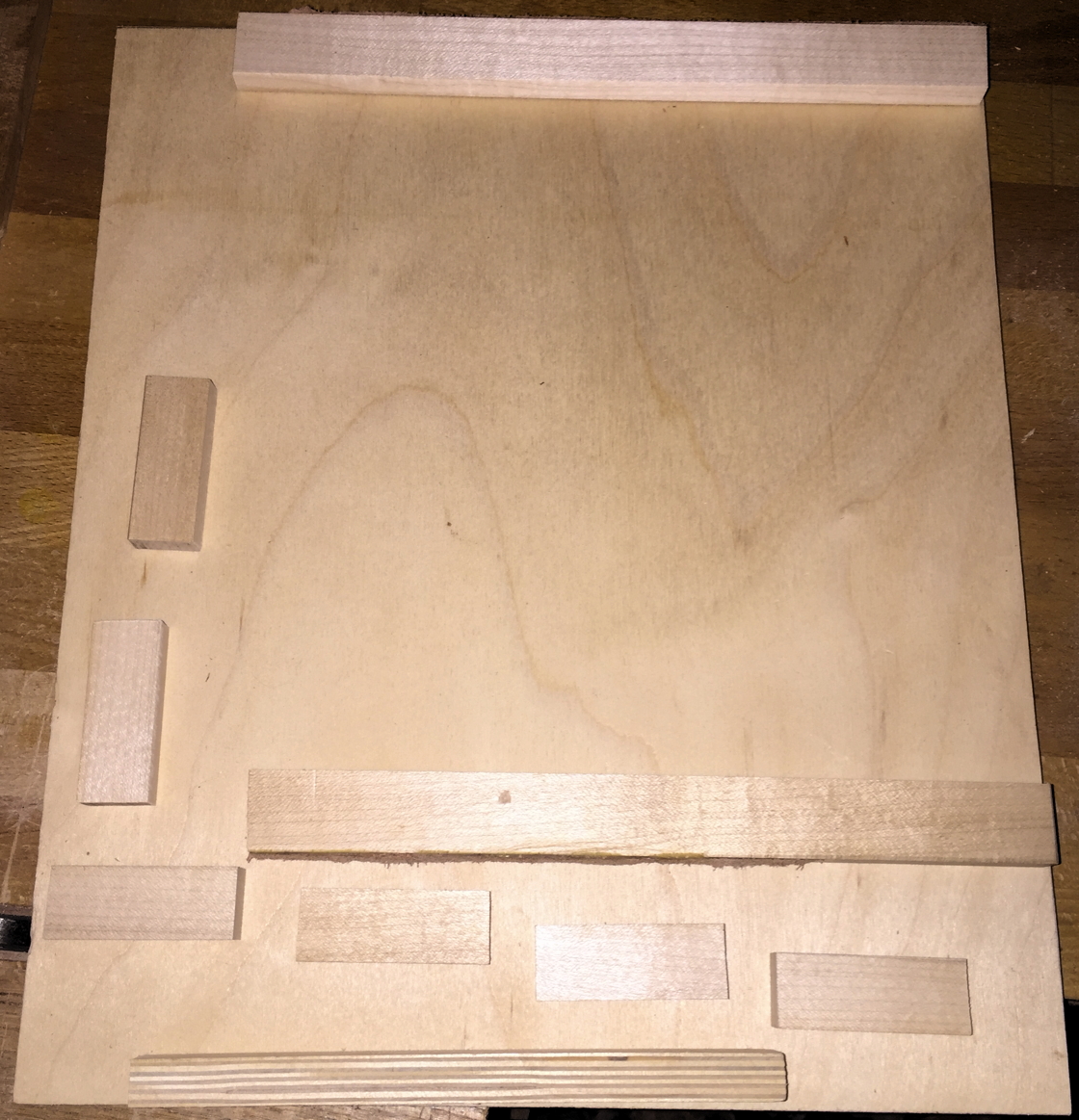
For my new honing board, I used an 11” x 13” piece of Baltic Birch Plywood, which lasted nicely on my previous honing board. For the stops, I raided my scrap-bin and found some Maple that was between 1/2”-3/4” thick (which wasn’t critical). Packed in with the new honing guide is a basic information sheet from Lie-Nielsen providing the distance for each of the stops, from 20-degrees up to 50-degrees, in 5-degree increments. I cut the maple into lengths around 2” and pre-drilled holes at each end with holes large enough so that the threads on the screws I used wouldn’t engage in the stop. This prevents the stop being held up off of the base, which can occur if the screw is engaging both the stop and the base.

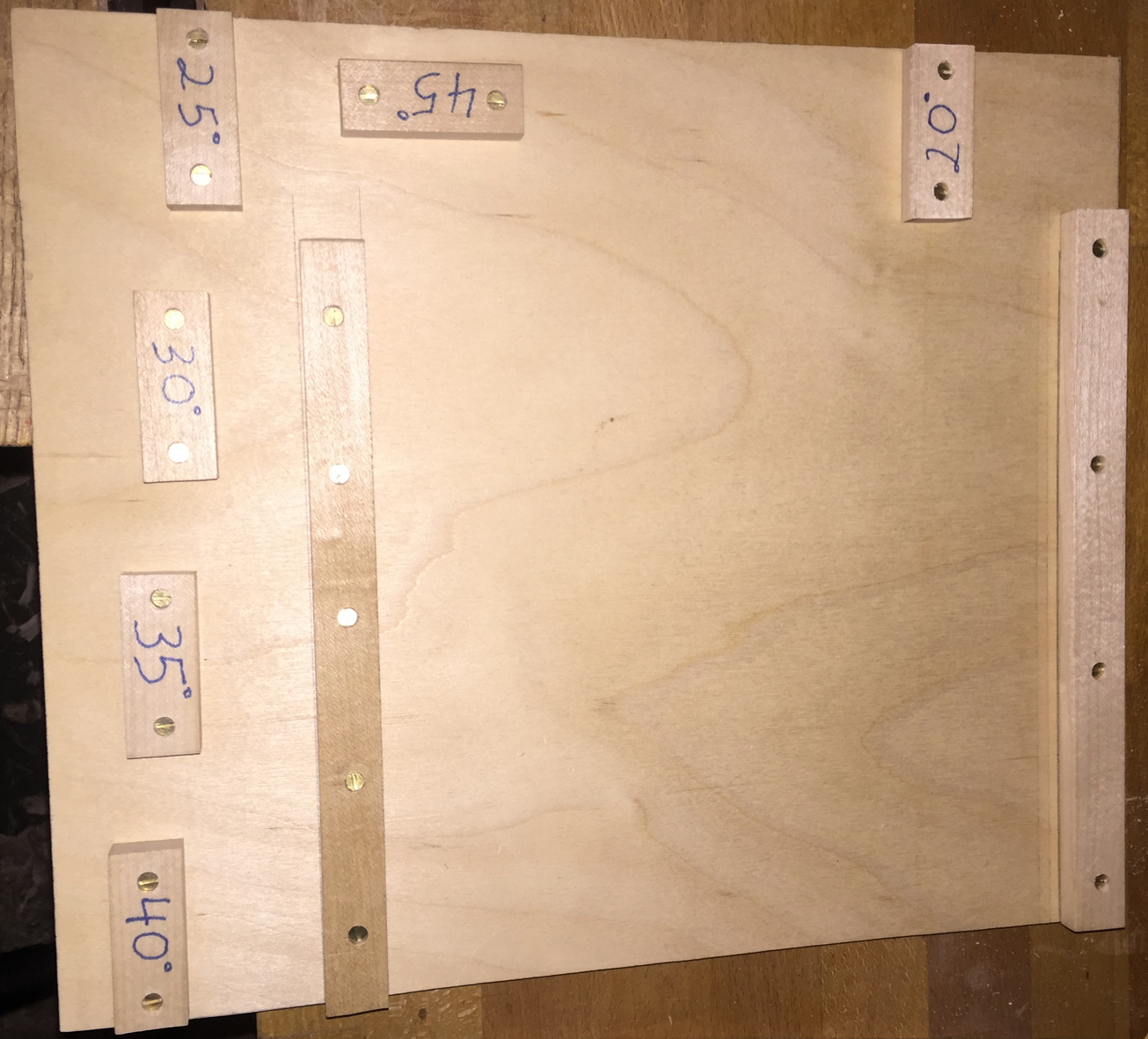
All of the stops are cut to size and laid out on the plywood.

All of the stops are cut to size and laid out on the plywood.

I made a line where the front edge of each stop belonged. Next, I clamped a straight piece up against the line, which really helps prevent the stop from accidentally shifting any direction but sideways, which won’t effect the projection of the tool or the angle.

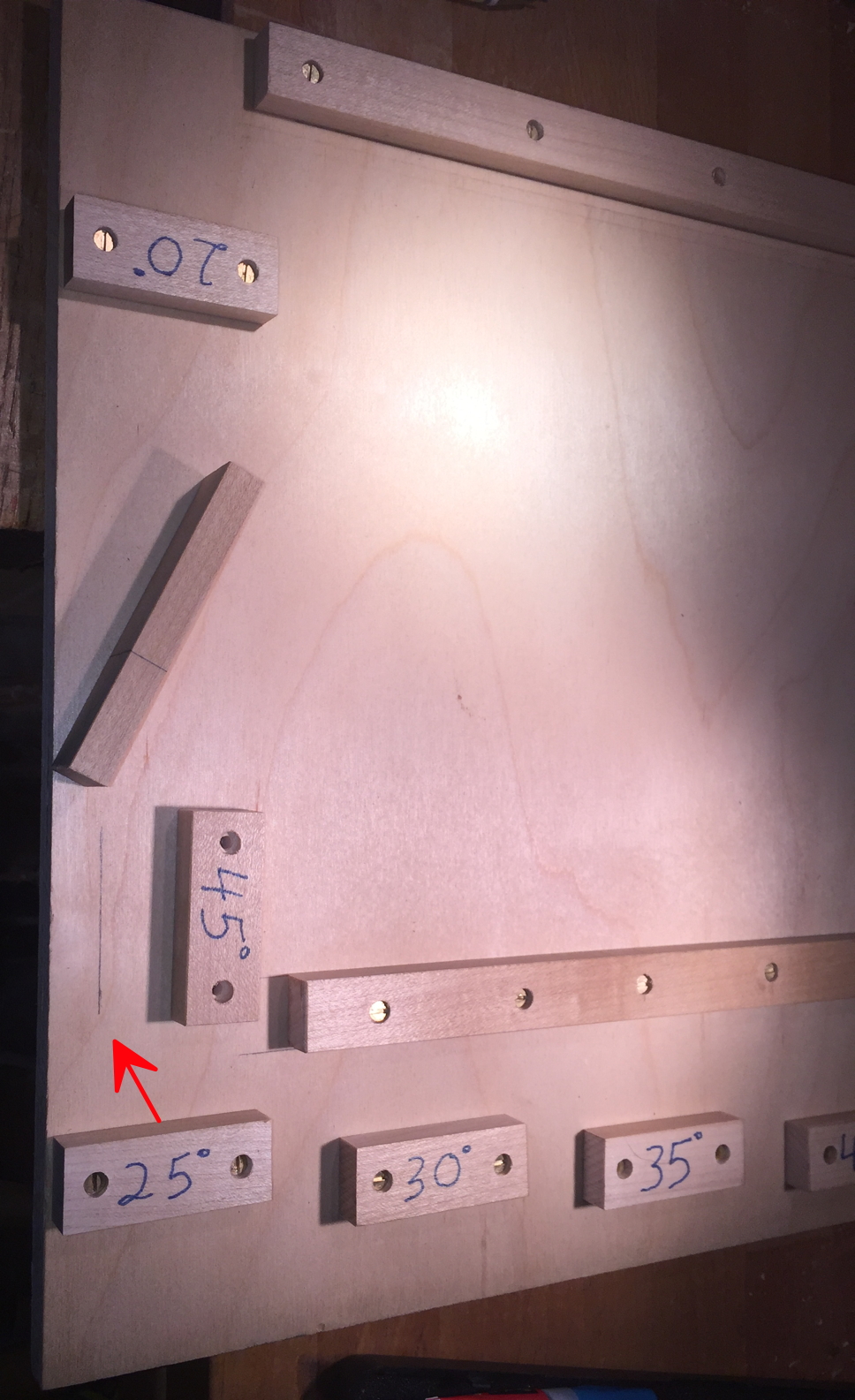
The location for the 45-degrees stop is highlighted with the red arrow.

The location for the 45-degrees stop is highlighted with the red arrow.

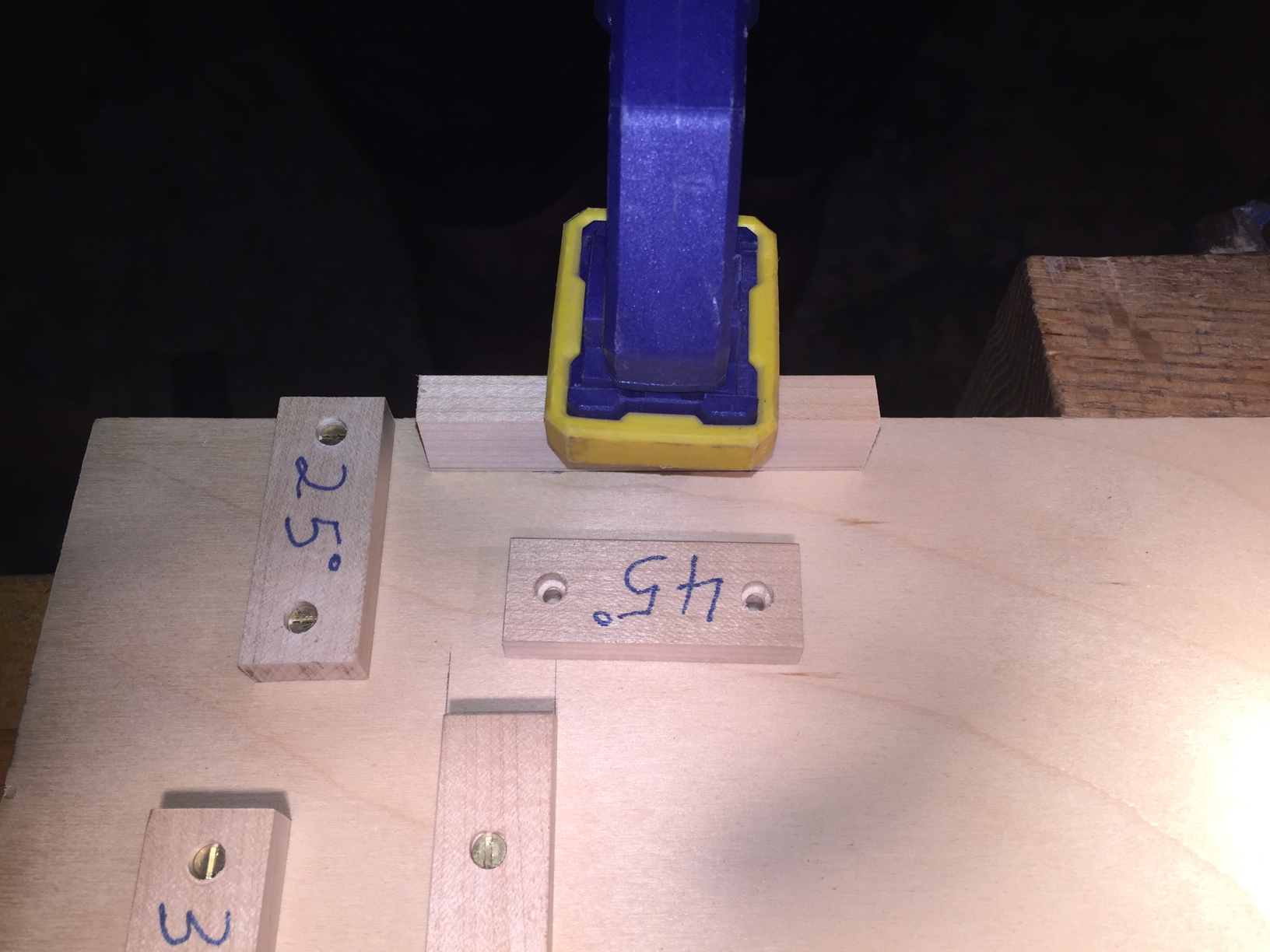
The straight block is clamped against the line to facilitate proper orientation.

The straight block is clamped against the line to facilitate proper orientation.

The 45-degree stop is installed precisely where intended.

The 45-degree stop is installed precisely where intended.

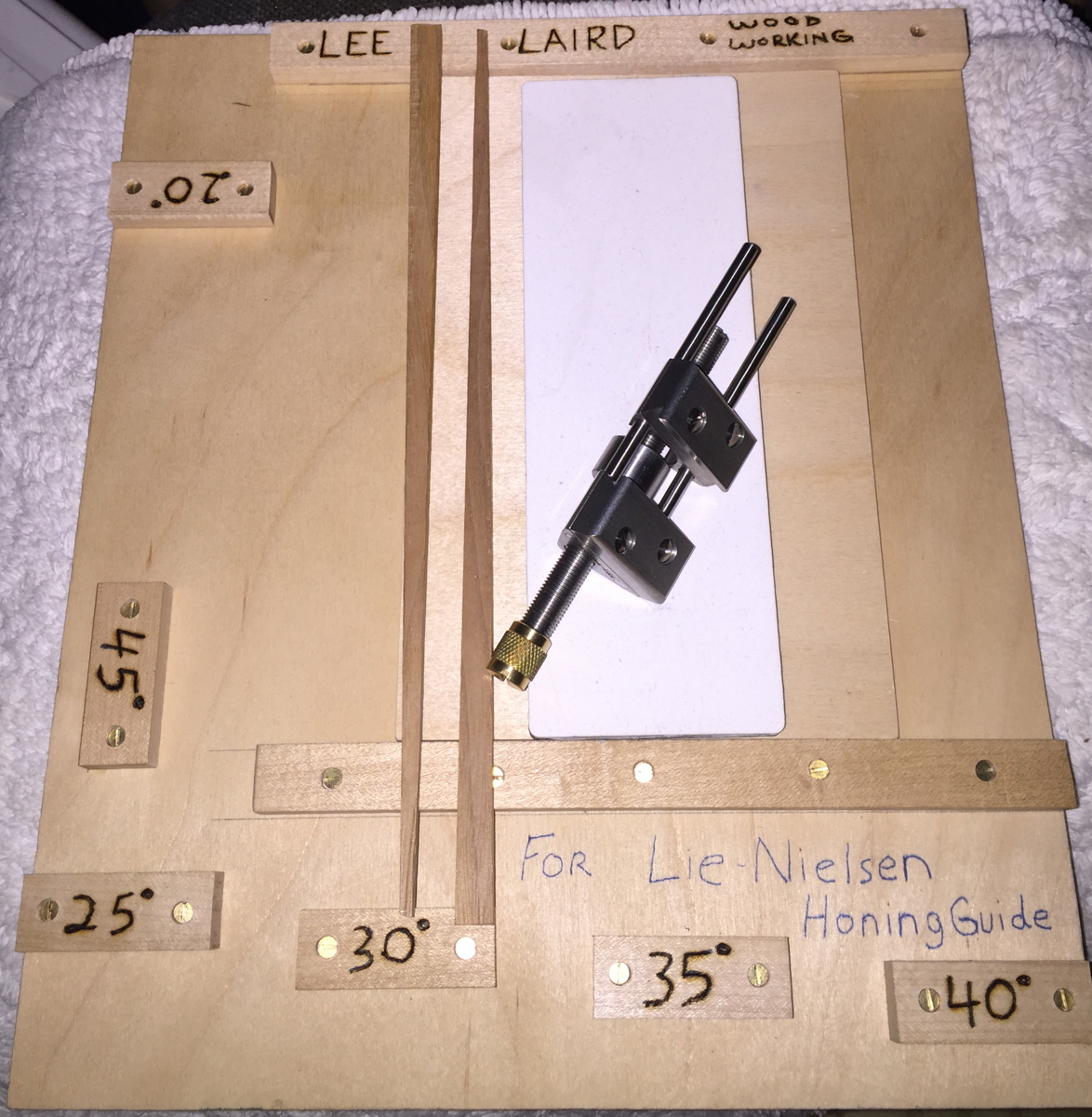
I used two longer pieces of the same Maple to house the area where the stone will be used. I pre-drilled again and inserted two end screws to make sure the stop stayed aligned, and then put in the rest of the screws. Since I use a couple of different types of stones, I left about ¼” extra beyond the length of my longest stone, which I made some cross-wedges to keep from moving. With two styles of stones, I also made a ¼” Baltic Birch Plywood removable plate that fits between the stone stops. My Shapton Glass Stones are quite short in comparison to most other stones so they need the boost.

First set of wedges cut to retain stone.

First set of wedges cut to retain stone.

Wedges engaged with good results.

Wedges engaged with good results.

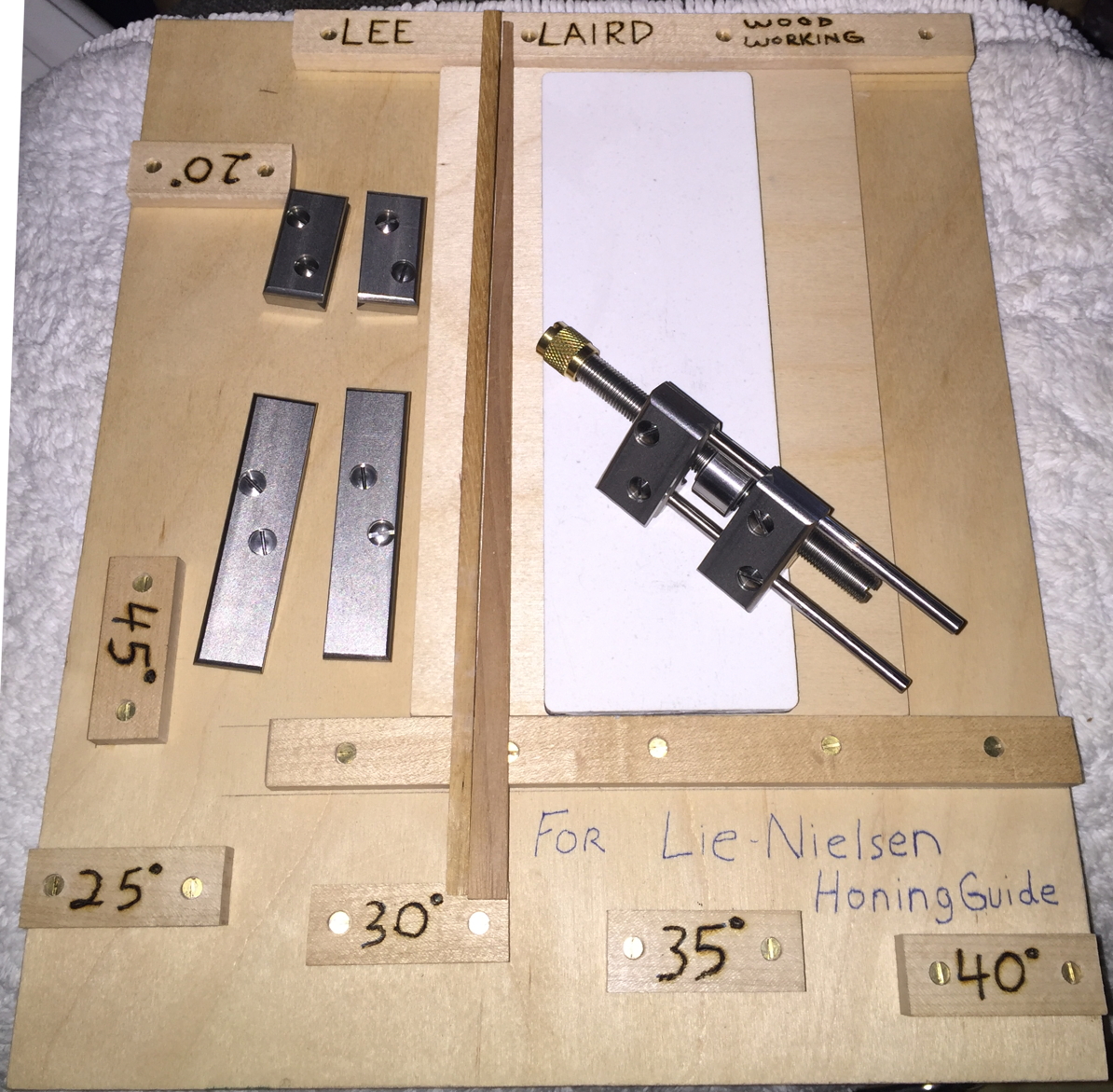
Here is another set of wedges I made for a bit more control, along with the honing guide, and the elevating plate for the Shapton stone.

Here is another set of wedges I made for a bit more control, along with the honing guide, and the elevating plate for the Shapton stone.

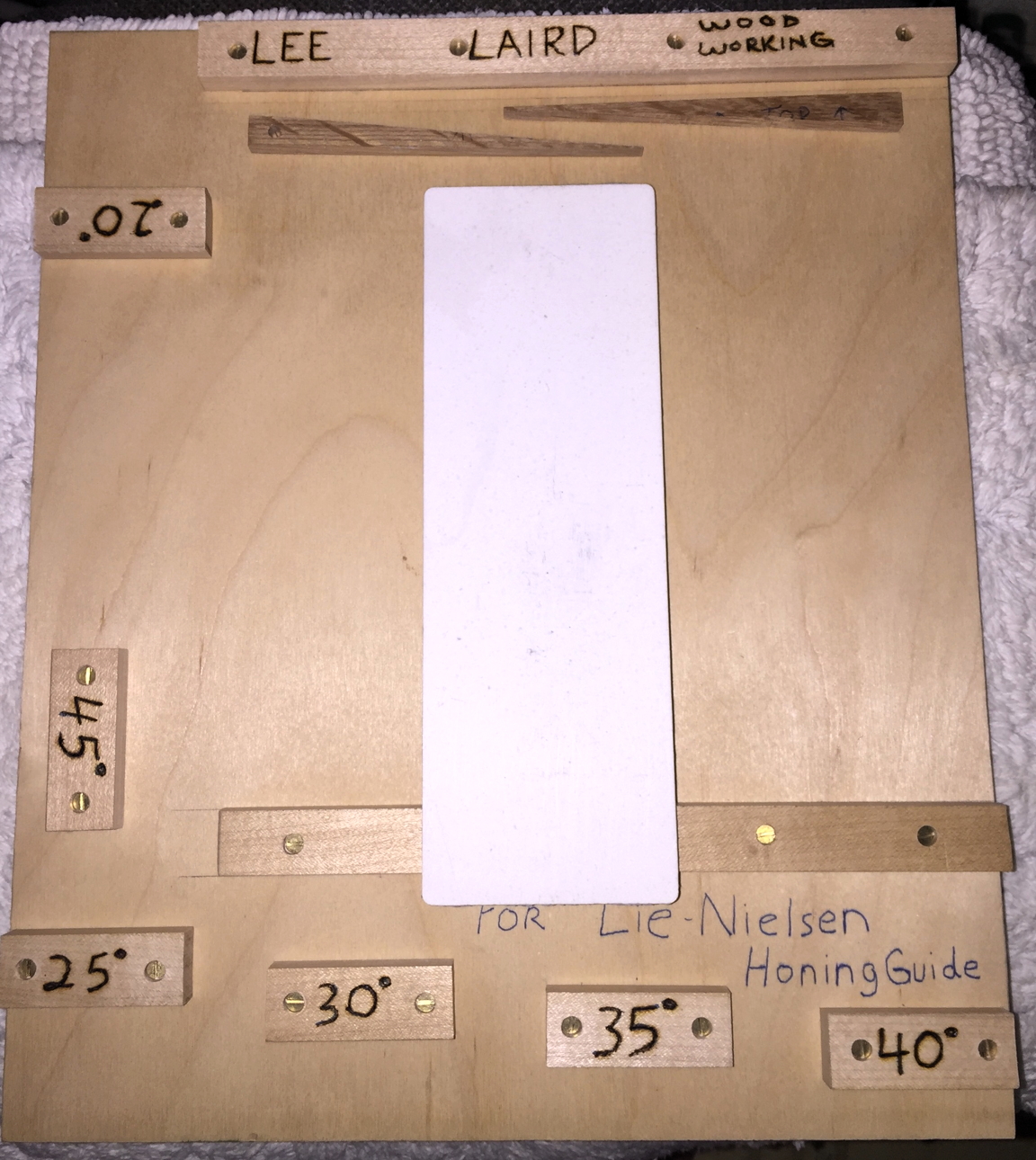
The accessory jaws are shown on the left in this photo, along with the completed honing board and guide.

The accessory jaws are shown on the left in this photo, along with the completed honing board and guide.

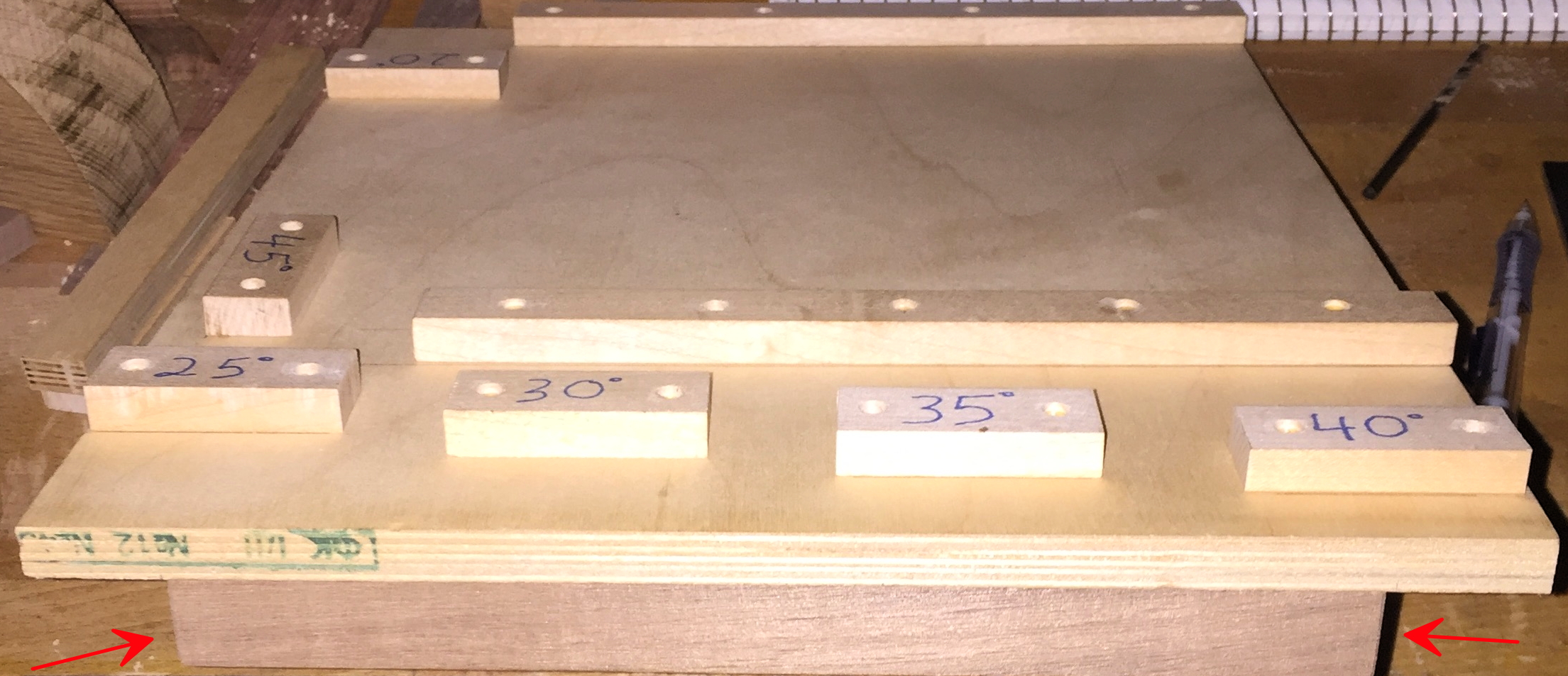
After all of the stops on the top surface were completed, I installed another scrap-bin piece on the underside at the edge closest to the user. I made sure the screws wouldn’t go all the way through the plywood and located them so they also wouldn’t run into any screws used for the stops on the top surface.

Red arrows flank the stop on the bottom surface.

Red arrows flank the stop on the bottom surface.

I hope you enjoyed the article, and thank you for checking it out. Please let me know if you have any questions or comments.

CLICK HERE to read Lee’s blog entry on how he used the board.


Lee Laird has enjoyed woodworking for over 25 years. He is retired from the U.S.P.S. and worked for Lie-Nielsen Toolworks as a show staff member, demonstrating tools and training customers. You can email him at LeeLairdWoodworking@gmail.com or follow him on Twitter at twitter.com/LeeLairdWW

Mar 022016
 

No Southern-fried Southern boy wants to be called a Yankee, but we share the characteristics of shrewdness and thrift. Thus, each month we include a money-saving tip. It’s OK if you call me “cheap.”

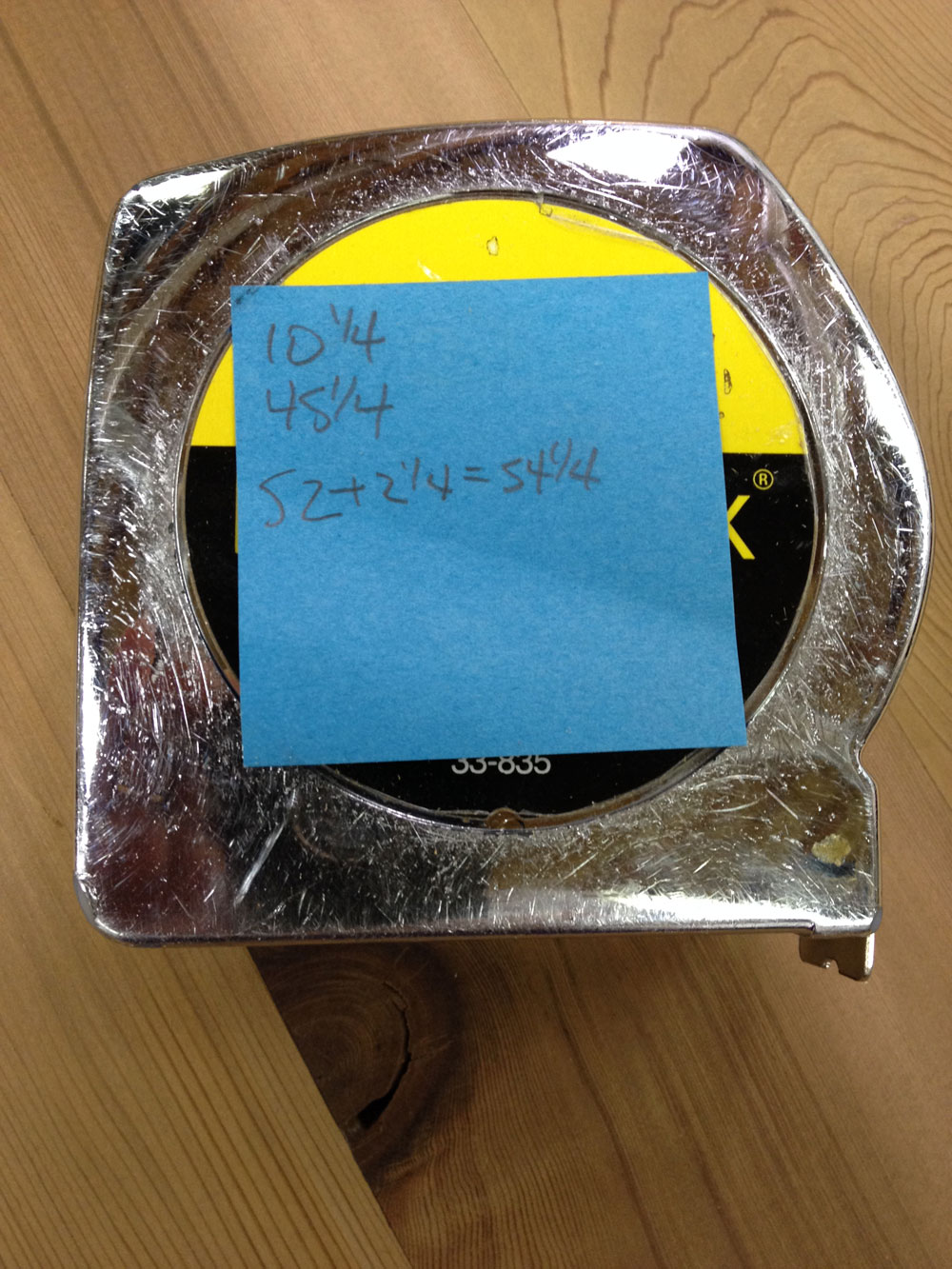
We’re always needing to write things down in the shop.  When you need a measurement (or two, or three) to take to the chop saw, a Post-It Note stuck to the label side of your tape measure will supplement your memory.  I can’t take credit for that one, but it’s been decades since I read or saw the idea somewhere, so, thank you, whoever it was.

I’ve been using this idea for decades, so it’s no wonder I can’t remember where I got it. When we first moved into this new house 18½ years ago, and I was building Brenda’s studio on the third floor, I went through a lot of Post It Notes because I didn’t want to waste a trip to the first floor and not get everything I needed. Using them for measurements is a real time and materials saver.

I’ve been using this idea for decades, so it’s no wonder I can’t remember where I got it. When we first moved into this new house 18½ years ago, and I was building Brenda’s studio on the third floor, I went through a lot of Post-It Notes because I didn’t want to waste a trip to the first floor and not get everything I needed. Using them for measurements is a real time and materials saver.

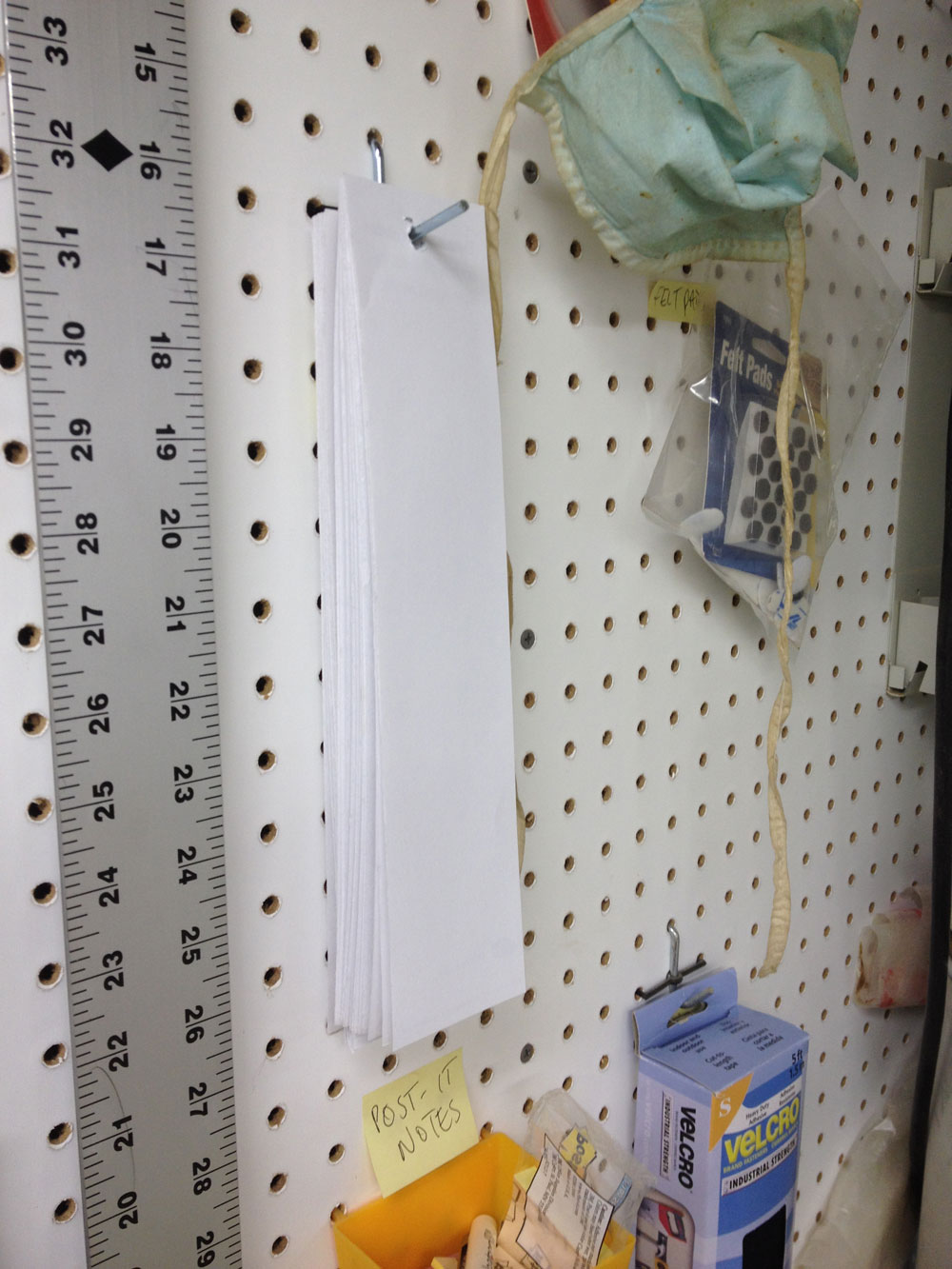
When you need to write more, this idea will help.  Take some scratch paper and staple several pieces together.  Now, punch a hole through the stack, so you can hang it on a peg or nail. If you don’t have a hole punch, a 1/4″ Forstner bit makes a smooth hole.

Why is my “scratch” paper so neat and uniform? It’s the perforated edges from the reminder postcards we send to pet owners each month, but any paper will do. I have to admit, this heavy card stock is nice!

Why is my “scratch” paper so neat and uniform? It’s the perforated edges from the reminder postcards we send to pet owners each month, but any paper will do. I have to admit, this heavy card stock is nice!

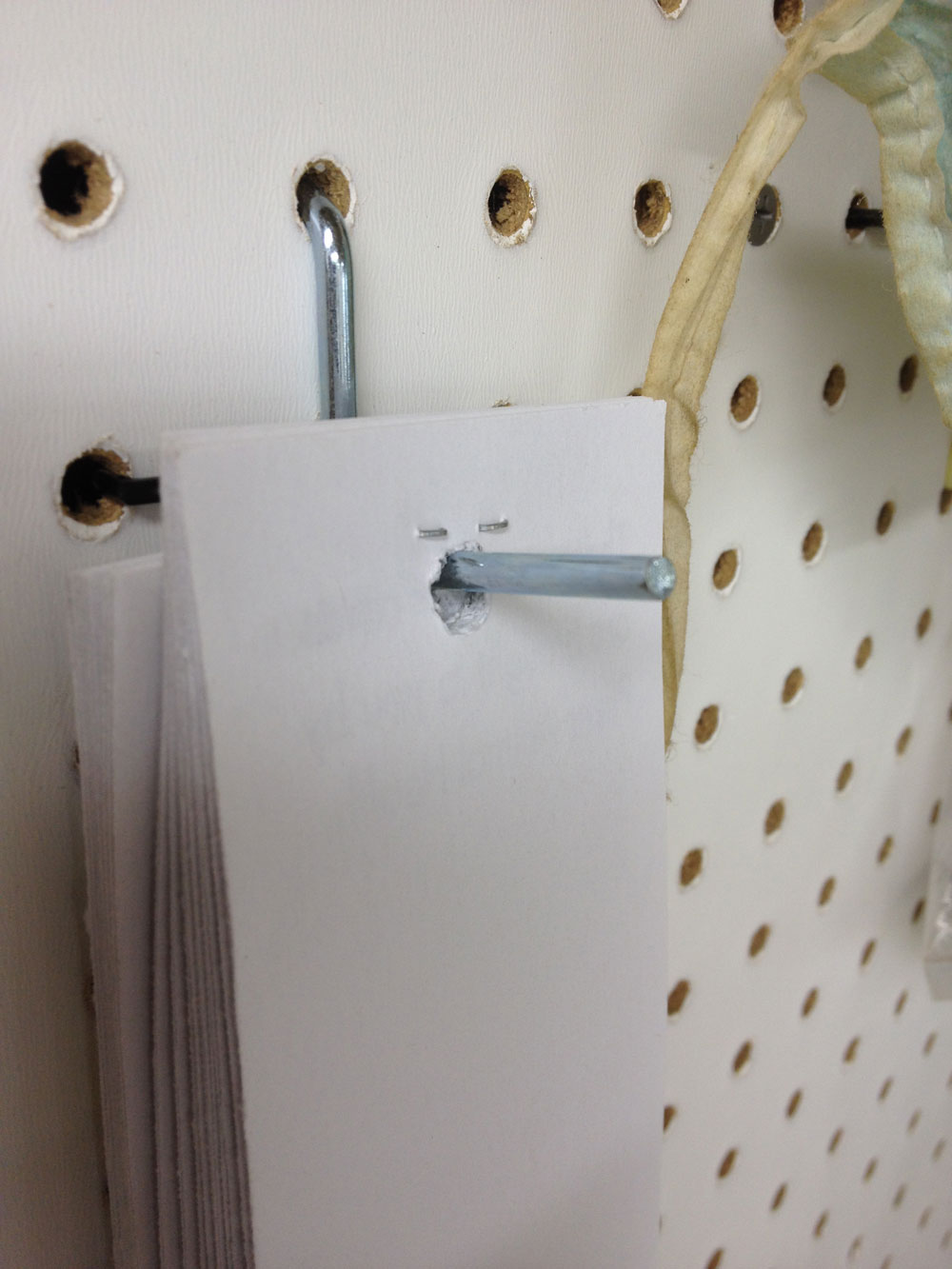
You’re not through yet!  Now, when you need a piece of paper, pull from the “open” side of the staple, which will release one slip at a time while continuing to hold the remaining pieces together.

Pull from this side and the “open” part of the staple will release one slip at a time, while firmly holding the rest.

Pull from this side and the “open” part of the staple will release one slip at a time, while firmly holding the rest.

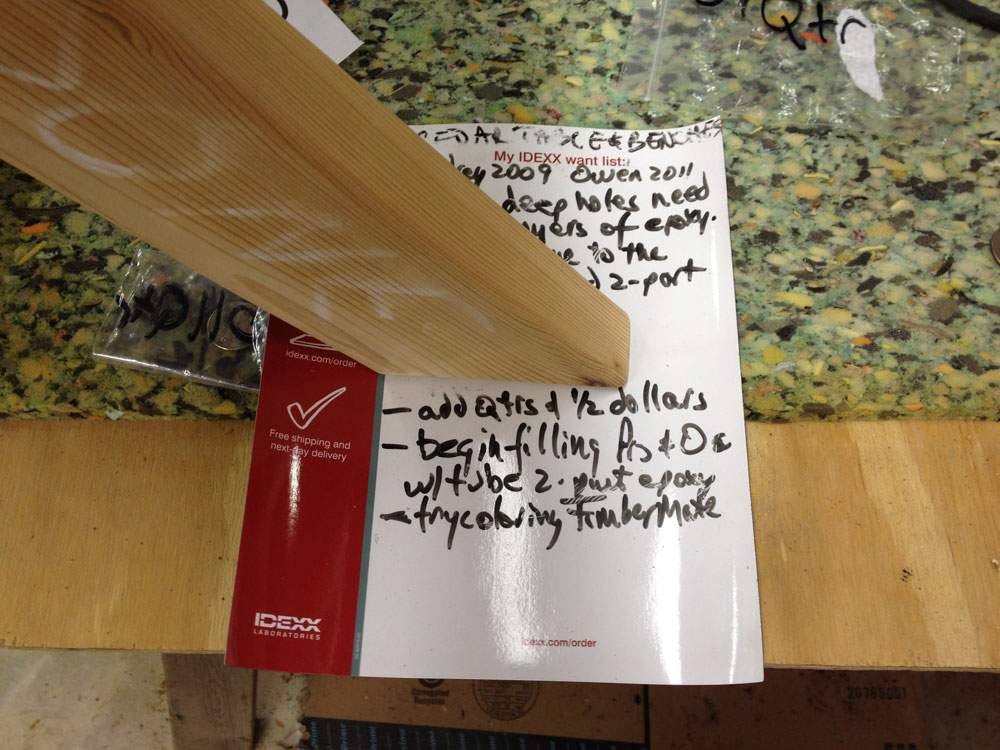
Suppose you need to write even more, or make a temporary sign.  Dry-erase boards work great.  Some of the ones I have were free, picked out of someone’s perfectly-good refuse on trash pickup day.  The others came from drug companies, and even included markers!

This dry-erase “board” was free from a laboratory company. It came with a marker and a plus: it’s magnetic. I use it to remind me what I wanted to do next when it’s a long time between shop visits.

This dry-erase “board” was free from a laboratory company. It came with a marker and a plus: it’s magnetic. I use it to remind me what I wanted to do next when it’s a long time between shop visits.


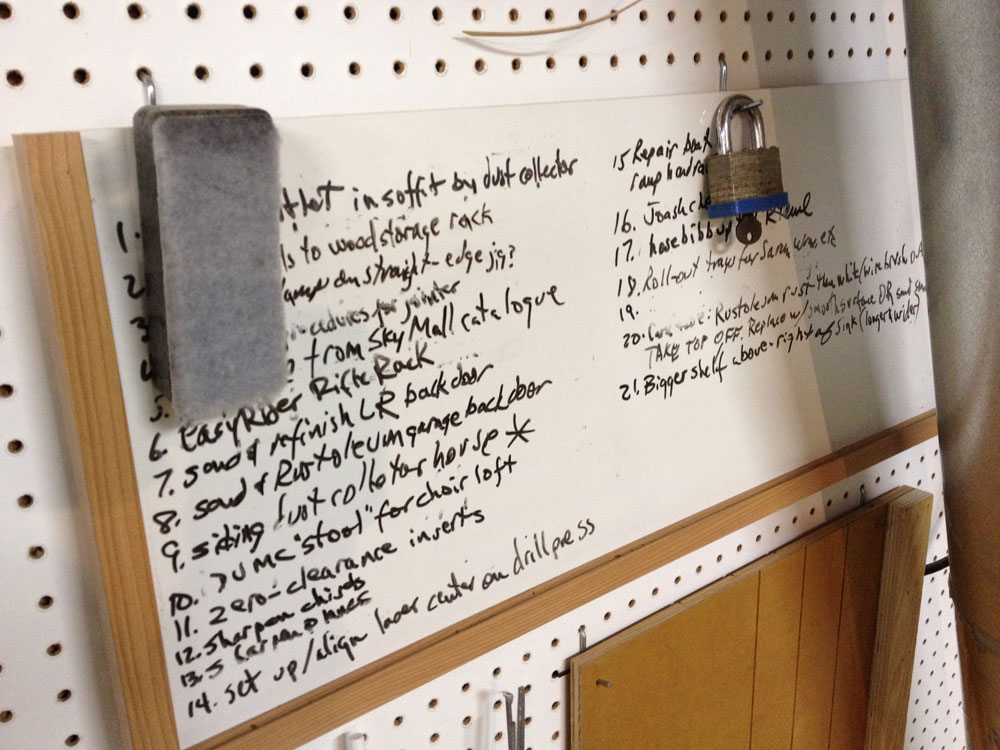
This whiteboard wasn’t exactly free, but I needed a board about 9" wide at work, and this is what was left. By the way, the table saw made a really nice cut on this material. This one is used for long-term projects, things I want to build “someday.”

This whiteboard wasn’t exactly free, but I needed a board about 9″ wide at work, and this is what was left. By the way, the table saw made a really nice cut on this material. This one is used for long-term projects, things I want to build “someday.”


Jim Randolph is a veterinarian in Long Beach, Mississippi. His earlier careers as lawn mower, dairy farmer, automobile mechanic, microwave communications electronics instructor and journeyman carpenter all influence his approach to woodworking. His favorite projects are furniture built for his wife, Brenda, and for their children and grandchildren. His and Brenda’s home, nicknamed Sticks-In-The-Mud, is built on pilings (sticks) near the wetlands (mud) on a bayou off Jourdan River. His shop is in the lower level of their home. Questions and comments on woodworking may be written below in the comments section. Questions about pet care should be directed to his blog on pet care, www.MyPetsDoctor.com. We regret that, because of high volume, not all inquiries can be answered personally.

Mar 012016
 

Welcome to “Tips From Sticks-In-The-Mud Woodshop.” I am a hobbyist, not a professional, someone who loves woodworking, just like you do. I have found some better ways to accomplish tasks in the workshop and look forward to sharing those with you each month, as well as hearing your problem-solving ideas.

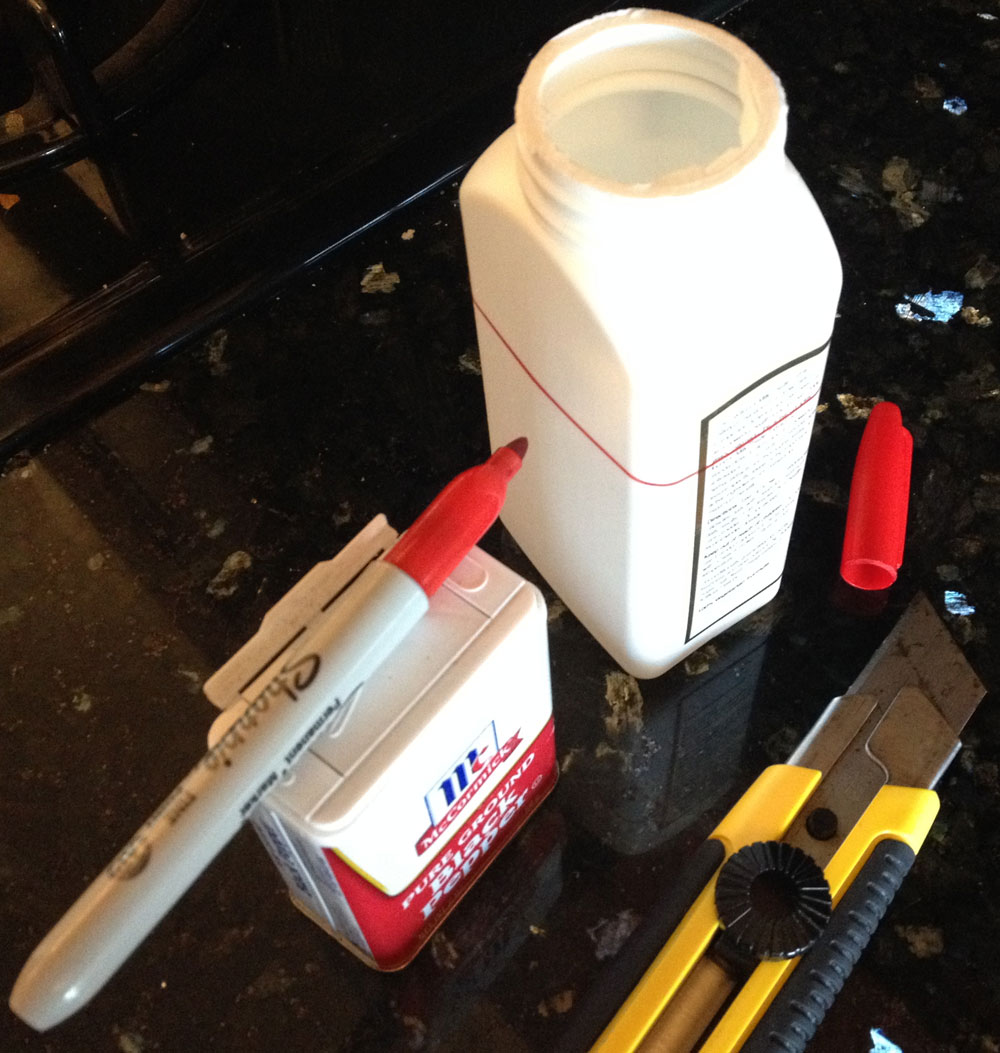
Sometimes you need to draw a line all the way around an irregular shape.  In this case, I wanted to make a little cup out of this old plastic bottle.  I’m recycling slivers of bar soap into new bars and trying this out for a mold.

This is my first foray into soap making. Or, should I call it soap re-making? Either way, this little trick worked quite well.

This is my first foray into soap making. Or, should I call it soap re-making? Either way, this little trick worked quite well.

One easy way to do that is to put the bottle against a miter gauge on your band saw and push it through.  Sometimes, though, the size or shape precludes that approach.

A tip I picked up from Tom Silva on This Old House is to take a flexible strip, it can be a laminate for a big circumference or a strip of cloth for a smaller dimension, and wrap it around the object.  Tom was cutting a porch column to its proper length.  Once the strip is pulled tight and the mating surfaces meet with perfect edge alignment, the line around the object will be straight and it’s just a matter of tracing against the strip with a pencil.

In this case, I didn’t need a lot of accuracy, and the height didn’t have to be exact.  I laid a Sharpie on top of a bottle and held it steady with my right hand.  With my left hand I rotated the bottle against the Sharpie.  Voila!  I think the bathtub is full.  Now, where did I leave my rubber ducky?


Jim Randolph is a veterinarian in Long Beach, Mississippi. His earlier careers as lawn mower, dairy farmer, automobile mechanic, microwave communications electronics instructor and journeyman carpenter all influence his approach to woodworking. His favorite projects are furniture built for his wife, Brenda, and for their children and grandchildren. His and Brenda’s home, nicknamed Sticks-In-The-Mud, is built on pilings (sticks) near the wetlands (mud) on a bayou off Jourdan River. His shop is in the lower level of their home.Questions and comments on woodworking may be written below in the comments section. Questions about pet care should be directed to his blog on pet care, www.MyPetsDoctor.com. We regret that, because of high volume, not all inquiries can be answered personally.

Feb 292016
 

Do you like working on your shop more than making things that come out of your shop?  Whether you call it “making shop furniture” or building cabinets for the shop, do you enjoy simply improving your shop?  To me, there’s something special in making the workspace better.

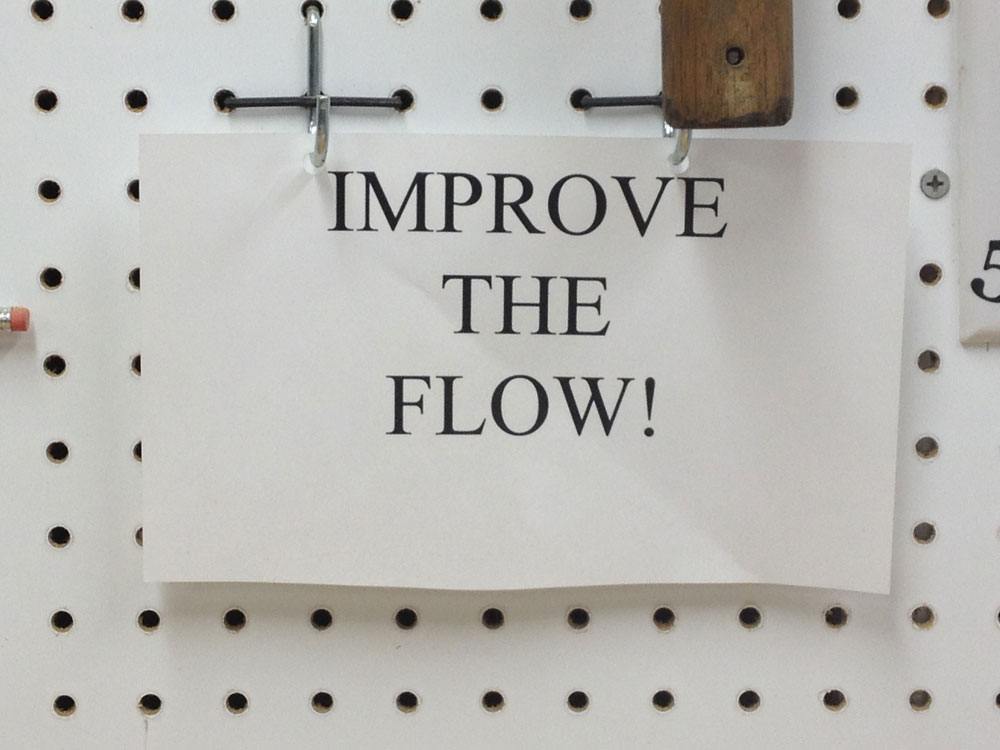
To constantly remind me to make the shop better, I have several iterations of this sign.

To constantly remind me to make the shop better, I have several iterations of this sign.

Of course, I think we all enjoy buying a new tool.  To me, “new tools” and “improving the shop” fall in the same category.

Sometimes the two coincide.  After Katrina flooded the lower level of our home, I bought some really inexpensive tools that I knew I would replace when I found exactly what I wanted.  I’d never had what I considered to be a good jig saw and, since I didn’t know which one I wanted, I just bought the bottom-level Skil.

A few years ago I got the Festool bug, purchased several tools, and decided I’d get a Festool Jig Saw.  I’d watched some videos of people using and talking about them and they were all ecstatic.  However, I’d had a couple of conversations with Steven Johnson about his Festool jig saw and he said he liked his Bosch better, and he wanted to sell his old Festool.

That left me thinking that I still wanted a Festool jig saw, so I didn’t buy a Bosch or a Festool, I just limped along with the little Skil.  After all, I didn’t need a jig saw very often.  I kept meaning to look at the Bosch at the home center, but I kept forgetting.

Several weeks ago the jig saw itch came back and I asked Steve if he was still happy with his Bosch.  If he was, I was going to at least look at it, and possibly buy one.

Procrastination paid off.

Steve said his previous opinion of the Festool jig saw was based on a much older model.  Since we’d last discussed it he’d purchased a new brushless-motor Festool Carvex and loved it! My decision was made.  Almost.  I still had to do was decide which model I wanted (I got the PSB 420 EBQ.) and dust extractor “package.”

I placed my order on Thursday and the Highland Woodworking shipping department wizards (thanks, Alexandra!) had FedEx boxes to me by Monday afternoon.

I dedicated the new CT36 to the Kapex and tucked it out of the way under the bench.

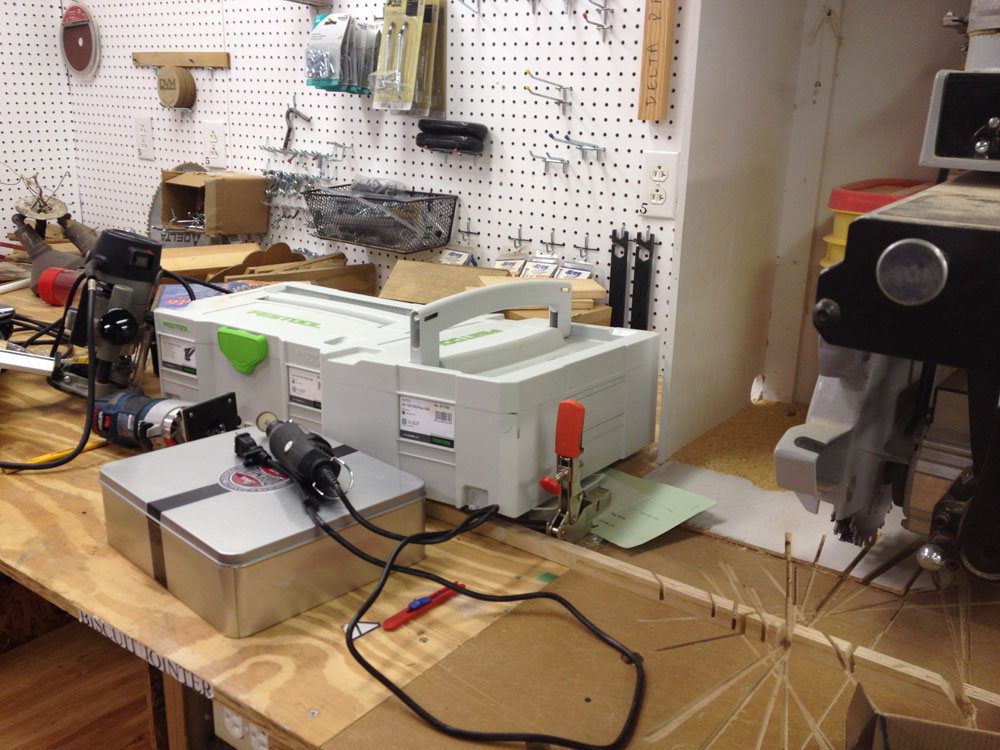
Because I’d also ordered the accessory kit for the Carvex, I had not one, but two new Systainers.

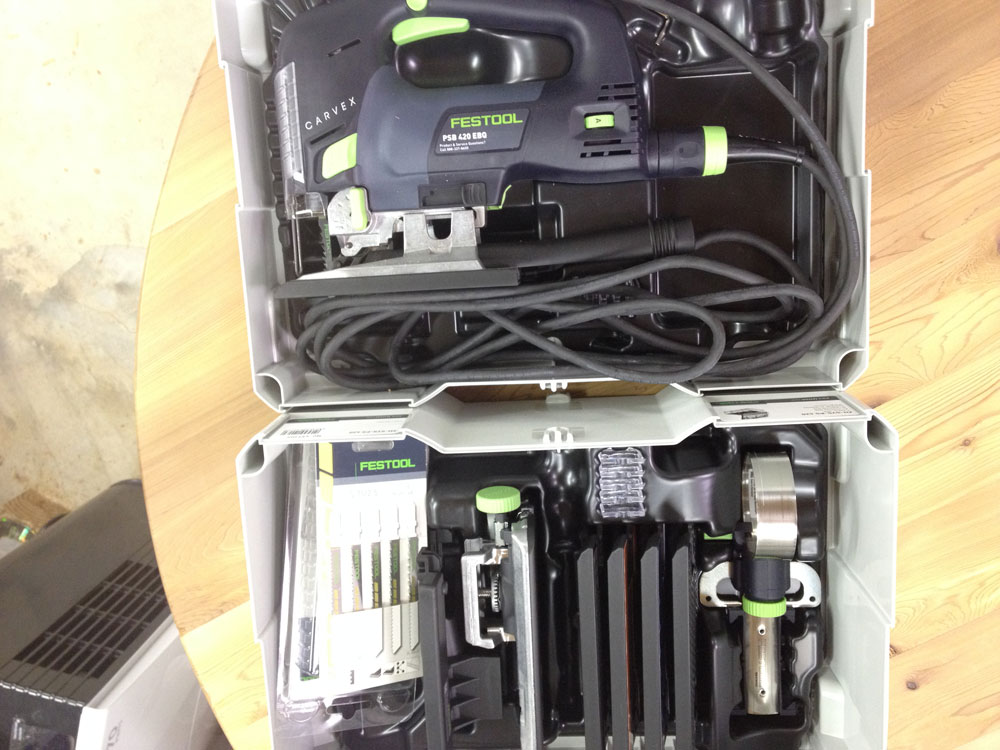
Here’s the new Carvex with the accessory kit. If you can swing it, either at the same time or later, the kit includes some must-haves that are much cheaper purchased as this set.

Here’s the new Carvex with the accessory kit. If you can swing it, either at the same time or later, the kit includes some must-haves that are much cheaper when purchased as this set.

I had already found myself to be annoyed by Systainers, as they were big, I didn’t have a dedicated place for them, and when stacked up on the workbench they were eating valuable real estate.

While the Rotex and ETS sanders were in use their Systainers were consuming space on the bench. They had to go!

While the Rotex and ETS sanders were in use, their Systainers were consuming space on the bench. They had to go!

I’d seen other woodworkers design elaborate storage systems for their Systainers but they took up wall space or floor space or both and I wasn’t willing to sacrifice either.

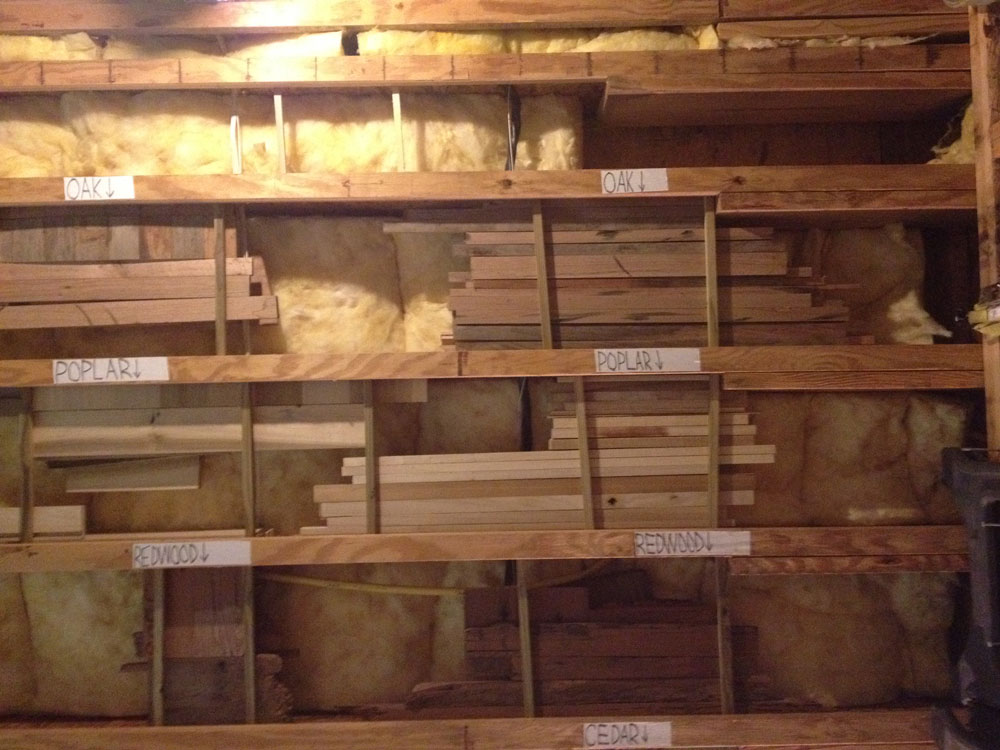
The following Saturday morning I woke up at 3:30 AM and no matter how hard I tried to go back to sleep, my mind went back to Systainer storage.  “In the ceiling space,” a loud voice kept repeating.  I was already using ceiling space for scrap wood storage, but there was plenty of space left. For wood cutoffs I had created this system, which depended on the pieces sitting on narrow strips of wood.  That still works well for wood scraps, but it was obvious the strips would move when inserting and removing a Systainer, especially with the weight of the tool inside.

This system in the ceiling of our garage works great for scrap wood storage. I wanted to put Systainers here, too, but needed an immovable support. More “noodling” required, as Steven Johnson would say.

This system in the ceiling of our garage works great for scrap wood storage. I wanted to put Systainers here, too, but needed an immovable support. More “noodling” required, as Steven Johnson would say.

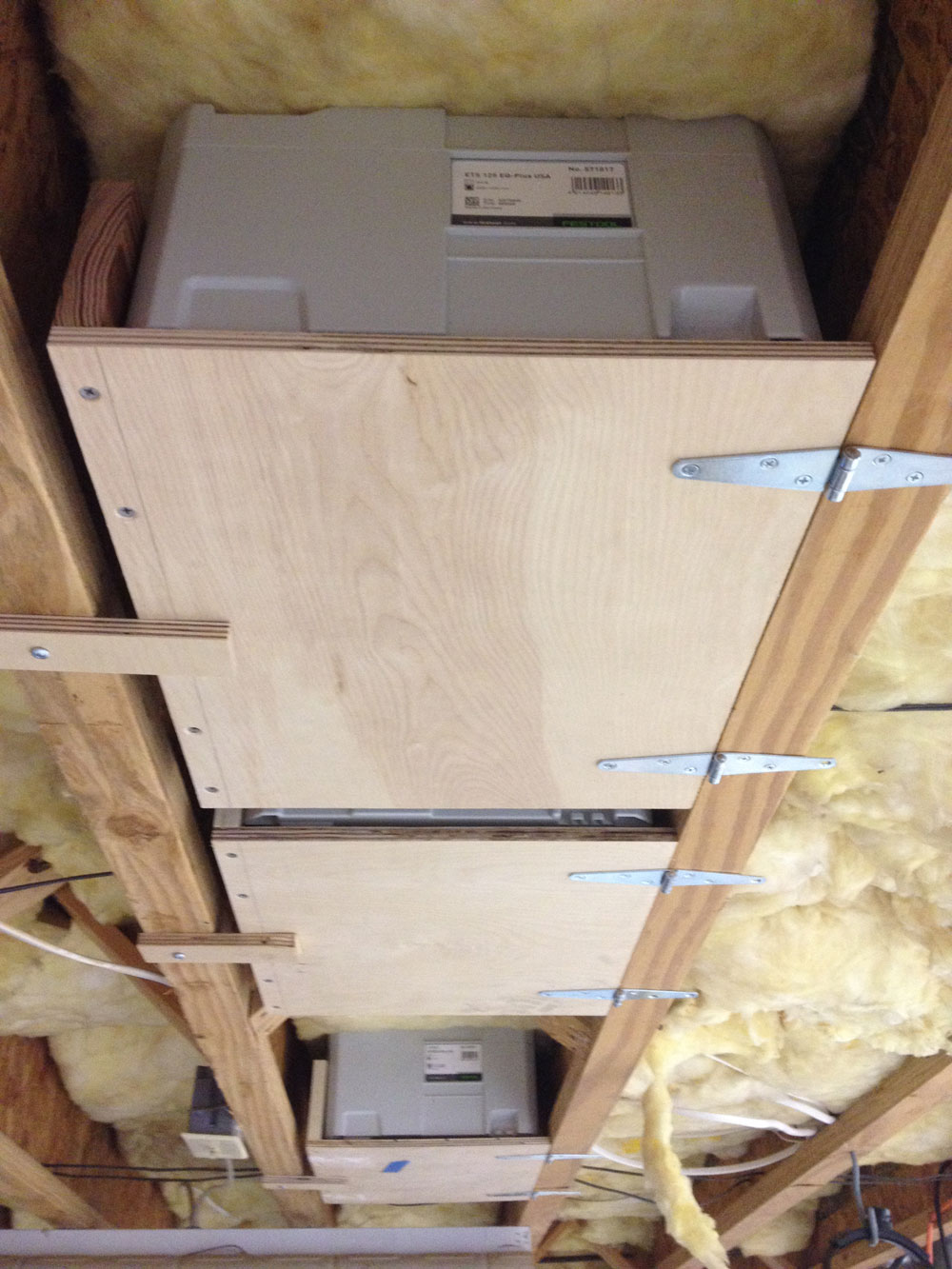
The mind is an amazing thing, and neither medical nor psychological science has been able to illuminate more than the surface of its secrets.  Between my 3:30 AM wake-up and my 5 AM get-up, I had a fully-designed, hinged system for the Systainers that I call “hatches.”  Brenda and I are big fans of the 2004-2010 television drama Lost.

Thoroughly obsessed with “improving the shop,” a week later I’ve left work early three evenings, I have “hatches” for all of the Systainers, and I’m trying to figure out where to put hatches for the DeWalt drills, the biscuit jointer I almost never use, and a few other small tools.

Here are the Domino, Rotex and ETS Sander Systainers tucked away until they’re needed. The sanders are used so much that their Systainers will probably stay empty. The Domino can quickly be pulled out when it’s needed, and put away when it’s not. The Carvex and its accessory kit’s hatches are in another location.

Here are the Domino, Rotex and ETS Sander Systainers tucked away until they’re needed. The sanders are used so much that their Systainers will probably stay empty. The Domino can quickly be pulled out when it’s needed, and put away when it’s not. The Carvex and its accessory kit’s hatches are in another location.

Jim Randolph is a veterinarian in Long Beach, Mississippi. His earlier careers as lawn mower, dairy farmer, automobile mechanic, microwave communications electronics instructor and journeyman carpenter all influence his approach to woodworking. His favorite projects are furniture built for his wife, Brenda, and for their children and grandchildren. His and Brenda’s home, nicknamed Sticks-In-The-Mud, is built on pilings (sticks) near the wetlands (mud) on a bayou off Jourdan River. His shop is in the lower level of their home. Questions and comments on woodworking may be written below in the comments section. Questions about pet care should be directed to his blog on pet care, www.MyPetsDoctor.com. We regret that, because of high volume, not all inquiries can be answered personally.