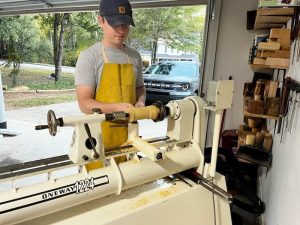
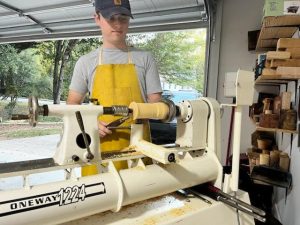
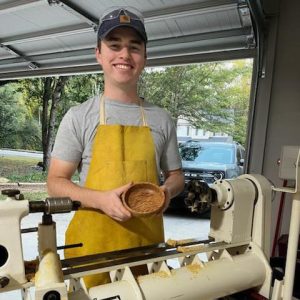
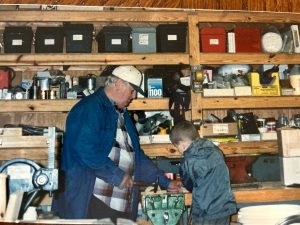
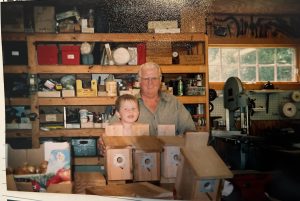
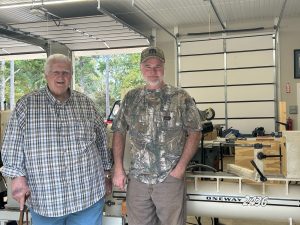
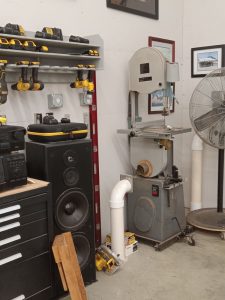
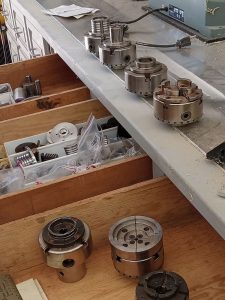
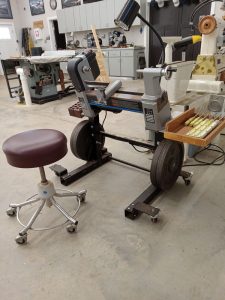
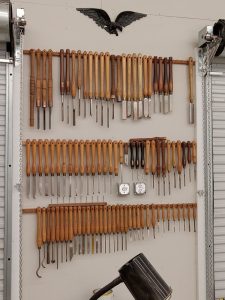
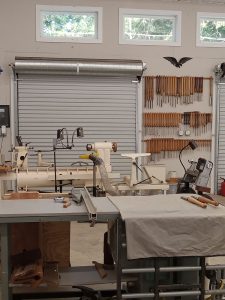
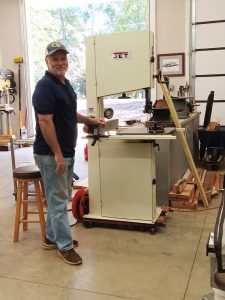
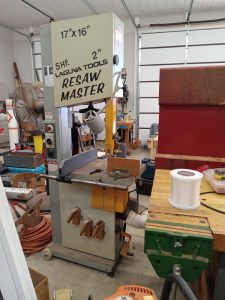
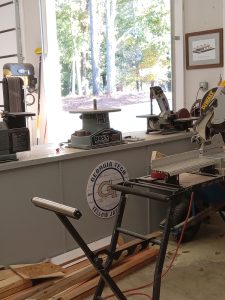
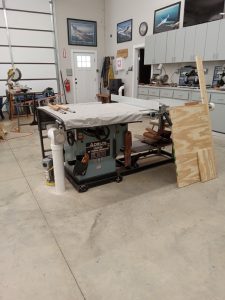
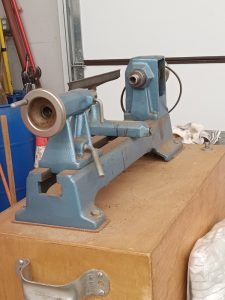
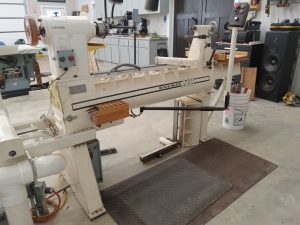
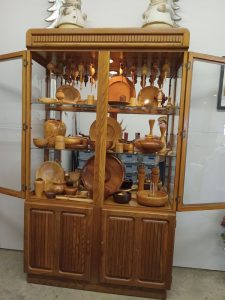
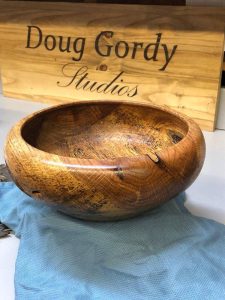
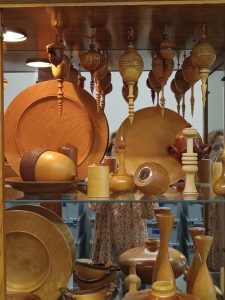
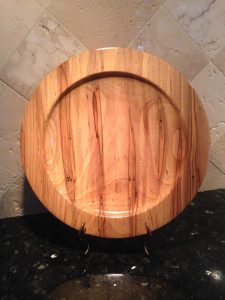
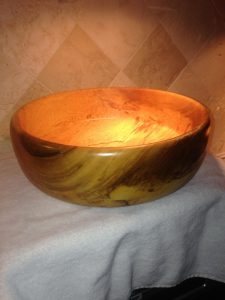
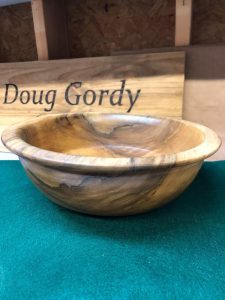
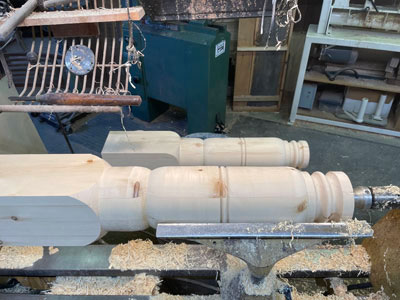
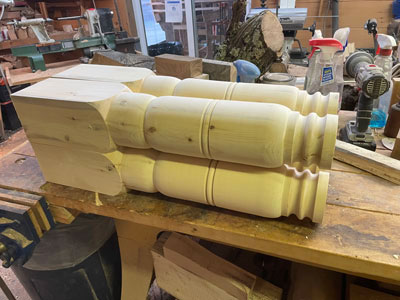
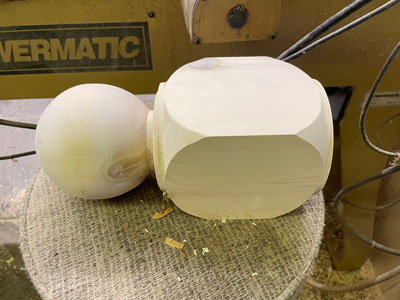
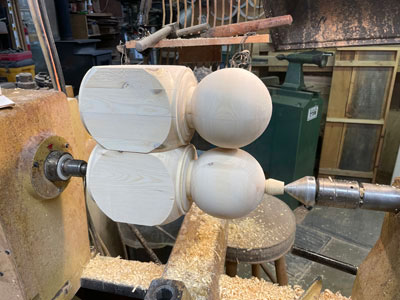
Doug Gordy was introduced to woodturning by his father, Vernon, a master woodturner. Doug recalls going with his father to Highland Hardware (now Highland Woodworking) for the first time in 1985, when he was a teenager. It was a much anticipated and frequent destination as he grew up. When Doug moved away from Savannah, whenever they were visiting family in the Atlanta area, a trip to Highland Woodworking was mandatory. Vernon introduced his grandson, Parker, to woodworking when he was about 5 years old. Parker, a recent GA Tech graduate, has recently started woodturning. His dad, Doug, said Parker has to go to Highland and buy his own Oneway lathe now.
Doug & his wife, Sherri, raised their family in Savannah GA, where Doug had a successful career working for Gulfstream Aerospace. He loved the beautiful woodworking details in the planes and the exacting perfection of what they built. His way of unwinding after a day at work was to work on his lathe for 2 or 3 hours. He says you have to be completely focused to do woodturning, it made him put aside any stress from work & relax. Doug learned from his father & further developed his skills by taking classes and watching master turners. If he saw something new, he took it as a personal challenge to learn to how to do it. Next on his list is turning a lampshade. A bit of a renaissance man, his interests also extend to carpentry, welding, building cars (and planes, of course), and making his own tools.
Doug turns pieces on commission, & now that he has retired & relocated to Milledgeville GA, he looks forward to having more time to devote to his art. Now 86, his father customized a lathe so he can continue to turn in their newly completed shop. Doug enjoys turning large pieces, letting the wood dictate the design. He is happy to work with domestic wood, and will go out with his chainsaw after a storm & help clear a fallen or damaged tree in exchange for some wood. He feels he is giving the tree a second life when he creates something with the wood he harvests. Sherri handles all the finishing, with Danish Oil or Teak Oil and various stains.
Doug is partial to Sorby Tools. He jokes he now has more tools than Highland Woodworking, and with the exception of the tools he has made, almost all of them came from Highland. Doug says the knowledgeable people at Highland, who have helped his father, then him & now his son over the years are an incredible resource. If there was something he wanted & on the rare occurrence that Highland didn’t have it, they would help him search for it & facilitate the acquisition. They love what they do & their customer service reflects that passion for woodworking.
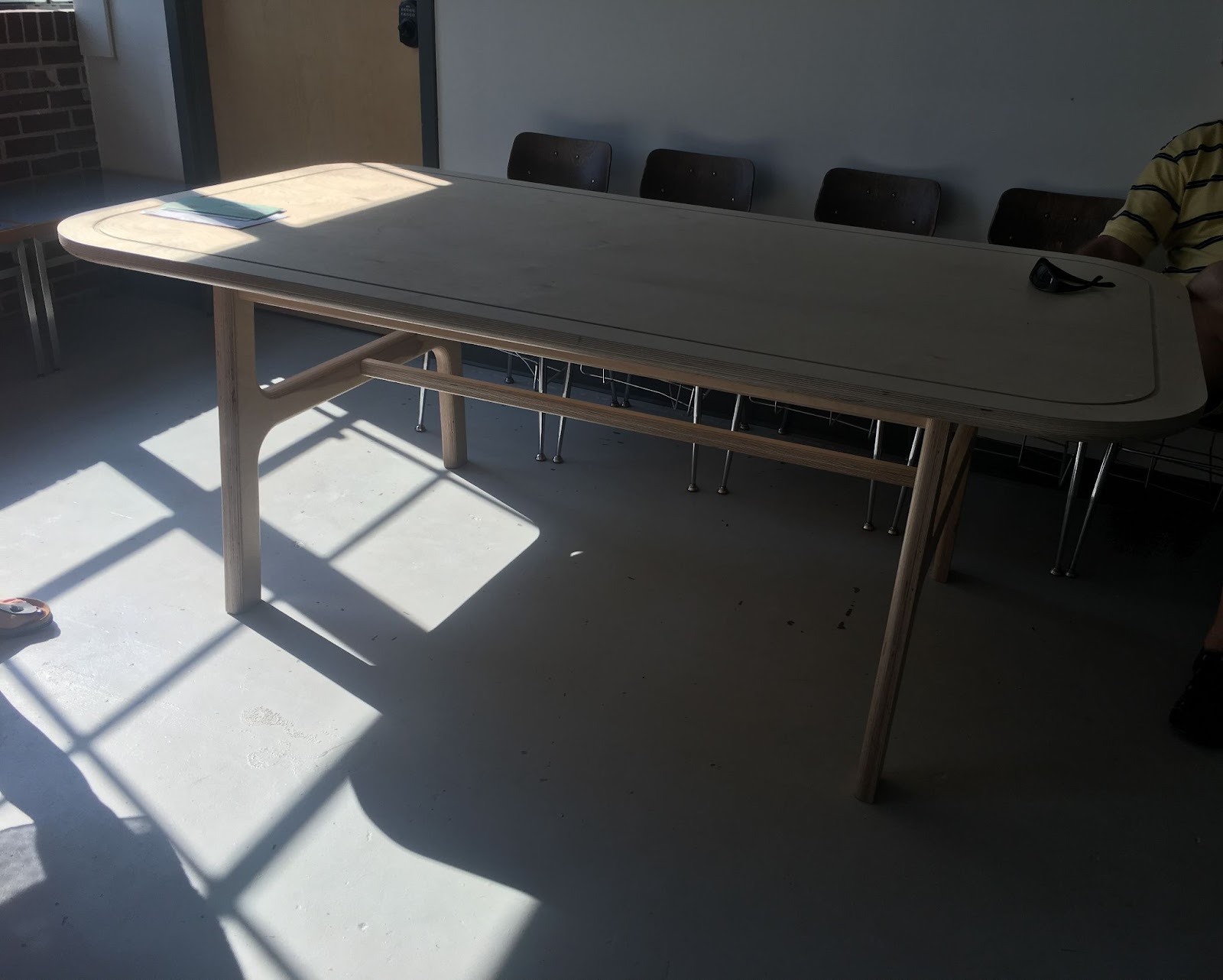
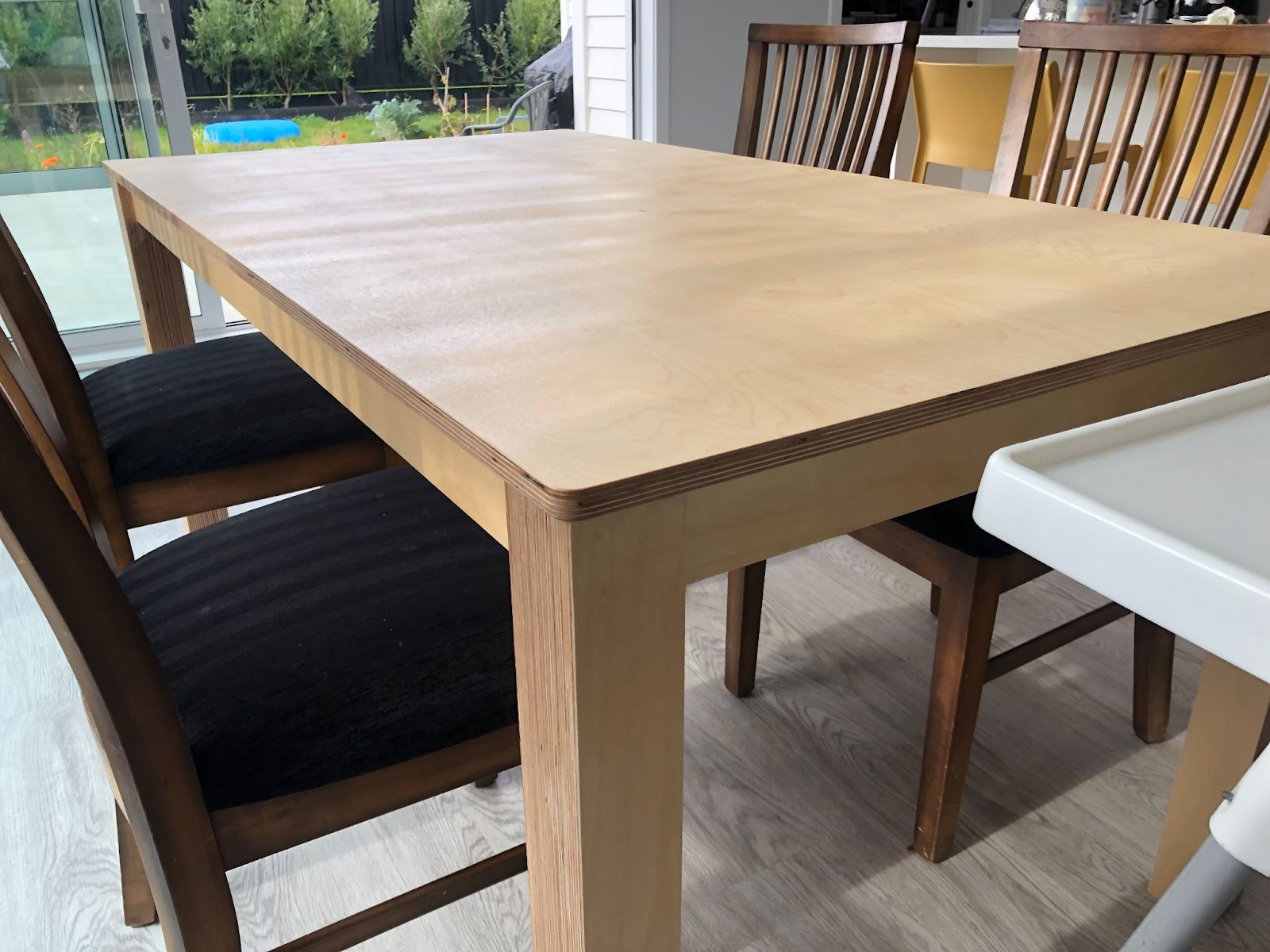
I recommended trying to build a desk for your first piece of furniture. The standard rectangle with four legs is simple enough for beginners to get stuck in, and will teach you valuable skills that you can use on more difficult projects.
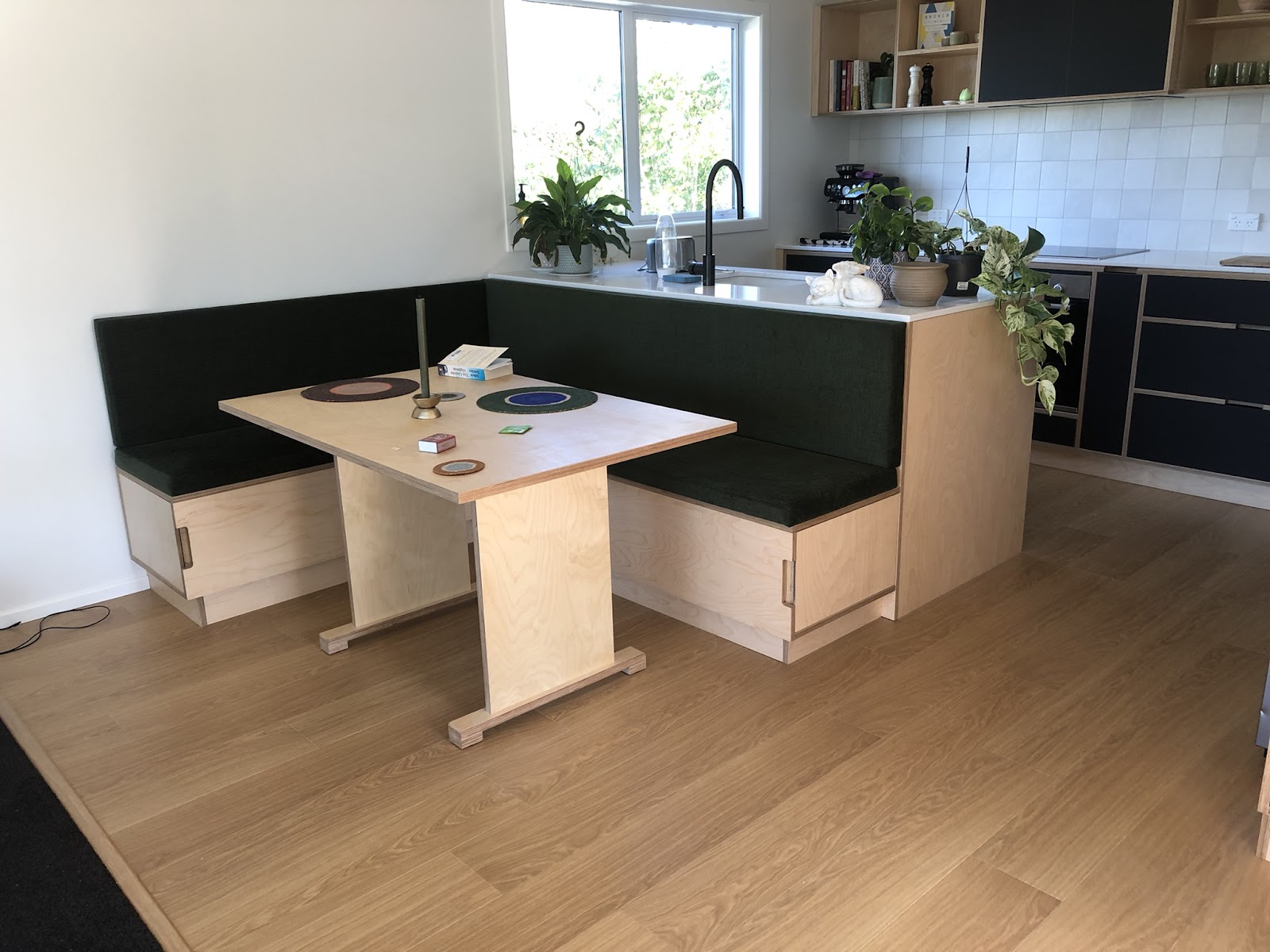
I love using single sheets of ply to create a whole piece of furniture with little to no waste and there are many plans available online that can guide you through the process from initial measurements to putting the finishing touches on your new desk.
Here’s a basic (and free) step by step guide that can take you from sheet to desk with some basic power tools. The basic outline is as follows:
1. Gather supplies. Get your plywood, power tools, pocket hole jig, sandpaper and finish, clamps, wood glue, and fasteners.
2. Layout your pieces on the ply. This will help ensure you get the best use out of your material.
3. Cut out your pieces using your circular saw or track saw.
4. Trim them to size with the miter saw.
5. Dry fit your pieces, and drill your pocket holes for assembling the desk frame.
6. Now it’s time to do everyone’s favorite thing – sanding the surface and edges.
7. Once everything is sanded, you can do the final assembly.
8. When you have glued and screwed everything together, It’s time to put the finish on.
9. All that is left to do now is enjoy your new one sheet plywood desk.
I recommend using a track saw to cut the pieces, but you can achieve the same result with a circular saw, a straight edge, and a couple of clamps. You will also want a miter saw to cut the small angles on the legs.
That’s All Folks
I hope I’ve convinced you that plywood is worth your time – whether you’re a seasoned journeyman carpenter, or a beginner who wants to build something that lasts for years and looks beautiful in your home. Please join us over at Sheet Good to get some inspiration for your plywood furniture creations. You can also find many more posts that delve into all the different aspects of this fascinating material.
A professional cabinet maker and furniture designer – Joel was raised on a cattle farm in Mississippi and has spent the majority of his professional life in Atlanta, Georgia. After obtaining a degree in Industrial Design from the Savannah College of Art and Design, he pursued further qualifications in cabinet making. For over ten years, Joel has specialized in working with plywood, and now operates as a freelance designer for various furniture manufacturers. Find more of Joel’s writing about plywood design and project ideas at Sheet Good.
Working with plywood throughout my career has shown me how versatile of a material it is, how sturdy it is, and how stunning it looks in any space. I think plywood is an incredibly efficient use of natural material that has been engineered to reduce some of the limitations of solid wood, and is now used in almost every facet of our living environments including buildings, cabinetry, furniture – the list goes on. I’m Joel, a plywood geek, and I’m going to take you on a journey and show you why you should be using plywood for your projects too. So pull up a stool (made from plywood, of course) and let’s delve into this world.
Why Listen to Me?
I’ve been working professionally as a cabinet maker and furniture designer for most of my life. I was born and raised on a Mississippi cattle farm but spent most of my professional life in Atlanta, Georgia. After earning my degree in Industrial Design from the Savannah College of Art and Design, I went on to earn my qualification as a cabinet maker. I spent over ten years honing my craft using plywood, and nowadays I work on a freelance basis for various furniture manufacturers. Here’s some examples of my work.
Photo Credit: Joel AndersonPhoto Credit: Joel AndersonPhoto Credit: Joel Anderson
Why Use Plywood?
Let’s get into the nitty gritty – why should you bother with plywood compared to solid woods, fiberboard, particleboard, or any non-wood materials? Let’s start with plywood’s unique composition – Plywood is made up of cross-laminated layers of wood veneer, and because each layer is in tension with the next it creates a dimensional stability not found in solid wood, while still being a lightweight material. Another unique feature comes from plywood veneers being shaved off the raw timber – a bit like an old-fashioned apple peeling contraption. This makes it possible to have large lengths and widths relative to the thickness of material and still be strong across both dimensions. If you’re building something with a large surface area, plywood is a great choice for uninterrupted wood grain.
Plywood is also very versatile, and this makes it useful for a variety of projects that require curved shapes. Thinner sheets can be formed around a frame, or using another technique called kerf bending, that allows thicker sheets of plywood to be bent. Even compound curves are possible by forming your own plywood in a mold.
Perhaps most important when thinking about furniture – plywood is beautiful. A sanded down sheet of ply used to build a table, chair, or kitchen cabinet creates a look that is both subtle yet striking. Depending on the species of tree used, the natural grains can create a light and airy appearance, or a darker and more contrasted look, which will give your space a natural vibe.
Types of Plywood
There are more types of plywood than I can list here, but these will get you started:
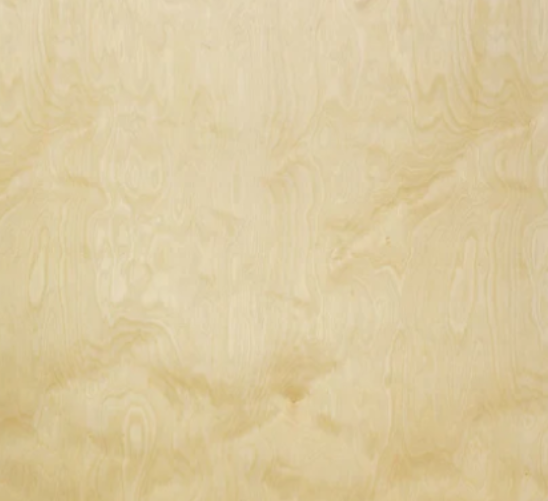
Birch Plywood A hardwood plywood that has good strength, beautiful visible grain texture, and is easy to finish. It is also known for having nearly no voids, so when you cut into it, no nasty surprises are waiting to be found. This is why birch is the most common plywood used in furniture making.
Photo Credit: Joel Anderson
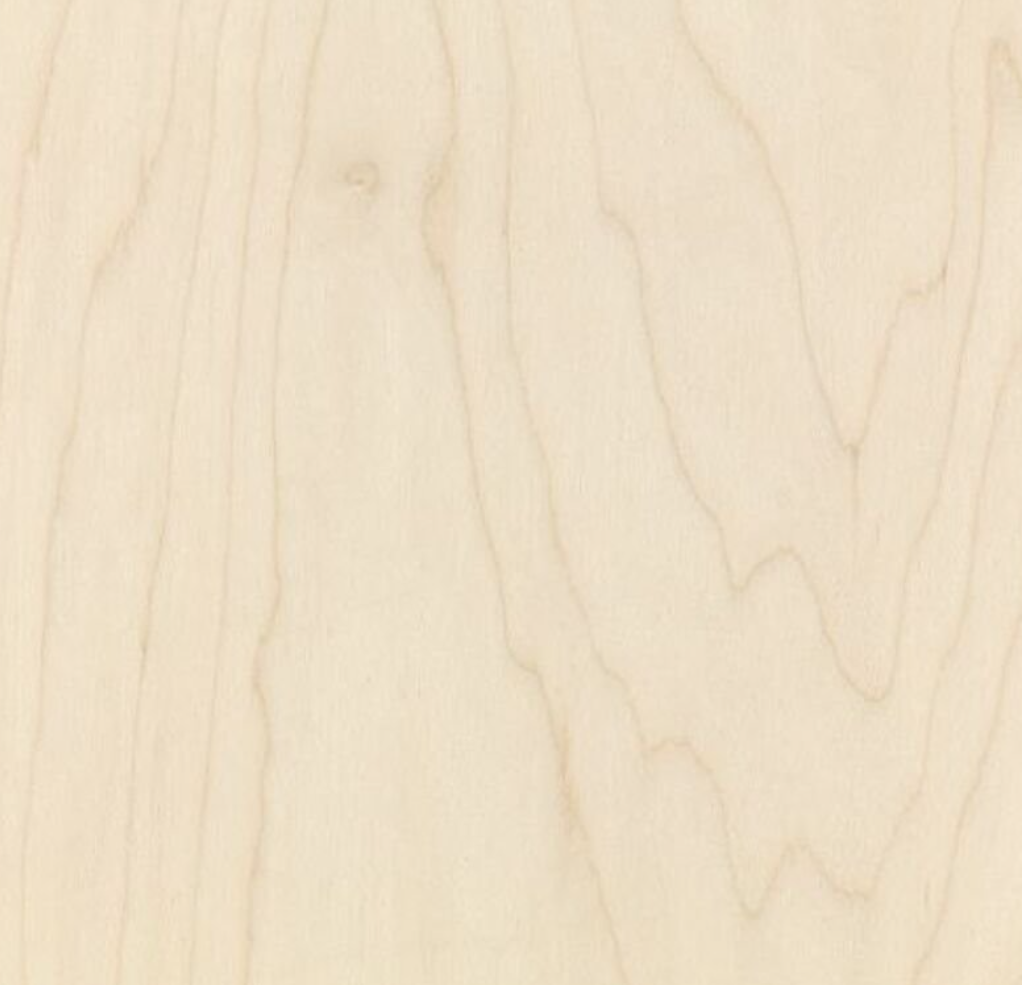
Maple Plywood Another great furniture-grade plywood found in North America is maple plywood. It has superior strength to birch but comes at a higher price. For the majority of projects, birch will get the job done but maple is always an option if you want to check it out.
Photo Credit: Joel Anderson
Veneers Many other species are not great for making plywood or would be prohibitively expensive. This is where veneers come in. Plywood veneers are a common way to apply different species to birch or maple cores so you can get the best of both worlds. This keeps the cost within reason while maintaining the durability and aesthetic strengths of birch and maple. Here are some of my favorites:
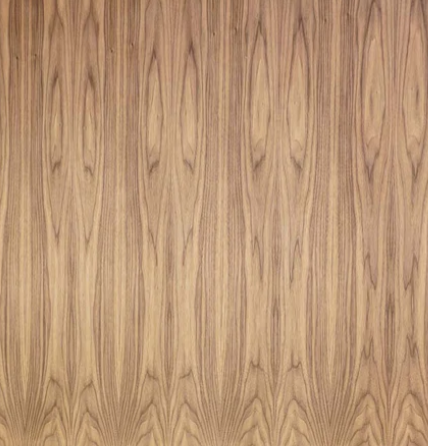
Walnut – The dark rich tones make this an excellent choice for anyone who wants to create a cozy atmosphere with their furniture.
Photo Credit: Joel Anderson
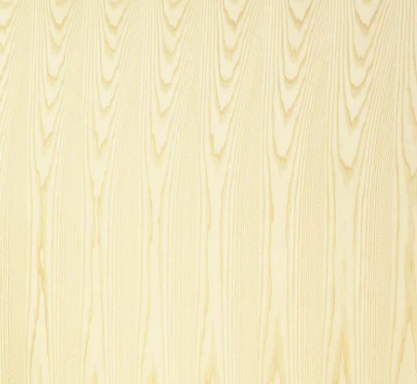
Ash – A cooler and more neutral grain pattern means that this veneer is able to fit into whatever space you want, and adds a refreshing natural vibe whether in your kitchen, living room, or bedroom.
Photo Credit: Joel Anderson
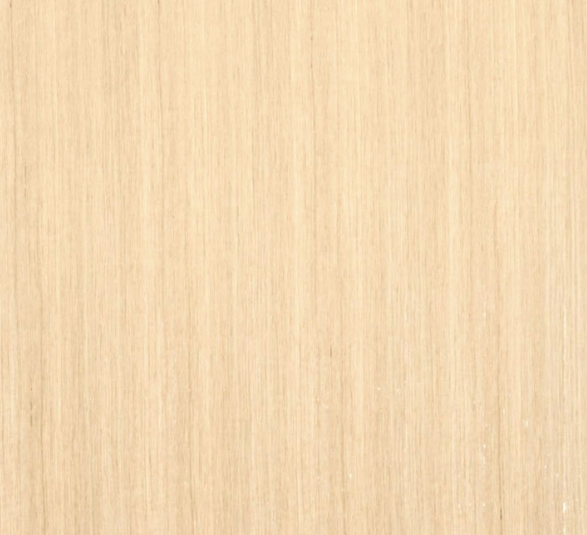
White Oak – I’m sure you’ve heard of white oak, as it’s a popular choice among furniture makers. Beautiful warm tones, but is still fairly light in color.
Photo Credit: Joel Anderson
Grades
It can be a daunting experience to go to a lumber store for the first time and be confronted with the different grades of plywood. What do they mean and how do they apply to the project you’re working on? Let’s break it down:
The rule of thumb is – use Grades ‘A’ and ‘B’ for furniture and features that are outward facing, and ‘BB’, ‘C’ and ‘D’ for anything that isn’t going to be seen by many people such as subflooring or interior walls. • Grade ‘A’ is the highest quality, with very few to no imperfections, and often comes pre-sanded or pre-finished. • Grade ‘B’ is still good, but may have some small knots and may not come pre-sanded. • Grade ‘BB’ is often nearly as good as ‘B’ but may have a handful of patched knots. • Grade ‘C’ will have some noticeable knots and other issues in the wood. • Grade ‘D’ will have larger knots and voids and won’t look presentable. It’s not pretty.
Sheathing, ACX, and CDX – What Are These?
If you see a plywood with multiple grades, that means it will have one side of each – so ACX will have a clean looking side but also a back with more knots and voids. The ‘X’ stands for the exterior grade adhesive which has glued the A and C sides together. These types of plywood are construction plys and can be a great choice for lining a garage, but aren’t really suitable for furniture making.
Plywood Cores
Veneer Cores
These are typically made using 3 or 5 layers for a 3⁄4” sheet of plywood. The layers are made up of thin strips of wood, or really thick veneers. They are made from a combination of a center and crossband veneers that are alternatively layered. This core has great strength and flexibility, but depending on the board the edge is not always the best looking, and can be prone to warping.
Multiply Cores
Multiply cores are usually made using 13 thin veneer layers for a 3⁄4” sheet of plywood. These thin layers create a beautiful edge pattern. The higher number of layers helps reduce warping of the material which makes it a great choice for furniture making.
Plywood Alternatives
Here are some of the other sheet materials you might come across when looking for material for your project.
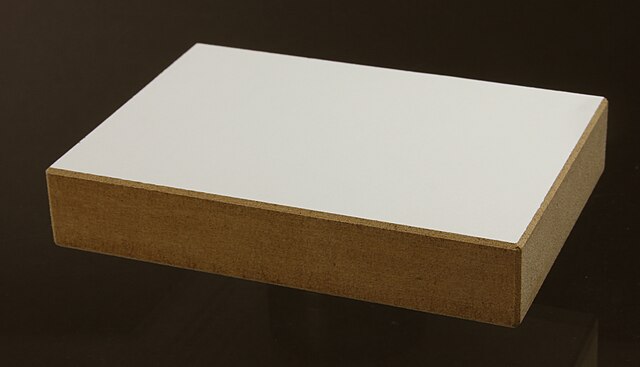
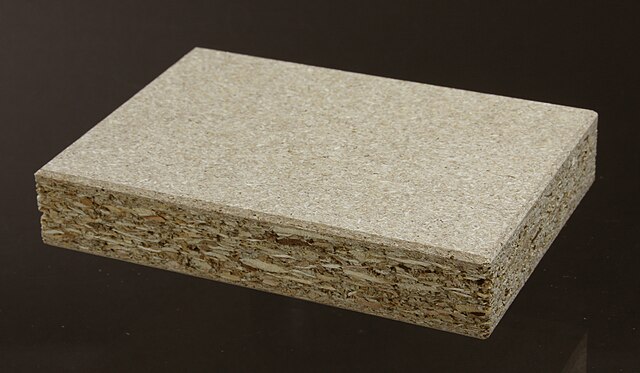
Medium-Density Fibreboard (MDF)
This material is known for being consistently thick and smooth, and this makes it a great choice for projects where you’ll be painting and doing detailed work. However, it is heavier than plywood while being less rigid and more brittle. This makes it perfectly fine for panel projects like cabinets, but not great for furniture.
Similar to MDF, this material is made up of small bits of wood that have been glued together and is often covered with a veneer or a laminate on its face. This material is commonly used in flat pack furniture (think IKEA). While it is light and generally quite cheap, it’s not good at taking heavy weight – we’ve all had that one IKEA shelf that finally cracked under the pressure, right?
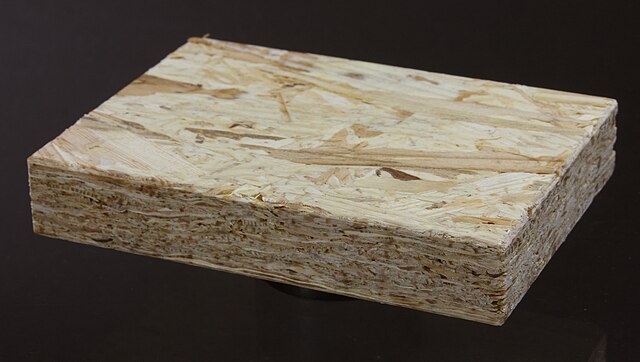
OSB is commonly used as an alternative to plywood, particularly in structural applications like subflooring or sheathing, as it is durable while also being cheaper. The main drawback is that it is more susceptible to moisture damage. It can also look good as a wall covering for a more industrial look. You can definitely use it for shop projects but the fit and finish leave something to be desired.
While these alternatives definitely provide their own advantages, and are oftentimes cheaper than plywood, I think it’s clear that plywood is stronger, more durable, and has a better appearance. When you’re building furniture or redoing your home interior, consider whether you’d rather spend a bit more now to have something long lasting and beautiful, or need to spend more money in a couple of years when the material starts to wear down.
What to Consider When Buying Plywood
As well as checking the grade, also take the time to think about what species of wood you want your plywood to come from – this can affect the aesthetics of your furniture. Something important to take note of is your budget. How much are you willing to spend overall? Don’t forget, mistakes happen, and material can be wasted. If you spend all of your budget on the finest ‘A’ grade plywood but then lose half of it to a poorly placed saw cut, will you have enough to start over? You can always contact Highland Woodworking to see if they have a board stretcher in stock.
Where to Buy
The classics of home improvement in the USA are stores such as Home Depot and Lowes, but they tend to focus on construction grade plywood and the alternatives mentioned above. This can be good for prototyping, but is generally not suited for furniture projects. I recommend asking your local woodworking store or a local cabinet maker where they source furniture-grade plywood. If the big box store is your only option I recommend going with Purebond Plywood – found at Home Depot.
The Non-Plywood Stuff
Highland Woodworking has got you covered for all of your other needs, whether you want to cut, sand, or stain your plywood furniture you can find it all here.
A professional cabinet maker and furniture designer – Joel was raised on a cattle farm in Mississippi and has spent the majority of his professional life in Atlanta, Georgia. After obtaining a degree in Industrial Design from the Savannah College of Art and Design, he pursued further qualifications in cabinet making. For over ten years, Joel has specialized in working with plywood, and now operates as a freelance designer for various furniture manufacturers. Find more of Joel’s writing about plywood design and project ideas at Sheet Good.
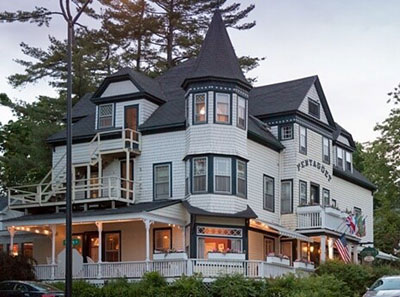
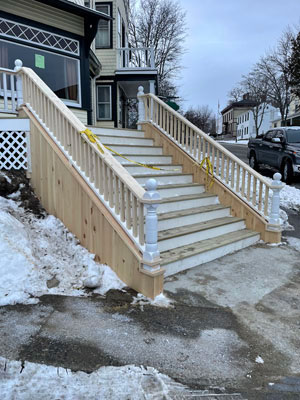
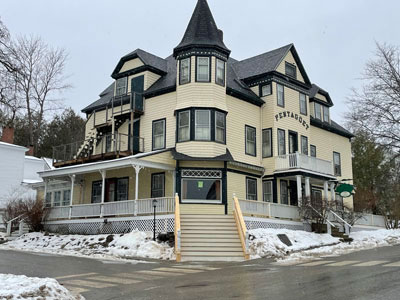
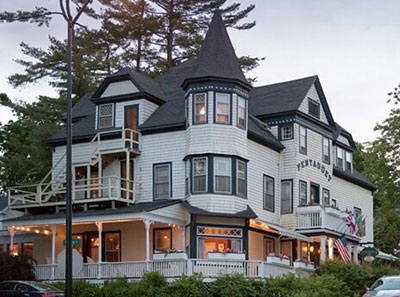
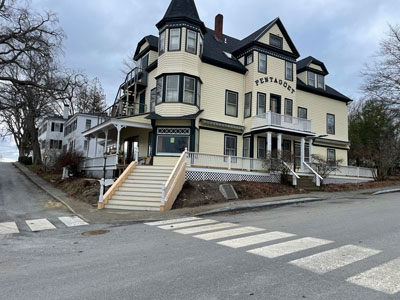
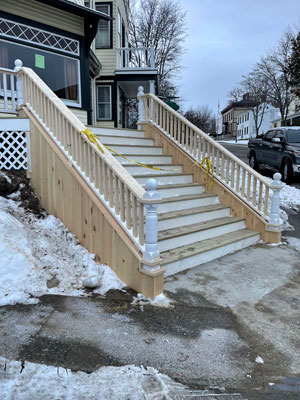
With an historic preservation grant and vision for a return to the past elegance, the new owners of the Pentagöet Inn in Castine, Maine asked me to create and turn the four new newel posts they needed for the renovated main entrance from the street.
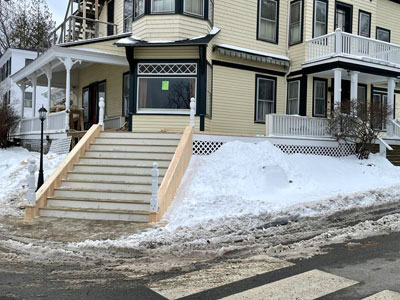
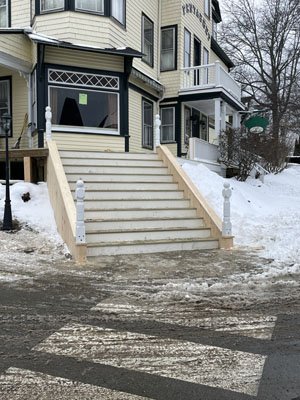
Their contractors did an impressive job, and the newel posts were smoothly incorporated.
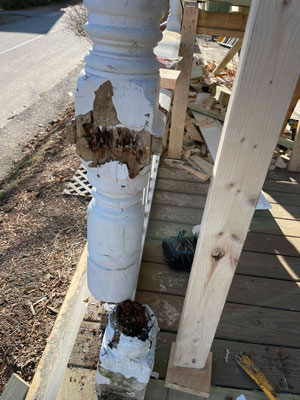
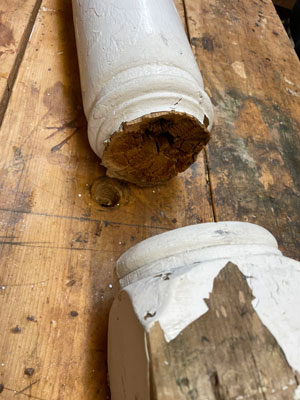
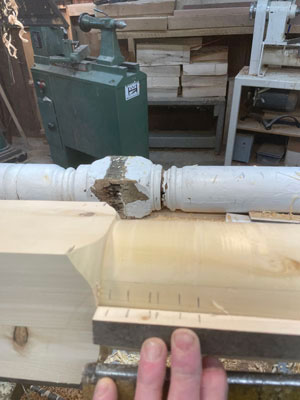
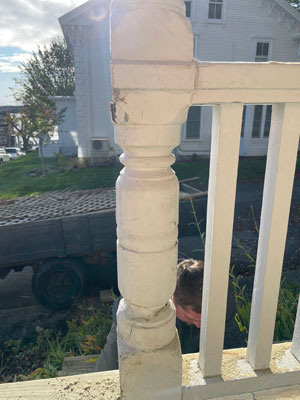
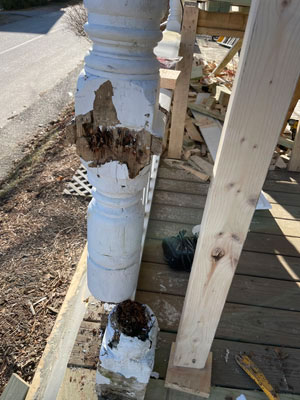
The work progressed smoothly until they began to tie the new balustrade to the existing 8′ porch post which they discovered was totally rotten …
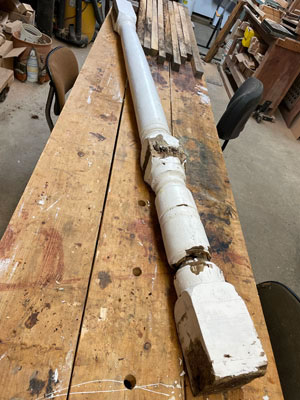
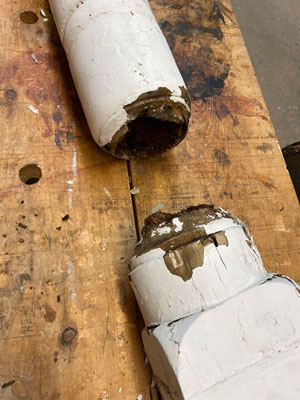
… base … middle section … and top.
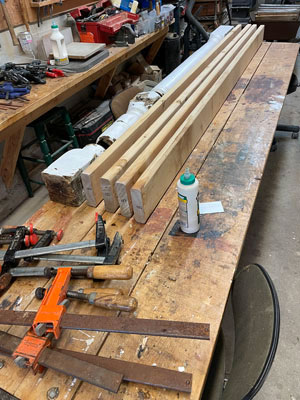
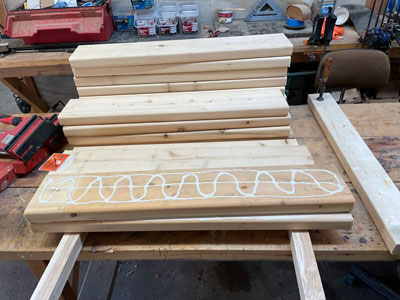
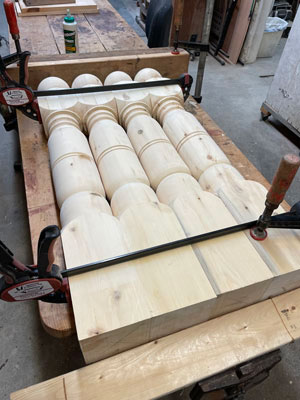
Knowing they were feeling the pressure of time and weather (we had enjoyed an unusual string of December/January warm and dry days), I was able to acquire the 8′ long 2″X6″ Alaskan Yellow Cedar boards
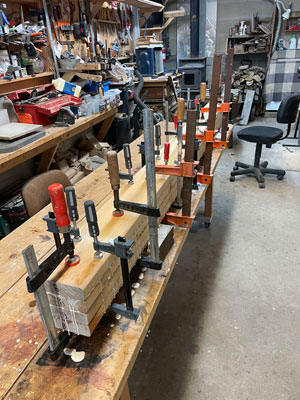
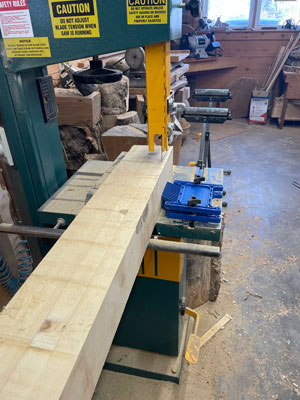
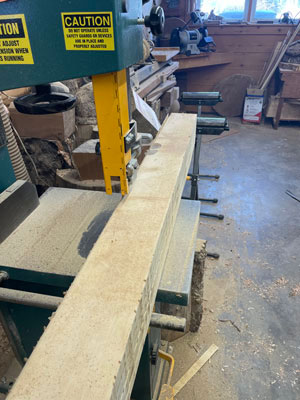
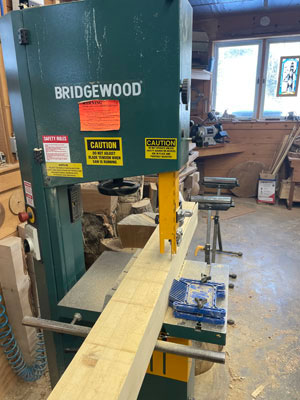
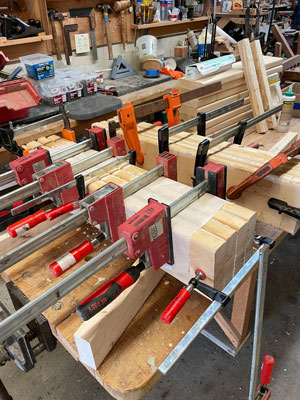
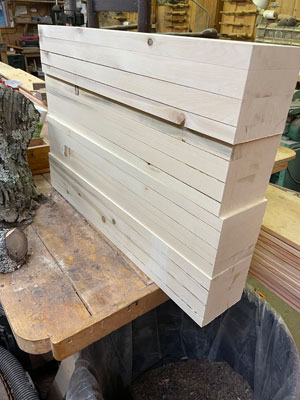
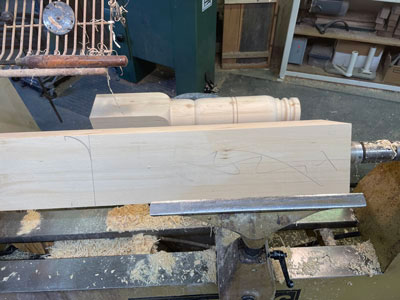
and glue them up (actual measure of 5 ½” X 6 ¼” in preparation for sawing to rough size on the bandsaw
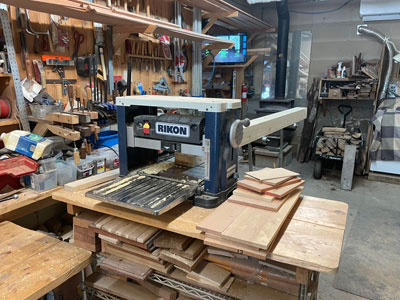
to then joint two adjacent sides before surface planing to the final dimension of 4 ¾” X 4 ¾” that matches the existing posts and the newel posts.
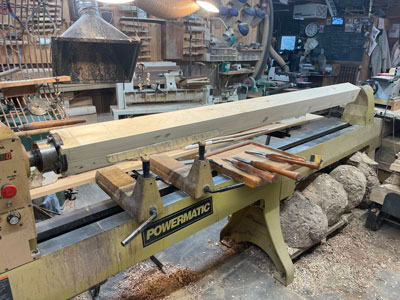
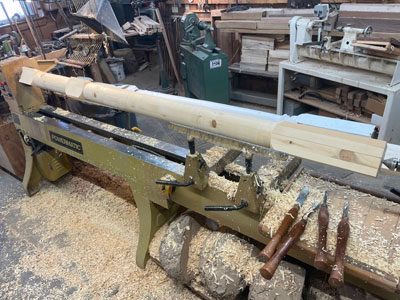
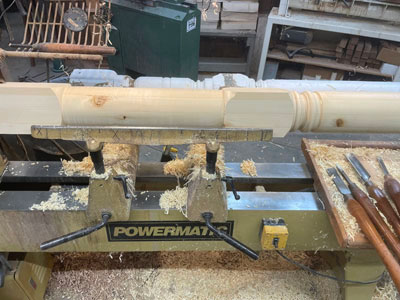
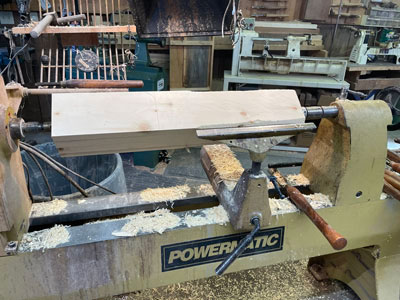
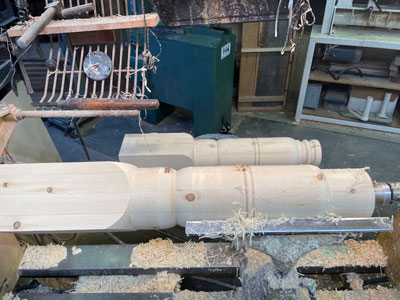
Once the blank is mounted on the lathe (note an 8′ long laminated ~5X5 blank does not require a mid-blank steady rest. The lathe runs well at about 400 – 500 RPM with no whip)
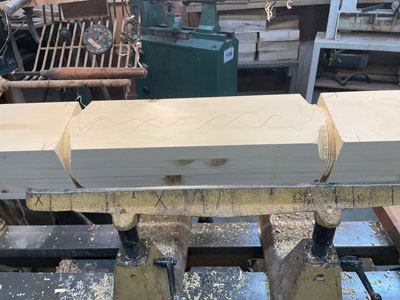
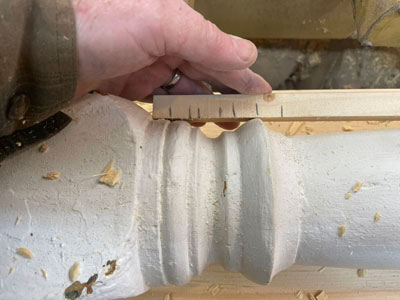
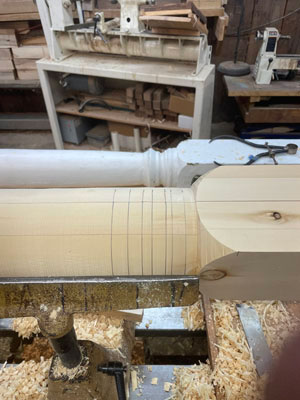
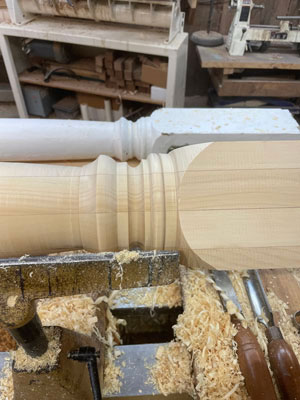
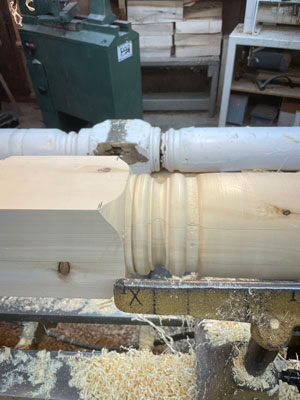
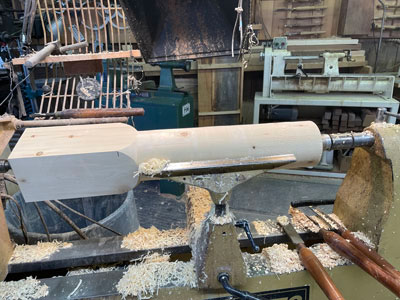
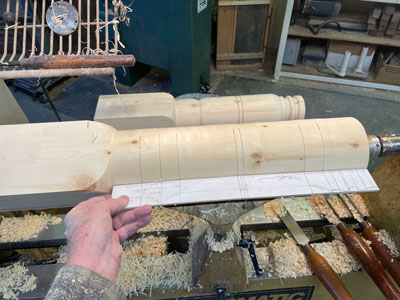
and the 24″ tool rest is in place; the first cuts are to measure carefully for the square pommel-to-round transition points and cut them in using the long point of the skew. The transition at bottom and top are straight angled cuts; the transitions in the middle section are lamb’s tongue which is made using a middle size Sorby 12mm gouge. When making restoration copies, the small details matter enormously. While most people will not notice directly, the dissimilarity will register on at least an unconscious level.
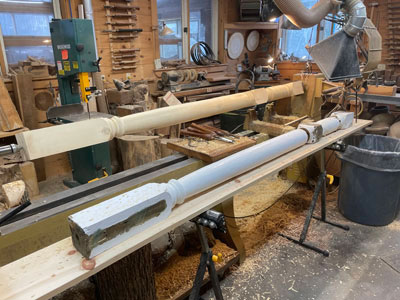
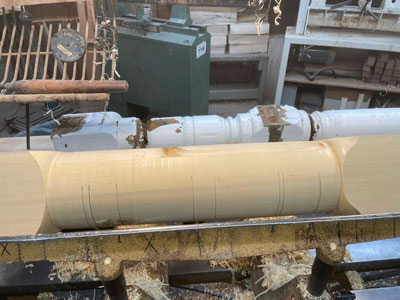
The next step is to round and taper the full column length. I find that it helps me to have the source profile post in my sightline to help me keep my attention focused and the details registered. In this case, I carefully placed the rotten post sections on a long board just on the far side of the new blank.
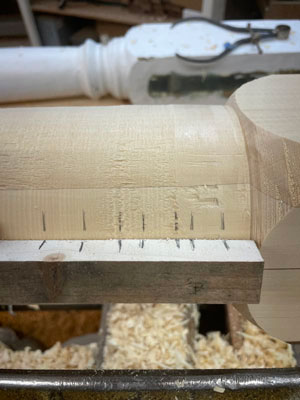
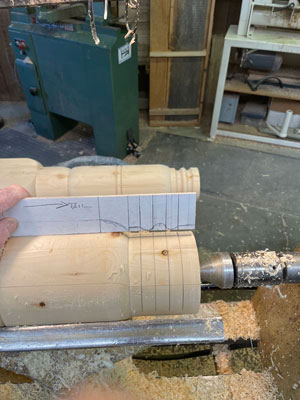
I worked with story-sticks to identify the various specific profile points of taper, bead, cove, (shoulder).
As with most turning, the best practice is to work on the larger diameters on the right (by the tailstock) before moving left (toward the headstock and power source).
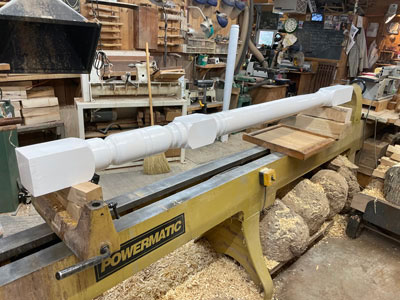
Once the turning is completed, applying the primer coat is most efficiently done while the post is still between centers on the lathe. I typically also prime the ends of outdoor posts with either primer or West System epoxy to help preserve the life of the post.
Delivering the post a week after they discovered they needed it was particularly satisfying, and the contractors put it in place that day, one day before we had an onset of cold and snow.
Doing a job like this is particularly rewarding as well as great publicity being so prominently a display of the work being done so visibly in the middle of our town. I look forward to the owner’s next phase in a year, when we will continue the restoration to the lower and upper balustrade, posts, and rails up Main Street to the right.
“Turning the Corner,” focuses on using woodturning on the lathe as a way of enhancing cabinetry, furniture designs, gallery products, and architectural installations. We hope to inspire woodworkers to extend their skills into basic, novice, and advanced woodturning while discovering for themselves this particularly sensual and spiritually rewarding dimension of working with wood. Located in Castine, Maine, Highlands Woodturning gallery and shop offers woodturning classes and shop time, a gallery of woodturned art, custom woodturning for repairs, renovations, and architectural installations. You can email Temple at temple@highlandswoodturning.com. Take a look at Temple’s Website at http://www.highlandswoodturning.com/
Fresh from New York City, the new, young owners of the Pentagöet Inn in Castine, Maine arrived two summers ago to embrace the long history of the Town and especially their beautiful building in a way that is both impressive and sustainable. Their vision and energy as owner/operators/hosts of this magnificent old-time, 130 year old wooden building, radiates an air of excitement, success, and intrinsic reward, and they have been honored properly by Hospitality Maine for their work.. At each phase of creative renovation effort, the interior and exterior are being transformed to preserve the history while thoughtfully and confidently moving into the next century.
One evening last summer while I dined there with family, I was invited to a sidebar discussion with the owners, introduced to their plan to restore the original but missing main entrance staircase funded by a significant grant from the National Trust for Historic Preservation. They asked if I would consider turning the four new newel posts they needed for the renovation later in the fall after they had received the necessary permits. In early December, they received them, and they asked me to return for further discussion and a more specific look at what they wanted to accomplish. Their contractor had already begun replacing the rotted floor joists and flooring for the porch, and they hoped he could complete the new staircase by Christmas, the Maine weather having been unexpectedly cooperative.
The 38″ lower section of one of the original 8′ porch posts was the profile they wanted, and they had an architect’s drawing of what they would need for the new 42″ balustrade. They felt the drawing was not as close to the profile they wanted but would more closely represent what is required by the much newer codes. While I was there, I pointed out to them the significant “repairs” to the lower section of porch post that were an attempt to disguise considerable rot with caulk and paint (not a good choice for a structural element). I carefully measured the lower post and created a story-stick of what I thought the original profile would be working from that and the adjacent posts.
The owners were fairly sure their architect had surveyed the porch and that while I needed to adapt the real profile (4 ¾” X 4 ¾”) to the taller design required to meet for code, the existing posts and rails would not be changed. The architectural drawing called for a 5″ X 5″ blank which they did not want me to use, preferring to stick to the original 4 ¾” square profile. All they needed from me was to create the four new newel posts for the new staircase balustrade that could be worked in smoothly with the existing posts and rails that framed the porch.
We discussed materials and pricing and together made the decision to have me glue up Alaskan Yellow Cedar (AYC) to make the turning blanks, the best readily-available, cost-effective choice for a long life outdoors. I also understood initially that the newel posts should be two parts pinned through the new horizontal railing.
AYC is readily available to us, is less expensive than Great Western Red Cedar, takes the water-resistant Titebond III glue well, and at 2″ X 6″ creates a blank (1 5/8″ X 5 ½”) that can be bandsawn, edge jointed, and surface planed to the desired 4 ¾” square blanks.
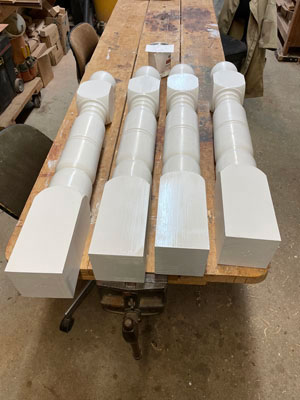
Working from both my story-stick of the lower post section as well as the architect’s drawing, I roughed the first blank, smoothed it, marked it, and finished the profile elements for the lower section using the Sorby continental 30mm roughing gouge, 32mm skew chisel, 10mm beading & parting tool.
With the first one complete, I reproduced it on the additional three lower blanks.
After I had cut and glued the eight blanks, I learned from the staircase contractor that they did not plan to pin through the horizontal rails after all. This meant to me that I simply needed to adjust the length of the upper section and pin the two sections in the shop before delivering. Working with the additional blanks for the top section now adjusted to meet the overall height requirement, I turned the profile that I understood would be mounted above the horizonal rails and pinned through.
The most efficient way to get the new posts square and true was to glue the top and bottoms together as a unit at the bench using bench dogs and the end vice.
Fortunately, it all worked out well. As is my custom, I primed the finished newel posts before delivering them on schedule – and understanding that with the cold weather they might not be painted very soon.
The contractors soon had them in place at the four corners of the emerging staircase, and very shortly thereafter they completed the remaining work on that portion of the job.
Unfortunately, when they began to tie the new staircase to the existing porch railing, they discovered that the first 8′ post had rotted beyond repair. The caulk and paint “repairs””had masked an even larger problem that was beyond the scope of me replacing just the bottom section. The rot went well up into the upper portion of the post.
Undeterred, the new owners asked me to turn a replacement post as soon as I could and to keep my story-stick handy for that anticipating their next restoration project on the other side of the new staircase next year.
“Turning the Corner,” focuses on using woodturning on the lathe as a way of enhancing cabinetry, furniture designs, gallery products, and architectural installations. We hope to inspire woodworkers to extend their skills into basic, novice, and advanced woodturning while discovering for themselves this particularly sensual and spiritually rewarding dimension of working with wood. Located in Castine, Maine, Highlands Woodturning gallery and shop offers woodturning classes and shop time, a gallery of woodturned art, custom woodturning for repairs, renovations, and architectural installations. You can email Temple at temple@highlandswoodturning.com. Take a look at Temple’s Website at http://www.highlandswoodturning.com/
In the lull between the frenzy of December/January holidays and the activities of the anticipated winter, the shop is relatively quiet. The backlog of architectural copy/multiple orders have all been completed and shipped; I have almost caught up with the several Christmas gift certificate lessons of 2022; and my grandson helped me give the shop its annual deep cleaning (not that that will last very long). As a result and benefitting from the unusually mild winter thus far, I have some rare discretionary time to work on projects of my own while I build inventory for the upcoming summer season. (In reality, Downeast/mid-coast Maine is known for only having two seasons – “off-season” of 10 months and “summer” of two months (July and August) when our population and activities swell geometrically.)
This year, I decided to hone my basic skills by turning a series of calabash bowls waiting within several elm logs and four beautiful black ash tree logs dropped off by a friend whose conscience would not allow him to split them for firewood. To vary my occupation, I also planned to turn a number of natural-edge hearts (Valentine’s Day is coming) by tackling a sizable pile of likely crotch blanks I had accumulated for “later.” Now has happily become “later,” and with the calendar and a recent visit to the local pharmacy in mind, the avalanche of Valentine’s Day gifting is nearly upon us.
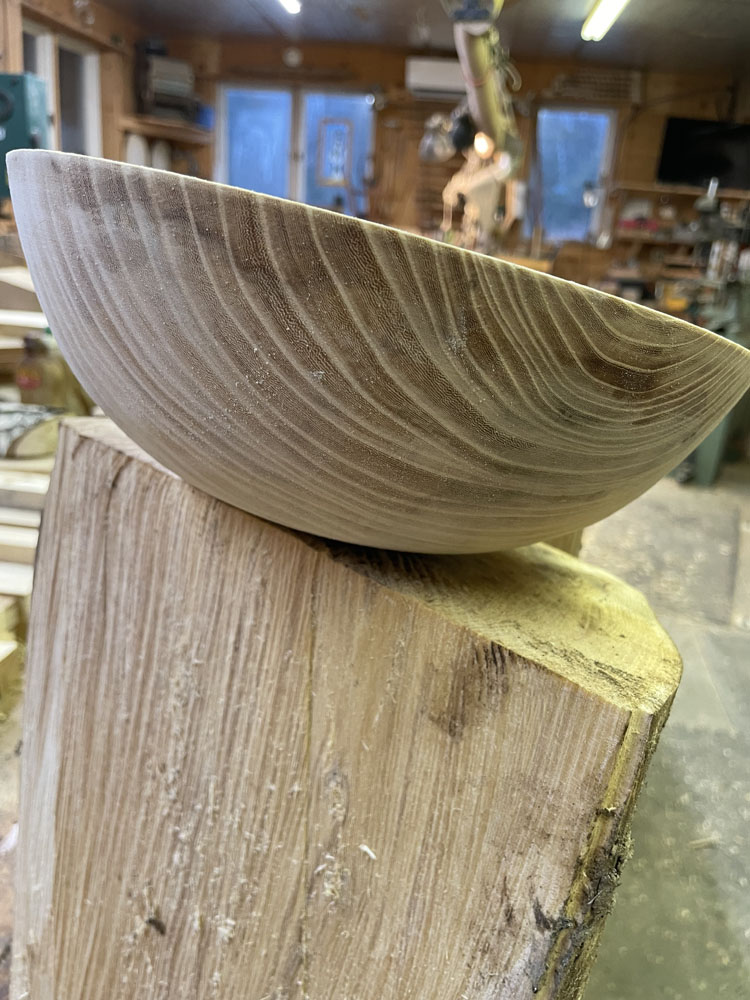
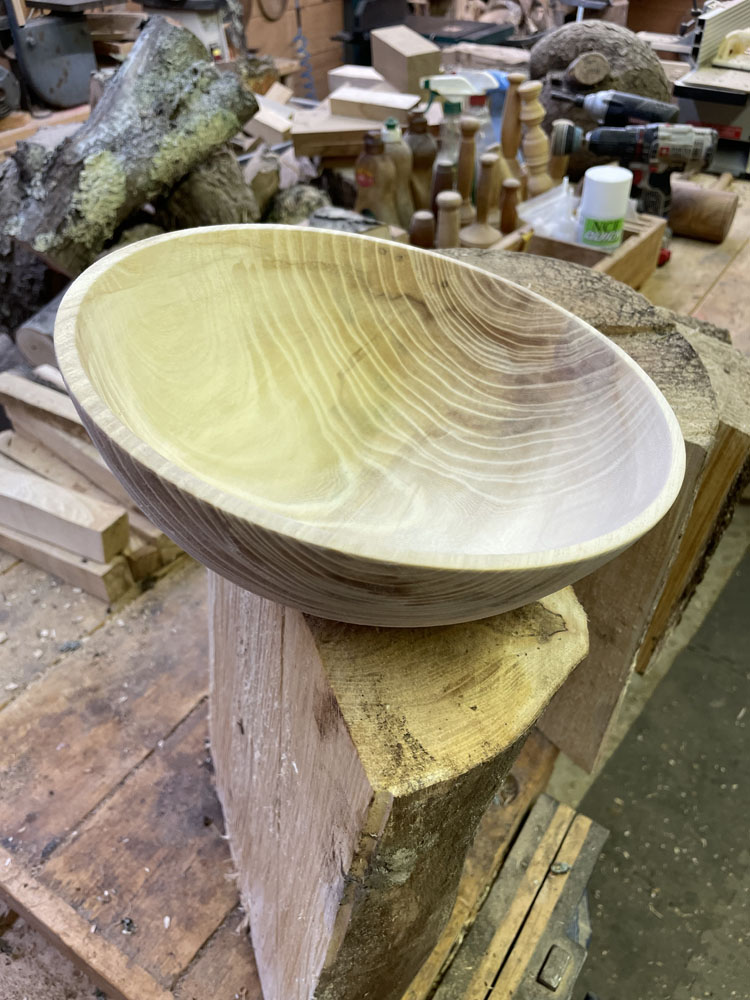
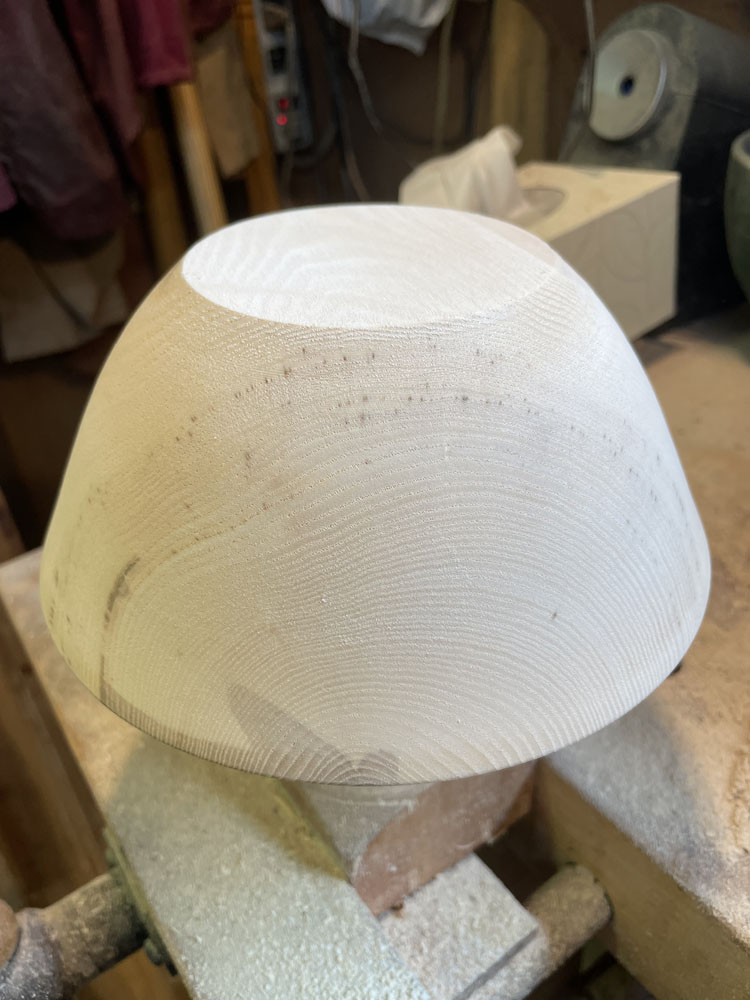
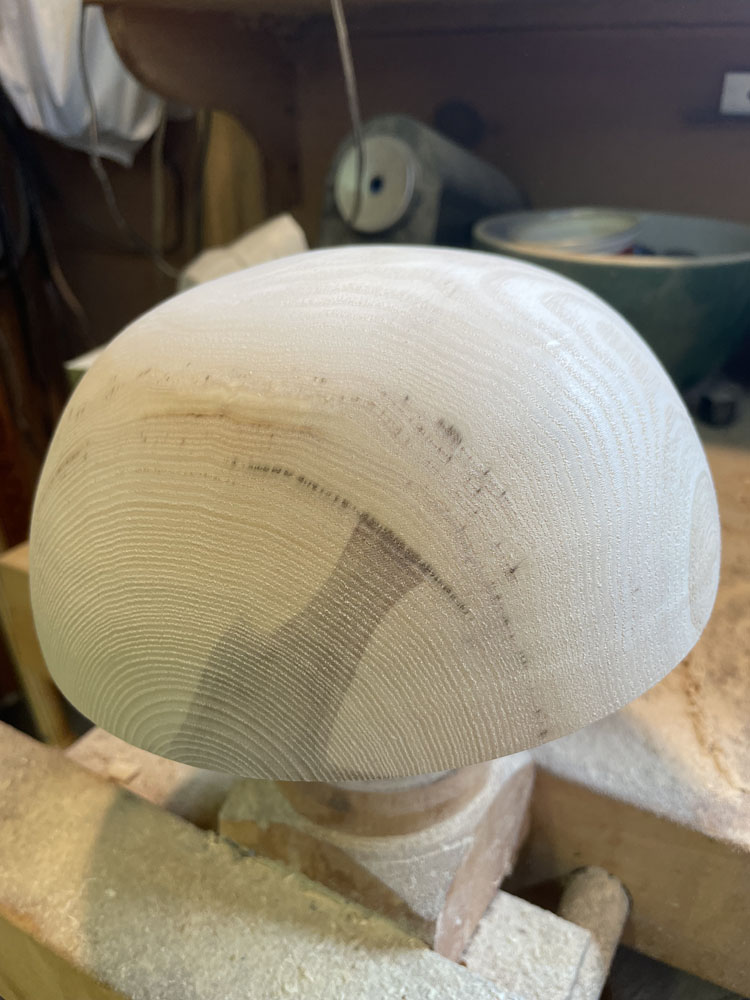
The popular calabash bowl distinguishes itself from a standard bowl by its smoothly rounded bottom. The starting blank should be green (pictured in elm), should be turned to a smooth finish using only the bowl gouge (not sanded), and the sustained thickness of the thin wall should extend all the way around the rounded bottom. The interior of the bowl should be a matched copy of the outside profile.
A more typical bowl (pictured in ash) has a flat bottom to keep it from rocking on the tabletop and might even include a foot or other profile decoration. While the interior of the bowl will be gently rounded, there is usually a thickened section of the wall where the inner side curves more severely to the inside bottom and the exterior profile of that wall extends to the flattened table-top outside bottom surface frequently with a reverse curve.
The beauty of the calabash bowls is that it is truly a “once-turned” bowl from green. As the finished wood dries, the bowl warps to an irregular shape giving each its own unique profile. Each bowl is characterized by its natural color, grain, figure, as well as its warped profile.
The skill challenge for turning calabash bowls lies in first establishing a pleasingly rounded curve from the sides through the bottom on the outside that in the second step when the blank is reversed for hollowing is accurately copied through the bottom on the inside. When the bowl is reversed to turn away the tenon required by the chuck in the final step of the process, the turner is challenged to accurately predict (imagine) where that inside curve runs as the bowl gouge carves away the tenon to complete the rounded bottom.
Like so many woodturning projects, the sensual return of handling the smooth, finished surface – using the hand’s palm to stroke the outside curve and then tracing the inside curve with the hand’s back – is enormously rewarding. The creative insights come from studying and trying to anticipate how the drying process of only a few days will re-designed the shapes and curves of the carefully carved profile. The eventually finished dry bowl, sometimes dramatic, sometimes subtle, affirms nature’s artistry well beyond the turner’s skill with the gouge.
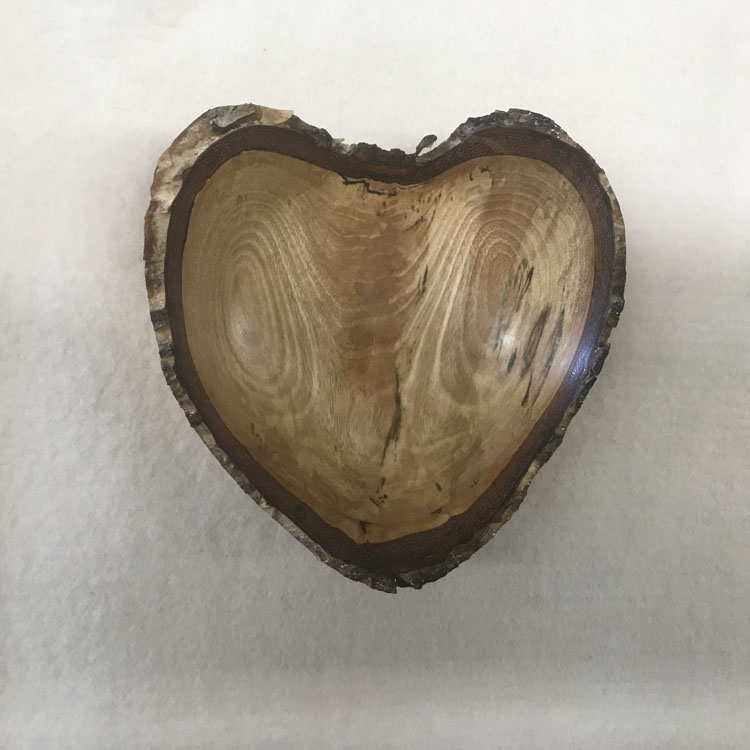
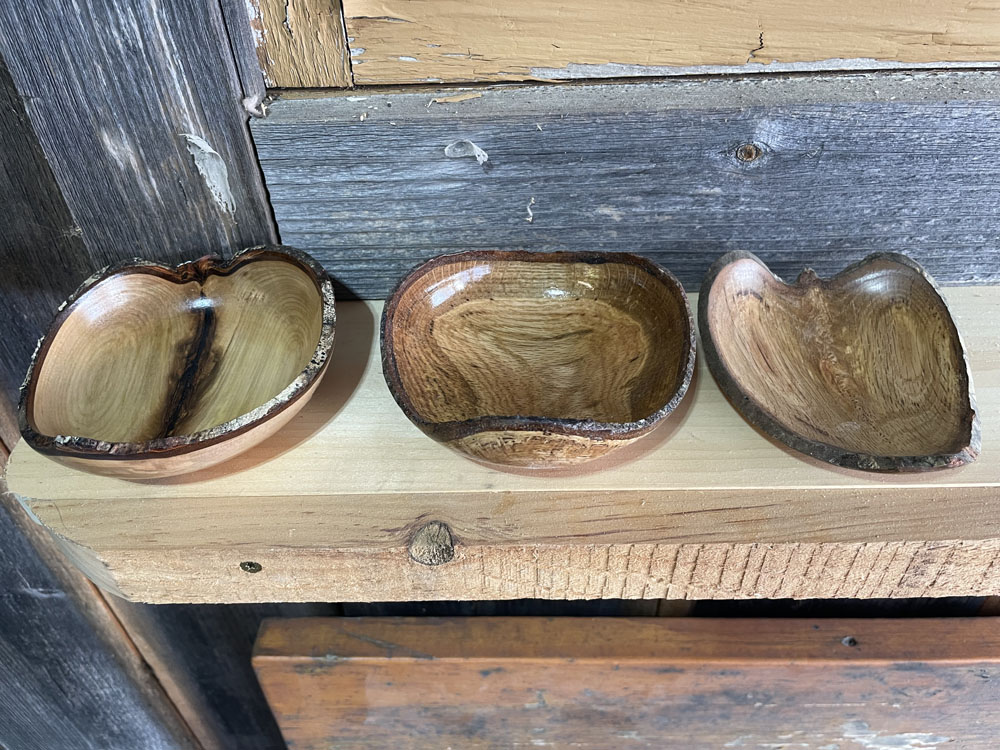
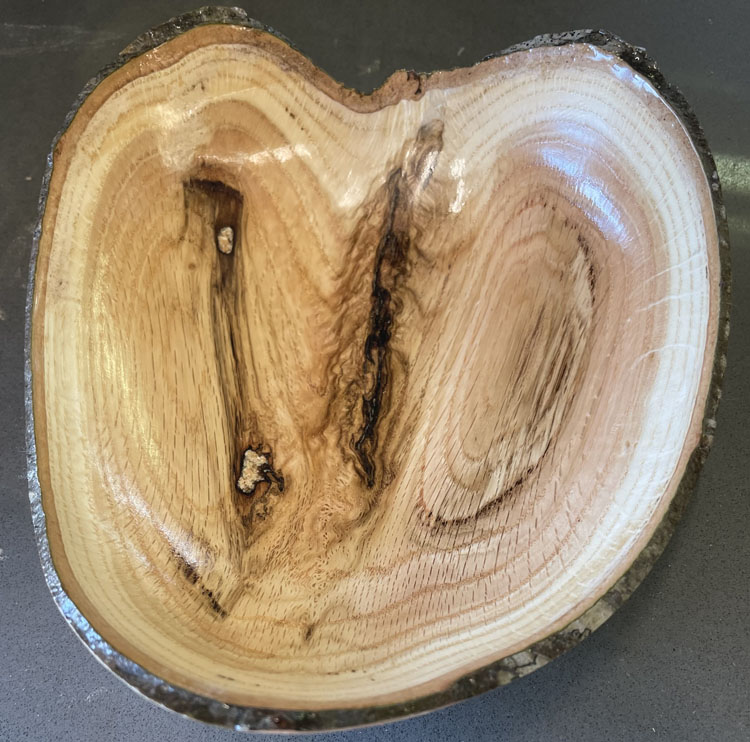
Contrasting with the calabash bowl’s stringent tool-control and design discipline, the natural edge, heart shaped crotch pieces offer a different kind of challenge. With these the final design begins with and is totally controlled by the selection and positioning of the blank at the beginning. Many wood types lend themselves to making these, but oak, cherry, and maple seem to yield the most dramatic and pleasing results. The goal is to display the clear outline of a bark-lined heart which at its center reveals the chaotic interweaving of grain where the two branches joined as the tree grew. (Pictured – maple)
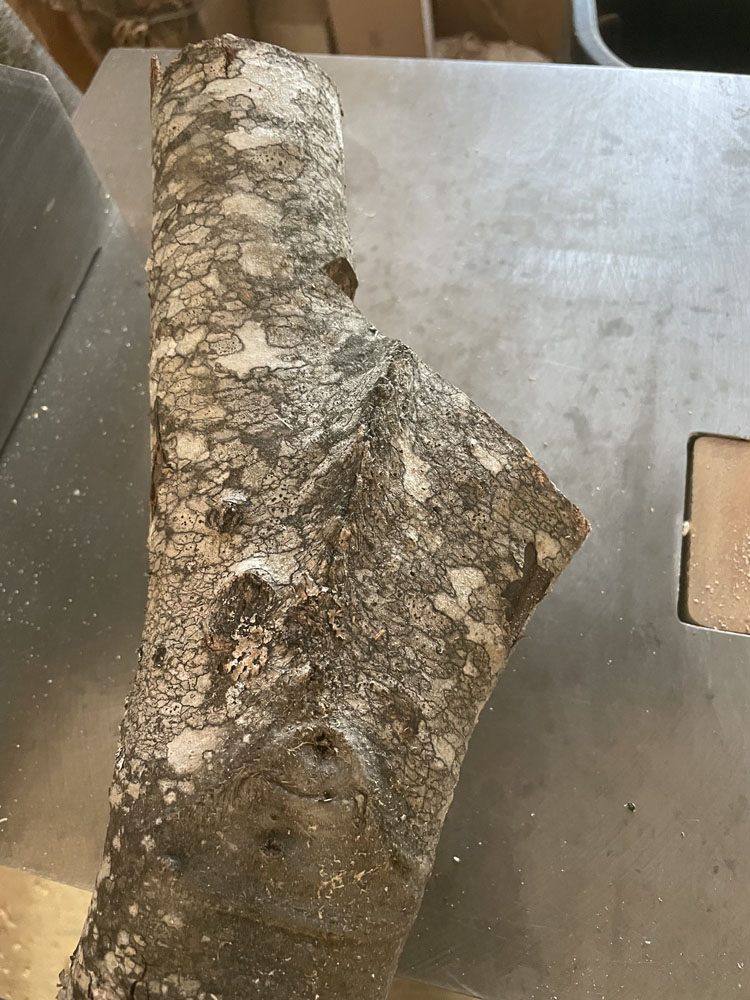
Identifying and harvesting the crotch in the woods is relatively easy, and the most desirable part is the swollen ridge of bark along the seam where the grain of the two branches converge/diverge (depending on your point of view).
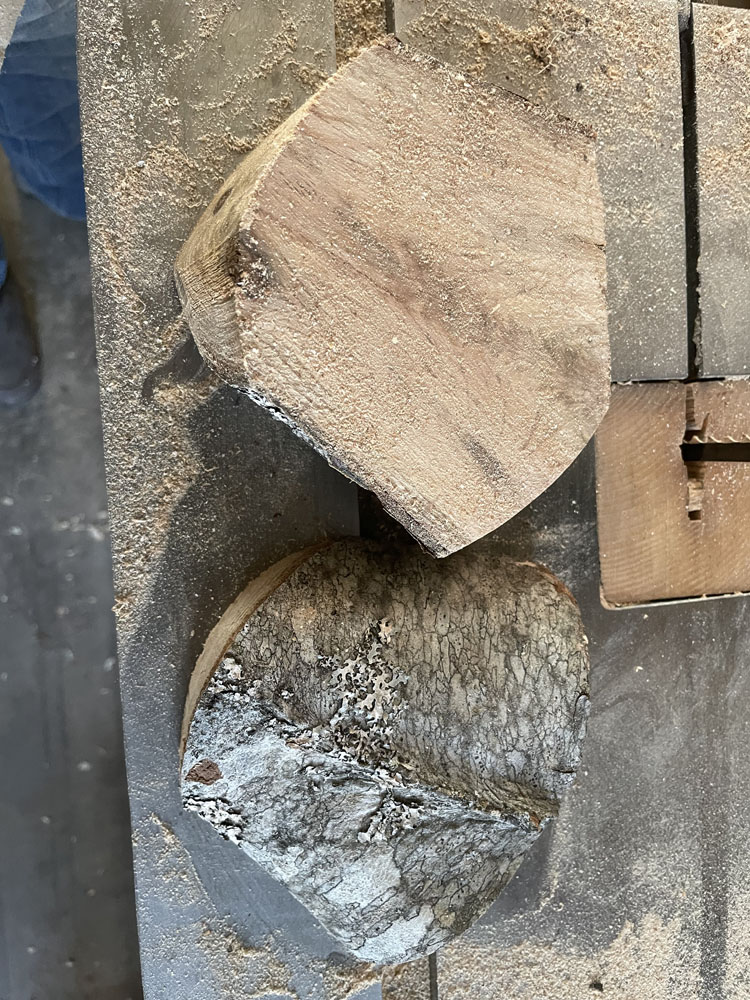
Ideally both branches should be of similar size, and the blank should be sawn on the bias before being trimmed to a rough circle for turning.
During my week of turning on my own for a few hours each day, I alternated between turning the green bowls of calabash and digging into my store of crotch/heart blanks.
Turning several bowls in the morning and several crotch/hearts in the afternoon encouraged me to explore different techniques and test the boundaries of my skills while building my inventory for the gallery and summer customers. More importantly and beyond the simple pleasure of being free to spend the time turning, I know from experience that my sustained time practicing and experimenting with similar forms and projects leads me to a new level of performance.
Ultimately, the message I regularly offer my woodturning students as well as my readers is that focusing on each set of skills – regardless of the level of past achievement – and spending the time and effort practicing by setting new goals that replicate that rehearsal pays off in the clear gain over time.
In 1969, I vividly remember telling my (then) girlfriend (later wife) that I had decided I wanted to become “really good” at something that required skill in my life rather than hit-or-miss “pretty good” at many different kinds of things that I could see in others around me. Fortunately, my wife and her mother, both of whom like me knew nothing about woodturning at that time, steadily encouraged and supported me from the beginning. My adventure continues today as I happily spend hours each day working in my shop with the wood, the lathes, the tools, and a host of wonderful friends who share my passion.
Located in Castine, Maine, Highlands Woodturning gallery and shop offers woodturning classes and shop time, a gallery of woodturned art, custom woodturning for repairs, renovations, and architectural installations. You can email Temple at temple@highlandswoodturning.com. Take a look at Temple’s Website at http://www.highlandswoodturning.com/
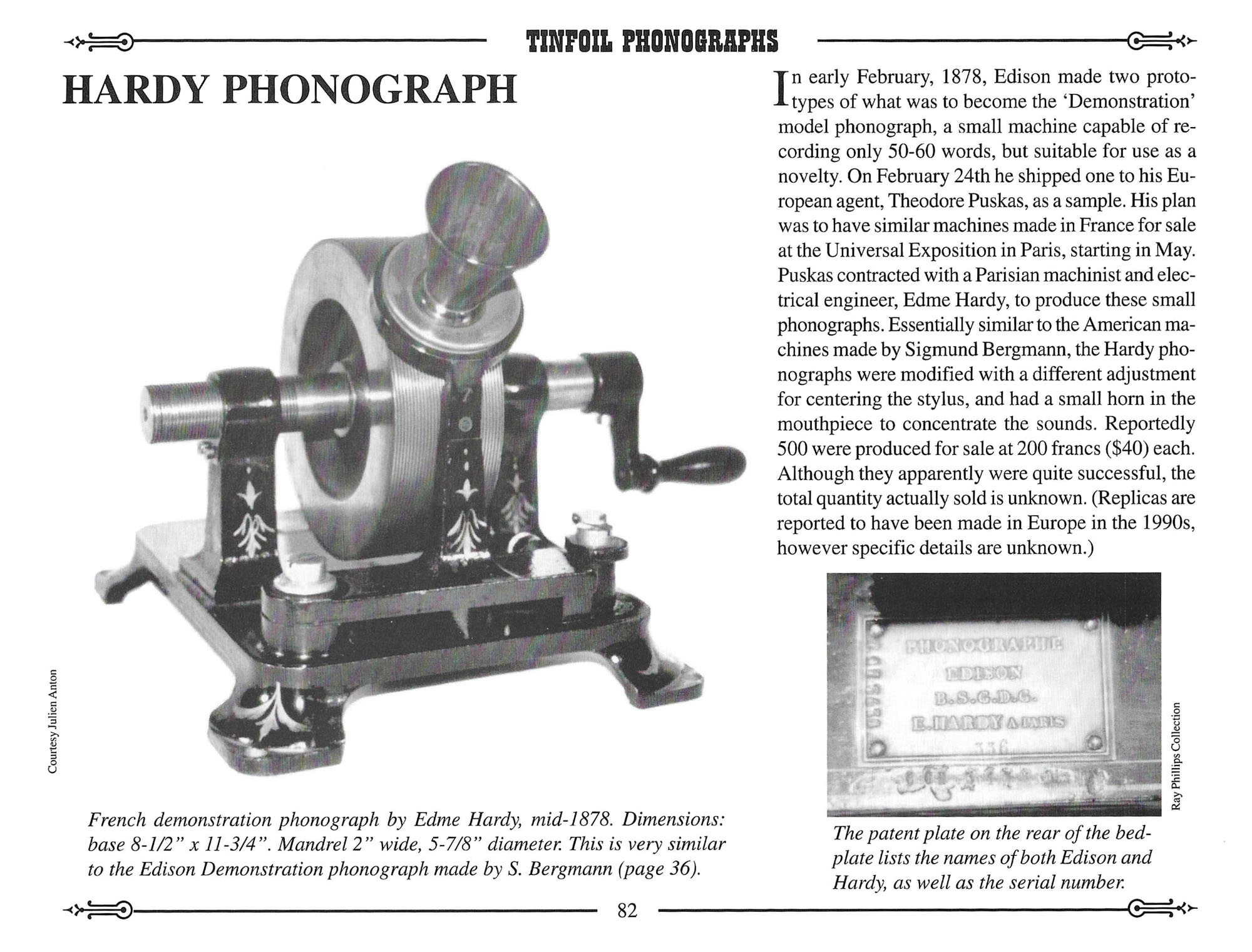
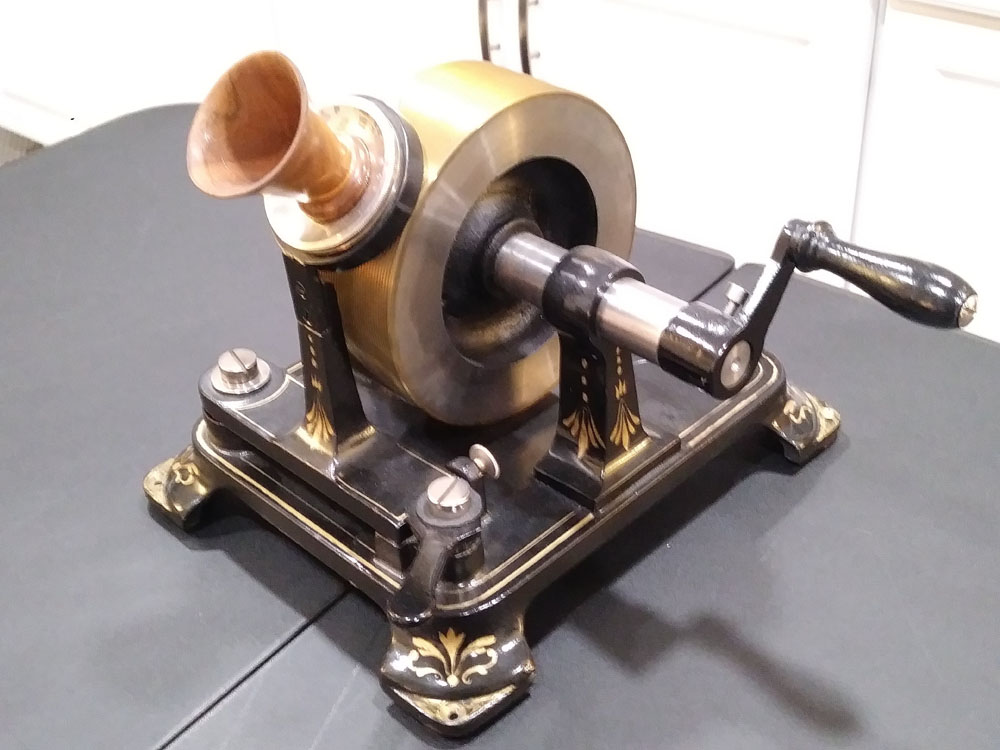
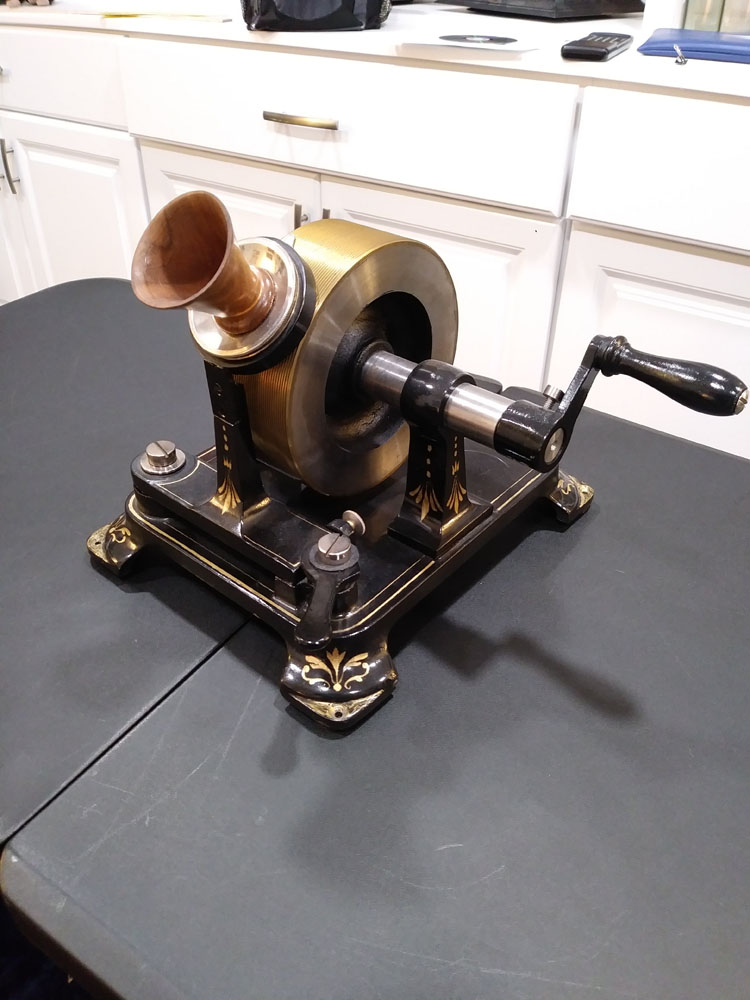
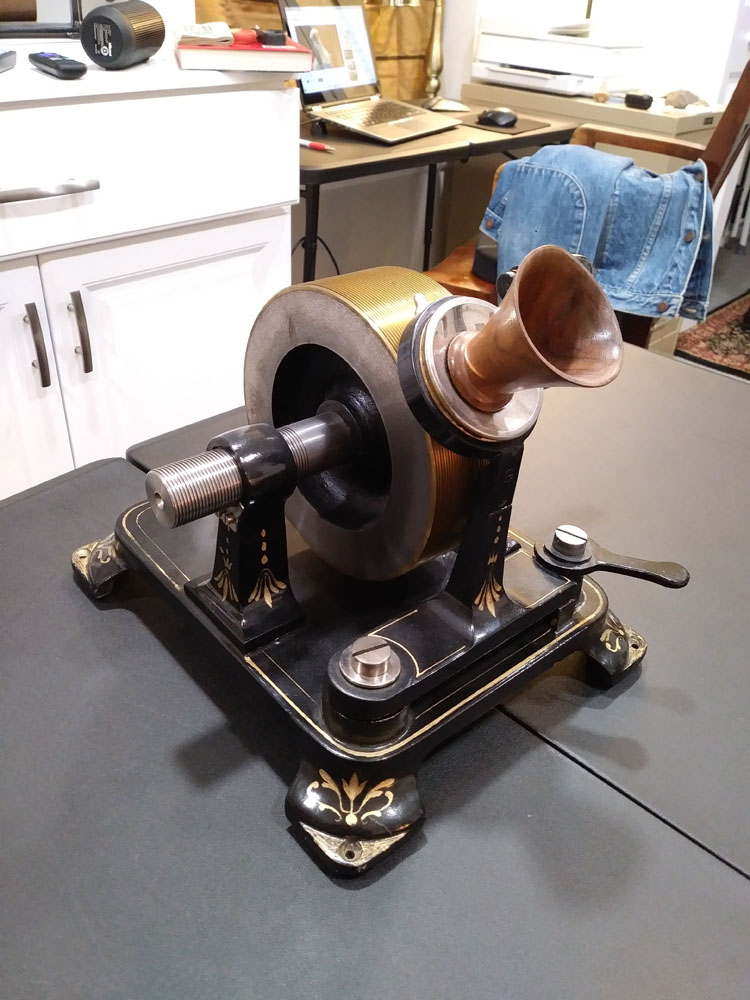
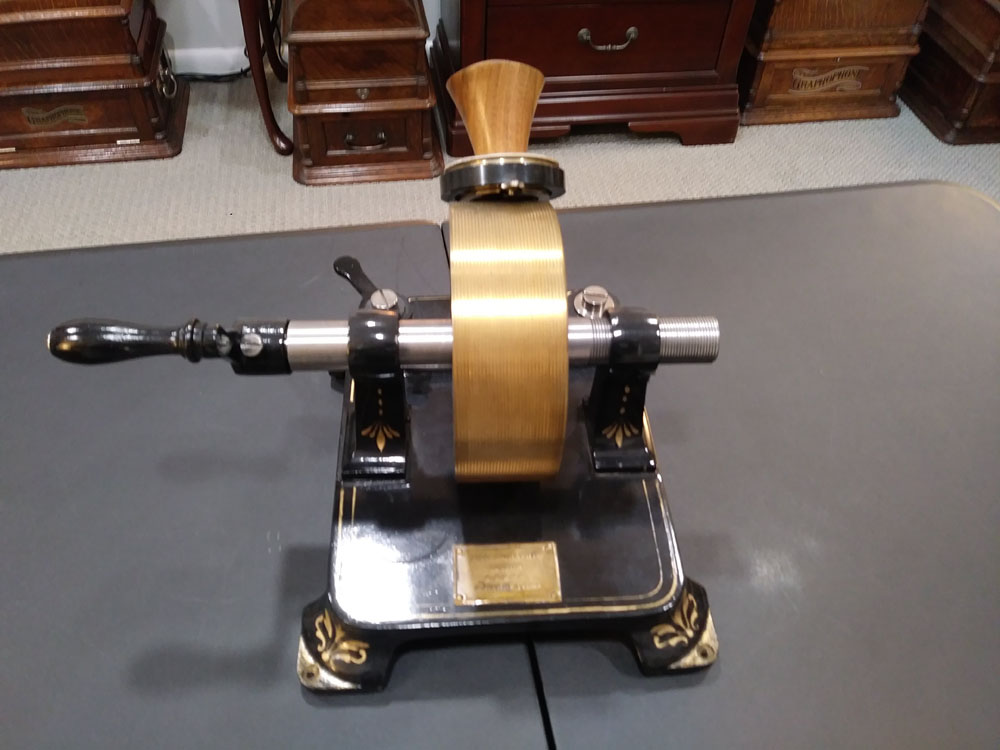
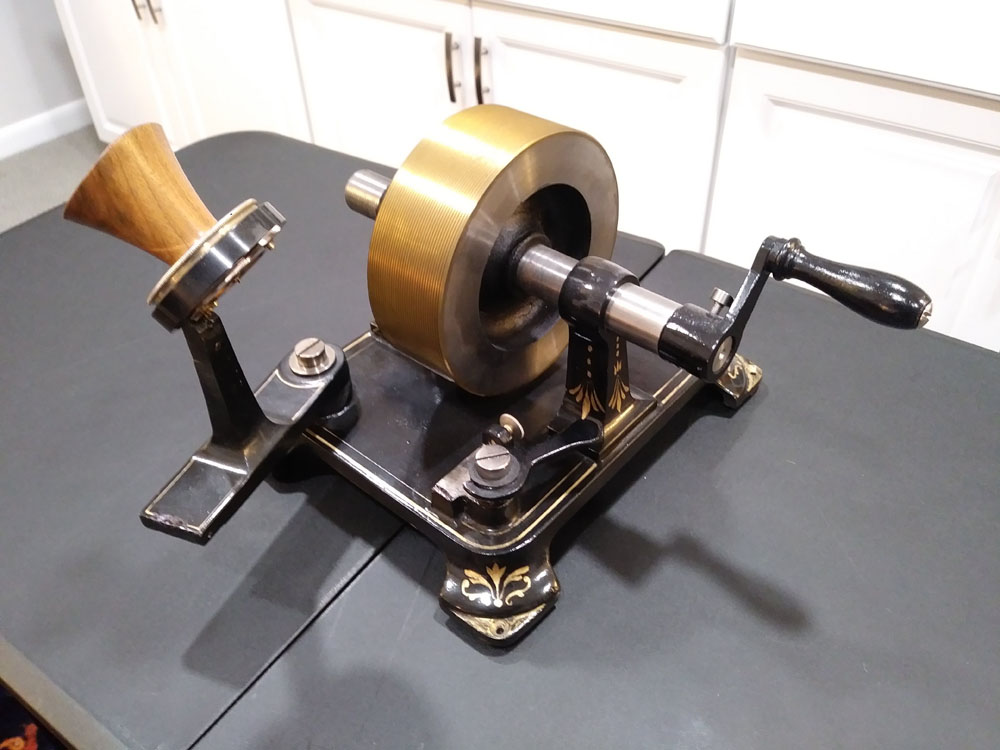
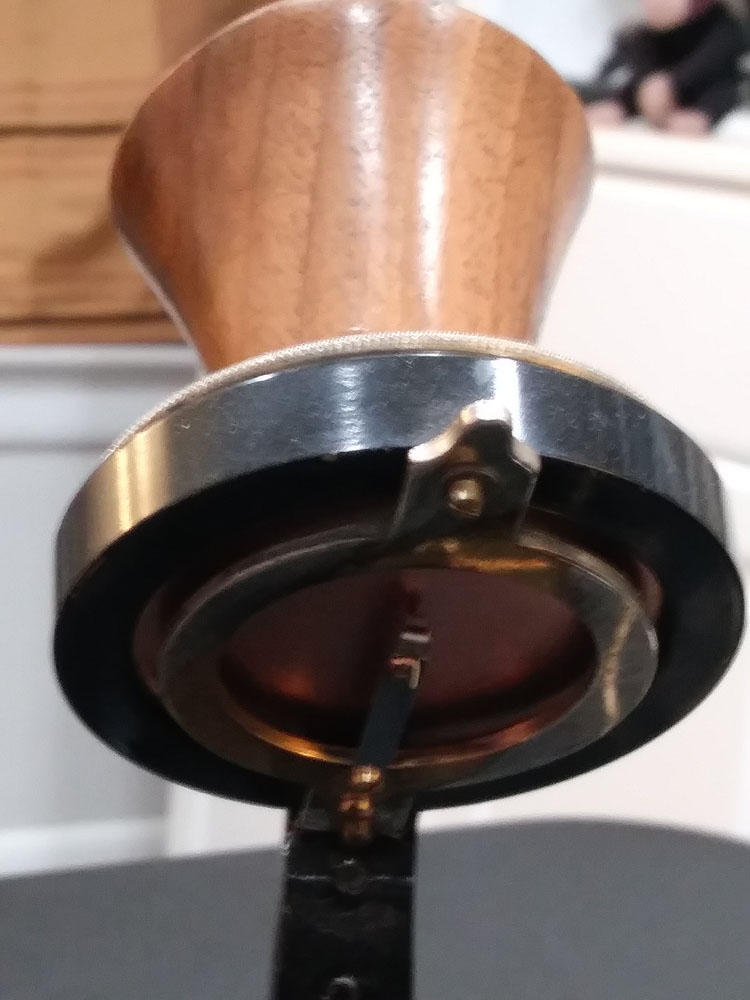
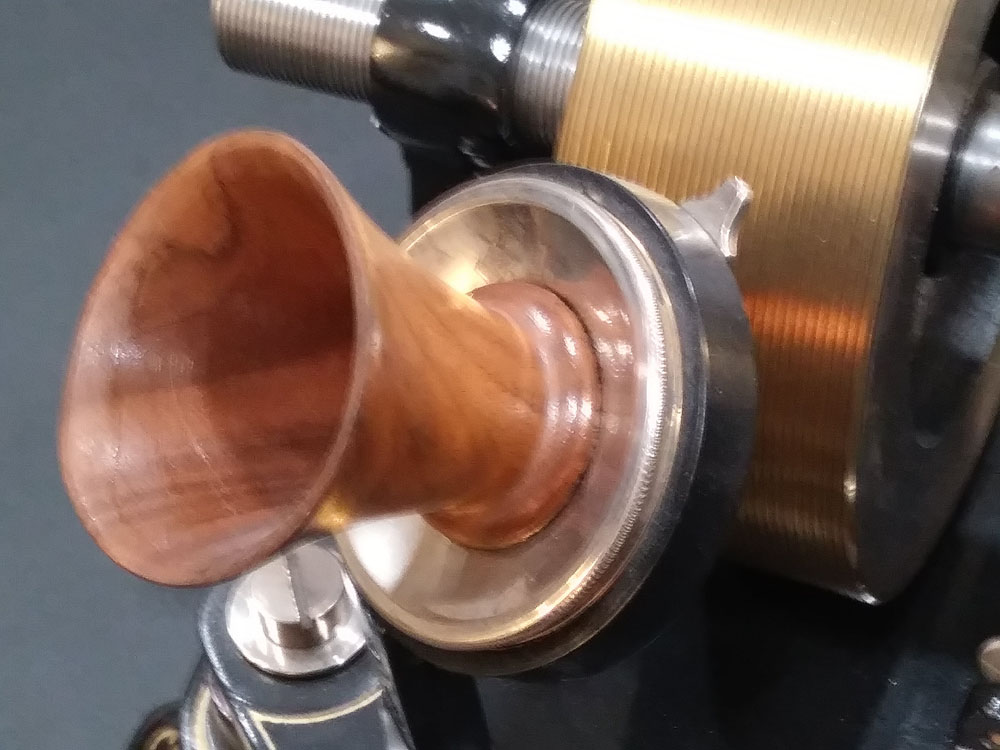
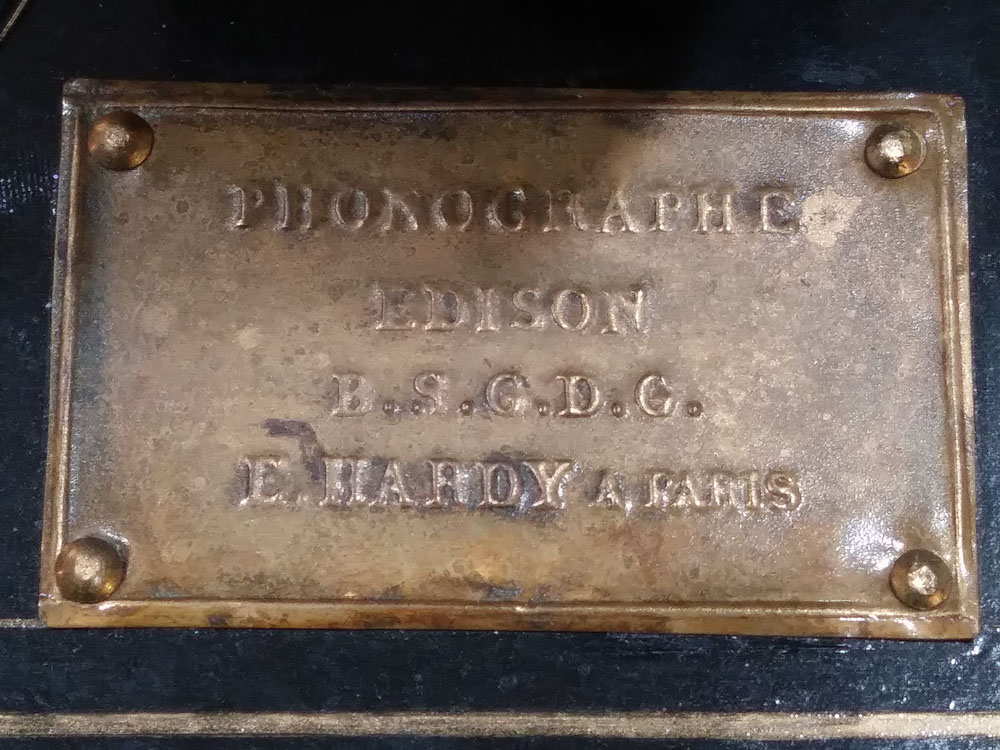
In a recent Turning the Corner column, writer and woodturner Temple Blackwood detailed the turning process for creating a mouthpiece for a Hardy Tinfoil Phonograph. The process Temple used for turning the replicas was interesting enough to stand alone as its own article, but we had even more questions when we were done about the machinery the mouthpiece was used on. See below for more information about the Hardy Tinfoil Phonograph, sent in by Temple’s client, Lee from Virginia. Thank you Lee for the follow up!
“The Tinfoil Phonograph that I have is a “Hardy”. I have included below a page from “Tinfoil Phonographs” by Rene Rondeau who is the world expert on this subject. The example I have is a reproduction commissioned by the late Ray Phillips who was a big phonograph collector.
Click the image above to enlarge
You can find some interesting footage on YouTube of the Ray Phillips Hardy Tinfoil Phonograph (the one featured in the woodturning column). And I am including a few more photos below.
I also made a Tinfoil Phonograph out of junk about eleven years ago, that you can also see on YouTube. I have learned a lot since making this crude device.”