Highland Staff

May 192015
 
You just thought I screamed when I saw the baby possum.
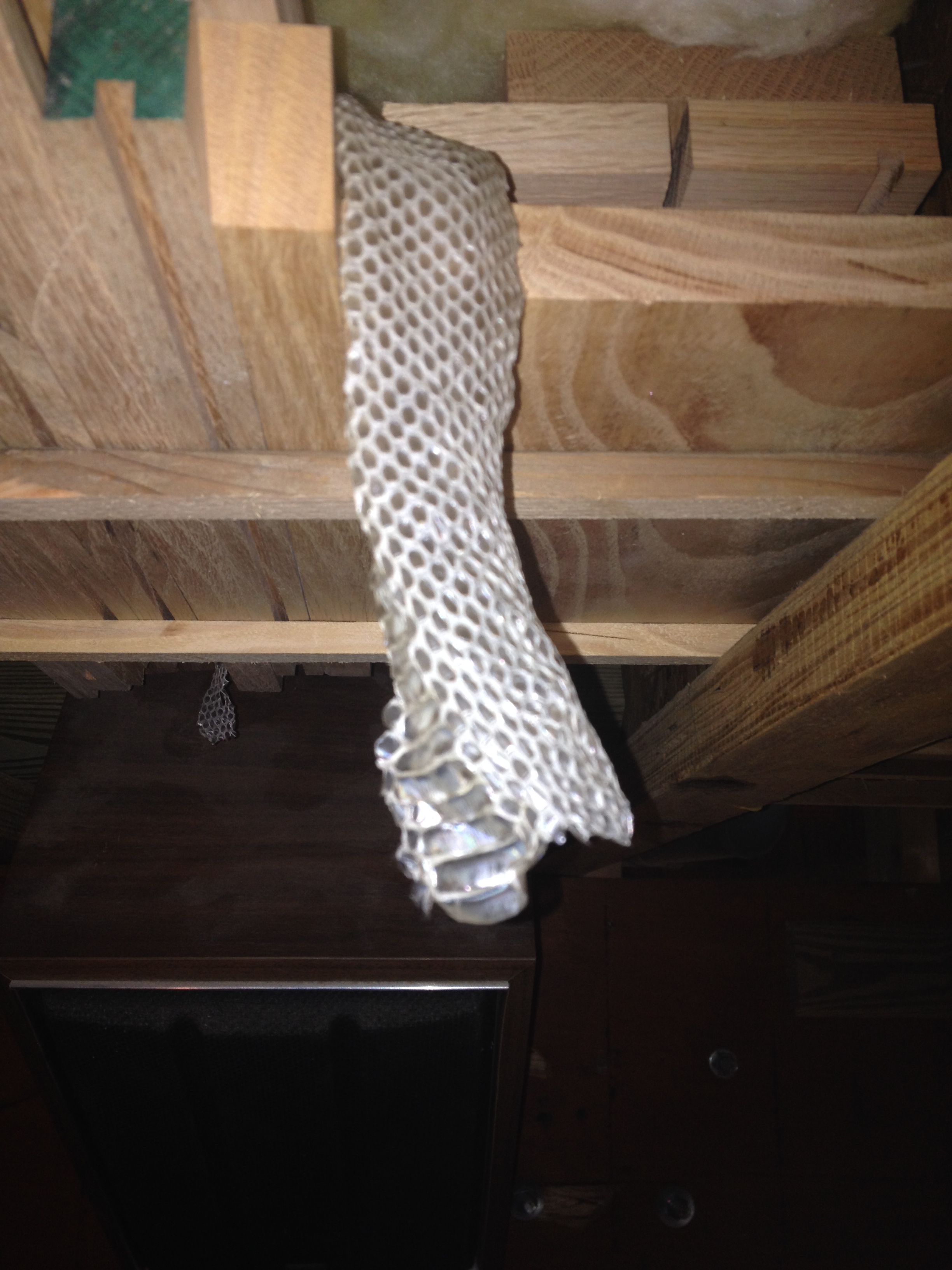
When I looked up and saw this snake skin in the un-likeliest of places, I immediately froze.
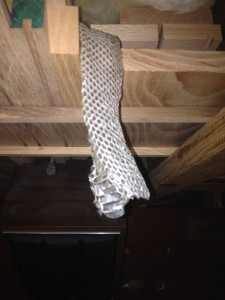
I couldn’t believe my eyes. Our practice doesn’t include exotic animals, but I knew enough about snakes to know this one wasn’t alive. Still, I was instantly terrified. I knew, at some point, its live owner had been here and could still be lurking. Maybe even right here!

I couldn’t believe my eyes. Our practice doesn’t include exotic animals, but I knew enough about snakes to know this one wasn’t alive. Still, I was instantly terrified. I knew, at some point, its live owner had been here and could still be lurking. Maybe even right here!

Standing on a ladder, it reminded me of when I worked in microwave communications electronics.  Our teachers always told us, “It’s not the big voltage that will kill you.  You’ll be careful around it.  But the little voltage, if you let your guard down, will startle you, make you jump, and you’ll inadvertently throw yourself into a high voltage circuit.”  I could just picture myself seeing a real, live snake and falling off the ladder in response:
“What killed ol’ Jim?” asked one mourner.
“A nonpoisonous snake.”
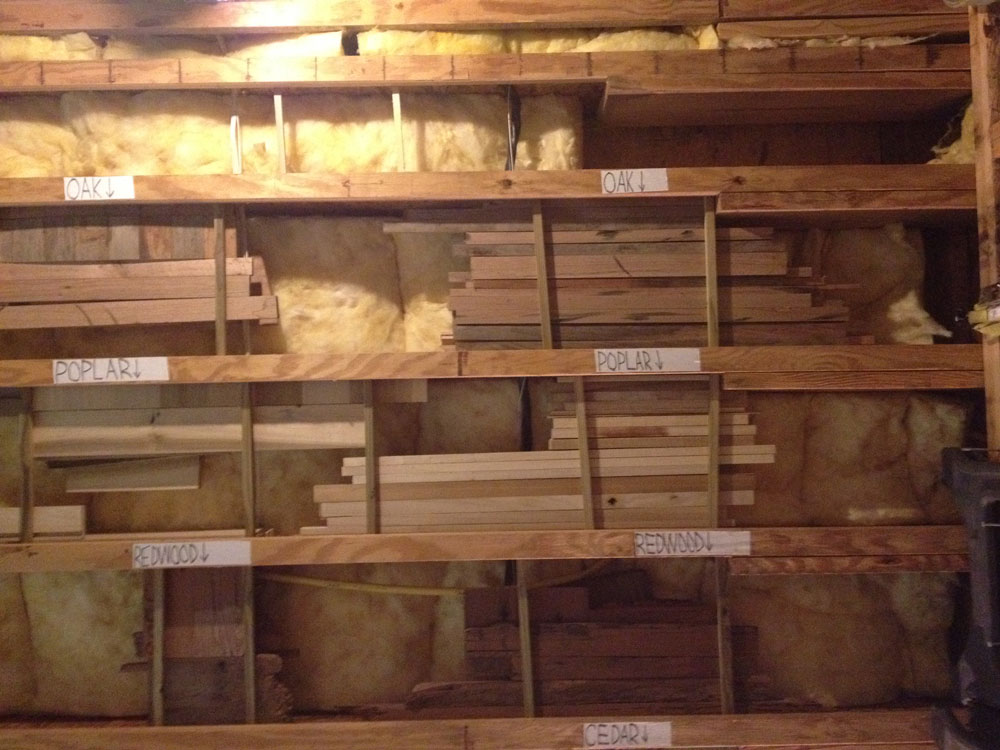
In the March, 2015, issue of Wood News Online we published a tip designed to save you space while making the most of scraps of wood you want to save. The gist of the tip was to use the area between ceiling joists for storage.  By arranging materials appropriately, you can store anything from big-enough-to-fit to small-enough-to-sit-on-top-of-the-big-stuff.  Of course, there’s a practical limit to how small you really want those smallest pieces to be, yet, it’s ultimately a personal decision.
For example, I have some redwood that came from the sign that stood in front of our veterinary practice for 24 years, until Hurricane Katrina knocked it down.  I’ve made some projects out of that wood that are priceless to me.  Not everyone is sentimental, much less about wood, but I am, so I have saved some pretty small pieces of that redwood just in case I have some use for a tiny bit of it somewhere.
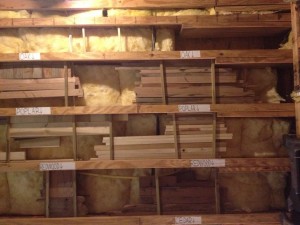
As you can see, some of these redwood pieces are really small, some are really rotten, but every scrap holds a memory, and stands a chance to be fitted into a project someday.
As you can see, some of these redwood pieces are really small, some are really rotten, but every scrap holds a memory, and stands a chance to be fitted into a project someday.

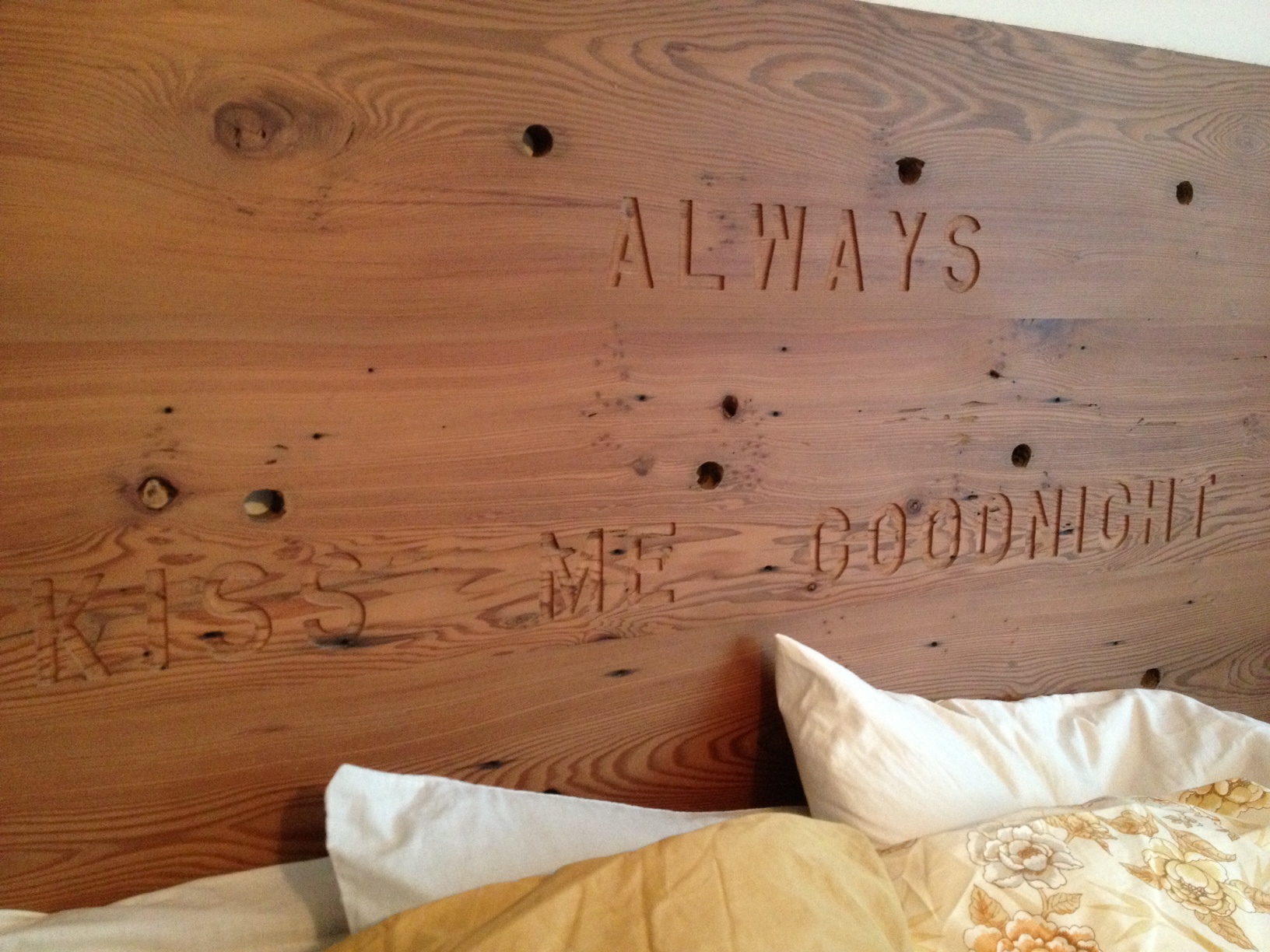
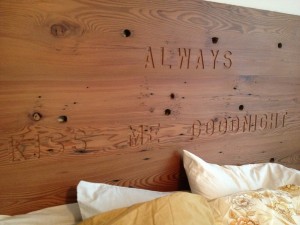
The 2x12 redwood boards that made the rails of our pre-Katrina Animal General Hospital sign were planed, sanded and glued up to make this simple, rustic headboard. The engraved phrase came from a Delta Airlines SkyMall catalogue advertising a needlework project. I wrote down the expression while on a flight to see our grandchildren, and kept it tacked to the shop wall for years before finding the right place to use it.
The 2×12 redwood boards that made the rails of our pre-Katrina Animal General Hospital sign were planed, sanded and glued up to make this simple, rustic headboard. The engraved phrase came from a Delta Airlines SkyMall catalogue advertising a needlework project. I wrote down the expression while on a flight to see our grandchildren, and kept it tacked to the shop wall for years before finding the right place to use it.

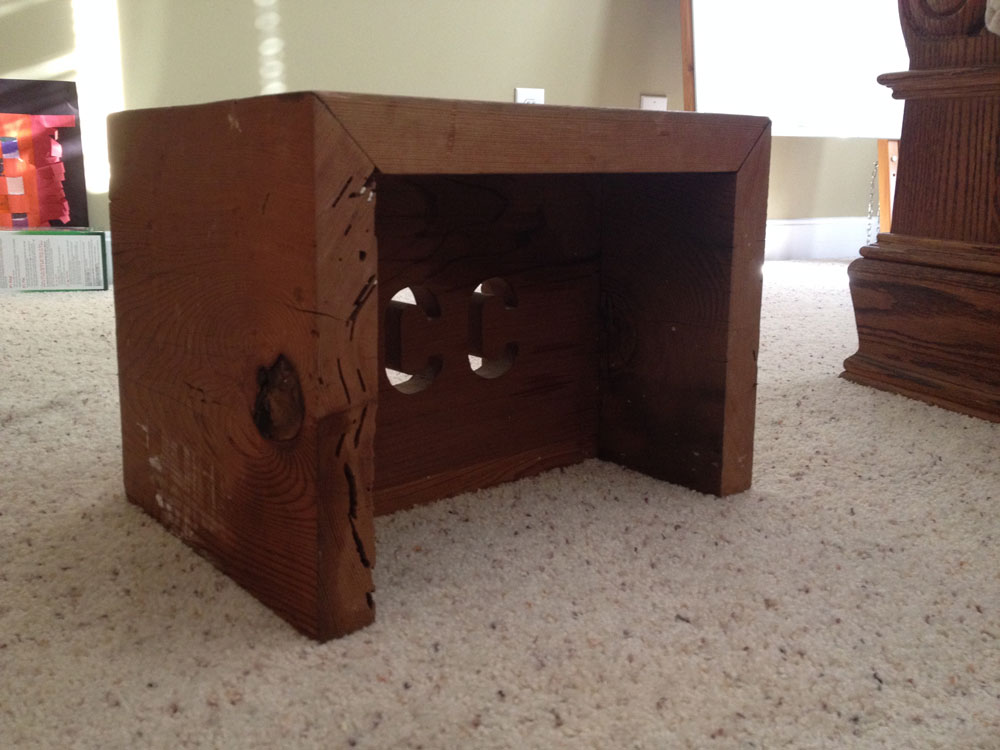
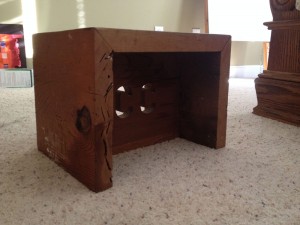
My Grandson Charlie’s stool was made from cutoffs of the same 2x12 redwood.

My Grandson Charlie’s stool was made from cutoffs of the same 2×12 redwood.
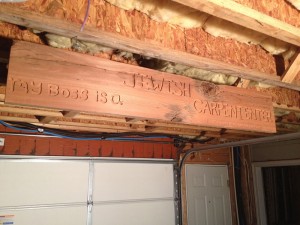
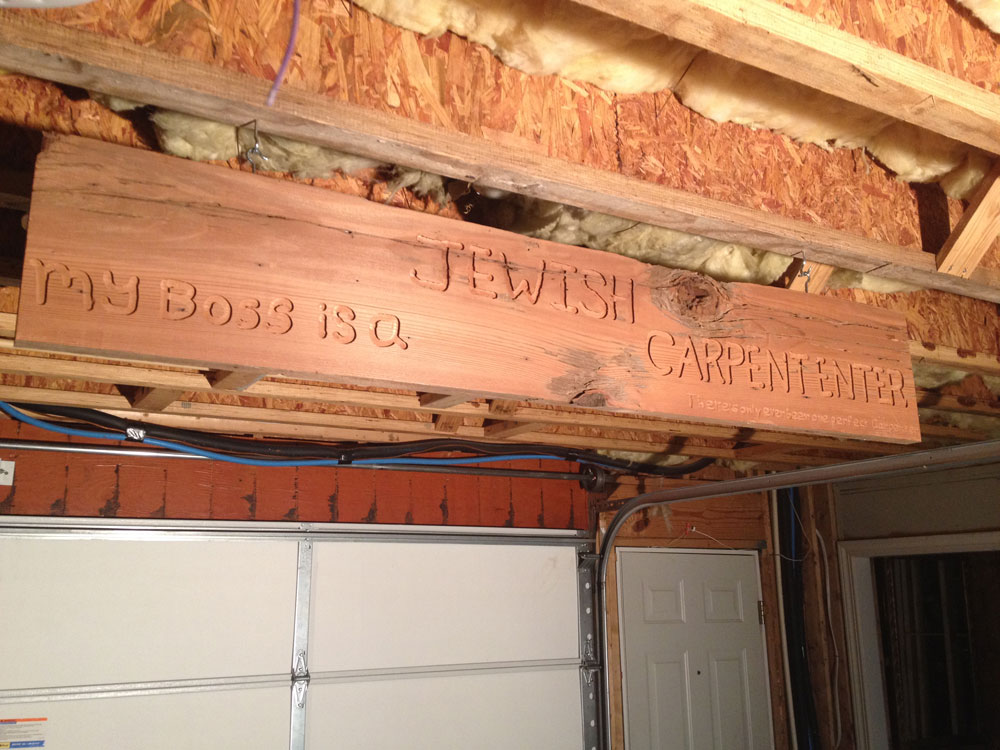
This sign hangs in the automobile-parking area of our garage, which shares space with the woodworking area. There’s a story that goes with the inscription underneath, but that’s another post.

This sign hangs in the automobile-parking area of our garage, which shares space with the woodworking area. There’s a story that goes with the inscription underneath, but that’s for another post.

Likewise, I have some oak tongue-in-groove flooring with an interesting backstory.  My wife bought some really cheap bedside tables from the “real wood” store, but she needed more top surface on hers.  The best I could come up with for short-term use was an old lauan panel I’d attached to some 2x4s with a picture-frame molding around it.  It was so ugly that Brenda covered it with a red cloth, awaiting a suitable and appropriate top for her “real wood” chest.
That task dwelt on my honey-do list for a long time until, one day, I got the idea to go to Lowe’s for some oak flooring.  I could just glue and nail it to a substrate, attach the top, and with a little sanding and some finish Brenda’s new table surface would be ready to reveal itself to the public.
At Lowe’s, I looked around, but I couldn’t find any oak flooring.  Third in line for the attention of the Lowe’s employee on duty in the hardwoods department, I waited, only to hear him say, “Oh, we don’t carry that.” “Oh, well,” I thought, I would just have to find out who does.  Then, I heard a sweet female voice behind me, saying: “Excuse me, sir.  I don’t mean to butt into your business, but I heard you asking about oak flooring.  I have some.  Does it have to be new?  My husband and I salvaged it from one Katrina-flooded house to use in another Katrina-flooded house.  If you would like to come by and look at it, just call me.  Here’s my address and my cell phone number.”
Now, this lady didn’t know me from Adam, yet she stood there with her little six-year-old daughter beside her, giving me her address and phone number, like it was 1946.  There is still a little trust and innocence in the world!
We met, she showed me the old floorboards, and I knew I had found a treasure trove.  “Take whatever you’d like, but we still need about this much,” she said, motioning to a small portion of the stack. Well, “stack” might be a little generous.  “Pick Up Sticks,” the child’s game, comes to mind when trying to describe the way the boards had been haphazardly thrown into the old garage.
I did some selecting as I went.  Some were curved along their length.  Many were twisted, and I do mean wickedly twisted.  Some were cupped.  Because these two homes were so close to the Bay St. Louis, MS, beach, they were probably underwater for days after Katrina’s winds were gone. Even the best pieces would require a good bit of milling. But, OH!  The character!  Worm holes, termite holes, nail holes!
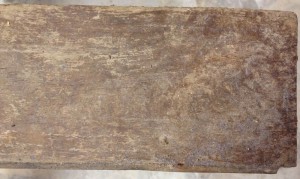
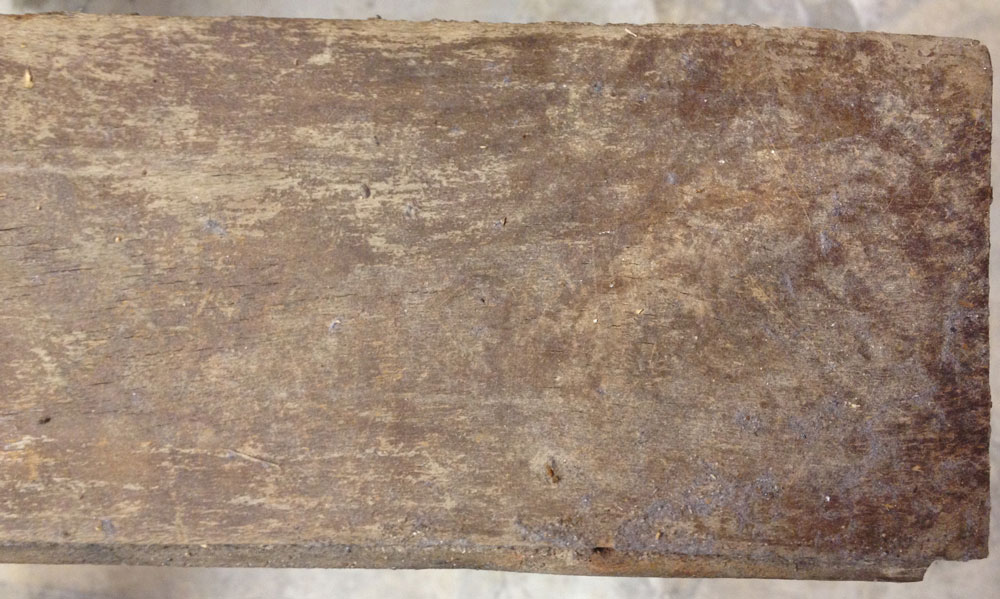
This is what the oak flooring looked like before cleanup and milling.

This is what the oak flooring looked like before cleanup and milling.

Trying not to be greedy, I took about the square footage I thought I’d need for a big top for Brenda’s side of the bed and a small top for my side, plus about 50% for waste, plus about 15% for miscalculation. There were still a lot of boards left.
I could hardly contain my eagerness so I began to unload, sort, and stack as soon as I arrived home.  Decades of grit filled the grooves and clung to the tongues, so each piece needed to be steel-bristle-brushed by hand before machining.
As soon as the first board came from the planer, I knew I had some epic wood.
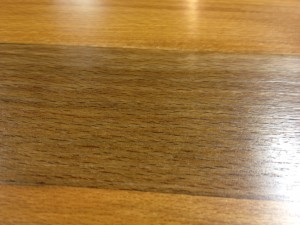
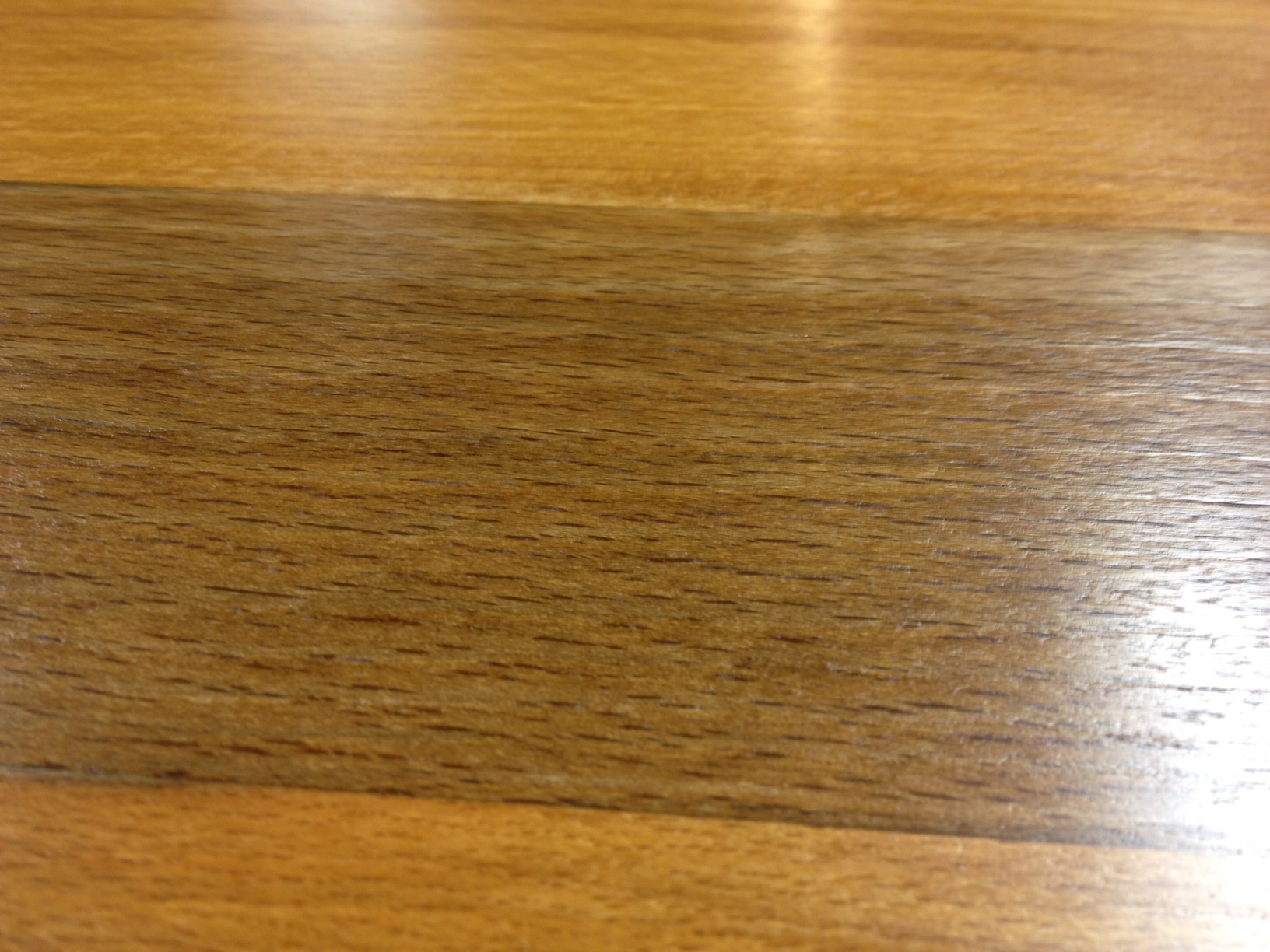
And, this is what those ugly boards turned into!

And, this is what those ugly boards turned into!

And a problem….
“How can I possibly put boards this beautiful atop a 1/4-inch-thick ‘real wood’ table?” I asked myself.  The obvious answer was, “I can’t, it would be an insult.”
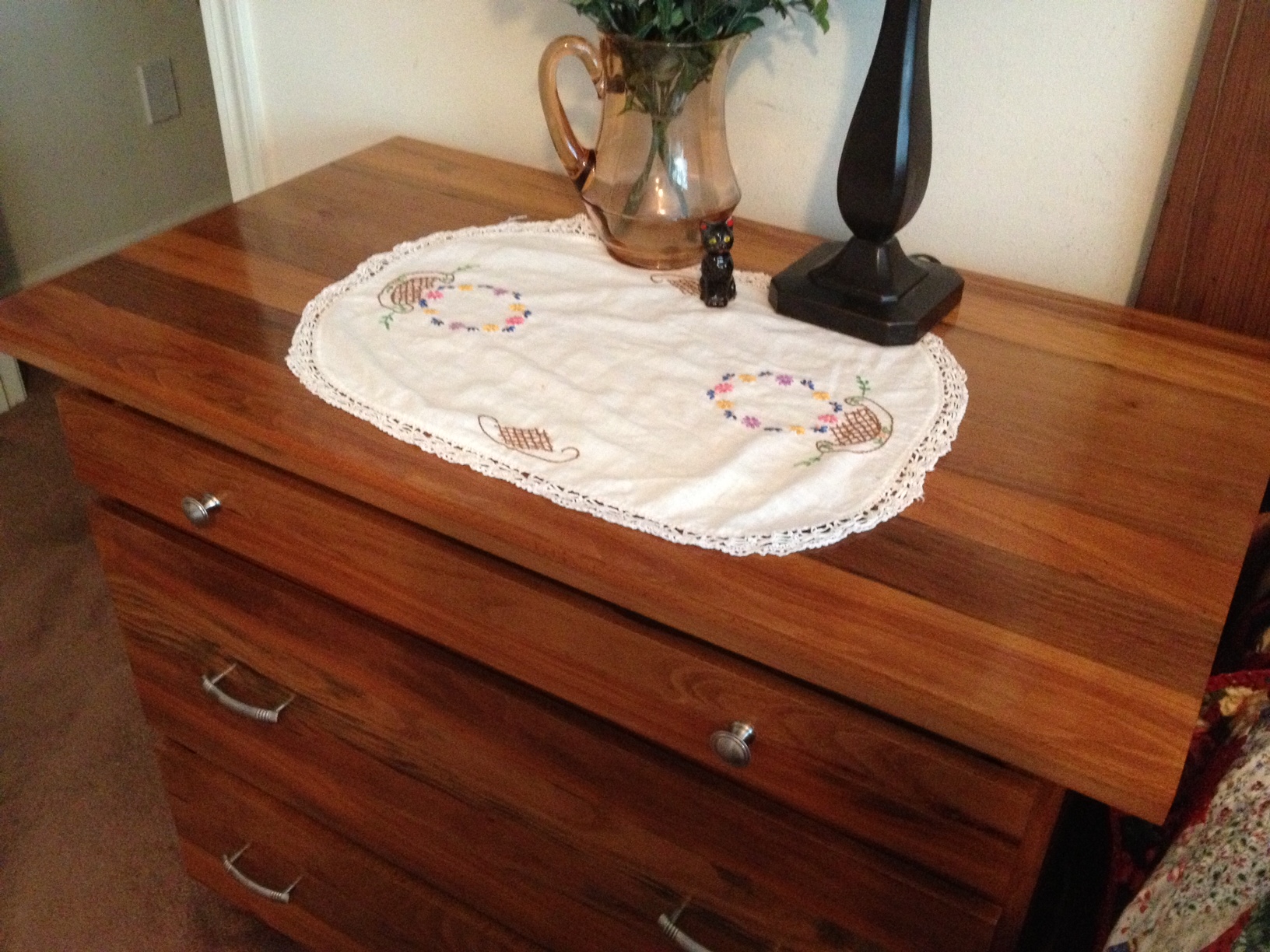
Thus were born the oak bedside tables in the accompanying pictures. It took several forevers to cull enough boards for the top to make it reasonably flat and produce acceptable joints.  Grain-matching was out of the question, so I just tried to keep adjacent boards from clashing.
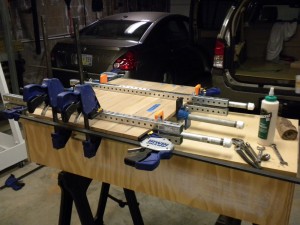
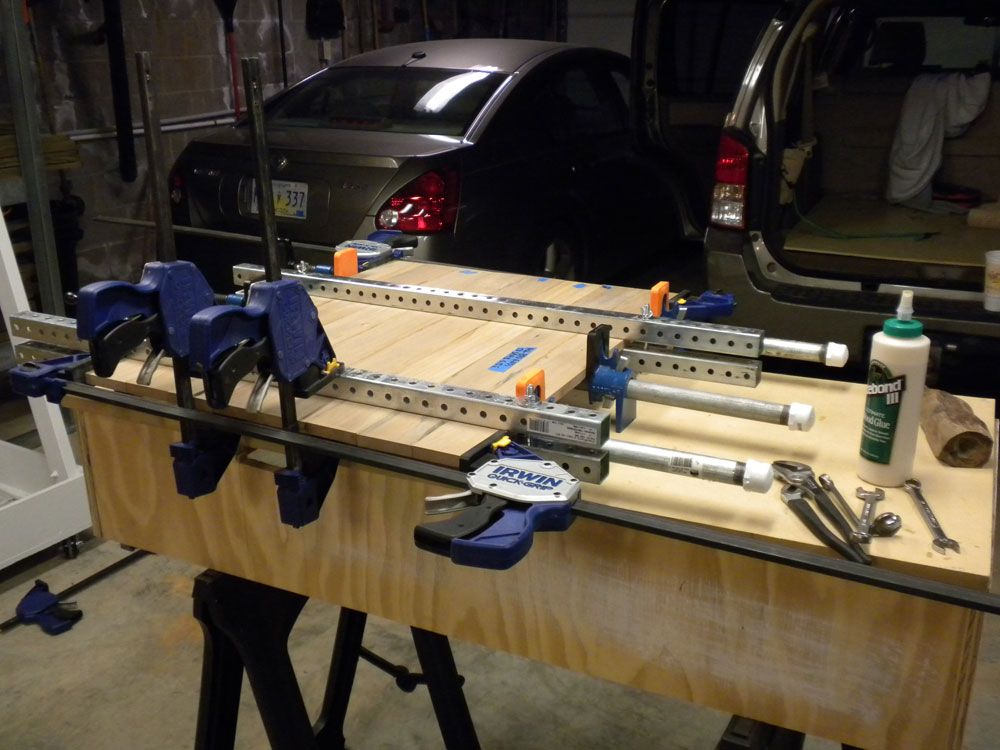
As you can see from the abundance of clamps, keeping this panel flat was a challenge. Stiff, square steel cauls helped. A glue with more open time would have helped, too.

As you can see from the abundance of clamps, keeping this panel flat was a challenge. Stiff, square steel cauls helped. A glue with more open time would have helped too.

As nice as it would have been to have solid wood for the sides, there just wasn’t enough material to make panels, but we are fortunate to have a good hardwood plywood dealer close by.  I didn’t think it would be possible to stain to match, so I just tried to coordinate.
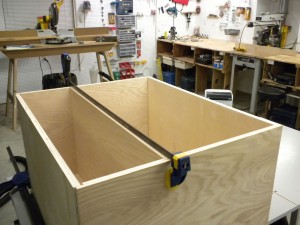
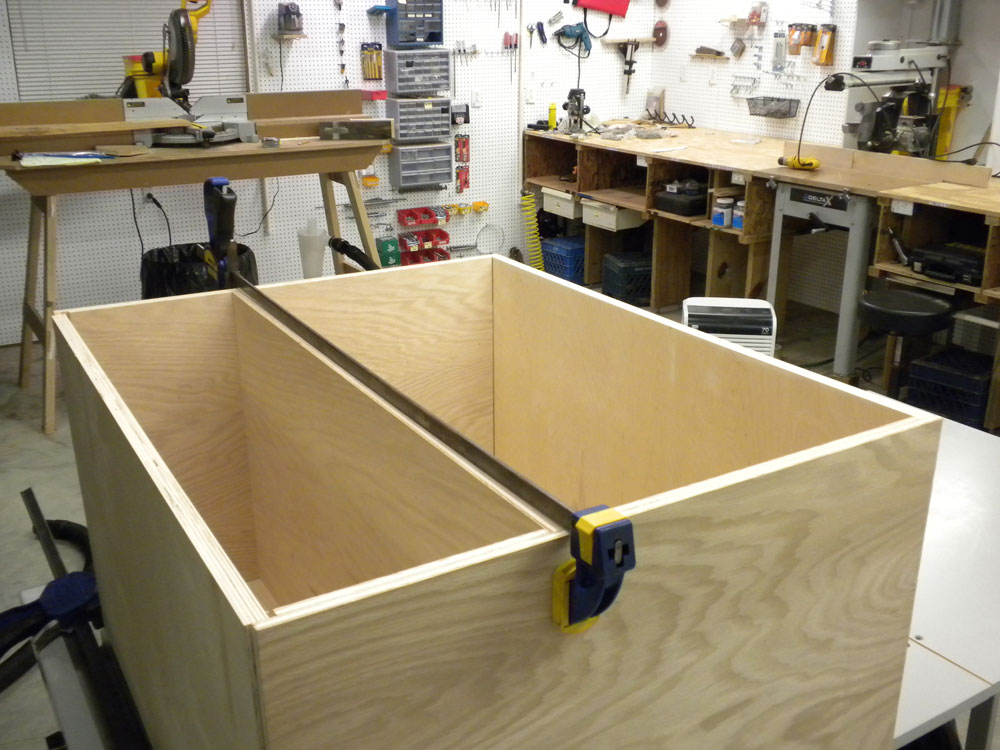
When home center plywood just won’t do, it’s great to have a source for really good hardwood plywood. No voids, no patches, no blemishes.

When home center plywood just won’t do, it’s great to have a source for really good hardwood plywood. No voids, no patches, no blemishes.

To make the top appear thicker I glued up a 10-inch-wide panel from cutoffs, then cut four strips and glued them along each edge, with a full-width board across the front.
Alan Noel taught me his wool-waxing technique via email.  CLICK HERE to read Alan’s column on wool-waxing.  The technique is as simple as applying wax with 4/0 steel wool and yields a surface with unbelievable smoothness.
The project gets Brenda’s seal of approval.  Like me, she’s sentimental, and using wood with a story for these two tables makes them all the more valuable.
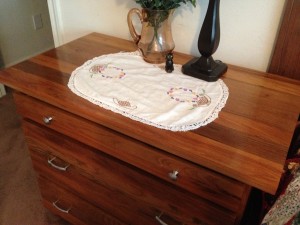
Brenda was pleased with the final result. A smaller, matching unit is on my side of the bed.

Brenda was pleased with the final result. A smaller, matching unit is on my side of the bed.

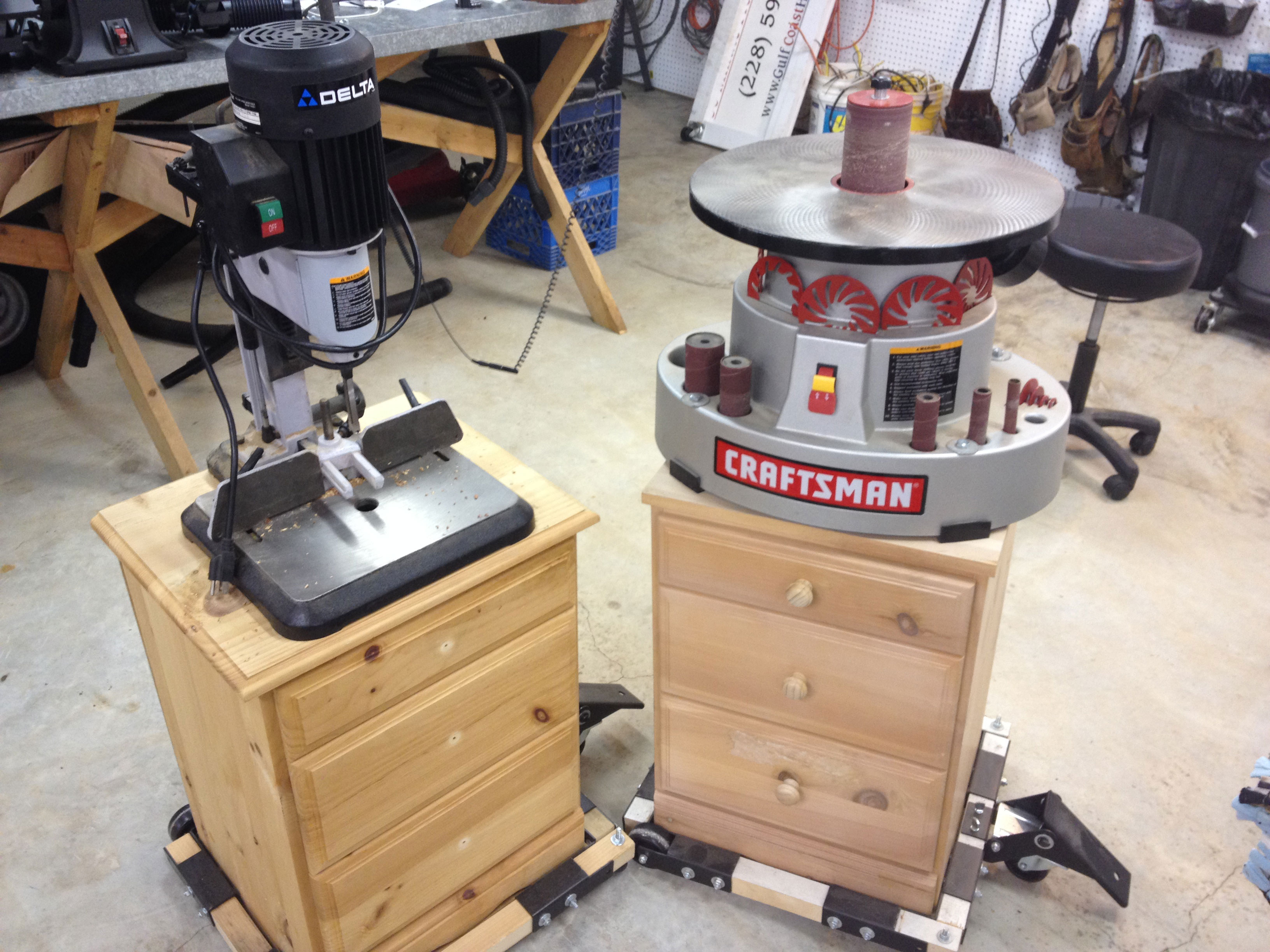
Oh, and the original “real wood” bedside tables?  They became rolling stands for our oscillating spindle sander and stationary mortising machine.  With drawers to hold accessories, they do a pretty good job.  I have mobile bases on every tool in the shop.
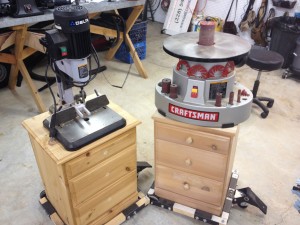
Not calling for heavy-duty function, these “real-wood” cabinets are up to the job of holding the oscillating spindle sander and stationary mortising machine.

Not calling for heavy-duty function, these “real-wood” cabinets are up to the job of holding the oscillating spindle sander and stationary mortising machine.

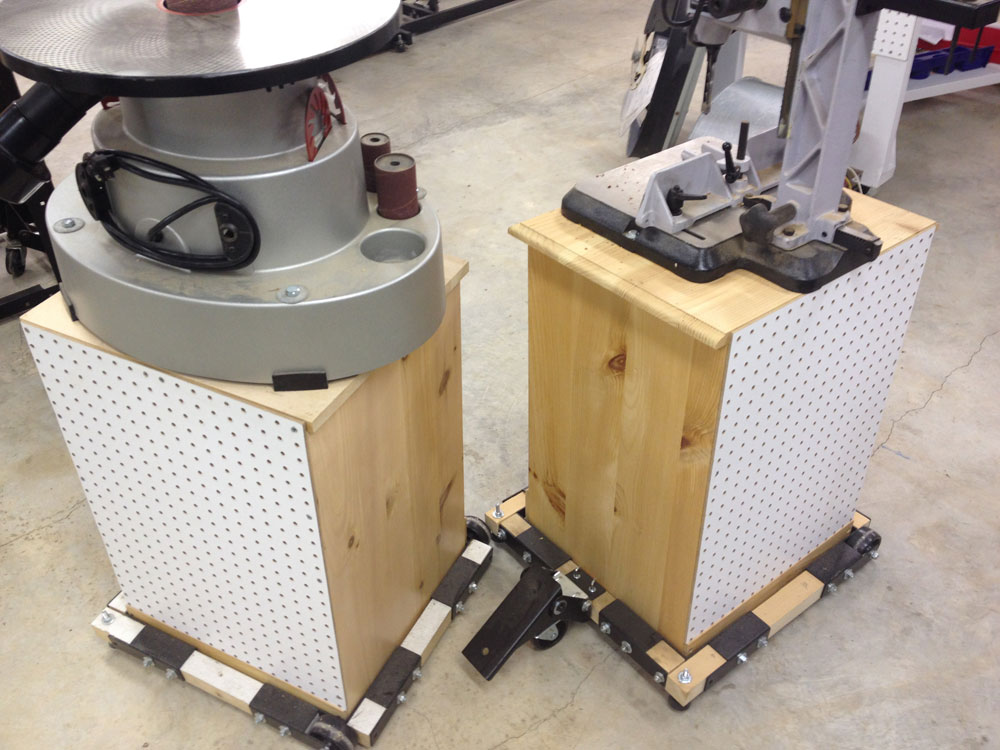
Thanks to the rigid portable bases that always fit because you determine the dimensions, they are very stable when in use, and just the right height.
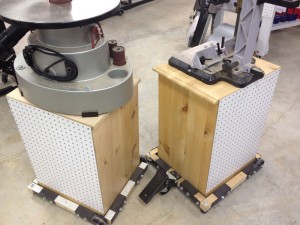
As the backs of the units are several inches from the backs of the drawers, they just seemed to cry out for the space to be utilized for storage, so I attached some pegboard. I haven’t found a use for it yet, so I tell myself it stiffens the thin “real wood” carcass.

As the backs of the units are several inches from the backs of the drawers, they just seemed to cry out for the space to be utilized for storage, so I attached some pegboard. I haven’t found a use for it yet, so I tell myself it stiffens the thin “real wood” carcass.

And, the snake skin?  I had to use a pair of pliers to pull it down.  I couldn’t bring myself to touch it.  Trying to figure out how he got there with no ladder, I inquired of a colleague whose practice includes a lot of exotic animals.  From a closeup of the skin he said it was probably a rat snake; we have a lot of them around our house.  He also sent me a link to a video showing just what good climbers snakes can be.
 —
Jim Randolph is a veterinarian in Long Beach, Mississippi. His earlier careers as lawn mower, dairy farmer, automobile mechanic, microwave communications electronics instructor and journeyman carpenter all influence his approach to woodworking. His favorite projects are furniture built for his wife, Brenda, and for their children and grandchildren. His and Brenda’s home, nicknamed Sticks-In-The-Mud, is built on pilings (sticks) near the wetlands (mud) on a bayou off Jourdan River. His shop is in the lower level of their home. Questions and comments on woodworking may be written below in the comments section. Questions about pet care should be directed to his blog on pet care, www.MyPetsDoctor.com. We regret that, because of high volume, not all inquiries can be answered personally.
May 072015
 

wn117This month we’ve got a brand new issue of Wood News Online full of woodworking project ideas, woodworking tips, and more!

This month’s projects include:

Constructing a Quilt Storage Rack– Forrest Bonner created a Sara-Style Quilt Rack design in Sketchup and then used that design to build the actual rack for a friend of his.

Building Our First Shaker Blanket Chest– Brian “Ziggy” Liloia and his partner, April, wanted to build a “little” project together, which ended up being a big, beautiful shaker blanket chest. In this article, Brian goes through the design and building process of this chest and shares his first experience of cutting dovetails.

This month’s woodworking tips include:

The Down to Earth Woodworker– This month, Steve suggests the hand planes you should have in a basic collection, replaces his shop lights with new LED bulbs, equates his recent jig buying adventure to an “anti-gestalt experience”, and gives us an update on his 5S Shop Wall Cabinet project.

Tips from Sticks in the Mud– Jim shares a tip on how to keep your vehicle free of scratches when transporting project materials (i.e. wood), as well as a money-saving tip on reusing disposable gloves.

Ask the Staff– Ed answers a question on the best method to use in order to remove a burn mark from the finishing on a beautifully aged cedar chest.

Finishing– Alan has a tip on the best methods to use when using a roller to paint your living space.

Two-Minute Safety Tip– This month’s reader-contributed safety tip is from Chris Harpe who explains how the use of incandescent task lighting in your shop can help decrease the likelihood of getting injured during cutter/blade spin down.

This month’s tool reviews include:

Book Review– Norm Reid has a book review on David Charlesworth’s A Guide to Hand Tools and Methodsa book that shares Charlesworth’s personal choices when it comes to picking a set of hand tools for your shop.

Tool Review– Jeff Fleisher shares his review of the Easy Chuck by Easy Wood Tools, a great tool for turners that allows you to “spend more time turning and less time adjusting and messing around with jaw changes.”

Video Product Tour– Steve Johnson gives us a different perspective on the SawStop Tablesaw by comparing it to a “Gestalt Experience.”

Our reader-contributed Show Us columns include:

Show Us Your Shop– This month we go inside the 20’x22′ woodworking shop of Steve Lyde who has a garage workshop in Altus, OK.

Show Us Your Woodworking– Dan Andrews shares a variety of woodworking projects including two wooden chests he has made as wedding presents.

Show Us Your Woodcarving– Jeff Greenberg’s inspiration for his carving projects came from a series of carvings made in Bali that feature the interweaving of several elements.

We’ve also got several new products including the book, Virtuoso: The Tool Cabinet and Workbench of Henry O. Studley, which is an in-depth examination of Studley’s famous tool chest that held over 250 different woodworking tools.

All of this and more in Highland Woodworking’s May 2015 issue of Wood News Online!

May 052015
 

No Southern-fried Southern boy wants to be called a Yankee, but we share the characteristics of shrewdness and thrift.  Thus, each month we include a money-saving tip.  It’s OK if you call me “cheap.” 

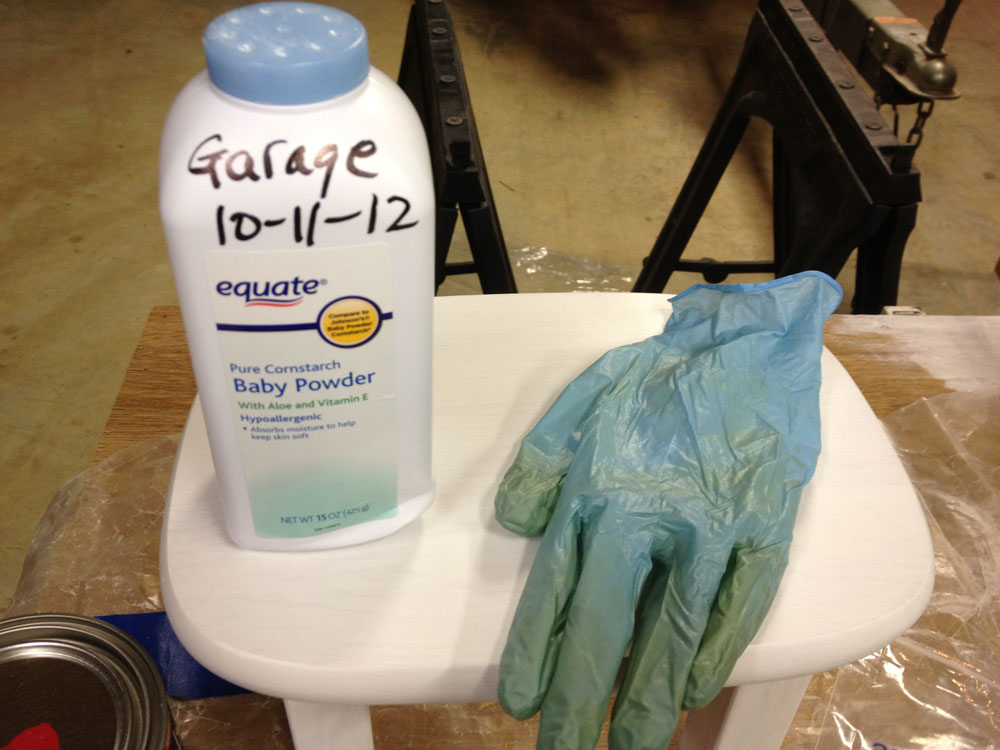
Here is an old glove trick straight from the surgical suite.  Back in the day, before latex, surgical gloves were resterilized and reused for subsequent surgeries.  To make regloving easier, talcum powder was added to the inside of the gloves.  Of course, eventually doctors noticed that powder caused a foreign-body reaction in their patients and became more careful, ensuring no powder got on the outside of the glove.   Surgical gloves are no longer “reusable,” but that doesn’t mean we can’t use that trick to make donning used gloves easier.

A little drying and some talcum powder and you can use those “disposable” gloves over and over. Just be careful not to mix dissimilar materials, like paint remover and finish.

A little drying and some talcum powder and you can use those “disposable” gloves over and over. Just be careful not to mix dissimilar materials, like paint remover and finish.

Purchase your shop its own bottle of talcum powder.  Using your wife’s powder will only make your life miserable.  Over time you’ll learn how little powder you can get by with and still get the gloves on easily.  Like those early surgeons, be careful not to get talcum on the outside of the glove where it might find its way into your finish.  The easiest technique is to put a pair on inside-out, apply the powder to the palm of the right glove and rub the back of the left, then alternate.  Pull both gloves off right-side-out and they are ready for the next use.


Jim Randolph is a veterinarian in Long Beach, Mississippi. His earlier careers as lawn mower, dairy farmer, automobile mechanic, microwave communications electronics instructor and journeyman carpenter all influence his approach to woodworking. His favorite projects are furniture built for his wife, Brenda, and for their children and grandchildren. His and Brenda’s home, nicknamed Sticks-In-The-Mud, is built on pilings (sticks) near the wetlands (mud) on a bayou off Jourdan River. His shop is in the lower level of their home. Questions and comments on woodworking may be written below in the comments section. Questions about pet care should be directed to his blog on pet care, www.MyPetsDoctor.com. We regret that, because of high volume, not all inquiries can be answered personally.

May 042015
 

Not everyone has a pickup truck.  Those who do will, sooner or later, pay the price of “temporary friends.”  That is, someone you barely know will call you up and say, “Hi, Joe, this is Fred, you know, I met you seven years ago at Susan’s party.  Susan?  Yeah, Susan.  Your second ex-wife’s girlfriend’s friend.  Well, anyway, you’ve got a pickup truck, and  my wife picked out a sofa that’s incredibly priced but the store charges $75 for deliveries, and…”

That’s just one reason I don’t have a pickup truck.

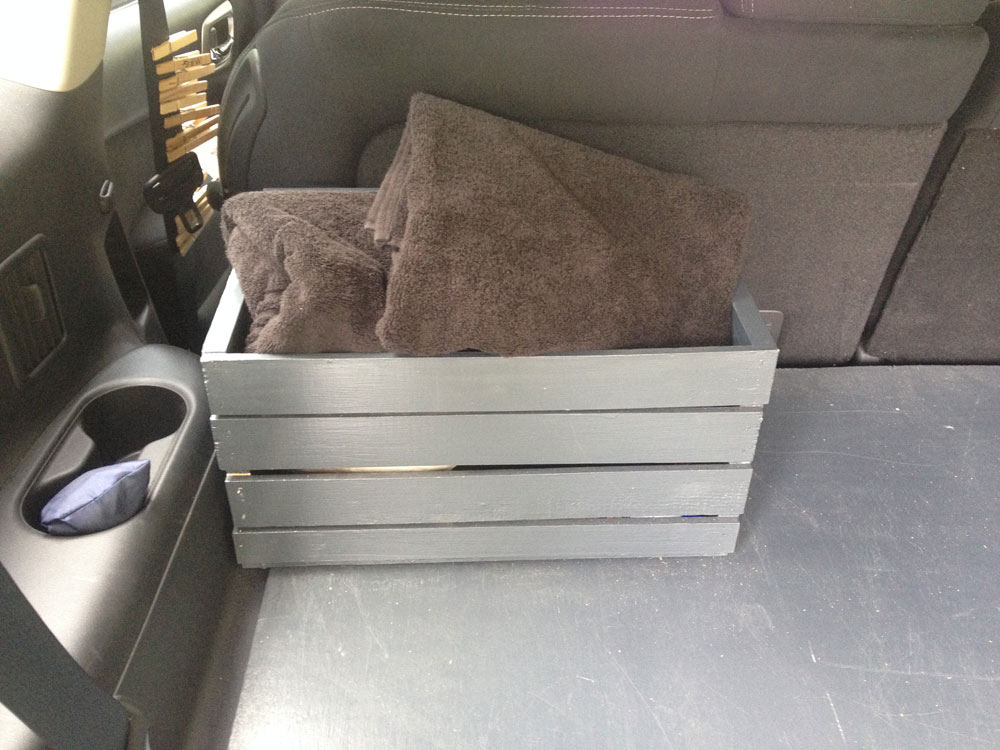
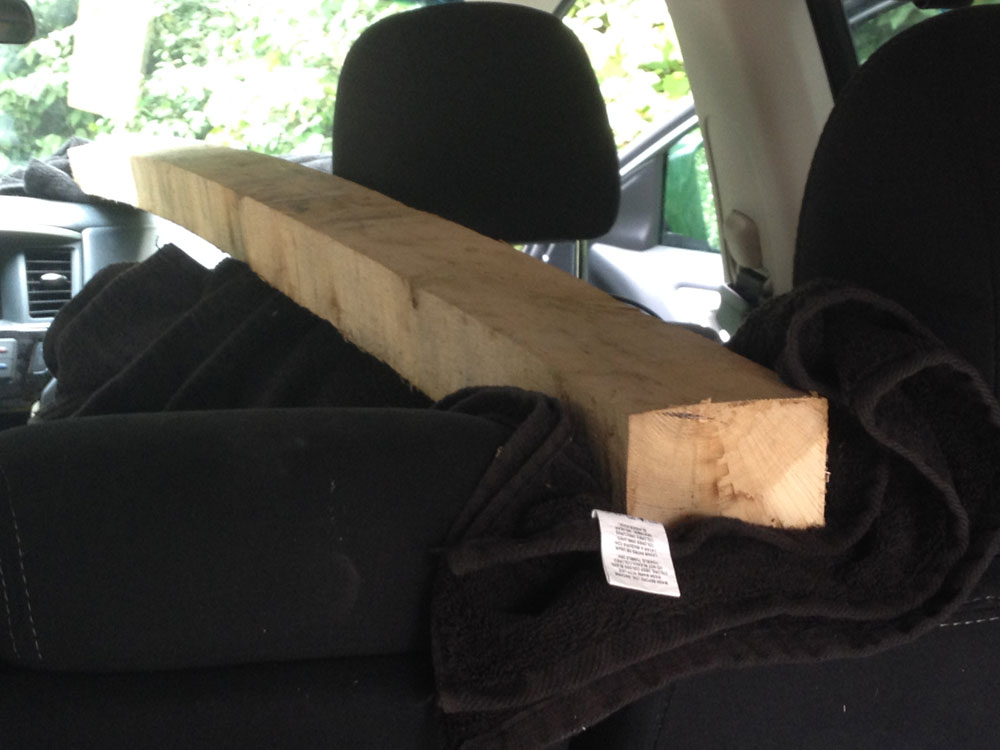
Still, those of us without trucks often have to carry something long or bulky.  And that item is likely to have to rest on your dashboard, upholstery or both.  For that reason I carry three bath towels in my van.

These are nice, thick towels to provide plenty of cushioning protection. When I need to carry a long board in my car I don’t want the dash scratched or treated-pine juice soaking into the upholstery. At the discount store they are only a few dollars each, but provide invaluable protection.

These are nice, thick towels to provide plenty of cushioning protection. When I need to carry a long board in my car I don’t want the dash scratched or treated-pine juice soaking into the upholstery. At the discount store they are only a few dollars each, but provide invaluable protection.

The cheapest bath towel at the dollar store works just fine.  Tuck them into out-of-the-way spaces like the spare tire well.

For my car, three towels are sufficient: dash, front seat, rear seat.

For my car, three towels are sufficient: dash, front seat, rear seat.

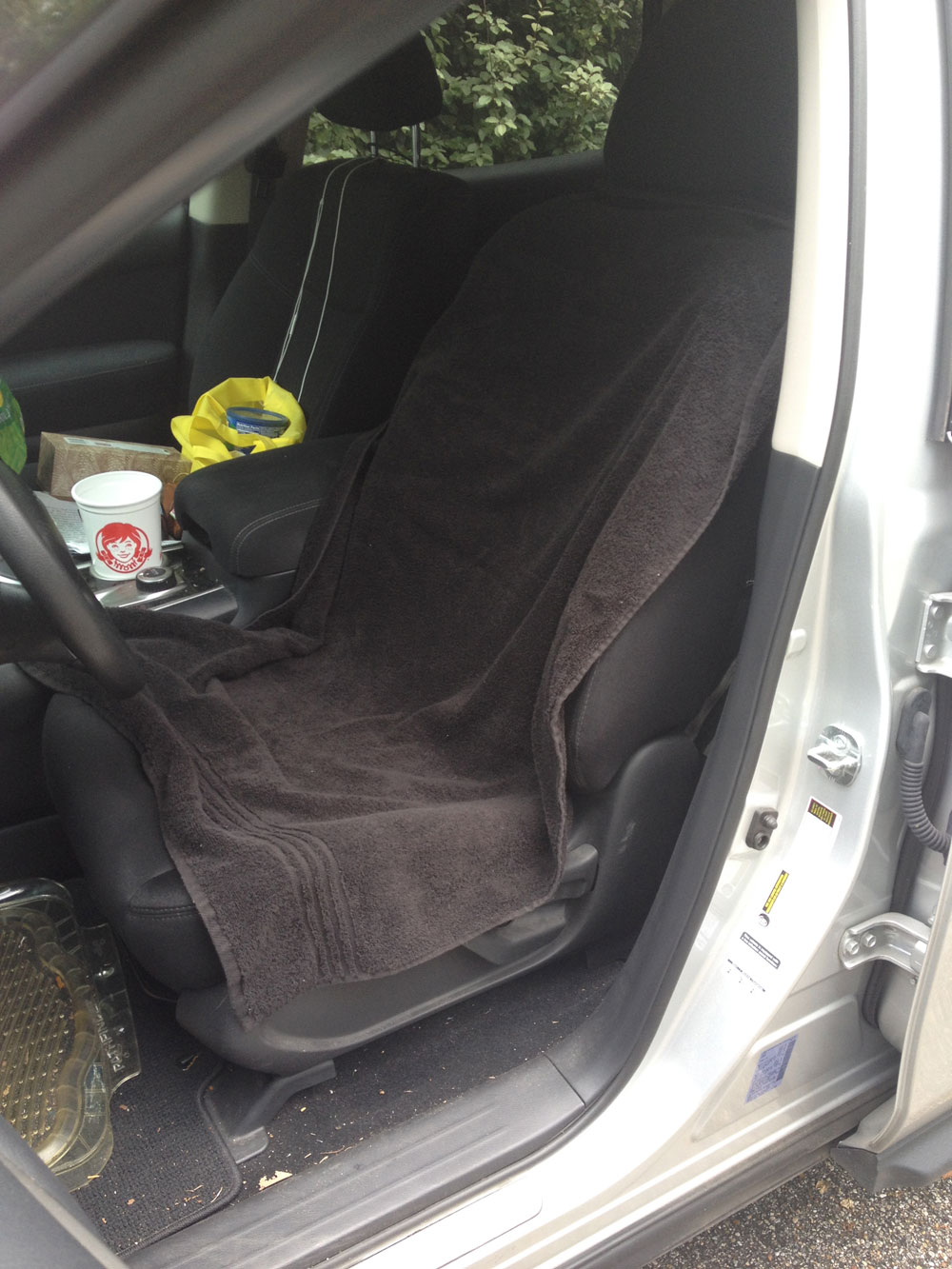
Not only will they cushion your load and protect your vehicle from scratches, they are terrific seat covers when you’re dirty or sweaty or both.

The only thing worse than being unable to clean the dirt out of your car’s upholstery is putting up with the sour smell because you sweated right down to the core of the driver’s seat. Protect the seat with one, or two or all three of your transport towels, depending on how sweaty you get.

The only thing worse than being unable to clean the dirt out of your car’s upholstery is putting up with the sour smell because you sweated right down to the core of the driver’s seat. Protect the seat with one, or two or all three of your transport towels, depending on how sweaty you get.


Jim Randolph is a veterinarian in Long Beach, Mississippi. His earlier careers as lawn mower, dairy farmer, automobile mechanic, microwave communications electronics instructor and journeyman carpenter all influence his approach to woodworking. His favorite projects are furniture built for his wife, Brenda, and for their children and grandchildren. His and Brenda’s home, nicknamed Sticks-In-The-Mud, is built on pilings (sticks) near the wetlands (mud) on a bayou off Jourdan River. His shop is in the lower level of their home. Questions and comments on woodworking may be written below in the comments section. Questions about pet care should be directed to his blog on pet care, www.MyPetsDoctor.com. We regret that, because of high volume, not all inquiries can be answered personally.
 

May 012015
 

Friday, May 1st is Safety Day for Woodworkers.  Here are some safety ideas you can use.

  1. Make sure you have a way to get in touch with someone to help you if you get hurt.  My wife used to call down the basement stairs to my shop periodically to see if I could still answer.  One of my friends was in his basement shop when he had a stroke and laid on the floor for several hours before they found him.  He did not survive.  Now that I live alone, I make sure my phone is very close at hand in case I need to call someone.
  2. Get you one of those panic buttons you hang around your neck.
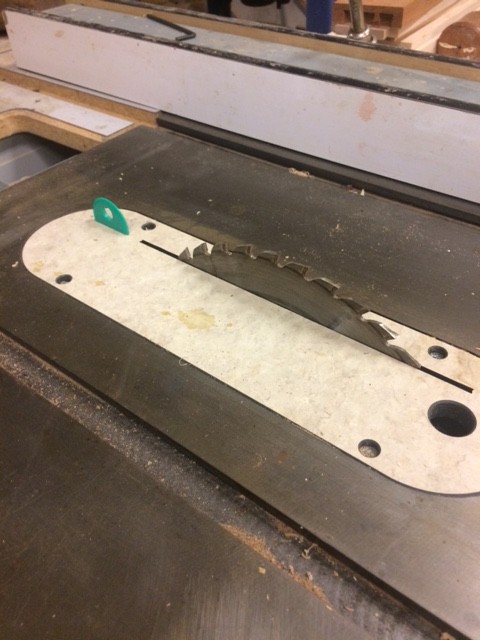
  3. Put a splitter back of the blade on your table saw.   Most kickbacks occur when a piece of wood twists into the back of the saw blade.  A splitter, either the one which came with your saw or an aftermarket device, will  prevent most kick-back accidents.
  4. Put the saw blade guard back on your saw.  Or get you one of those 3-D printers that are dropping in price and maybe you can print yourself some prosthetic fingers after you leave them on the saw table.  I ran a Land Surveying Company and one of my crew made wooden stakes to sell to the company.  We bought them a thousand at a time, so he spent his weekends making stakes.  He got complacent and left his right index finger laying on the saw table.

    Aftermarket Splitter

    Aftermarket Splitter

  5. Make sure you have a First Aid Kit close to hand.  And in case of a severe injury, it may be critical to have a trauma blood clotting bandage.  Better safe than sorry. Plus some of you old guys may take blood thinners, and if you cut yourself with those in your system, it will take a long time to clot.
  6. You realize that cell phones do not always transmit your address when you call 911, don’t you?  It sounds silly, but if you are lying on your shop floor in a pool of blood, can you keep your senses about you long enough to tell the dispatcher where you are located?  Might want to hang a sign with your address on the the wall.  Or at least tell the operator your address at the beginning of the call before you pass out.  And make sure they can see your address from the street.
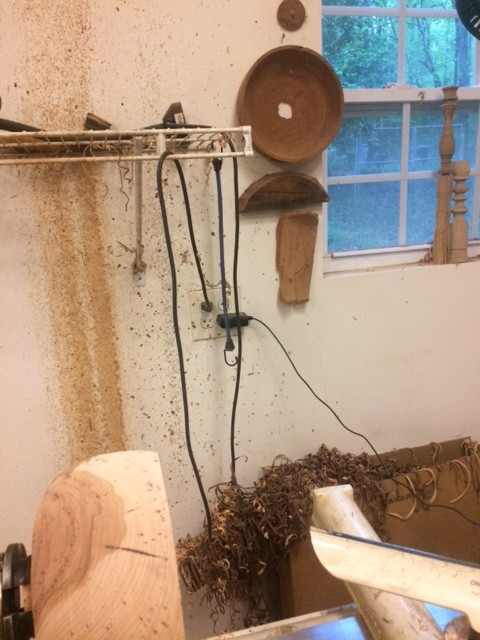
  7. Wear a face shield when you are turning.  Stuff flies off all the time.  Mike Mahoney was teaching a class a few years ago and one of his students lost his front teeth when a chunk of wood flew off the work.  I keep pieces which came off screwed to the wall behind the lathe so I can be reminded of what can happen.

    Missile Wall for Lathe

    Missile Wall for Lathe

Let’s be careful out there.

Apr 212015
 

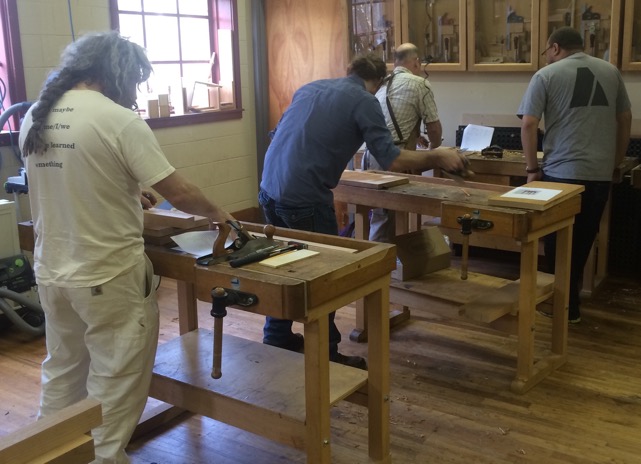
One of the joys of taking a woodworking class is getting to do or see some technique you have read about and think you know, but have never actually done.

A good example was in the class I took at Highland a few weeks ago to build a Shaker Style End Table with instructor Jim Dillon.  Jim works at the carpentry shop at Fernbank Science Center in Atlanta and teaches classes in the evenings at Highland.  I don’t know if they let him work on the dinosaurs at Fernbank, but they probably should.

Stock Preparation

Stock Preparation

There are three big things I learned at the class with Jim :

The first is the hand planes.  Now intellectually, I am very familiar with hand planes.  You may think the same thing, in that you have read lots of books, and seen lots of videos, and watched Roy Underhill for years, but until you have seen and HEARD! someone use a sharp plane on a piece of wood, let me tell you, Buford, you have no idea.  Most of us think the way you get a good finish on a piece of wood is to feed it through the electric thickness planer and then hit it with 320 sandpaper in the random orbit sander.  You really need to get in a class with someone who has a properly sharpened hand plane and see the shimmering sheen left by a hand plane and those read-a-newspaper-through-it shavings.  Once you can do that, there will be no sandpaper on your projects.  One and done as they say.

Tapering Jig at Work

Tapering Jig at Work

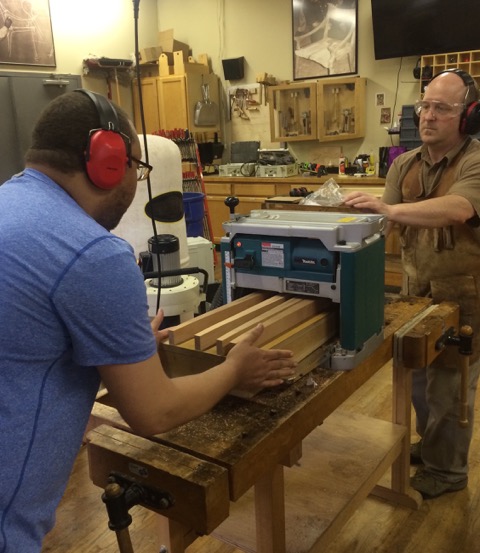
The second thing was the tapering jig we used to taper the table legs.  I have tapered legs before on the table saw with a tapering jig and it is not a comfortable situation.  My hands are a little too close to the blade and I always felt like it was one step from total disaster.  I wanted to call someone and say if you don’t get a call back from me in ten minutes, send the ambulance and the PortaJohn.  As you can see in the photo, we had a tapering platform we ran through the thickness planer.  It worked beautifully and is easily made.  Simply double sticky tape the legs to the jig and keep running the jig through until the cutter head reaches the flat where the side aprons land.  I think I remember it being 7/16” per foot taper.  I like this tapering jig.  No ambulance.  No PortaJohn.

Bevel Edge on the SawStop

Bevel Edge on the SawStop

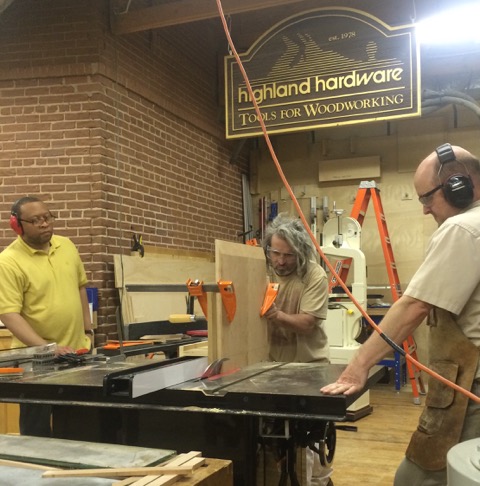
The third thing was the bevel on the edge of the table.  We set this up so that the remainder edge on the table top was a quarter of an inch and then we wanted the bevel to be four inches wide.  Since we had all planed our table tops by hand, none of them were the same thickness.  There followed a pretty good discussion of how to make that work and the answer is the angle of the saw blade has to change slightly.  If you hold the quarter inch remainder plus the four inch bevel on different thicknesses, then the angle is the only variable.  You can see in the pictures that we set the table top on edge and clamped it to a fence riding jig for safety.  (And I am truly deeply sorry for that fleeting one hundredth of a second when I thought what a great blog entry if someone tripped the SawStop.)

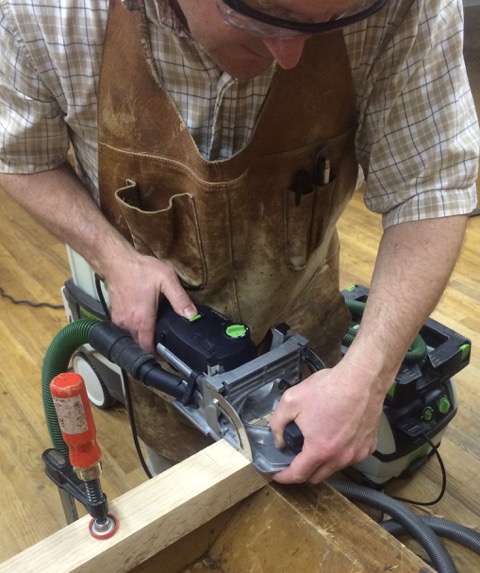
Festool Domino Joiner

Festool Domino Joiner

It was a real pleasure to use the SawStop Table Saw and the Festool DF 500 Q Domino Joiner, neither one of which I own or use.  If I ever trade my table saw, the SawStop is top of my list.  The Festool Joiner is more tool than I need in my little shop, but what a well-thought out, professional quality tool.  It has every adjustment you could ever need and the Dominos were almost a drive fit when we installed them.  The eighth inch reveal at the legs where the apron meets was a dial-in on the Festool and it worked perfectly.

Good class, well taught with good tools and techniques and well worth your money.  Watch the class schedule for the next one and join in.


Apr 172015
 

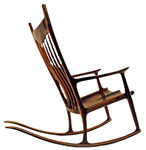
sculpted rockerIf you aren’t familiar with The Wood Whisperer Guild, now is a pretty good time to find out about it. Our friend, Marc Spagnuolo (The Wood Whisperer), has been passionate about teaching woodworking for over a decade and with modern day technology, he has found a way to spread his teaching expertise through the Guild.

Next month’s upcoming Guild Build is the Sculpted Rocker, a project designed by Charles Brock of The Highland Woodworker. This is a project near and dear to Highland Woodworking and we’ve got all the tools you need to make this project with The Wood Whisperer Guild.

Through The Wood Whisperer Guild, Marc will provide hours of detailed video instruction to building this project. While you are building, you will be able to connect with all of the other woodworkers that are working on the project at the same time as you.

Now get building!