Highland Staff

Jun 042018
 

No Southern-fried Southern boy wants to be called a Yankee, but we share the characteristics of shrewdness and thrift. Thus, each month we include a money-saving tip. It’s OK if you call me “cheap.

This project might not be for everyone, but, if you’re tight like me (Alan, are you paying attention?), it will be right up your alley.

We live on the Mississippi Gulf Coast. For the purpose of this article, the key word is “Coast.” Think “flat.” When we get rain, there is nowhere for it to go, because we’re already near sea level.

As a result, we frequently experience flooding in the yard between my garage at work and the back door of the clinic, requiring me to wear knee-high rubber boots to navigate the trail. When I get inside, I have to take off my boots for work, so I can either carry my dress shoes, along with all of the other paraphernalia I tote in, or I can keep a pair of “emergency” shoes indoors.

For years, maybe decades, I’ve had a pair of black Reeboks under my desk for such emergencies. Because they don’t get used much, and I never wear them outside the clinic, they still look much like the day I bought them.

That is, they did, until one day I put them on and realized the sole of the right one had become unattached from the upper. I flopped around the hospital the rest of the day, vowing to figure out a way to save these otherwise perfectly good shoes.
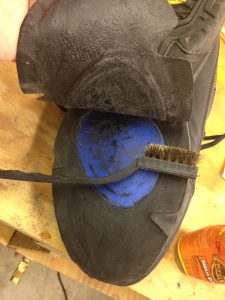
A bronze-bristled wire brush made short work of cleaning the sole and upper mating surfaces.

Some dry-fitting allowed me to see where the spring clamps needed to be in order to put the flexible sole in perfect contact with the upper. Then, it was just a matter of wetting one side, applying glue to the other, and, voila!
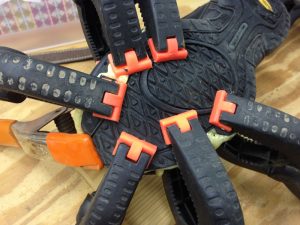
With clamp placement already worked out, it was a simple matter to position clamps accurately after applying glue.
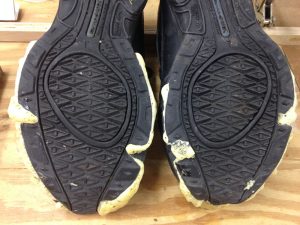
Clearly, I couldn’t see patients in these shoes anymore, but they cleaned up nicely with a rasp and wire wheel, followed by some Magic Marker to paint the Gorilla Glue black.

Well, it was voila! for a while. A few weeks later, the back half of the sole came loose. The challenges were different here. In the front, clamp position is easy and the sole is thin and flexible. In the back, the upper and the sole both become thicker and less flexible. Some edges simply were not going to lie down where they belonged.

Enter screw gun and drywall screws. That thick, thick upper allowed the screws deep purchase and made perfect positioning of the sole possible.
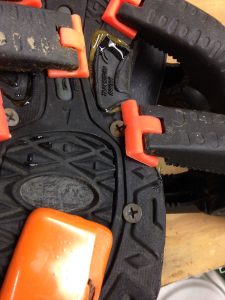
The steps were: 1, apply glue. 2, drive the drywall screws through the sole, holding in the upper. 3, apply spring clamps to hold down edges for a good final appearance. 4, wait.
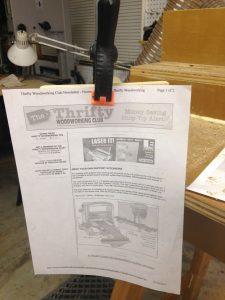
There isn’t a better paper clip in the world for holding your building plans.
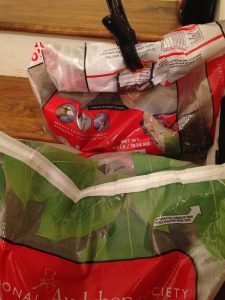
What else will they hold? Any sort of bag, like these bags containing black oil sunflower bird seed.
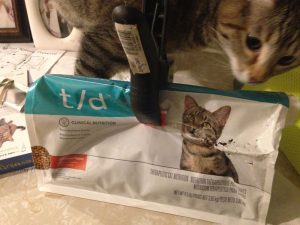
They’re good for pet food bags, too, but they won’t keep the kitty from chewing holes in the bag if you forget to put it back on its high shelf.
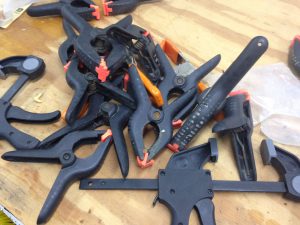
Talk about cheap: I bought these at the jot-em-down store, a dozen in a mesh bag for a few bucks. I’ve had them for 40 years. They were flooded in Katrina and still work fine.


Jim Randolph is a veterinarian in Long Beach, Mississippi. His earlier careers as lawn mower, dairy farmer, automobile mechanic, microwave communications electronics instructor and journeyman carpenter all influence his approach to woodworking. His favorite projects are furniture built for his wife, Brenda, and for their children and grandchildren. His and Brenda’s home, nicknamed Sticks-In-The-Mud, is built on pilings (sticks) near the wetlands (mud) on a bayou off Jourdan River. His shop is in the lower level of their home.Questions and comments on woodworking may be written below in the comments section. Questions about pet care should be directed to his blog on pet care, www.MyPetsDoctor.com. We regret that, because of high volume, not all inquiries can be answered personally.
Jun 012018
 

Welcome to “Tips From Sticks-In-The-Mud Woodshop.” I am a hobbyist who loves woodworking and writing for those who also love the craft. I have found some ways to accomplish tasks in the workshop that might be helpful to you, and I enjoy hearing your own problem-solving ideasPlease share them in the COMMENTS section of each tip.  If, in the process, I can also make you laugh, I have achieved 100% of my goals.

Spring clamps.

Are they, for you, like me, the clamps you love to hate?

I never have figured out how to apply spring clamps to hold two pieces and not make one or both workpieces move. Besides that small conundrum, I think they’re great!

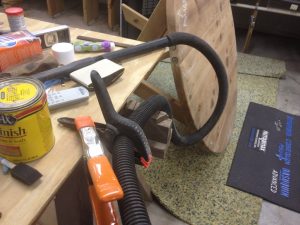
I especially like to use them for holding things other than work. For example, I have a ceiling-mounted ShopVac Hangup attached to a ceiling- mounted cyclone separator. Its long, long hose will reach my worktable area easily. But, when I’m working further away, the hose wants to recoil. To keep it close, I hold it in place with a clamp big enough to allow the small-diameter hose to avoid restriction, which means it’s close by when I need some vacuum. A remote control allows me to turn it on and off right from where I’m working.

A spring clamp to hold a spring clamp. Funny, but it works. It might take two hands to compress this big boy, but the space in the jaws allows the 1-1/4″ hose to stay in one place, yet still pass plenty of air.

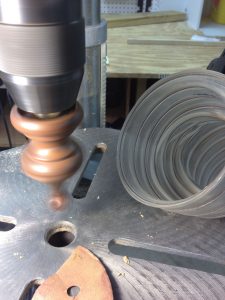
I also use spring clamps to hold a 4″ dust collector hose on the table of my drill press when I’m sanding. At high RPM, this technique can generate a lot of dust, and the high volume of the dust collector can catch it all.

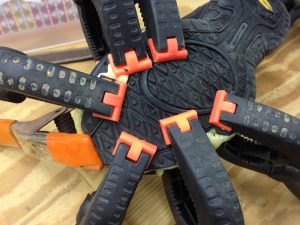
When I was salvaging these perfectly good Reeboks I glued the soles back onto the uppers with glue. These spring clamps were invaluable.


Jim Randolph is a veterinarian in Long Beach, Mississippi. His earlier careers as lawn mower, dairy farmer, automobile mechanic, microwave communications electronics instructor and journeyman carpenter all influence his approach to woodworking. His favorite projects are furniture built for his wife, Brenda, and for their children and grandchildren. His and Brenda’s home, nicknamed Sticks-In-The-Mud, is built on pilings (sticks) near the wetlands (mud) on a bayou off Jourdan River. His shop is in the lower level of their home.Questions and comments on woodworking may be written below in the comments section. Questions about pet care should be directed to his blog on pet care, www.MyPetsDoctor.com. We regret that, because of high volume, not all inquiries can be answered personally.
May 302018
 

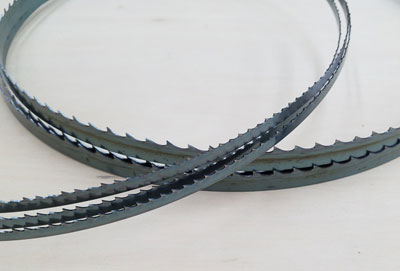
Recently, Jeff Fleisher took a closer look at Highland Woodworking’s General Purpose Bandsaw Blades, a great, excellent all-round blade choice, available in a variety of widths, lengths and tooth patterns.

The General-Purpose Bandsaw Blades from Highland Woodworking provide an excellent, everyday blade for your bandsaw. The carbon steel blade is sharp right out the box and for the average bandsaw user they will give you excellent results. They obviously won’t keep an edge as long as a carbide tipped blade but at the very low price point for these blades it is very easy to replace them when they eventually get dull.

Click here to read more of Jeff’s review

May 242018
 

We still can’t believe it has been 40 years! Last month we had quite a party to celebrate all those years. Hopefully you were able to join us in Atlanta, but if not, we were lucky to have Bill Rush Photography on hand at our 40th Anniversary Celebration, taking some great photos of the event! Scroll through and enjoy!

May 222018
 

Last month we held our official 40th Anniversary Celebration here in Atlanta with special guests Nick Offerman, Roy Underhill, Thomas Lie-Nielsen, Charles Brock and more. We were so excited to celebrate with almost a thousand of our customers who came from all over the country to join in on an amazing day of woodworking fun.

If you weren’t able to make it to Atlanta, or if you came and want to relive the festivities, watch our video below!

May 172018
 

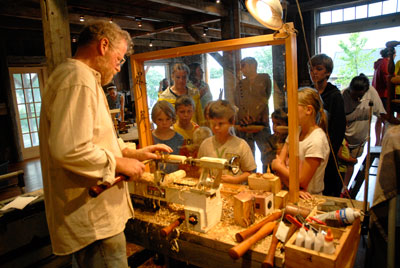
In the May 2018 issue of The Highland Woodturner, Temple Blackwood offers some helpful tips for doing a woodturning demonstration for a crowd of people. Going beyond the typical “keep things moving so people don’t get bored” advice we usually hear, Temple has great information about types of wood to use for a dramatic result, tricks for preparing for the demo and how to apply a finish without splashing your audience.

In an effort to share my own passion for wood as a sensually rewarding material to work with in a concrete way and to communicate with both other people as well as with the source-trees, I developed a series of demonstrations using wood that clearly comes directly from the tree.

Click here to read more of Temple’s great article on How to Demonstrate Woodturning.

Click here to read the May 2018 issue of The Highland Woodturner

May 152018
 

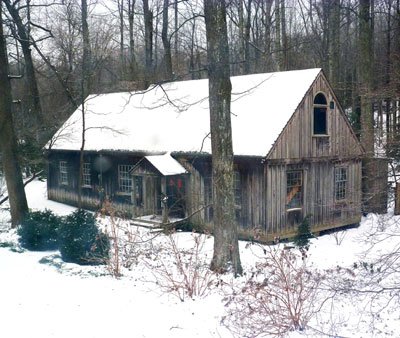
This past year, we’ve featured a wide array of shops in our monthly newsletter, Wood News Online, including Brent Nichols’s backyard workshop, Farrell Eaves’s shop-in-the-woods, and the barn shop that Mark and Rachel Mysliborski share.

Take a look at some of these workshops for ideas and inspiration, or just for fun.

And to read about even more shops, click to check out our Shops Gallery.

If you would like to submit your own shop, just SEND US PHOTOS of your woodworking shop along with captions and a brief history and description of your woodworking. (Email photos at 800 x 600 resolution.) Receive a $50 store credit redeemable towards merchandise at Highland Woodworking if we show your shop in a future issue.