Measure twice, cut once.
Such sayings are legendary, sage advice.
We all know that accuracy is one of the most important factors in a good woodworking outcome. Usually, it’s a matter of “taking the time.” Taking time to mark accurately, line up a cut accurately, and execute the cut accurately.
Whether a butt joint or miter, few aspects of your work can make it look uglier than an ill-fitting intersection.
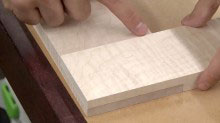
A perfectly-executed half-lap joint by Marc Spagnuolo.
There are plenty of ways you can enhance accuracy. Marking your cutlines with a knife instead of a pencil, for example.
Many woodworkers intentionally cut their pieces long and fine-tune after.
Picture framers often “shave” their miter cuts for accuracy to the thousandth.
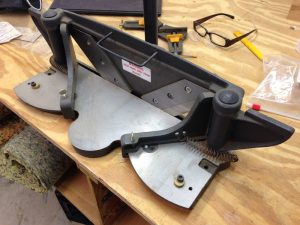
When nothing less than perfection will do, nothing beats making one’s cuts a tad long and improving them with this miter trimmer. Highland provides a handy product tour.
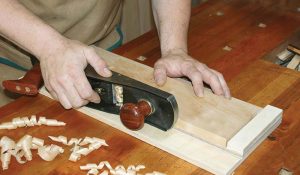
Shooting boards. I suppose they’ve been around almost as long as hand planes.
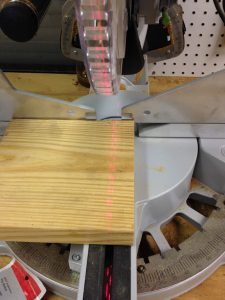
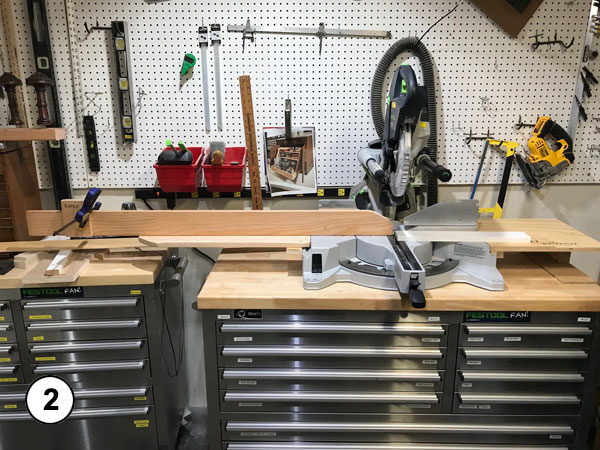
The laser guide on this Kapex is quite good, although I usually still cut and test.
Some would argue that accuracy isn’t improved, even though most people would say speed is. This month’s poll asks about your preferences regarding lasers.
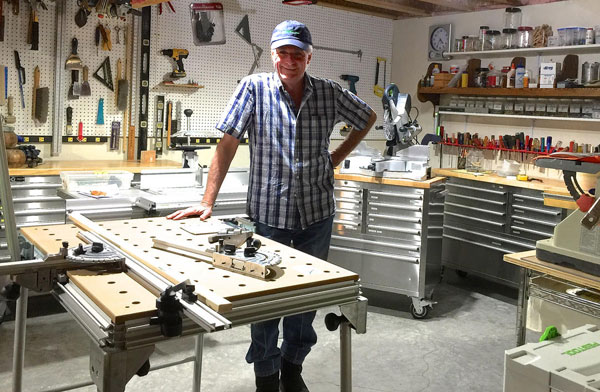
Jim Randolph is a veterinarian in Long Beach, Mississippi. His earlier careers as lawn mower, dairy farmer, automobile mechanic, microwave communications electronics instructor and journeyman carpenter all influence his approach to woodworking. His favorite projects are furniture built for his wife, Brenda, and for their children and grandchildren. His and Brenda’s home, nicknamed Sticks-In-The-Mud, is built on pilings (sticks) near the wetlands (mud) on a bayou off Jourdan River. His shop is in the lower level of their home.Questions and comments on woodworking may be written below in the comments section. Questions about pet care should be directed to his blog on pet care, www.MyPetsDoctor.com. We regret that, because of high volume, not all inquiries can be answered personally.