Highland Staff

Nov 072018
 

Is plywood acceptable in fine furniture? And, while we’re at it, what is fine furniture? Is it furniture made only with hand tools? Is it made only with solid wood? Is it defined by certain joinery?

My answer to all those questions is, “Whatever gets the job done, has an eye-pleasing design, has well-fitting joints, is strong and has a beautiful finish.”

Of course, “eye-pleasing” is in the optical structure of the beholder. Even classic lines and traditional rules of proportion aren’t going to delight everyone.

How strong is strong? Some might be thinking, “It just needs to be strong enough to last until I move out of this apartment.” “Or the twenty years I live in this house.” Others want to be able to pass their handmade furniture down to their children, grandchildren and beyond. I read a piece recently in which a Japanese woodworker said that 100 year old furniture had barely begun its life, that it might be 200 years old before it really has character.

As for plywood, let’s face it: it’s hard to get stronger than quality plywood.

How beautiful does the finish have to be? It, too, should be durable. To some, that means varnish. To others, paint. Some might think an oil finish is durable enough, even if it has to be renewed periodically. Perhaps the beauty of the oil finish outranks the need for durability.

Can we agree that ill-fitting joints would universally take a piece out of the running for “fine?”

The bottom line? We’re all entitled to our own opinions, and to make and finish our furniture however we like. And, if we want to call it “fine,” after all, it’s our furniture and our viewpoint.
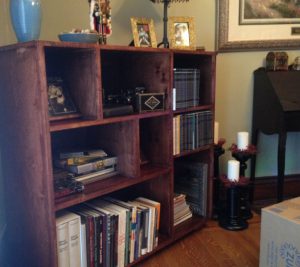
I considered this my very first foray into “fine” woodworking. Our son, Andy, wanted a cabinet to display his photography books, magazines and classic equipment. He sent me a sketch on a napkin and wanted to know if he could make it with a circular saw and hammer. I think that was his way of asking me if I would do it. I made it from furniture-grade oak veneer plywood with red oak solid wood banding. Andy wanted to finish it himself and sent me these photos when he was through.
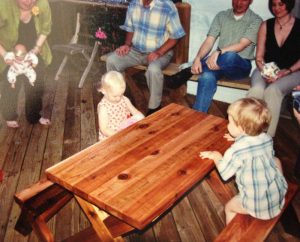
Perhaps it’s a stretch to call a picnic table, much less a diminutive picnic table, “fine” furniture, but I intended this table to be an heirloom our eldest granddaughter would pass to her grandchildren and beyond. It’s plenty strong. There is no plywood. This was her second birthday party.
Nov 052018
 

Welcome to “Tips From Sticks-In-The-Mud Woodshop.” I am a hobbyist who loves woodworking and writing for those who also love the craft. I have found some ways to accomplish tasks in the workshop that might be helpful to you, and I enjoy hearing your own problem-solving ideasPlease share them in the COMMENTS section of each tip.  If, in the process, I can also make you laugh, I have achieved 100% of my goals.

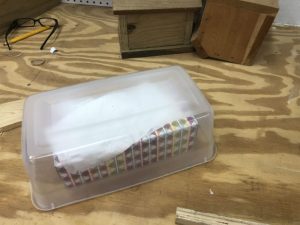
A while back I showed you three ways I was experimenting with to protect my Kleenex boxes from dust. I promised that I would tell you which style of Kleenex protection won out. Not surprisingly, I chose the technique that was easiest and involved spending the least amount of time. That is, a simple cover over the Kleenex box that would allow me to just lift up the cover, select a Kleenex, drop the cover back on, and get back to work.

The most protective was also the most time-consuming, which was screwing a plastic shoebox lid down, then snapping the box part over the Kleenex. I just didn’t have the time or patience to go through the added step of securing the container.

Ditto for the other technique, which also involved unsnapping the lid, only with the shoebox upright.

Efficiency wins again!

As is often the case, the simplest way is the best way. Using this setup, the Kleenex gets dust protection, and I get quick and easy access.


Jim Randolph is a veterinarian in Long Beach, Mississippi. His earlier careers as lawn mower, dairy farmer, automobile mechanic, microwave communications electronics instructor and journeyman carpenter all influence his approach to woodworking. His favorite projects are furniture built for his wife, Brenda, and for their children and grandchildren. His and Brenda’s home, nicknamed Sticks-In-The-Mud, is built on pilings (sticks) near the wetlands (mud) on a bayou off Jourdan River. His shop is in the lower level of their home.Questions and comments on woodworking may be written below in the comments section. Questions about pet care should be directed to his blog on pet care, www.MyPetsDoctor.com. We regret that, because of high volume, not all inquiries can be answered personally.

Nov 022018
 

No Southern-fried Southern boy wants to be called a Yankee, but we share the characteristics of shrewdness and thrift. Thus, each month we include a money-saving tip. It’s OK if you call me “cheap.

A fundamental principle of power tool safety is that the operator needs to be able to cut the electricity to his/her tool quickly, preferably without the distraction of having to look. Router tables, table saws and other stationary equipment usually incorporate a large, red OFF switch, sometimes with a paddle. Switches on portable tools are considerably more subtle.

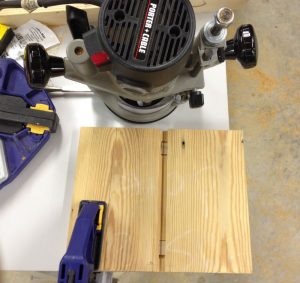
I love my Porter-Cable routers, but I don’t get enough shop time, or router time, to remember whether it’s the left or the right side of the rocker switch that turns it off.

I already had fingernail polish, so there was no added expense to mark the switch right on top so I could immediately identify the correct side to reach for at the end of a cut. I used several coats, and, despite years of use, this red mark remains just this bright.

When it’s time to turn a tool off, you don’t want to waste time fumbling. Now, it’s as quick and simple as reaching for the red spot.


Jim Randolph is a veterinarian in Long Beach, Mississippi. His earlier careers as lawn mower, dairy farmer, automobile mechanic, microwave communications electronics instructor and journeyman carpenter all influence his approach to woodworking. His favorite projects are furniture built for his wife, Brenda, and for their children and grandchildren. His and Brenda’s home, nicknamed Sticks-In-The-Mud, is built on pilings (sticks) near the wetlands (mud) on a bayou off Jourdan River. His shop is in the lower level of their home.Questions and comments on woodworking may be written below in the comments section. Questions about pet care should be directed to his blog on pet care, www.MyPetsDoctor.com. We regret that, because of high volume, not all inquiries can be answered personally.

Nov 012018
 

Welcome to “Tips From Sticks-In-The-Mud Woodshop.” I am a hobbyist who loves woodworking and writing for those who also love the craft. I have found some ways to accomplish tasks in the workshop that might be helpful to you, and I enjoy hearing your own problem-solving ideasPlease share them in the COMMENTS section of each tip.  If, in the process, I can also make you laugh, I have achieved 100% of my goals.

Recently, I was cleaning out a closet and ran across some things that simply have no use anymore. I bought them, and I’m not sorry I did, but now there are better products that have simply superceded them.

Back in the day, I spent a fortune on a top-of-the-line Lowrance paper graph. The modern digital “fish finder” does thousands of things more, at a fraction of the cost.

Then, there’s my old 35 mm SLR. A Film camera, that is. I have no use for it and no one wants it or the dozen accessories I have for it. Ditto for the mini-cassette video camera.

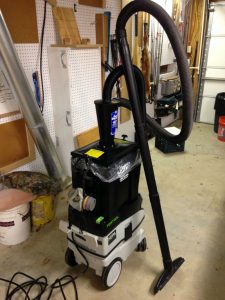
Now, I see that Festool has come out with a CT CYCLONE Separator for Dust Extractors. However, I have a separator made to sit atop a Festool Dust Extractor that isn’t a Festool brand, and I can’t possibly justify throwing it away to buy the Festool item, as much as I’d like to. I also don’t see Festool starting a buy-back amnesty program just so I can upgrade.

The unit I have is completely acceptable. It has served me well for a number of years. It’s just that, knowing Festool, I’m sure they did it better.

This Ultimate cyclone has separated a ton of debris in the several years I’ve had it. Still, there’s a new choice to pair with your Festool Dust Extractor. And, I want one.

Like any separator system, you’re going to have a savings on HEPA filters because almost no debris reaches the inside of the dust extractor. You won’t be filling bags all the time because the dust stays in the CT Separator, which is lined with a disposable plastic bag. You can purchase supplemental clear plastic VAB-20 Collection Containers if you need to keep your dust boxed up to move off-site. A three-pack is $180. You can even use it without the Collection Container, but the capacity is diminished, emptying into what Festool calls a “pan.” The CT I use for my Kapex sits under the workbench, so the height savings would be a plus for me.

I have one small beef with my current unit, and that is the Systainer clips don’t always hold it securely. Because Festool is a system, I’m sure that wouldn’t be a problem with the real thing.

As you might expect, the Festool Cyclone costs about 25% more than its competitor. It is Festool, after all. If something happened to my old unit, I’d be on the horn today to get this ordered. If you, like me, vacuum your shop floor with your Festool CT, as well as using it with tools, you’ll definitely want one, too.

You can purchase the CT Cyclone at Highland Woodworking.


Jim Randolph is a veterinarian in Long Beach, Mississippi. His earlier careers as lawn mower, dairy farmer, automobile mechanic, microwave communications electronics instructor and journeyman carpenter all influence his approach to woodworking. His favorite projects are furniture built for his wife, Brenda, and for their children and grandchildren. His and Brenda’s home, nicknamed Sticks-In-The-Mud, is built on pilings (sticks) near the wetlands (mud) on a bayou off Jourdan River. His shop is in the lower level of their home.Questions and comments on woodworking may be written below in the comments section. Questions about pet care should be directed to his blog on pet care, www.MyPetsDoctor.com. We regret that, because of high volume, not all inquiries can be answered personally.

Oct 302018


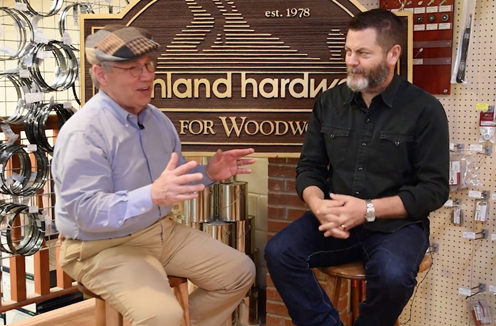
From Roy Underhill’s saw mill home to Nick Offerman’s LA workshop, Charles Brock has interviewed many woodworkers in between and told us dozens of fascinating stories in the 7 years he has been hosting The Highland Woodworker.

Now you can find any episode of The Highland Woodworker in our ALL NEW Highland Woodworker archives page! Or just re-watch the entire series from beginning to end, if you are in the mood.

Take a look and find your favorite episode in The Highland Woodworker Archives.

Oct 252018
 

The ‘famous’ Wood Slicer Resaw Bandsaw Blades, available exclusively at Highland, cut more smoothly and quietly than any other bandsaw blades on the market. Fine Woodworking rated the Wood Slicer ‘Best All-Round Performer’ in their independent test for speed, flatness and smoothness.

Mike Morton takes a closer look at the Wood Slicer, how to set it up and how to use it in the video below.

Click to find out more about the Wood Slicer Resaw Bandsaw Blade, available at Highland Woodworking.

Oct 232018
 

Introducing the new SawStop family of Router Tables. Enjoy the best of precision routing with many great features and options, as well as the high quality we have come to expect from the SawStop brand.

In the video below, Jim Dillon takes a closer look at the various SawStop Router Table models, including the various features and options for each model.

Click to find out more information about the SawStop Router Tables, available at Highland Woodworking.