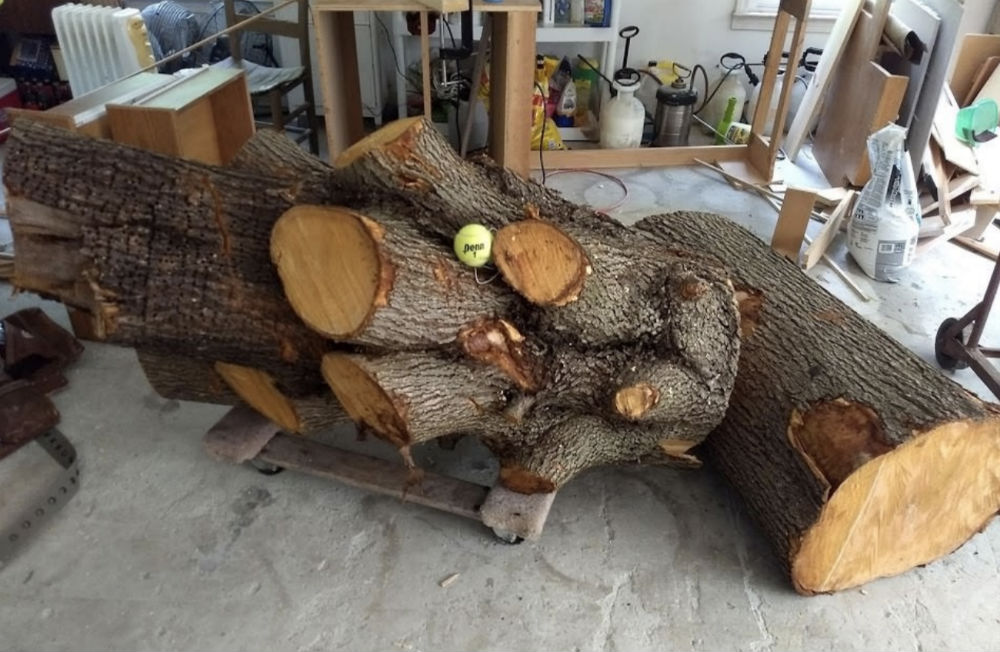
I was initially disappointed to find out that the tree they were felling was a Bradford pear, that despised tree that smells like rotting fish in the spring and collapses under its own weight in the winter. Still, the loggers were happy to drop it off in my driveway rather than spend an hour chipping it, so I was resolved to experiment on my new wood. I can today state, emphatically, that if you get the chance to get 400-500 pounds of green pear wood for free, you should take it. You don’t need to park your car indoors anymore.
I admit to being one, and I’m going to submit strong evidence in support of you being one, too.
As many of you know, one of my interests is birding. “What is birding?” some of you are asking. My earliest avian-studies mentor, the late Judith Toups, used to say there were three levels of bird-interest enthusiasts.
The first was backyard birdwatchers. These are folks who feed birds and look out at the feeder on a somewhat regular basis, but they’re not going beyond the yard to make a feathered friend.
The second level is a birdwatcher, no qualifying adjective. Birdwatchers typically have a pair of binoculars and may infrequently go on outings to find and look at birds.
The third level is birders. Think “woodworkers.” Obsessed. Willing to spend large amounts of money on equipment. Able to spend hours and hours in pursuit of perfection. I think the woodworkers in the audience have the concept.
A few months ago, my wife, Brenda, and I went on a trip, a vacation, a chance to sit around and do nothing.
Unfortunately, doing nothing is not something I’m good at. Fortunately, the place we went has good birding, so I had plenty to do. Being a beach location, one can sit in his condo and watch osprey, gulls of several species, egrets, herons and other shorebirds without ever leaving his room. It’s almost like doing nothing, while expending just a little effort.
I did some of that, but I also spent a good bit of time wandering the island in a more adventurous mode. That meant a backpack, water, binoculars, camera, spotting scope, a tripod and lightweight portable seat. About a 26 pound load.
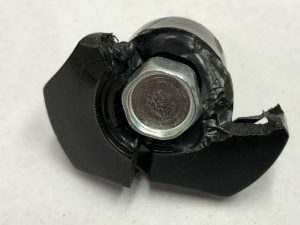
To get all that stuff to and from the destination, I used all of the skills my Navy corpsman father taught me about packing a suitcase. My tripod was nestled in one leg of a pair of jeans, and the seat was in the other leg, with all of that surrounded by other clothing. Somehow, on the return trip, baggage handlers managed to break the plastic handles on a wing nut which was part of my tripod.
My tripod is old, a Vivitar that is no longer manufactured, and the Vivitar company is out of business. In other words, replacement parts are not available. How was I going to fix this crucial adjustment part?
Of course, when I returned home, the first order of business was business. After 8 days out of town, there were plenty of appointments when Monday morning came calling.
Likewise for Tuesday through Saturday.
But, Saturday afternoon I had time to visit the garage and begin to ponder a repair process. Step One was to determine the thread type. Good! It wasn’t metric! That piece of information alone gives you a hint as to how old the tripod must be.
Since a 5/16″ nut fit on the broken wing nut, which is actually a bolt, I began looking at my supply of adjustment knobs I keep for assemblies. Darn! I had every configuration of knob except one that would work.
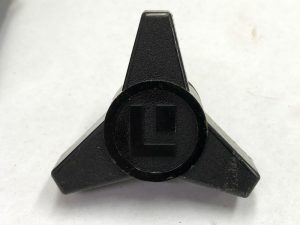
Plan B: Dig through the supply of 5/16″ bolts and figure out a way to attach a “handle” to it. Then, what should appear in the pile, but the attachment knobs to my old Lowrance paper graph. Non-fishermen call them “fish finders.” When that albatross died, the only usable parts were the “U” bracket it was mounted in and the knobs that attached it to the bracket.
Moment of truth: will the threaded part be the right length? It worked!
I’d saved those knobs for over 20 years, but the effort finally paid off. This Lowrance part was going to save my Vivitar tripod!
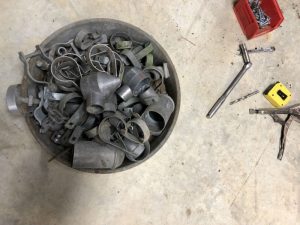
A week or so later I found myself looking for old, saved valuables again. The chain-link fence gate at our clinic had rusted and needed to be rebuilt. Having installed the original fence, I knew I had fence parts somewhere. Out of a pan of elements I was able to find enough corners and brackets that all I had to buy was some new pipe.
“Thar’s gold in that-there pan!” I just had to save those parts a few decades to come up with an almost free new gate.
“Never throw anything away.”
Having been raised by five children of the Depression, I’ve heard that all of my life.
In the span of a couple of weeks, the practice proved itself right again.
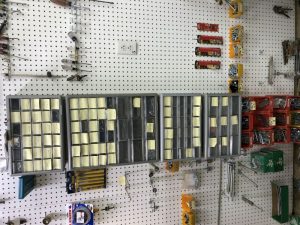
While many of these little plastic drawers have new supplies in them, there is a lot of vintage treasure, too.
Jim Randolph is a veterinarian in Long Beach, Mississippi. His earlier careers as lawn mower, dairy farmer, automobile mechanic, microwave communications electronics instructor and journeyman carpenter all influence his approach to woodworking. His favorite projects are furniture built for his wife, Brenda, and for their children and grandchildren. His and Brenda’s home, nicknamed Sticks-In-The-Mud, is built on pilings (sticks) near the wetlands (mud) on a bayou off Jourdan River. His shop is in the lower level of their home.Questions and comments on woodworking may be written below in the comments section. Questions about pet care should be directed to his blog on pet care, www.MyPetsDoctor.com. We regret that, because of high volume, not all inquiries can be answered personally.
No Southern-fried Southern boy wants to be called a Yankee, but we share the characteristics of shrewdness and thrift. Thus, each month we include a money-saving tip. It’s OK if you call me “cheap.”
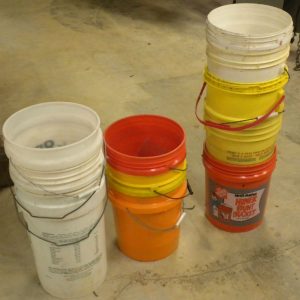
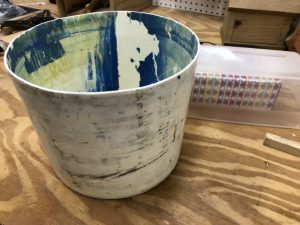
A 5 gallon bucket is the perfect diameter for immersing a 10-inch or smaller table saw or circular saw blade in your favorite blade cleaner. I shortened a bucket to about 6″ high, making insertion and removal really easy. Of course, you don’t have to cut down your bucket if you don’t have very many. I’m blessed with tons.
I have some buckets from the “orange” store, and I have some buckets from the “blue” store, but, I’ve never, ever, bought a bucket for use in the shop.
One nice thing about cutting most of the top of the bucket off is easy access. If you put a 10″ saw blade in here, you don’t have to fumble for it at the bottom of a canyon. Another advantage, though, is that it can double as a washing container for parts. Put some solvent in here, grab a toothbrush and some Scotch-Brite pad, and soon your item is clean.
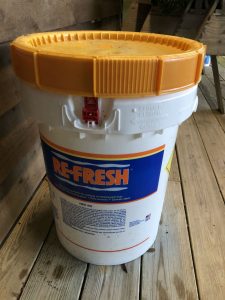
I finally found the ideal (read “free”) soaking container for a 12″ blade. Since I have a 12″ Delta radial arm saw and a 12″ DeWalt miter saw, removing pitch from them meant a lot of scrubbing until I found this bucket on the side of the road, took it home, and discovered it was perfect for soaking our dog’s Potty Park grass, and the lid ideally accommodated a 12″ blade.
What a find this huge bucket was. It certainly solved two problems for me.
There is just enough diameter, without being wasteful, and just enough depth to fully immerse a 12″ blade.
Now, I warn you, it took years of optically scouring the roadsides before I came across this gem. Don’t think you’re going to
happen on a rare find like this tomorrow. But, maybe I have inspired you to believe, “Yes! It’s really out there waiting for me!”
Jim Randolph is a veterinarian in Long Beach, Mississippi. His earlier careers as lawn mower, dairy farmer, automobile mechanic, microwave communications electronics instructor and journeyman carpenter all influence his approach to woodworking. His favorite projects are furniture built for his wife, Brenda, and for their children and grandchildren. His and Brenda’s home, nicknamed Sticks-In-The-Mud, is built on pilings (sticks) near the wetlands (mud) on a bayou off Jourdan River. His shop is in the lower level of their home.Questions and comments on woodworking may be written below in the comments section. Questions about pet care should be directed to his blog on pet care, www.MyPetsDoctor.com. We regret that, because of high volume, not all inquiries can be answered personally.
Welcome to “Tips From Sticks-In-The-Mud Woodshop.” I am a hobbyist who loves woodworking and writing for those who also love the craft. I have found some ways to accomplish tasks in the workshop that might be helpful to you, and I enjoy hearing your own problem-solving ideas. Please share them in the COMMENTS section of each tip. If, in the process, I can also make you laugh, I have achieved 100% of my goals.
I needed to make a little tray-in-a-box. It was going to be simple, but I still wanted it to be pretty. I didn’t want defects in the wood, or any rough places, or the miter-sawn edges to blow out. I didn’t have time to make a zero-clearance backup for my DeWalt miter saw, so I made that quick and dirty, too.
The box was going to be painted, so thin, resawn poplar off the wood storage shelf would work great.
Step One was to make a rabbet along one edge for the bottom to sit in. It’s easiest to do that while there is just one board.
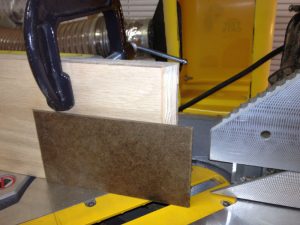
Next, I wanted to miter the corners, but first, the miter saw needed a backer board.
A little scrap oak veneer plywood, slightly bigger than the project piece will act as a backerboard, supporting the fibers of the poplar as the saw blade slices through, preventing a fuzzy edge. Clamp it, then make an initial cut, and it’s ready to use.
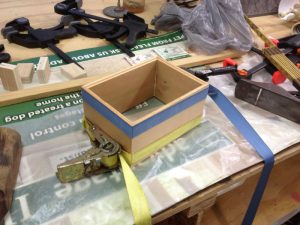
A little glue squeezeout can be cleaned up when it tacks. You don’t want glue bulging under your paint. Be sure to check the diagonals to guarantee the box is square, or the lid will never fit.
Now, on to the bottom. Again, it’s a painted box, so hardboard works fine and doesn’t take up much space.
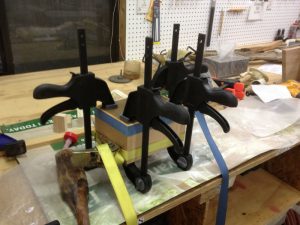
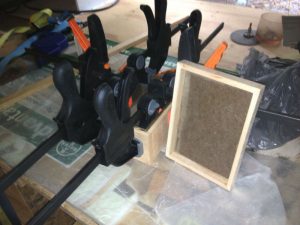
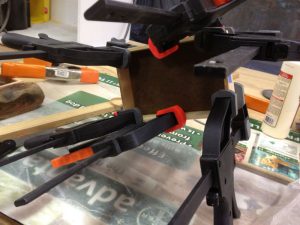
The bottom doesn’t need clamp pressure, so these little squeeze clamps hold it gently in place while the glue dries. The miters had been glued for about an hour, so I felt comfortable working with the box carefully, leaving the strap clamps on.
Hardboard works great to line the box and give it a lip for the lid. Again, it’s going to be painted. I glued it in place and clamped it until the glue cured.
The lid is similarly mitered, glued, strap-clamped and a hardboard top is glued into the rabbet.
… tray construction is almost identical to the lid, albeit with a slightly smaller perimeter.
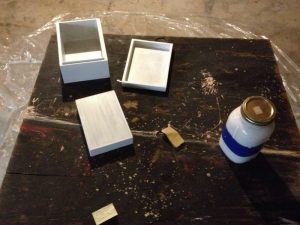
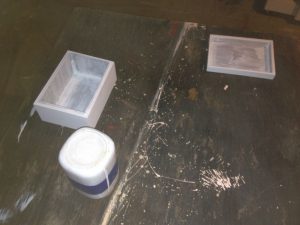
A little primer and a couple of coats of paint, and it’s ready for gift delivery. I would have shown you a photo of the final box, but I asked Brenda to find it for me and she hasn’t been able to produce it yet. Take my word for it, it was cute.
Jim Randolph is a veterinarian in Long Beach, Mississippi. His earlier careers as lawn mower, dairy farmer, automobile mechanic, microwave communications electronics instructor and journeyman carpenter all influence his approach to woodworking. His favorite projects are furniture built for his wife, Brenda, and for their children and grandchildren. His and Brenda’s home, nicknamed Sticks-In-The-Mud, is built on pilings (sticks) near the wetlands (mud) on a bayou off Jourdan River. His shop is in the lower level of their home.Questions and comments on woodworking may be written below in the comments section. Questions about pet care should be directed to his blog on pet care, www.MyPetsDoctor.com. We regret that, because of high volume, not all inquiries can be answered personally.
Christopher Schwarz’s fascination with workbenches and workbench design history continues in his new offer from Lost Art Press, Ingenious Mechanicks. Norm Reid reviewed the book, here are a few of his initial thoughts:
A recent release from Lost Art Press, this book is an homage to Christopher Schwarz’s love for workbenches and his dedication to understanding them in all their manifestations. On the surface, Ingenious Mechanicks is a beautifully-illustrated treatise on ancient workbenches. But while it does illuminate our understanding of how woodworkers from Roman times forward did their work, it contributes much more than that. Readers will find here guidelines for crafting several styles of low workbenches that are both beautiful (they can serve as furniture!) and surprisingly functional. In doing so, it turns our heads toward new directions for approaching hand tool woodworking that may well shake up practices well-enshrined in Western tradition since before Joseph Moxon and André Roubo came on the scene.
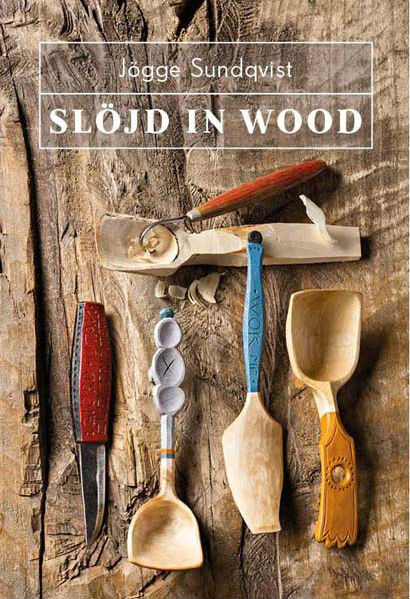
Lost Art Press has really upped their game this year in the variety of books they are releasing. We were especially excited to see this book on crafting utensils, given the current spoon carving craze. Norm Reid read the book and reviewed it for us:
In this brilliant little book, Slojd in Wood, Jögge Sundqvist provides a complete course in crafting utensils and other useful items from wood. Though the Swedish term slöjd may at first be off-putting to English-speaking readers, it needn’t be. Slöjd refers to crafty and traditional ways of working with hand tools to make functional and decorative items for around the house and homestead. The term itself derives from the word slög, meaning artful or clever. Slöjd is a practice that has evolved from centuries-old traditional practices of self-sufficiency that can be applied to many types of raw materials. Here, Sundqvist shows how to craft items from his chosen medium, wood.
I think we can all agree this world would be a little better off with more woodworkers, right? All of the skills we learn from woodworking – self-reliance, persistence, planning, hand-eye coordination, the ability to problem-solve, are useful in many areas of our lives.
If you aren’t sure what gift to get the non-woodworker on your list this year, maybe it is time to try and convert them to a woodworker? At Highland, we’ve got ideas for all tool categories at economy and premium level pricing, so you can find the right gift for anyone who might like to learn to work wood.



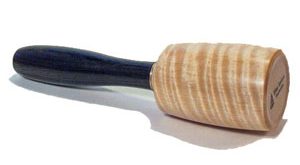 I think we can all agree this world would be a little better off with more woodworkers, right? All of the skills we learn from woodworking – self-reliance, persistence, planning, hand-eye coordination, the ability to problem-solve, are useful in many areas of our lives.