Highland Staff

Dec 112018
 

Christopher Schwarz has noticed a trend in some sections of the woodworking world: otherwise capable woodworkers struggle when it comes to using their hand tools, even when their tools are of the highest quality. Chris thinks he knows why that might be the case.

Click here to find out


Dec 052018
 

Fresh on the heels of the question in November’s Poll, “Does plywood belong in fine furniture?” I was faced with the question of whether paint is appropriate thereon.

I was listening to Wood Talk, Episode 451 “We’ve Changed After Ten Years.” Here’s how Shannon Rogers handles painting in his shop: Rag on paint, sand with 220 after the first coat, apply a sealer coat of shellac, which binds each coat of paint to each other, levels out the surface and traps any powder created from the sanding. The next coat of paint will be “super smooth” whether brushed or rolled. Topcoat with lacquer, which adds depth and reflection. “Turns that nice paint job into a professional paint job.”

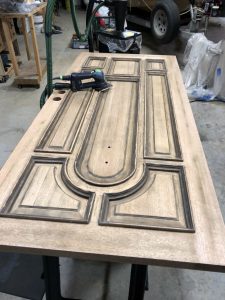
Paint is on my mind these days, as I paint the front door of our home. Now, no one is going to look at this door closely enough to necessitate a fine-furniture finish, paint or otherwise, but I’ll be trying out Shannon’s technique on the next project I paint.

There was nothing to do but take this door down to the wood before applying primer and then white paint. The Festool RO90, with its 3″ round, and Delta pads, was indispensable in minimizing the amount of hand sanding required.

I would have used Shannon’s steps on the storage project for our youngest granddaughter. I made this project from poplar, and it painted up nicely.

Next time I see Audrey I’ll have to ask her if she thinks this painted chest qualifies as fine furniture. She seems to like it.


Jim Randolph is a veterinarian in Long Beach, Mississippi. His earlier careers as lawn mower, dairy farmer, automobile mechanic, microwave communications electronics instructor and journeyman carpenter all influence his approach to woodworking. His favorite projects are furniture built for his wife, Brenda, and for their children and grandchildren. His and Brenda’s home, nicknamed Sticks-In-The-Mud, is built on pilings (sticks) near the wetlands (mud) on a bayou off Jourdan River. His shop is in the lower level of their home.Questions and comments on woodworking may be written below in the comments section. Questions about pet care should be directed to his blog on pet care, www.MyPetsDoctor.com. We regret that, because of high volume, not all inquiries can be answered personally.

Dec 042018
 

No Southern-fried Southern boy wants to be called a Yankee, but we share the characteristics of shrewdness and thrift. Thus, each month we include a money-saving tip. It’s OK if you call me “cheap.

You know me. I throw next to nothing away. If I have to get rid of something, I first ask, “Can this be recycled?

Not only do I dislike discarding usable items, I’m not above picking up good materials from other people’s trash. More on
that next month.

Some see it as a contradiction to me to promote this column as “cheap” and “money-saving,” then recommend Festool, but, as many others can attest along with me, Festool purchases are an investment in value, not just an ordinary tool with an extraordinary price.

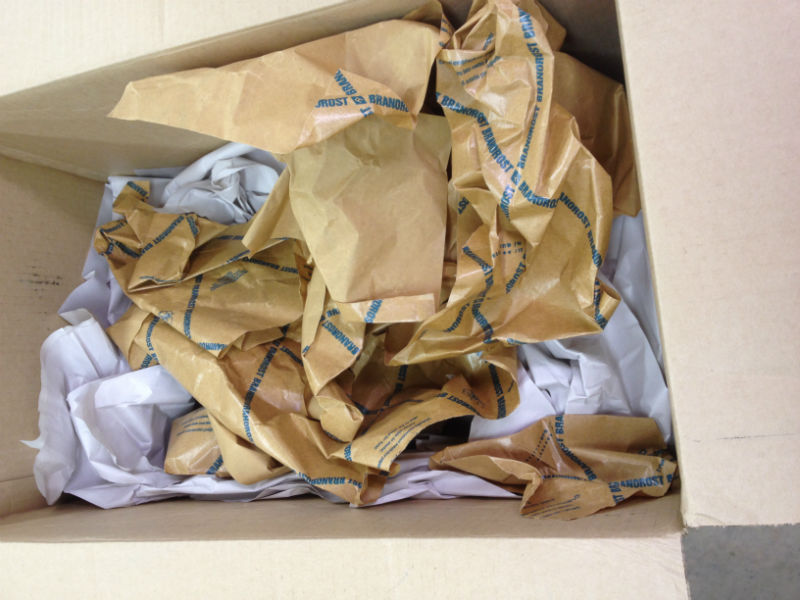
Some of my earliest Festools came protected in anti-corrosion paper. Any time I get some of this kind of paper, I hoard it. Think of it as adding to the value.

A box full of genuine Festool anti-corrosion paper collected after a tool shipment.

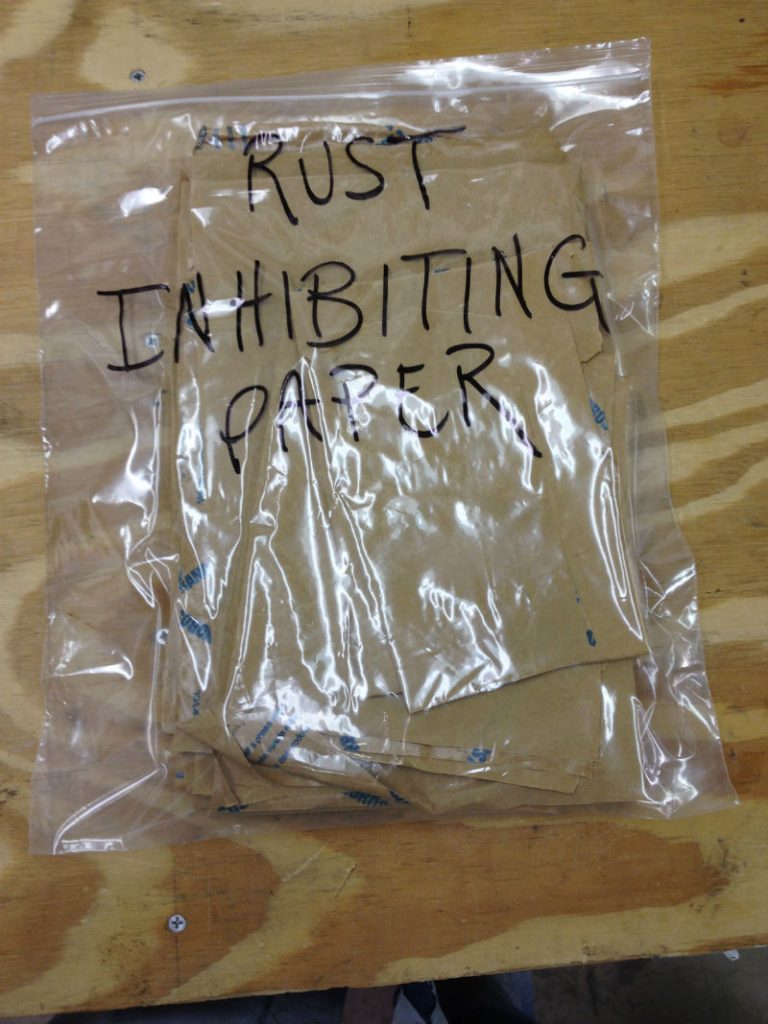
Step One is to seal it in one or more Ziploc bags to help retain the active ingredients.

A free zipper-locking bag provides long-lasting protection for one’s valuable protective paper.

The tools it originally protected may not need it after they leave the vicinity of the Atlantic Ocean, but both ferrous and iron-free tools around your shop can certainly benefit.

Have an old iron plane that mostly sits on a shelf? Wrap it up in corrosion-inhibiting paper.

These papers are technologically advanced. They start with kraft paper that scrapbookers would call “acid-free,” but, without getting bogged down in details, there is a lot more to it. Ingredients are added that vaporize over time, releasing the anti-corrosion effect as the calendar ticks by. Close the item and its protective paper in a  zipper-locking bag, and the vapors are trapped and “recycled” (although not permanently).

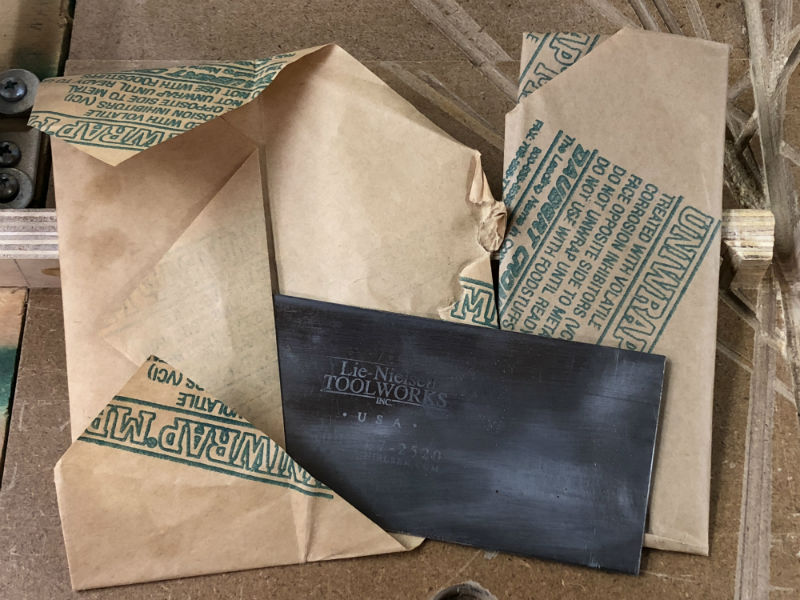
Not surprisingly, makers of fine planes and other metal tools also use corrosion resistance to protect their products in transit. There is no need for that protection to end with the shipping process, however. The Lie-Nielsen Card Scrapers pictured below stay in their protective paper whenever not in use.

Lie-Nielsen tools use the finest of components, and come to the end user fully protected. There is no reason they can’t stay protected.


Jim Randolph is a veterinarian in Long Beach, Mississippi. His earlier careers as lawn mower, dairy farmer, automobile mechanic, microwave communications electronics instructor and journeyman carpenter all influence his approach to woodworking. His favorite projects are furniture built for his wife, Brenda, and for their children and grandchildren. His and Brenda’s home, nicknamed Sticks-In-The-Mud, is built on pilings (sticks) near the wetlands (mud) on a bayou off Jourdan River. His shop is in the lower level of their home.Questions and comments on woodworking may be written below in the comments section. Questions about pet care should be directed to his blog on pet care, www.MyPetsDoctor.com. We regret that, because of high volume, not all inquiries can be answered personally.

Dec 032018
 

Welcome to “Tips From Sticks-In-The-Mud Woodshop.” I am a hobbyist who loves woodworking and writing for those who also love the craft. I have found some ways to accomplish tasks in the workshop that might be helpful to you, and I enjoy hearing your own problem-solving ideasPlease share them in the COMMENTS section of each tip.  If, in the process, I can also make you laugh, I have achieved 100% of my goals.

Festool has solved the problem of vacuum hoses abrading the edges of your workpieces by encasing the hose in a protective sleeve. They call it the Sleeved Antistatic Hose.

However, suppose you have the older Festool hose, or the plastic hose that came with your other-branded shop vacuum. Maybe it’s complicated by working on a project that requires you to do a lot of start-and-stop sanding. How simple can we make
the solution?

I ran into those very problems when I was making the round cedar picnic table pictured below.
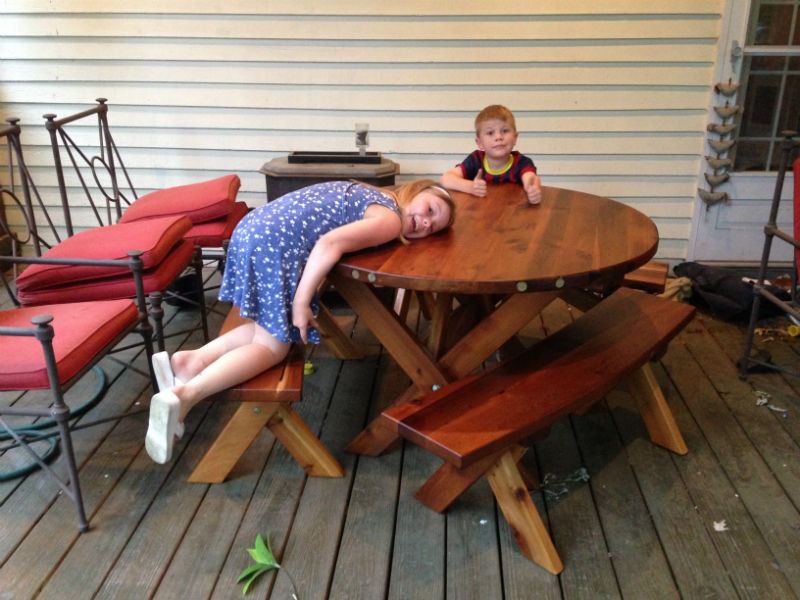
I think they like it!

Sanding cedar can be very tedious, as the wood is soft but the knots are hard. As I worked out little defects, I had to sand a bit, vacuum, examine, then sand more or move on to another defect. At that time, I didn’t have a dust separator on my Festool Dust Extractor, but I did have one in the ceiling, attached to a little Shop Vac Hangup.
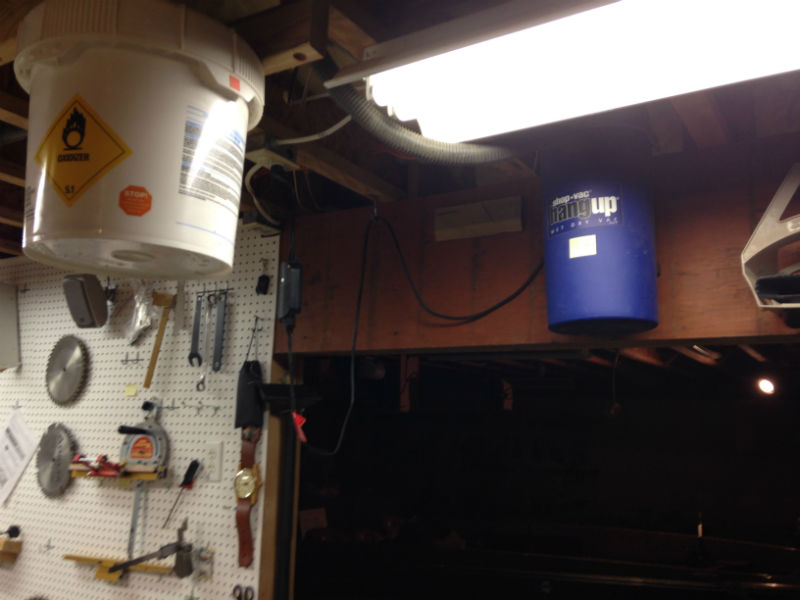
By mounting this mini-vacuum and a dust separator in the ceiling, attached to a long, long hose, I can vacuum
almost anywhere I do benchtop work in my shop.

As it happened, though, I was working at the extreme end of the length of the hose when I had the tabletop balanced on its edge on the floor. Thus, every time I stopped vacuuming, the hose wanted to recoil out of reach.

A couple of clamps solved the problem. I got a big squeeze clamp that would accommodate the diameter of the hose without crushing it, and another clamp to hold that clamp to a nearby table. Voila! The last 18 inches of the hose were handy when I needed to remove dust, and out of the way while I was sanding.
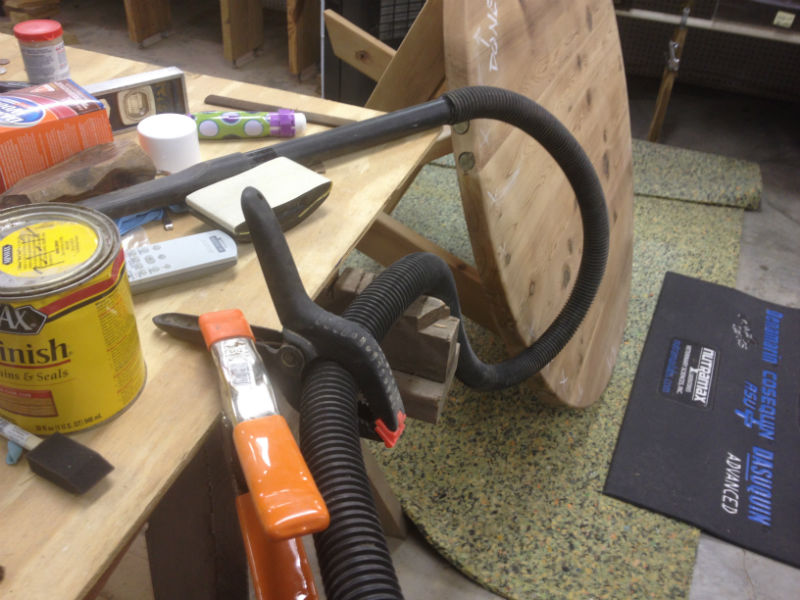
A couple of inexpensive squeeze clamps and my hose was both protected and available.

Then, there was the matter of repeatedly starting and stopping. No problem. I have a low-amperage remote switch that allows me to activate the vac from the work site. Further, you can order them with specific channels, allowing you to control separate tools
with additional units.

Of course, Festool has that covered now, too. Any current model of dust extractor can be retrofitted with a Bluetooth remote control. You can even mount the remote switch on the hose, so it’s always handy! Click here to order or learn more.

You want even more? How about a dust separator that mounts right on your Festool extractor? Yep, they have that, too, click here. Then click here to watch a video, and prepare to be amazed at how flexible this little addition is.

Now, if I’d just had all that when I was working on the table. It might not have taken me 18 months to finish!


Jim Randolph is a veterinarian in Long Beach, Mississippi. His earlier careers as lawn mower, dairy farmer, automobile mechanic, microwave communications electronics instructor and journeyman carpenter all influence his approach to woodworking. His favorite projects are furniture built for his wife, Brenda, and for their children and grandchildren. His and Brenda’s home, nicknamed Sticks-In-The-Mud, is built on pilings (sticks) near the wetlands (mud) on a bayou off Jourdan River. His shop is in the lower level of their home.Questions and comments on woodworking may be written below in the comments section. Questions about pet care should be directed to his blog on pet care, www.MyPetsDoctor.com. We regret that, because of high volume, not all inquiries can be answered personally.

Nov 202018
 

Not all of us have beautiful natural light pouring through the windows of our shop. And even if you do, you may still need more light in your shop. The sun does go down at the end of the day, after all, and we aren’t always done with our woodworking by sunset! If you are looking for a great light to shine on your woodworking, the Flex Arm Magnetic LED Work Light might be just what you are looking for.

Matthew Morris walks us through the key features of this flexible work light and shows off some of the convenient ways you can use it around your shop.

Click to find out more about the Flex Arm Magnetic LED Work Light, available at Highland Woodworking.

Nov 152018


We are excited to present the brand new fifth issue of Mortise & Tenon Magazine! Take a look at what Norm Reid had to say about it:

Once again, Joshua Klein and his co-editor Michael Updegraff have brought forth an eclectic and engaging gathering of articles about matters woodworking in Mortise & Tenon Magazine, Issue 5. As is their wont, the articles range widely in scope, emphasizing an historical perspective, with nary an electron-powered device in sight. While respect for tradition is evident throughout the issue, missing is the explicit attention to conservation and preservation that was evident in prior issues. Also missing is any attempt to present a how-to-do-it approach to our art and craft. What remains, though, is delightful and inspiring, as well as a darn good read.

Click here to read the rest of Norm’s review

Click here to purchase your own copy of Mortise & Tenon Magazine

Nov 132018
 

We all love spending time in our workshops, but what if we could make our shop a little nicer to be in by adding a couple of capable accessories? Listening to some music or a sports game would certainly make that sanding task go by more quickly. And a brightly lit space is much more enjoyable than a dark, poorly lit shop.

The Festool Sysrock and Festool Syslite II can help. Take a look at the video below to see our Down to Earth Woodworker Steve Johnson’s thoughts on the Festool Sysrock. And click the link below the video to read about the Festool Syslite II and why Steve no longer thinks of it as a ‘glorified, overpriced flashlight’.

More Than a Worklight: The Festool Syslite II

Click to find out more about the Festool Sysrock and the Festool Syslite II, both available at Highland Woodworking.