Highland Staff

Sep 262018
 

For a limited time, trade in any old tool that you already own (regardless of its age or condition, and it can even be a hand tool like a chisel or screwdriver) for a Festool 55 series Track Saw or any Festool Plunge Router. You will receive $100 cash back from Festool in the form of a prepaid Mastercard.

Here’s how it works. After you purchase your new Festool track saw or plunge router and register it online, Festool will send you a prepaid shipping label to allow you to ship the tool you’re trading in directly to Festool at no expense to you. You will receive your $100 prepaid Mastercard within 4-6 weeks of receiving the trade-in tool.

Take advantage of this opportunity to save while trading up to Festool quality and innovation. Hurry, offer ends October 31, 2018.

Click to shop eligible Festool Trade-up program tools

Sep 252018
 

If you are looking to improve the safety in your shop, the Micro Jig GRR-Ripper System is a very good start. Micro Jig is serious about making it safe to do the close work that sometimes has to be done on the tablesaw, router, jointer and bandsaw, letting you grip, hold and feed both sides of small workpieces, ripping strips as narrow as 1/4 inch (down to 1/8 inch with an optional leg).

In the video below, David Picciuto takes a closer look at the Micro Jig GRR-Ripper System.

Click to find out more information about the Micro Jig GRR-Ripper Advanced GR-200 System available at Highland Woodworking.

Sep 212018
 

I have been hearing about Joseph Moxon and his book Mechanick Exercises for several years now.  Christopher Schwarz of Lost Art Press writes about Moxon all the time and was able to find some details of the Moxon vise in Andre Roubo’s L’art du Menuisier, including a detailed drawing at Plate 280 of a twin screw wide clamping vise.

Over the years there have been several iterations of the Moxon vise. Benchcrafted in particular has a wonderful version of the vise which includes screws and hand wheels. Highland sells the hardware and you furnish the lumber. Lake Erie Toolworks offers another version through Highland and their version comes with the lumber included.

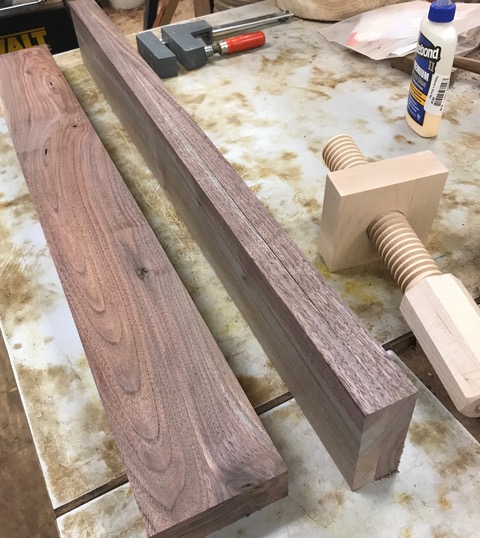
A new kit by Acer-Ferrous Toolworks just came on the scene at only $99.99. I got a kit from Highland to put together and give you my opinion. Included in the kit are two wooden screws and two wooden nuts made from lovely hard maple and beautifully machined with wooden threads. You will have to furnish your own wood for the jaws, recommended at 4 inches wide and 1-1/2 inches thick. The length can be whatever you want it to be depending on what kind of work you plan on doing. The instructions recommend 32 inches long which should give you about 24 inches or so of clamping room between the screws.

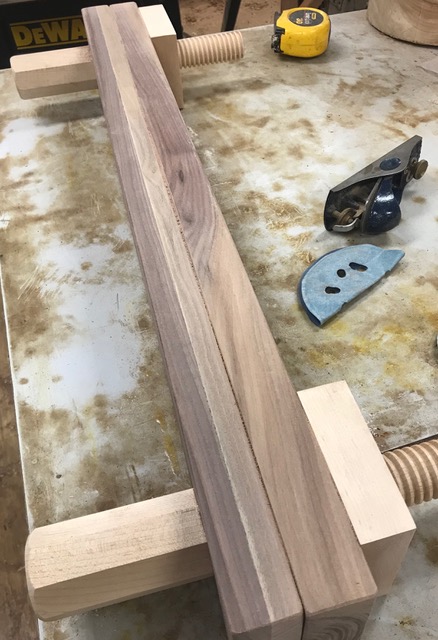
I have had some rough sawn walnut drying in my basement for several years, so I pulled out some of it to make the jaws. I only had enough inch and a half material for one jaw so I glued up two thinner pieces to make the other. I milled them both down to the dimensions recommended on the plans and then set out the holes for drilling on my drill press. As recommended, I used a 1-1/2 inch spade bit which moved right through the walnut jaws. It is critical to have the holes perpendicular to the face of the jaws, so the drill press is the best way to go. Once the holes were drilled, the next task was to glue the wooded nuts to the back of the rear jaw. The trick is to get them in exactly the right spot so they line up with the screw holes in the jaws and let the screws run true. The way to line the screws with the rear jaw holes is to wrap the threads with a shim to keep them centered. The instructions recommend cardboard from a cereal box, though they did not say what brand you had to use.  I only had Honey Nut Cheerios and since I wasn’t sure that would work, I found some thin cardboard in the shop.  
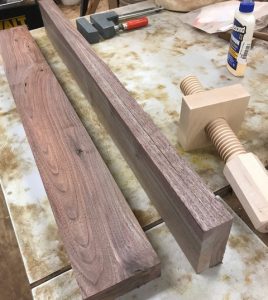
I wrapped the threads with the cardboard and added painter’s tape to get close to the diameter needed to slide snugly through the drilled hole in the rear jaw.  By setting the nut in place on the outside and turning the screw tight through both jaws, I was able to clamp the nut to the outside of the rear jaw while the cardboard shim centered the screw in the rear jaw hole. When I was sure it was all in the right place, I loosened the nut and spread some glue on it, carefully avoiding the threads so it was not one big piece of expensive fire wood. When the glue dried, I screwed the vise apart, saving the tape and cardboard, and then put the other nut on and glued it the same way.

After the glue was dry, I put the whole thing together and checked it out. I realized I had made the jaws slightly shorter than the nuts, so I planed and sanded all the pieces to the same height. I broke all the sharp edges on both jaws to make it pleasing to the touch and it was ready to try out.
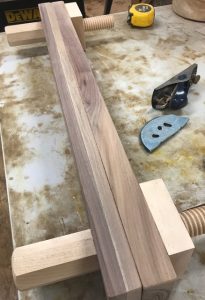
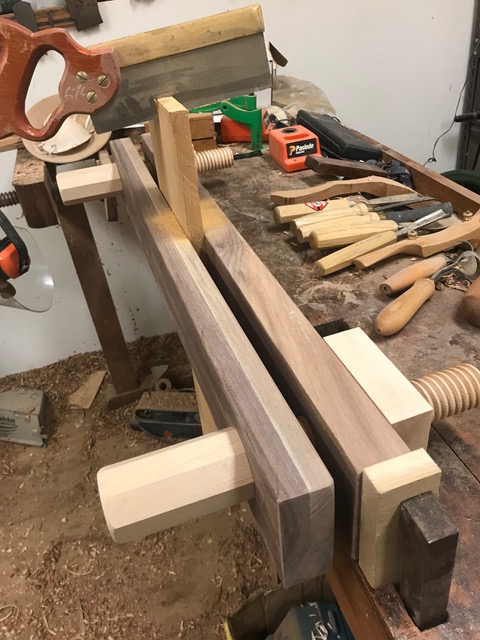
When mounted on my bench it certainly works as advertised. Clamping pressure is strong with very little effort. The increase in working bench height due to the height of the jaws is very pleasant when you are trying to do any kind of cuts on the end of a  board. Obviously, this thing lives for making dovetails on the end of long wide boards like a blanket chest or a tool chest. Anything up to about 24 inches wide and maybe 40 inches long would work without any problem.  The whole thing is very sturdy and easy to use.
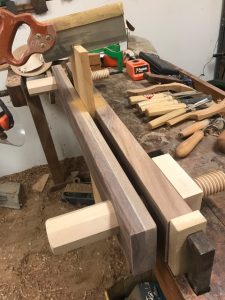
If I were to make another one of these, (and you can look for this one at the store in the next few days if you want to try it out), I would probably make two changes. While looking over the literature to write this article, I saw where some recommend dropping the bottom edge of the front jaw say half an inch below the rear jaw. That way, the rear jaw sits on top of the bench, and the front jaw is used to align the vise to the front face of the bench. As built, any board clamped into the vise aligns it to the bench, a solution which works nicely for small boards but would be awkward for larger boards.

The second change would likely be a small clamping piece attached to the rear of the back jaw. If you notice in the photo above, my bench dogs are set in from the edge of the bench just a little too far to let the bench dogs grab the vise directly.  If the vise had a clamping piece or was mounted on a flat base that extended onto the bench, then the bench dogs could grab, or two hold downs would catch. In addition, if the front jaw were made shorter than the back jaw, clamping would be easier.

Several articles I saw recommend making a beveled top on the front jaw, so if you are making blind dovetails and need to tilt your saw to the ceiling to keep from cutting the face of the finished dovetail piece, it could be more easily done.  I think it would be easier to simply raise the workpiece.

I have not put finish on the vise yet, though I think I will do so. Several articles recommended not finishing the clamping faces to make it easier to hold the workpiece.

All in all, a good piece of equipment. With a little adaptation to your particular workbench, and if you do the kind of work this vise lends itself to, then the Acer Ferrous Moxon Vise Kit is well worth the price. Stop by the store and get your hands on it and see how you like it.

Sep 192018
 

With comfortable pivoting handles, large jaw capacity, and much more, Highland’s new Non-Slip Parallel Bar Clamps will be versatile workhorses in your shop. The sliding jaw incorporates an anti-slip system to prevent it from free fall sliding on the rail when used vertically, yet the jaw slides quickly into position by pushing the handle slightly towards the rail for sliding it closed and pulling it away from the rail to slide the jaw open. These clamps will ease the stress of time-sensitive glue-ups and make life easier for you in the workshop.

In the video below, Justin Moon takes a closer look at these clamps.

Click to find out more information about the Non-Slip Parallel Bar Clamps available at Highland Woodworking.

Sep 122018
 

If you are looking to give your shop a bit more flexibility, we’ve got the perfect tool for you. The Rikon 10 inch Bandsaw 10-305 is compact and well-made. It is an excellent starter band saw for those on a budget and useful to owners of larger bandsaws who want to reduce the hassles of blade changes for separate cutting operations.

In the video below, Mike Morton takes a closer look at the Rikon 10-305. Watch the video to learn the basics for setting up and using this tool in your own shop. Please note the Rikon 10″ bandsaws are now blue, rather than the green shown in the video.

Click here to find out more information about the Rikon 10″ Bandsaw available at Highland Woodworking.

Sep 052018
 

Let’s face it: Almost no one is giving away free tools, free wood and free fasteners. You need money to feed your woodworking obsession.

If you’re like most of us, you like the finer things in life. In woodworking life, anyway. Sure, you can make pretty shavings with a $5 vintage plane, but isn’t that Lie-Nielsen No. 8 Jointer Plane a thing of beauty? You know you want it. Go ahead. Click on the link. It costs nothing to look.

Now, you’re hooked.

Whether it’s a Festool Router, Festool Dust Extractor, or just a really nice Chisel, we simply like the good stuff.

Mama always told me, “You have to spend money to make money.” If you’re working wood for a living, you’d better have plenty of efficiency built into your work to pay your shop rent, your help and your utilities. Along with that, you need to cover the cost of expendables, such as materials and hardware, as well as things that wear out like belts, sharpening stones and tools that need to be replaced.

When I was a tournament bass fisherman, it was my goal to earn enough in winnings to pay for my boat, a kazillion rods and reels, lures and all the gas it took to pull and run the boat.

I was dreaming.

I’ve never dreamed of being a professional woodworker, but I do try to pay for woodworking without sinking the household budget.

To accomplish that, I dedicate my writing income to woodworking and, if I write enough words for enough magazines, I can cover the cost of tools and wood both. It keeps me busy! On that note, Highland Woodworking is always looking for more Wood News contributors and they pay in Highland Woodworking store credit if you want to earn some new tools!

Sitting on the cedar deck, the Bayou in the foreground, my Number One Cat helping me write. I think this article will be a winner.


Jim Randolph is a veterinarian in Long Beach, Mississippi. His earlier careers as lawn mower, dairy farmer, automobile mechanic, microwave communications electronics instructor and journeyman carpenter all influence his approach to woodworking. His favorite projects are furniture built for his wife, Brenda, and for their children and grandchildren. His and Brenda’s home, nicknamed Sticks-In-The-Mud, is built on pilings (sticks) near the wetlands (mud) on a bayou off Jourdan River. His shop is in the lower level of their home.Questions and comments on woodworking may be written below in the comments section. Questions about pet care should be directed to his blog on pet care, www.MyPetsDoctor.com. We regret that, because of high volume, not all inquiries can be answered personally.

Sep 042018
 

No Southern-fried Southern boy wants to be called a Yankee, but we share the characteristics of shrewdness and thrift. Thus, each month we include a money-saving tip. It’s OK if you call me “cheap.

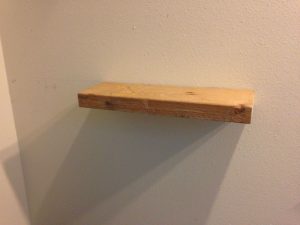
Before I made the Domino-supported shelf in this month’s other tip, I had a different foray into floating shelves.

Brenda and I have a treadmill in our shared home office. It doesn’t see much use, not for the usual American reason, but because we prefer to walk outdoors when the weather cooperates. However, if it’s raining when I arise at 4:45 AM, I need entertainment to help pass 45 minutes of drudgery. Walking outside is naturally entertaining. TiVo allows us to have our favorite shows at the ready. For me, that’s This Old House, New Yankee Workshop reruns and everyone’s favorite Highland Woodworking entertainer, Roy Underhill in The Woodwright’s Shop.

For years I had a bulky CRT television sitting on the desk, but, when it died, it made perfect sense to free up desk space and raise my viewing to head height on the treadmill. Looking down at the TV was always hard on the neck, and this was my chance to remedy that.

Requirement #1: Fill the space from the window to the wall. Requirement #2: Enough strength to support the television, speakers, TiVo Mini and a couple of remote controls. Requirement #3: It had to be cheap. No surprise there!

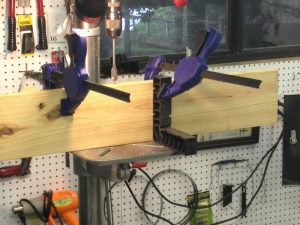
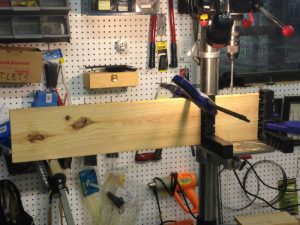
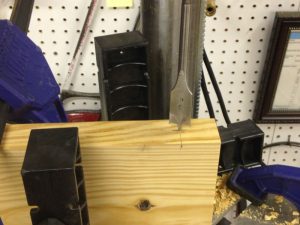
I’ve laid out the steps in the photo series below.

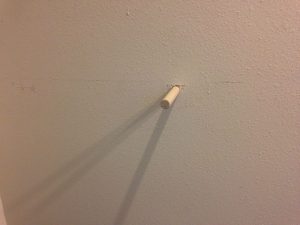
There were three studs I could access. Because I was putting 3/4″ dowels in 1-1⁄2″ studs, the centering had to be close to ideal. Also, the drill had to be perpendicular to the wall. Since the wall was almost perfectly plumb, I was able to use the level on the back of the DeWalt drill.

I had an untreated pine 2×6 that had enough depth and length to accommodate the TV, so I practiced with a little scrap first to ensure I could drill straight into it. The scrap fit well.

Once I had three dowels in the wall I was able to mark the exact spot to drill the shelf for perfect alignment. To square the shelf to the drill press, I had clamps everywhere! The middle hole was the easiest, and I could clamp a square front and back on the drill press table.

The next hole was a bigger challenge. The second square wouldn’t fit on the back for the squares to counteract each other. Also, working alone, I had to have support for the length of the board.

The end hole was the biggest challenge. It wouldn’t matter whether the first two were perfect if the board leveraged itself out of alignment and this hole was off. The “back” square even had to go sideways!

The dead blow hammer I’d just bought came in super handy, as the fit was really tight. We moved into this house 23 years ago this Thanksgiving. Brenda was able to find a quart of paint left over from painting our office. It hadn’t been touched in all those years. I took it to Sherwin-Williams and asked them to shake it. The fellow who greeted me seemed to be an experienced manager type. He looked at the can. He looked at me. He looked back at the can (which was in pristine condition, not a spot of rust on it). After a moment he said, “You’ve had this one a while, haven’t you? We haven’t made this line of paint in years and years.” I told him the story, and how all I needed was enough paint for the shelf and the wall adjacent to it. He cheerfully shook the can and even thanked me. Now, that’s customer service!


Jim Randolph is a veterinarian in Long Beach, Mississippi. His earlier careers as lawn mower, dairy farmer, automobile mechanic, microwave communications electronics instructor and journeyman carpenter all influence his approach to woodworking. His favorite projects are furniture built for his wife, Brenda, and for their children and grandchildren. His and Brenda’s home, nicknamed Sticks-In-The-Mud, is built on pilings (sticks) near the wetlands (mud) on a bayou off Jourdan River. His shop is in the lower level of their home.Questions and comments on woodworking may be written below in the comments section. Questions about pet care should be directed to his blog on pet care, www.MyPetsDoctor.com. We regret that, because of high volume, not all inquiries can be answered personally.