Highland Staff

Jan 222016
 

Editor’s Note: The following blog series, ‘Chips from the Chisel’ is John Gainey’s experience as a carpenter and joiner apprentice on the Cardiff Docks in South Wales from 1955-1960. John’s garden woodworking shop was featured in the November 2013 issue of Wood News Online.

CLICK HERE to read Part 1.

CLICK HERE to read Part 2.

The Yard and Workshops

The workshops overlooked the commercial dry dock where ships came in for repair, cleaning, and painting.

The building was an old stone victorian type. At the start was the top office. Underneath that was the timekeepers office where we collected our brass discs or checks for time in and out, and our wages. My first number and one of many obtained through life was 806, with which I collected my wage of 2 pounds, 17 shillings, and 6 pence.

Next was the plumbers and tinsmiths. Then the electricians. Next were the stores with ladders and heavy equipment. Next to that were the bricklayers (jokingly referred to as failed carpenters to us). Next the painters and decorators and special crew called scruffers. These men worked in the dry dock and red-leaded the side of the ships using long handled brushes to reach the underneath and sides with the red lead paint. At the end of the day, their boots, clothes, hats, and faces were all red with paint. There were no showers or baths, so they went home like that.

Then there was the mill, the carpenters shop, and the wheelwright shop.

The Mill

The mill contained the basic machines. A very large circular saw that took two men to lift out the blade for sharpening, especially done when a nail or sometimes a bullet from the war was deep inside the timber and the teeth were damaged. Also within the mill were a large bandsaw, small circular saw, tenoner, planer, and an old iron lathe that was run with a wide belt that clanked noisily. On it we turned chisel handles made from old hickory shunting poles discarded by the railway men but still usable by us. Then the cattle pens, blacksmiths, and patternmakers shop.

The Sawyer

All blades and saws were continually kept sharp and true. Floors were swept clean at the end of the working day. As to the jobs, he only accepted mortising if it was authorized by the carpenter. All apprentices had to chop out their own by hand, large or small, but he would reluctantly put stuff through the saw and planer for us. The occasional packet of cigarettes was a good bribe now and then to have a mortice chopped, but not too often.

The Characters

One old character was Mr. George. He was quite a small chap and wore an old suit (very shiny from age), an old cap, and an off-white scarf around his neck.

The wheelwright’s shop was down in the yard and was overlooked by the carpenters shop. Often it was enveloped in blue smoke pouring out of the doors and windows. Then the cry of “George has missed the hole again” was given by an observer. What that meant was that George,  when repairing a cart or sack, would have to bore a hole for a long bolt, first through one end then through the other, as the bit was not long enough to go right through. But George would occasionally miss joining the two holes. So he would put a poker in the fire til’ it was red hot, then burn down the hole until it made contact with the other hole. This enabled the bolt to go right through, but as was noted, resulted in much smoke pouring out of the work shop, leaving George glassy-eyed, coughing, wheezing, and gasping for breath. But still with a smile on his face!

During lunch time, we apprentices would go down to see him and to hear him tell us the tale of working life when he was strong and healthy; and how colorful it was too!

Another character was a man called Mr. Jack. He was a laborer. A very, very quiet man. In fact, during all the time I knew him I never heard him speak. He was, I presumed, traumatized from his experiences in the war. He always wore the same old shiny suit with no shirt, just an old jumper, and an off-white scarf around his neck. My attention was drawn to him when I had just begun my apprenticeship.

I was told that if I needed help timber carrying I could ask Jack “Snot” to assist. This name seemed to me derogatory and insulting to call him, as I was brought up to not be disrespectful to people, especially adults. The reason for the derogatory name was that Jack always had a perpetual dewdrop positioned on the end of his nose that always looked about to fall (and at times did) on the job that was being worked on. Some would say he timed it to fall on the shove halfpenny board when it was his turn and always won the game. But I think that was an exaggeration made up by a poor loser. He was always very helpful to all of the apprentices.

Jack lived in a district called Tiger Bay and cycled to work on a very old upright bike. But what was so unusual was his means of lighting. The obligatory front lamp was a lit candle in a jam jar tied on to the handlebars. The rear light was a glowing cigarette held behind him, so he would draw and hold, draw and hold, all the way to the workshop. I often think how I would have loved to have heard his story, but at the same time as a young man I didn’t pursue it, much to my regret.

All of the men in the workshop were characters in their own right. They all had pride in their work from carpenters to laborers, from painters to shipwrights, they all had respect for each trade and the material being used. There was plenty of banter (what new apprentice hasn’t been sent to trundle all the way back to the stores to ask for a skirting ladder or a bucket of sky hooks??), but never anything malicious and they always shared a desire to teach the apprentice. They were willing to pass on their knowledge, skill, and experience, and I am grateful for that!

To be continued…

Jan 202016
 

hwtfrontWelcome to 2016 with a brand new issue of The Highland Woodturner, Highland Woodworking’s newsletter geared toward turners from beginning to advanced!

In this month’s issue:

A Case for Prototyping: The Vise Project– Curtis Turner discusses a recent project where he turned a new round handle to replace one of his customer’s traditional vise handles. In this article, Curtis discusses his process for the project as well as the problems he encountered while working on the project.

What’s the “Right” Way to Use Friction Polish?– Rick Morris discusses different types of Friction Polish that are out on the market for your finishing needs. He also performs several tests to find out the following:

  • Should friction polish be applied with the lathe running or stopped?
  • What type of applicator should the polish be applied with?
  • What speed should the lathe be running while polishing?
  • How much sanding is enough for the friction polish to make a high-gloss finish?

Show Us Your Woodturning- Aaron Thomas– Aaron is a disabled war veteran who has turned to woodworking, specifically turning, in order to help him cope with PTSD. He specializes in Native American Flutes, as well as table lamps, standing lamps, and oil lamps.

Phil’s Turning Tip: Making a Morse Taper Reamer– If you have a morse taper that won’t sit properly in the quill, you’ll want to check out Phil’s tip on making a reamer to clean the quill.

Featured Products:

Rikon 70-220VSR 12-1/2 inch Midi Lathe– If you’re looking for a new lathe to replace your old one or to get started in woodturning, the Rikon 70-220 is a great solution, which is designed to handle a wide variety of projects.

Flex Arm Magnetic LED Work Light– One of our most popular items, this work light will help save your eyes and brighten up your workspace for improved accuracy.

Jan 152016
 

Editor’s Note: The following blog series, ‘Chips from the Chisel’ is John Gainey’s experience as a carpenter and joiner apprentice on the Cardiff Docks in South Wales from 1955-1960. John’s garden woodworking shop was featured in the November 2013 issue of Wood News Online.

CLICK HERE to read Part 1.

Workshop Furniture

The workshop contained everyday items for general use, namely long seating benches, small stool benches, saw horses, trestles, bench hooks, clamp blocks, mitre box, mitre block, and of course not one but two shove halfpenny boards, one of oak and the other of greenheart- french chalked.

Each man’s bench was his own personal domain or world of work (his bench was sacrosanct). It was never worked on by any other person except by permission. Some old timers would not even allow anyone to sit on the bench as this was considered bad manners.

The Glue

The glue was toffee like slabs known as hoof glue. The apprentice would wrap the slab in an old piece of sacking and break up the slab by hitting it with a mallet until it was as small as possible. Two pots were on the stove, one contained water that was brought to a boil and the other was inside the large pot and contained the melting glue. The smell could only be remembered and described by those who have used it…

When gluing up a job, speed was essential, as was accuracy of squareness using rods from corner to corner. Even to this day I still think I have to work with speed during a glue up, in case the glue goes off (of course hot glue is no longer used in the modern workshop).

All of this work was for a wage of 12 pounds for a 40 hour work week!

The Apprentice

There were 5 apprentices in our workshop. The wage was 2.17 pounds for a junior apprentice and 5 pounds for the senior apprentice, with one whole day and one evening at technical college.

Handmade Tools

The first thing to make was the tool box (mine is now a stained and waxed blanket box in the bedroom). Dovetailed, brass handled, GWR stamped into it, box lock, trays and mitre skirting, and lid with beaded edging were just a few highlighted features of the box. It stood on the bench when finished and was looked at with such pride and accomplishment (only to be told to get it down to the paint shop to be painted black).

Next was the mallet, ash or beech, and was used with a tapered handle for removing if need be. The head was angled and the cheeks rounded to avoid bruising the job at hand. The shape and size was a matter of personal choice. The apprentice usually followed the advice of the craftsman.

Next were the planes: rabbet plane, scruffer with horned handle, and grannie’s tooth.

Finally, the oil stone box. Morticed with hinged lid and a nail snipped off on the bottom to prevent sliding. All of these were carefully made. Skills and knowledge were acquired by the minute from the pool of experience around each apprentice.

Tools were bought with due care and attention was only given to the best brands used: Spear and Jackson, Marples, Mawhood, etc.

I made a ghastly mistake of purchasing 3 wood chisels from Woolworths and brought them to the workshop. The craftsman took one look at them and said “they are not going down on my bench” so I threw them away and from then on always bought the best, even though it took time to save the money to get them.

The Work

The range of work was extensive including desks and drawers for the draughtsman’s office, pontoon decking, and doors and windows on the dock buildings.

Warehouse doors were framed, ledged and braced 18ft by 10ft with tongue and grooved boards. When assembling, the tenons were coated with prime paint and then wedged and dowelled. They were then lowered down to the mill through two trap doors in the middle of the workshop, into the paint shop, and then taken to the site for hanging on iron sliding shoes. The door was placed in position. A rope was attached and the laborers would pull the door upright for the carpenter to fit it on the metal shoes and slides. The warehouses are still there to this day and are now used by a well-known timber dealer.

There were trestles to be made for the potato warehouse. Sizes ranged from 4 feet to 15 feet for the wooden chutes or trays to rest on and the sacks of potatoes were sent down them to the waiting lorries. They were well-made with sawn timber used for all of the edges and the corners were chamfered. Pride of workmanship was always found in these projects.

The walls of the workshop were lined with templates. Patterns and clamps of every description.

The diminished style door, or gunstock style door, was artistry of the craft. A combination of window and door for maximum light, with fielded panels and bolection moulding.

The apprentice practiced making joints to acquire the skills necessary to learn the differences between a haunch and franking, a muntin and mullion, the style and the jamb, the tails and pins, fox wedging and dowels, the mortise and tenon, just to name a few. The books obtained were Carpentry and Joinery (Volumes 1, 2, and 3 by Caxton Press). Volume 2 contained the mystic of the steel square.

The knowledge and discipline of the craft had to be learnt and followed.

To be continued next week…

Jan 082016
 

Editor’s Note: The following blog series, ‘Chips from the Chisel’ is John Gainey’s experience as a carpenter and joiner apprentice on the Cardiff Docks in South Wales from 1955-1960. John’s garden woodworking shop was featured in the November 2013 issue of Wood News Online.

johngainey

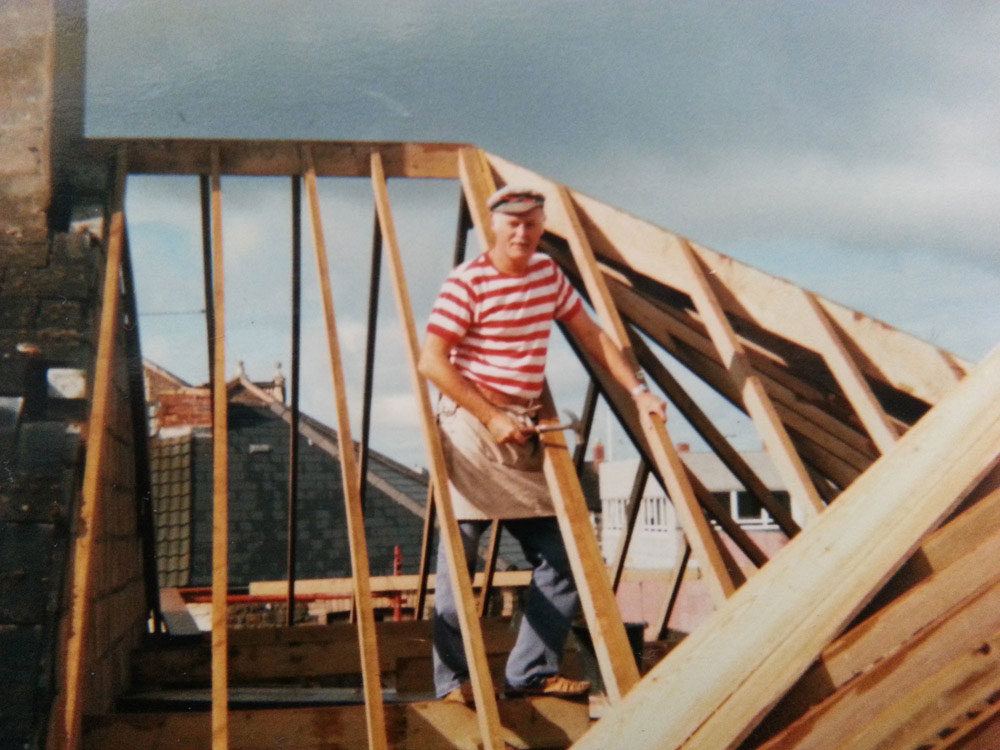
I stood at the top of the stairs and looked down the long workshop. I saw workbenches, men’s faces, and white aprons. It was 1955, I was 15 years of age and just left school. I was nervous and shy.

One of the men in a white apron beckoned me over to him. I walked to his bench and there I started my career as an apprentice carpenter and joiner…

I got the job because my mother was an office cleaner for the Great Western Railway. (GWR) The Docks and Inland Waterways, and The Pierhead Building at Cardiff (which is now a museum). This entitled her to two free tickets a year on the railway and any member of her family was able to work at a trade for the GWR. There were a number of trades I was offered, including carpentry and joinery.

The Workshop Benches and Furniture

The workshop was above the mill on the first floor. It contained every day items for general use, namely long seating benches, small stool benches, saw horses, trestles, bench hooks, clamp blocks, mitre box, and of course not one, but two shove halfpenny boards (one of oak and the other of greenheart-french chalked).

The shop consisted of nine workbenches, double sided, each approximately 12 feet long with metal vices and some wooden vices at each end. The well of the bench contained loose boards that could be lifted out to hide personal work from the foreman’s notice. There was also a drawer on each side for the tools used that day. The tops of some of the benches were chipped and gnarled from years of use. Underneath was a shelf containing offcuts of different jobs and woods of every kind.

Each man’s bench was his own personal domain or world of work (his bench was sacrosanct). It was never worked on by any other person except by permission. Some old timers would not even allow anyone to sit on the bench, as this was considered bad manners.

The Men

The men were either carpenters and joiners, qualified to wear the white apron as a badge of their trade, or just carpenters. The carpenters were unqualified and so they did the rough work on the docks such as lock gates, pontoons, coal tips (which lifted the coal wagons and tipped the coal into the waiting ships). These men wore the blue overalls of the GWR workforce. Hanging above their benches on the wall were various tools used daily: an adze, crosscut saw, and large auger bits with a hole at the end for a wooden handle, which ranged in size from 2 to 4 inches. I remember being allowed to use the adze on a piece of greenheart for a lock gate. The edge had to be rounded over; the men joked that it would be safer to stand with your feet in 2 buckets to avoid cutting the toes off.

At each bench was a large, black wooden toolbox with white initials painted on the front, which no one would go into without permission (an unspeakable crime if done so). Billy cans and enamel mugs were stored in a small cupboard hanging on the wall by each bench containing tea, sugar, and a tin of condensed milk. A small mess room for eating meals was at the end of the shop, but was rarely used as the men preferred to eat at their benches and stretch out on top for a snooze at the dinner hour. Woe betide the apprentice who made a noise during that sacred hour.

The Tools

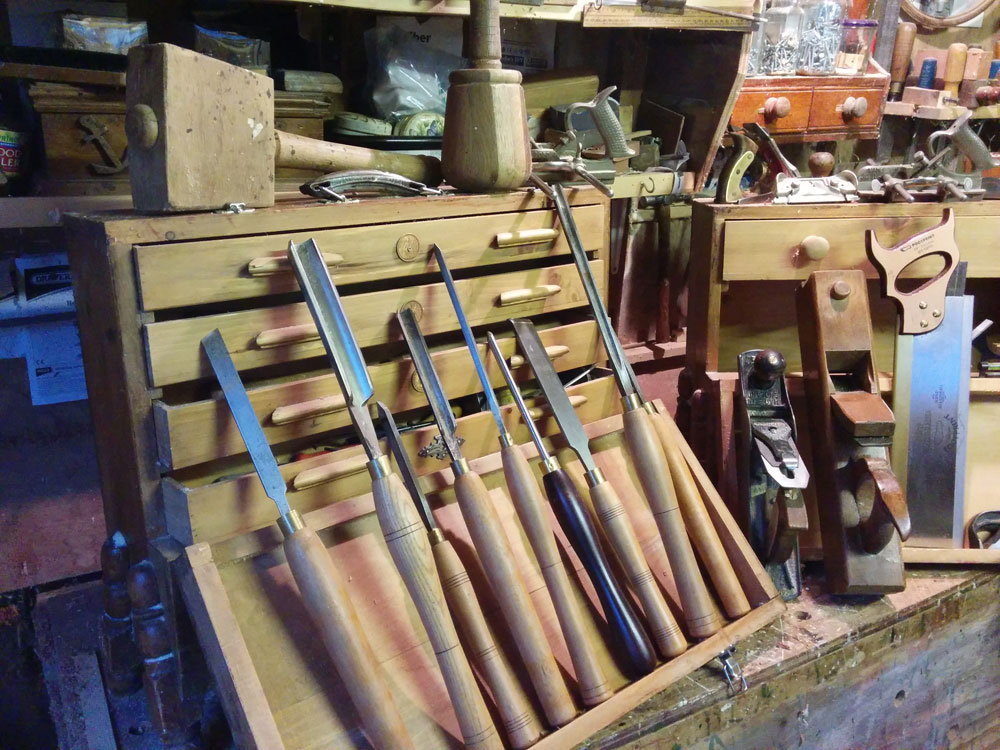
tools

Each man’s tool chest contained his saws (the rip, panel, dovetail, and coping saw), chisels, hammers, mallet, screw drivers, moulding planes, squares, and gauges, wheel brace and drills, Stanley ratchet brace, and bits protected in a bit roll and the wings kept sharp. The bits ranged from a quarter to one and a quarter.

A rare piece was the sight of an expanding bit with a single spur and moveable wing for larger holes. No electrical drills were seen or used, no electrical tools of any description were seen on the benches. Holes in the wall were made by hitting a rawlplug chisel with a hammer (and the occasional knuckle).

Saws were sharpened by the craftsman himself on the saw horse, especially after the terrible misfortune of hitting a nail secreted in the timber or a slotted screw joint when reducing a table top. When that happened then a groan would go up from all who heard it and felt it as happening to their own saw. Then a saw set was brought into action, the spring type with a dial for T, P, I.

A file went along the length to even the teeth height. Then one side sharpened, then the other, avoiding what was called ducks and drakes, meaning large and small or uneven teeth.

No matter what kind of saw, the same loving care was taken on the joiners personal saw. Then they were oiled and stored in the tool chest on buttons attached to the under side of the lid.

Of course the most desired or prized saw was the Henry Disston of Philadelphia, USA. The combination of Philadelphia steel and the expertise of Henry Disston who served his time with Spear and Jackson of Sheffield, England, made it the most sought after and prized saw to be obtained.

The tool chest contained moulding planes of various shapes and sizes. The bead, ovolo, round, and hollow (no routers then) were all carefully stored in a safe position for the cutting iron. Also in the tool chest were the Sash Fillister (or plough) with its brass tipped ends, spokeshaves (wooden and iron), wooden jackplanes, wooden smoothers, all stamped with the craftsman’s name. Although most men desired and had the metal jack and smoother planes made by Stanley.

The oil stones, both rough and smooth, were encased in a mortised out box and lid, lovingly protected and cleaned. Slip stones for gouges and moulding plane irons were all stored with oily rags covering them from damage in the safe drawers of the tool chest.

Paring chisels, firmer, mortise and bevelled, cleaned and edges protected in the drawers. They were always used with a mallet, never hit with a hammer. That was considered to be the wanton action of a botcher and a sin to the joiners code of conduct. A craftsman was assessed by the condition of his chisels. A splintered top on a chisel handle was a sure sign of mistreatment and the sign of a botcher.

To be continued

Jan 052016
 

No Southern-fried Southern boy wants to be called a Yankee, but we share the characteristics of shrewdness and thrift. Thus, each month we include a money-saving tip. It’s OK if you call me “cheap.”

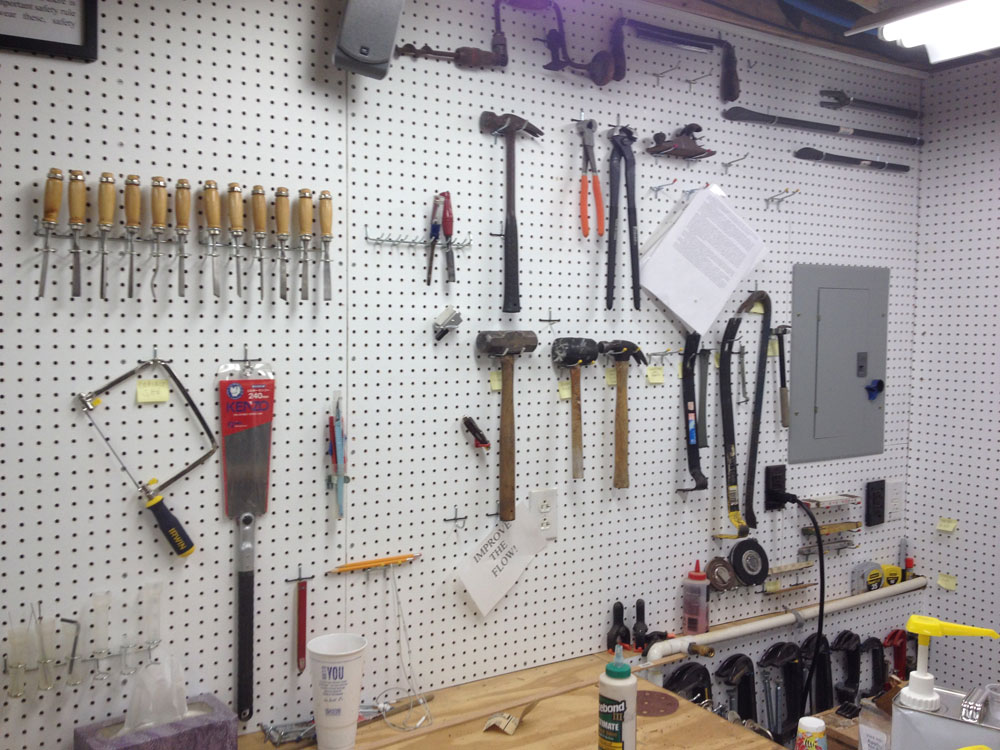
Good light reflection is supplied by white pegboard on all shop walls.

Good light reflection is supplied by white pegboard on all shop walls.

To make the most of the light fixtures installed, almost everything in my shop is white, or very light-colored.  I purchased white pegboard, which cost more initially, but saved a ton of time and mess compared to painting natural, dark brown pegboard and dealing with the inevitable runs as paint drips from the peg holes.  When we first moved to this home on the bayou, bass fishing was my number one hobby, and I never intended to get so heavy into woodworking and furniture-making, much less having virtual visitors in my shop.  If I’d known, I might have put a white ceiling in before installing the lights.

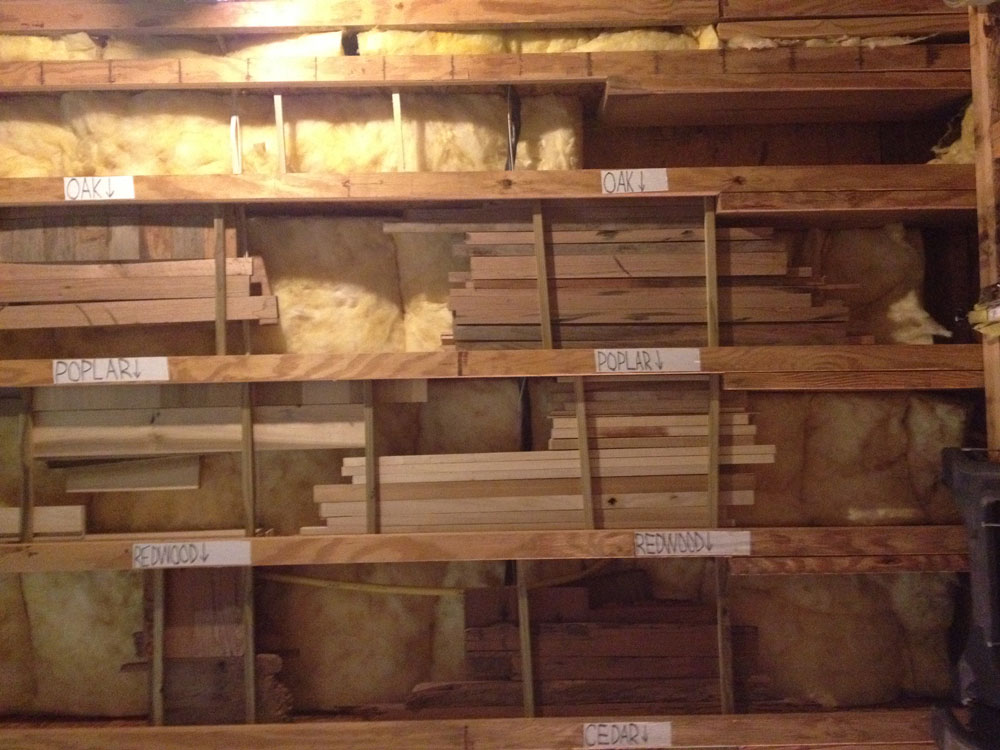
On the other hand, if I had covered the ceiling, I’d have lost all of this good storage space.

On the other hand, if I had covered the ceiling, I’d have lost all of this good storage space.

Wooden tool cabinets are either painted white or finished in their natural, light wooden color.

Even in areas where there is no wall-covering, I’ve lightened up the decor by painting natural-color studs with leftover white paint when working out brushes and rollers.

Everything that can be a lighter color is painted or covered to maximize reflection of light.

Everything that can be a lighter color is painted or covered to maximize reflection of light.

Jim Randolph is a veterinarian in Long Beach, Mississippi. His earlier careers as lawn mower, dairy farmer, automobile mechanic, microwave communications electronics instructor and journeyman carpenter all influence his approach to woodworking. His favorite projects are furniture built for his wife, Brenda, and for their children and grandchildren. His and Brenda’s home, nicknamed Sticks-In-The-Mud, is built on pilings (sticks) near the wetlands (mud) on a bayou off Jourdan River. His shop is in the lower level of their home. Questions and comments on woodworking may be written below in the comments section. Questions about pet care should be directed to his blog on pet care, www.MyPetsDoctor.com. We regret that, because of high volume, not all inquiries can be answered personally.

Jan 042016
 

Welcome to “Tips From Sticks-In-The-Mud Woodshop.” I am a hobbyist, not a professional, someone who loves woodworking, just like you do. I have found some better ways to accomplish tasks in the workshop and look forward to sharing those with you each month, as well as hearing your problem-solving ideas.

As you might imagine, I’m much too cheap to have hired a lighting designer to help with the process of choosing and placing illumination fixtures in my shop.

On the other hand, I didn’t scrimp on the number of lights, and there were several good reasons:

  • Insufficient light in a workplace potentially creates unsafe conditions.
  • Poor lighting might lead to mistakes and do-overs, which cost time and money.  Such mistakes might occur in missing a needed repair, sanding or even finishing.  Not being able to see one’s tape or rule could lead to a major boo-boo!
  • As we age, we need more light on our work.

We built our house 19 years ago last Thanksgiving, when I was only 43.  I haven’t needed additional lights because I was generous with them in the beginning.

Still, there are times a task calls for intense light.

It’s dark in there!

It’s dark in there!

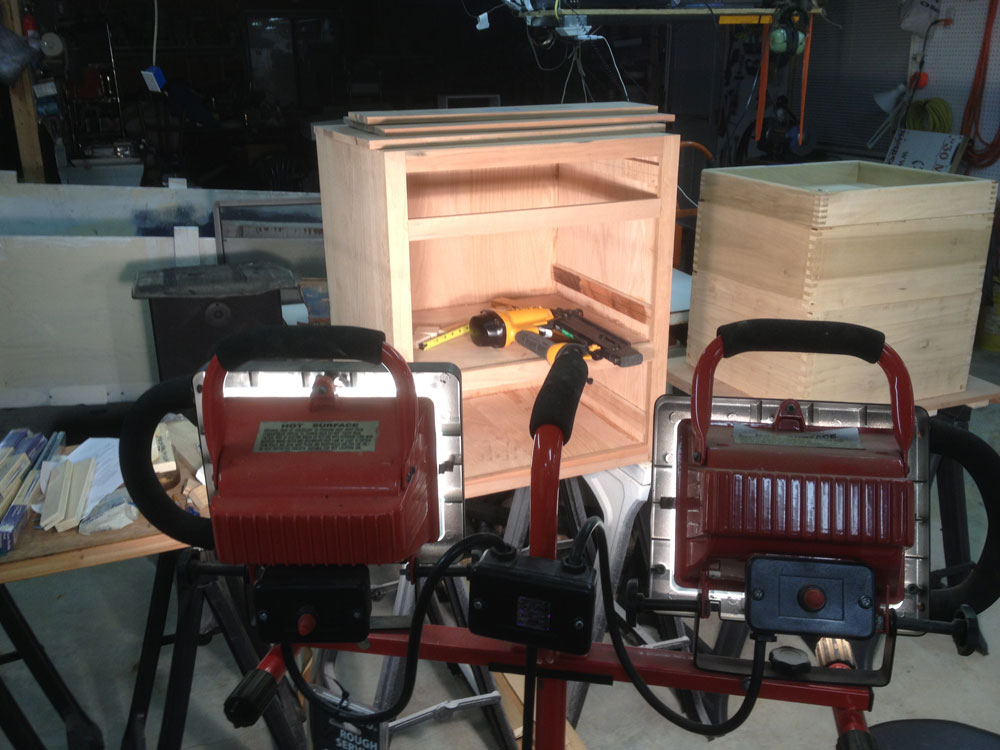
I have the work lights you see pictured, and I’m quick to set them up when a job will require extra light for a significant time period, such as installing drawer slides inside a cabinet.

70_2

A story goes with these lights picture above.  They were in the garage when Hurricane Katrina’s floodwaters came, and I was ready to throw them into the trash pile.  One of our sons, Andy, wanted to plug them into the generator so we could continue our cleaning work into the night.  With my background in electronics, I was more than a little nervous, to say nothing of protective of our children, who had come all the way from Kentucky to rescue us.  We switched both lights on, plugged them into the silent generator, then pulled the starting rope.  To my surprise, the lights came on, and have continued to operate flawlessly for the subsequent ten years.

There are other times localized lighting is needed for just a few moments.  Enter my mother-in-law.  Well, not exactly, but the Christmas present she gave me several years ago.  Since she doesn’t read the column, I’ll admit what I thought when I opened my Christmas package a few Decembers ago:  “What the heck use do I have for this?”  Little did I know!

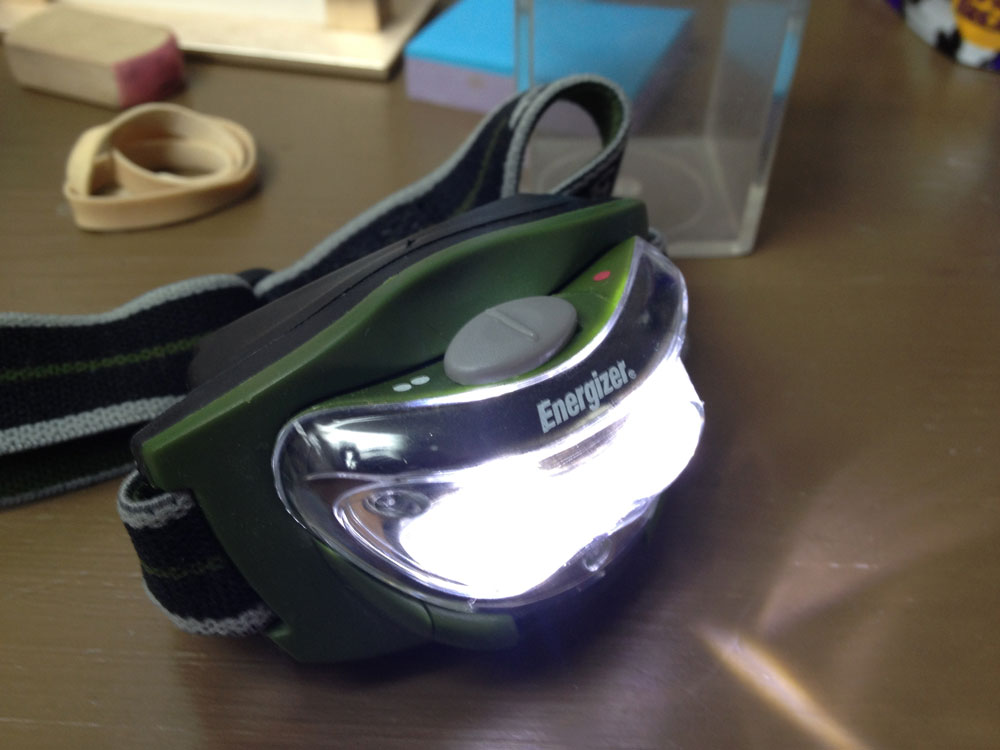
For years, I underestimated the value of this little headlight until I used it one day. Now it sees service regularly!

For years, I underestimated the value of this little headlight until I used it one day. Now it sees service regularly!

I kept the headlight on a peg hook for emergencies when the electricity went out.  One day, I needed a lot of light in a small space, didn’t want to drag out the big lights, and thought of the headlight.  It fit the bill perfectly.  Since then I’ve used it many times to illuminate a hard-to-see project step.  It’s especially useful when working in the inky darkness of the inside of a table saw.  Elusive nuts and washers suddenly appear in its halogen blue-white glow.

You can get a perfectly suitable headlight from $12 to $30 at any big box store. There is no need to spring for the $1600 Heine model!

Jim Randolph is a veterinarian in Long Beach, Mississippi. His earlier careers as lawn mower, dairy farmer, automobile mechanic, microwave communications electronics instructor and journeyman carpenter all influence his approach to woodworking. His favorite projects are furniture built for his wife, Brenda, and for their children and grandchildren. His and Brenda’s home, nicknamed Sticks-In-The-Mud, is built on pilings (sticks) near the wetlands (mud) on a bayou off Jourdan River. His shop is in the lower level of their home. Questions and comments on woodworking may be written below in the comments section. Questions about pet care should be directed to his blog on pet care, www.MyPetsDoctor.com. We regret that, because of high volume, not all inquiries can be answered personally.

Jan 022016
 

Welcome to our 2016 Woodworking Resolutions blogger series. Every year we invite our bloggers to share their resolutions specific to their woodworking goals for the new year. Click each link below to read our bloggers’ resolutions!

Well, it’s that time of year again, when we—like the two-faced Roman god Janus for whom January is named—take a look back at what we’ve accomplished (or not!) and then look ahead to what we resolve to achieve in the coming year.

My biggest accomplishment, despite a damaged ankle that will soon require surgery, was to finally complete a pair of oak bedside tables. These Stickley-inspired pieces will soon rest in the bedroom of my step-son, where I hope they’ll bring great joy. But aside from small things—a fishtail pipe box of curly maple, for instance—I didn’t accomplish nearly all I wanted to do, or that I’m capable of doing. My resolutions for 2016 are intended to correct that.

One reason I did so much less than I wanted in 2015 was the disorder in my woodshop. I don’t have enough storage space and the space I do have is not used to best advantage. So my first set of resolutions is intended to help me be more efficient and productive in the shop. I’ll start by decluttering my space so it is ready for work whenever I walk into it. I resolve also to reorganize the layout of my tools and work stations to enhance my workflow. And I plan to build some things to improve my organization—a joinery bench with the Benchcrafted Moxon vise that’s waiting to be installed, a saw till to replace the one that’s too small for my collection, a hand tool storage cabinet so my chisels and planes have a better place to live than on my bench top, and a mobile storage cart that combines space for sheet goods, boards and prized shorts and offcuts.

My power tools merit attention as well. I resolve to set aside regular time for maintenance so my tools get the servicing they need before problems arise. I also resolve to get an Elipse P100 dust mask and filters and really use it to protect my lungs. And 2016 just may be the year I upgrade my Sawstop with the new sliding table.

As a co-owner of Shenandoah Tool Works, I resolve to increase my production of our ever-popular birdcage awls by improving my efficiency at the lathe. And just maybe, my partner and I will introduce a new tool for this year, incorporating the same fine hardwood handles as our mallets and awls. But, shhh, it’s too soon to talk about that.

All of this prep work is intended to result in some completed projects. Sure, I’ll lose two months’ shop time after my ankle surgery, but since I’ll be more efficient, I should get more done, right? So I hereby resolve to build the following things in 2016:

  • A Queen Anne dressing table for my wife Betsy out of some figured walnut I’ve got stored
  • A chair to go with the dressing table, maybe?
  • A dining table for my step-daughter
  • A Shaker-inspired coffee table for my sister
  • Some boxes using the figured walnut and ash I’ve been saving up
  • Bowls and hollow forms at my lathe
  • Some natural edge coffee tables out of figured slabs I’ve been hoarding
  • A Chippendale secretary of figured cherry that I started years ago
  • A mahogany lap desk (or two) like the one used by Thomas Jefferson
  • A bookshelf to tame my burgeoning library of woodworking volumes
  • A cupboard to store canned goods in the kitchen
  • Some knife handles for Ron Hock kitchen knife blades
  • Wine bottle stoppers, pens and other small turned objects
  • And I’m so forgetful, I’m sure I’ve left something off this list, but it’ll probably come to me later

Oh my, as I look at it now, I wonder what I’ll think about this list when next year comes around? I suspect I’ll say to myself, “what in the world was I thinking”?

May 2016 be kind to you and your family and may your woodworking time be productive and, most important, fulfilling.