Highland Staff

Dec 172015
 

Only a few years ago, I was new to woodworking. Recently retired, I found the time to pursue a long-deferred interest, making things with my favorite medium, wood. I began by taking classes offered locally. Then began the inevitable progression of tool acquisitions, power tools at first, then hand tools, especially planes. The problem with planes, though, was the fact that I barely knew how to use them. Frankly, I was frightened into believing that sharpening was a skill that would forever remain beyond my capacity.

Then I discovered a class on hand planes in the Marc Adams School catalog. Chris Schwarz and Tom Lie-Nielsen were the instructors for the weekend class and I decided to learn from the best. So, with my best friend in tow, I headed for Indianapolis. That class was all I’d hoped it would be and more. In two days, I learned the basics of planing and sharpening and how to set up my planes for use in my own woodshop. Though hardly yet an expert, I nonetheless felt equipped for the next step in my woodworking growth.

I came back from that class full of enthusiasm, perhaps more than was then warranted. I quickly leaped to the assumption that now I knew enough about hand planes to teach a class of my own. So I applied to teach a local class and, to my naïve delight, was accepted.

Only later did the moment of truth arrive. Petrified is not too strong a word for how I felt. Fear of failure drove me to read back over my class notes obsessively, gleaning every bit of knowledge I could from my classroom experience. And I read everything I could get my hands on, Chris Schwarz’ Handplane Essentials and Garrett Hack’s The Handplane Book being the most informative and useful sources. Still, I felt only half prepared and wished as hard as I could that I had never volunteered to teach at all.

Teaching day came and went and all my worry went for naught. My preparations pulled me through and the first class went very well. The students got a lot out of it and none of the anticipated complaints materialized. Yet while I could see that the students learned a lot, it was clear that I had gotten even more than they did from the experience.

It seems there’s nothing like the pressure to prepare for teaching to burn a new skill or bit of knowledge into your brain. Since that first class, I’ve taught hand planes classes maybe a couple dozen times. And always when I teach, I learn something new. I no longer need to study before each class. My learning takes a different pathway now. Always students ask questions I never thought to ask myself, prompting me to delve into knowledge lying below the surface of my mind or to think through issues for the first time. Sometimes, the questions prompt research after class that leads to entirely new learning.

My students’ progress during the day-long class and the excitement and confidence that builds on their faces show me I’ve given them all I can squeeze into a single day. At the same time, I know I’ve learned more to deepen my own knowledge and skills than I ever could by taking a class or reading alone. I think I qualify as an expert hand plane user now. That’s an outcome I might never have achieved if I hadn’t decided to delve into learning by teaching.

Norm Reid is a woodworker, writer, and woodworking instructor living in Virginia’s Blue Ridge Mountains with his wife, a woodshop full of power and hand tools and four cats who think they are cabinetmaker’s assistants. He is the author of the forthcoming book, Choosing and Using Handplanes. He can be contacted at nreid@fcc.net.
Dec 152015
 

For several years I have made Christmas ornaments as gifts. Several went to co-workers at ornament exchange parties and others were given to family and friends as gifts. After retirement, I resolved to furnish a tree with mostly handmade wooden ornaments.

A friend of mine had decorated trees for a local charity (Kootenai Health Foundation “Festival of Trees”) so I approached her to help with the design for the 2015 event. This annual event consists of approximately 30 decorated trees that are displayed at a local resort hotel and then donated for a fund raising auction. Debbie Lane agreed to design my tree with a railroad theme. My nephew, Jake, agreed to supply some of the materials required and my brother, Bryce (the model train enthusiast), was enlisted as rail car adviser. So last February I started on the focal piece of the project, a model train set entirely handmade from wood.

I have often used reclaimed and scrap materials for ornaments and other projects so I searched my scraps and tried to utilize materials that were already on hand. Jake provided two planks, one cedar and one pine, from his 1910 era barn. Several people gave me tree trimmings and I purchased the wood stock of another woodworker at his estate sale.

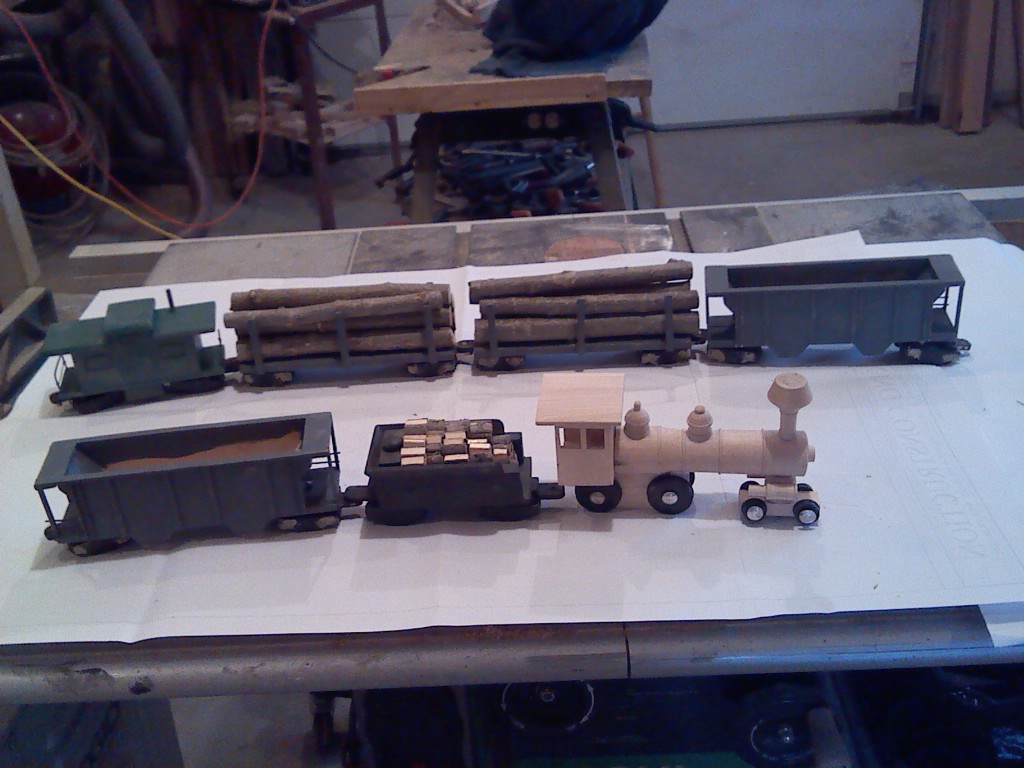
I searched the net for pictures of antique rail cars and used them in the design of the set. My first challenge was to lay out the cars to a common “gauge” and proportion. Each car had eight wheels anchored in swivel trucks and mounted on steel axels. This was the most tedious task of the project as the total 64 wheels had to be turned to equal diameter including the typical flange common to all rail wheels.   Each car was then fitted with a steel pin that extended into the car and allowed the truck to pivot. All the cars were then fitted with typical details to mimic the original. Most have access ladders. The caboose has a smoke stack for its wood stove, the log cars have real wood logs strapped to them with chains, the ore cars have real gravel heaped to their tops, and the tender has real split firewood ready for stoking.

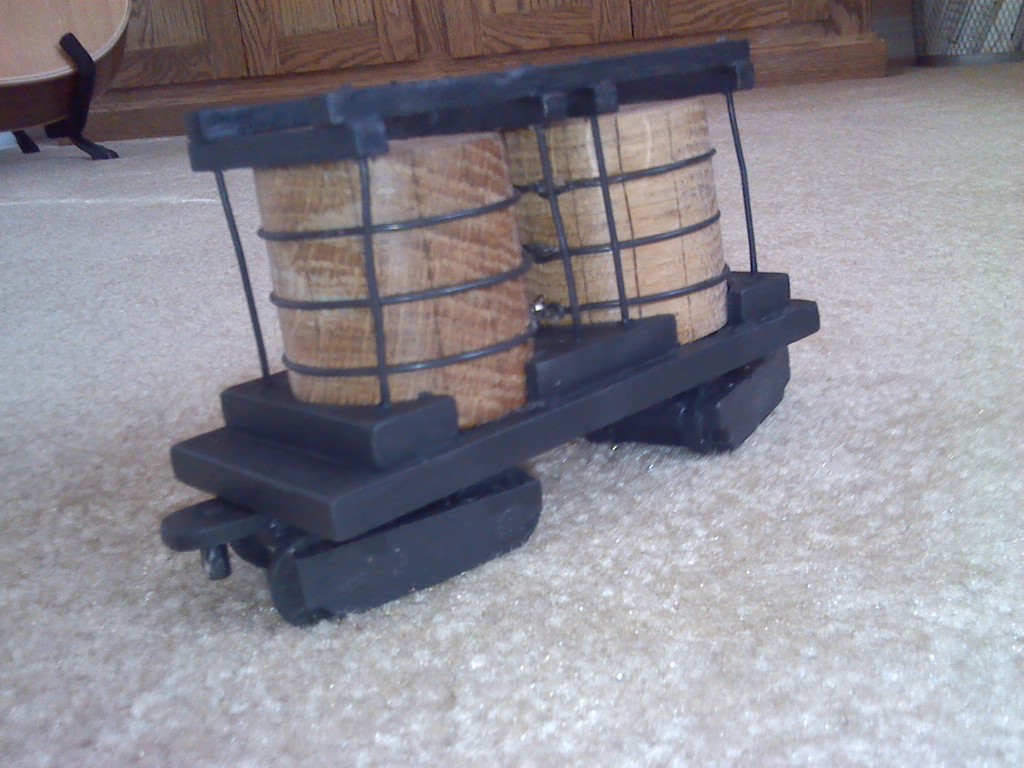
My expectation was the train would be set out on tracks in front of the tree so I made two boxes from the pine planks to store the train out of season. When I laid out the boxes I discovered there was room for an additional car. The tank car was made as an afterthought to fill this space.

1 train set

2 tank car

As the train set was in progress, I turned to making ornaments. Debbie urged we buy a nine foot artificial tree and, when I asked how many ornaments would be required, she replied “lots.” Event rules require the tree to be decorated on all sides. I made the ornaments in sets of a dozen so there would be a sufficient amount to go on all sides. Bells, complete with clackers, were turned from the cedar plank. Small balls with painted belt were turned from maple. Flat mahogany medallions, turned to 3 inch diameter and engraved with railroad company logos, continued the train theme.

3 medallions

4 small balls

For the fourth set of ornaments I settled on large balls. As the pine plank was not thick enough to turn four inch balls, I made them in two pieces glued together at their hemisphere. This allowed me to hollow them out to reduce weight. Finally Chris Root, one of Debbie’s crew made a set of glass balls covered with wood beads.

6 large balls

7 beaded balls

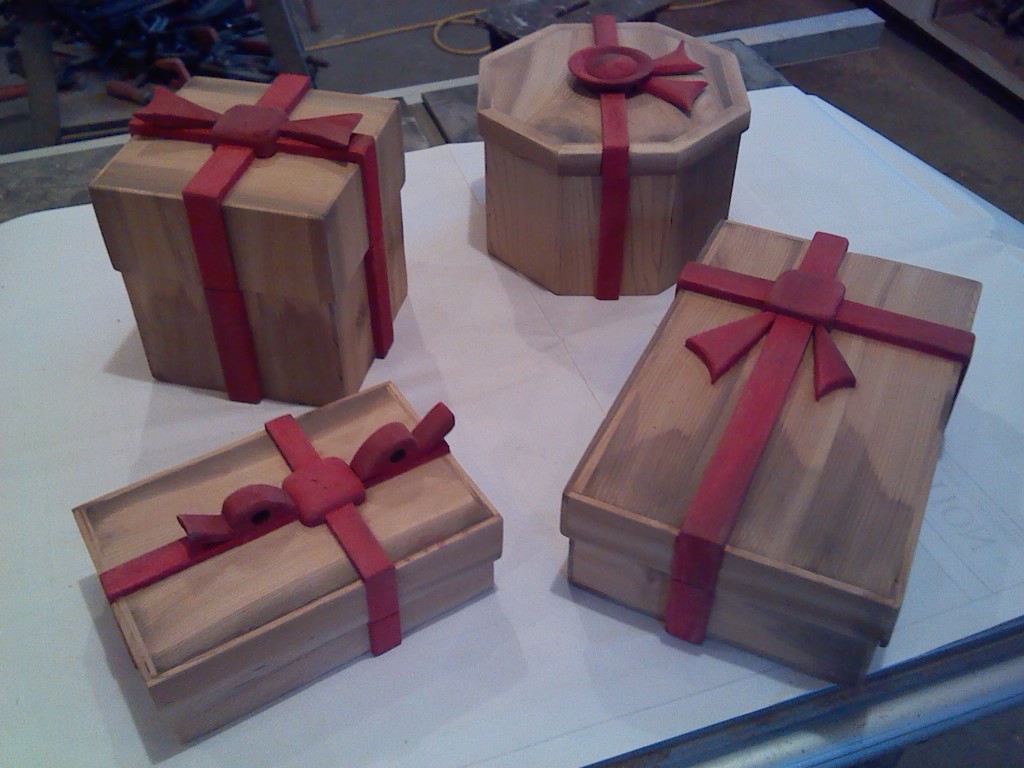
As an added surprise, I made four wood boxes from the cedar plank. Each was to be filled with its own treat. One had foil covered candy coins, the second contained handmade Christmas cards, another chocolate oranges, and the third candy canes. Each item represented traditional Christmas gifts.

8 boxes

9 box filled

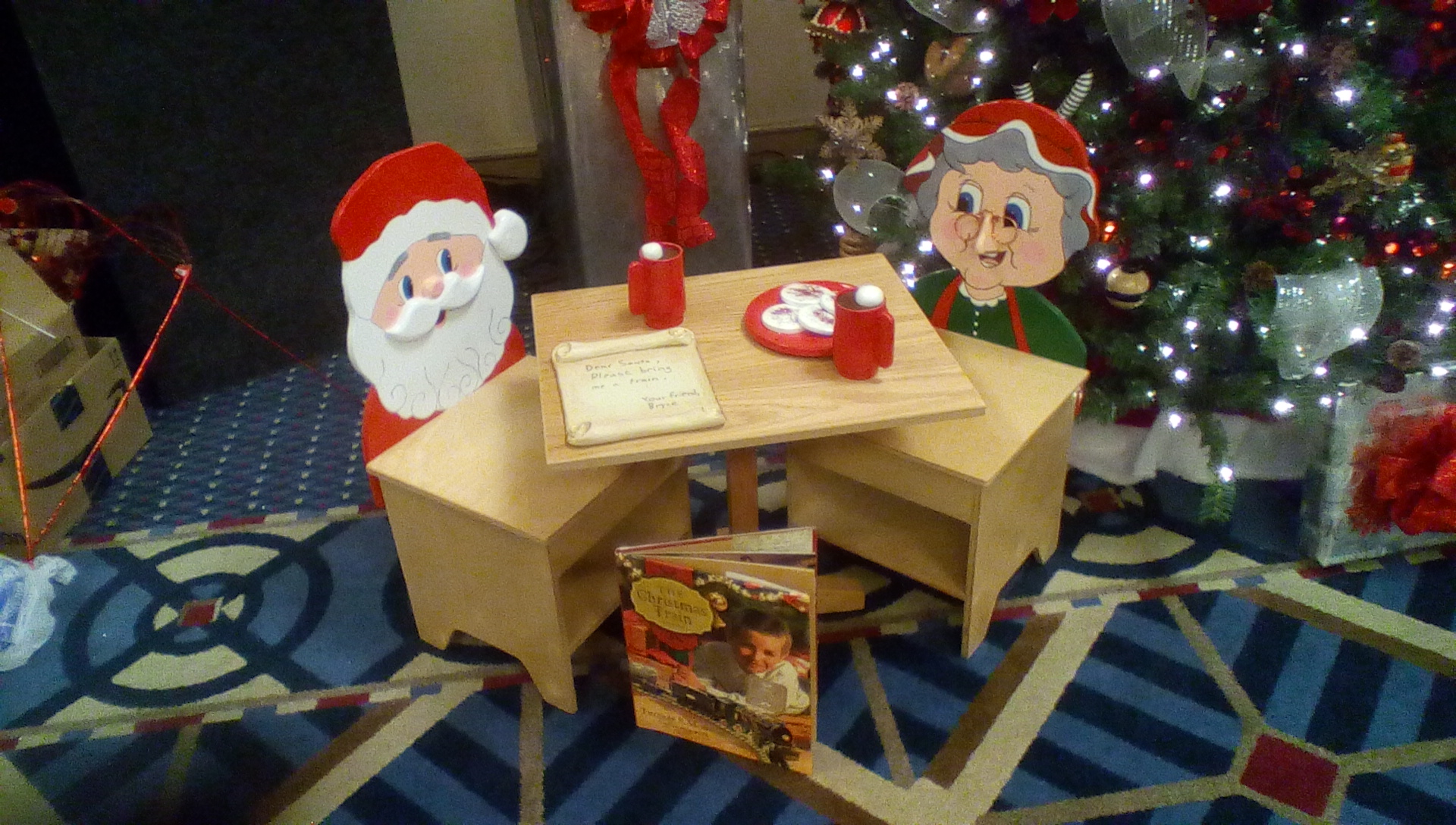
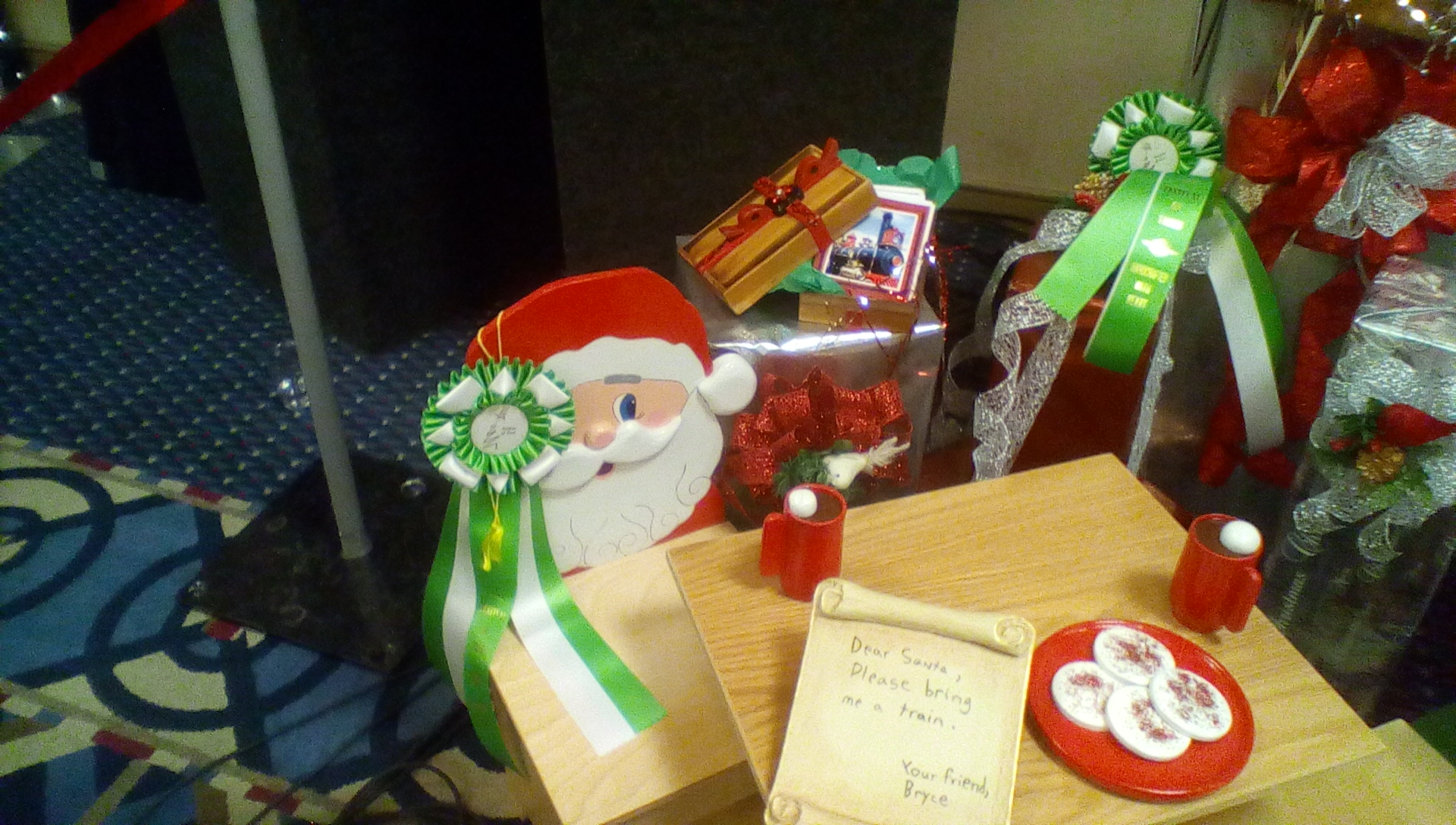
About mid-October more than 70 handmade ornaments were ready for decoration. I turned my attention to peripheral items that would surround the tree. I had previously made children’s theme chairs and decided to make a Santa and Mrs Santa set for our tree. Debbie, in addition to being a decorator and a talented artist, drew the chair backs and I added a table. Debbie then painted the chair backs. Of course, the scene could not be complete without a snack for Santa, so I added a plate of decorated sugar cookies and two mugs of cocoa complete with marshmallows, all made out of wood.

10 table

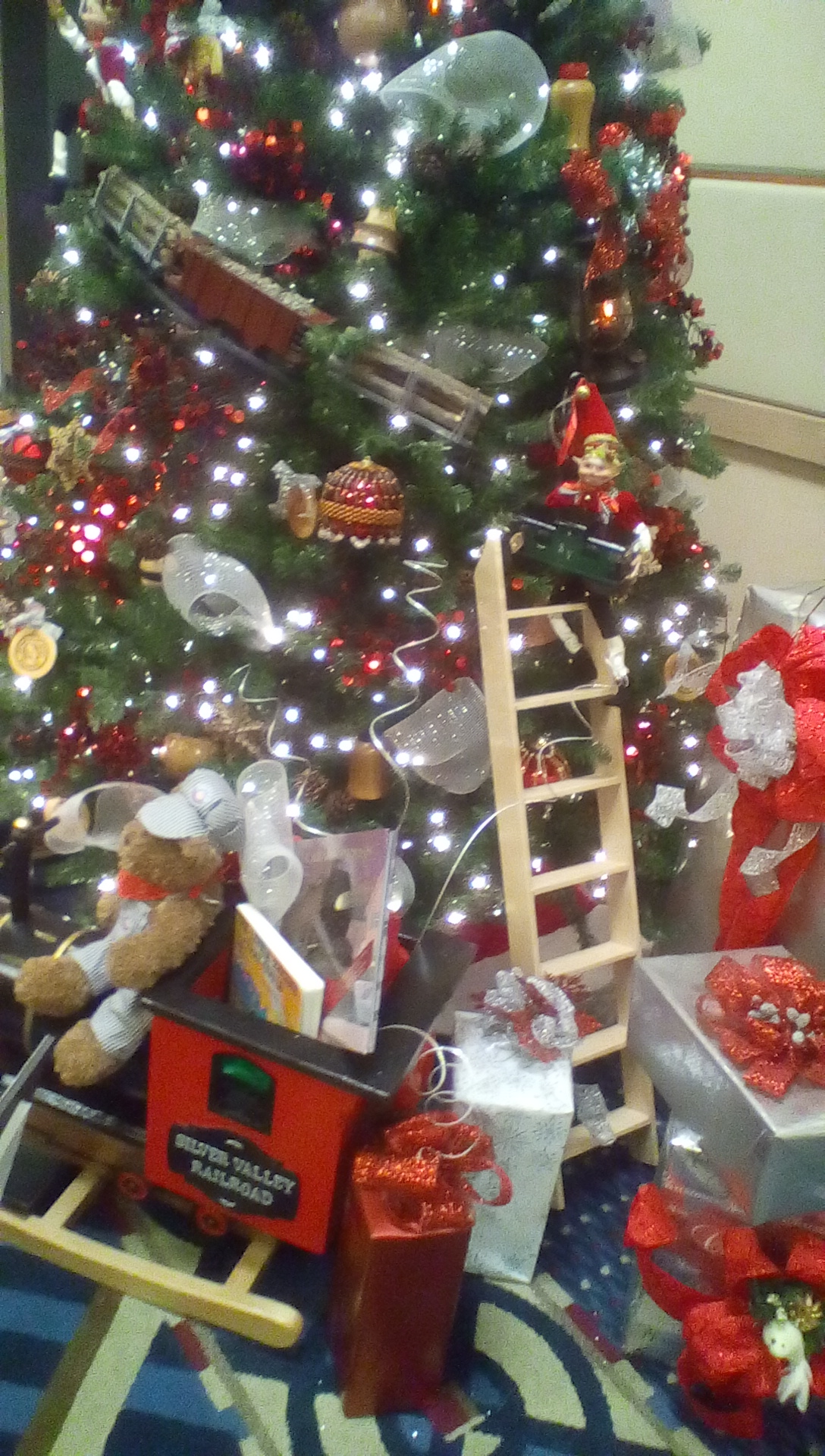
As the Thanksgiving Day deadline loomed, Debbie and her design partner Kim Torgeson sprang into creative action. The tree was purchased and set up in my garage as that was the only place with enough ceiling height. Immediately they decided the train set would be better displayed as a part of the tree. It was decided to mounted it to the track and suspend it climbing up the side of the tree. To complete the scene, an elf doll was envisioned climbing a ladder to carry the caboose into place and I was commissioned to build the ladder.

11 train finished

12 elf

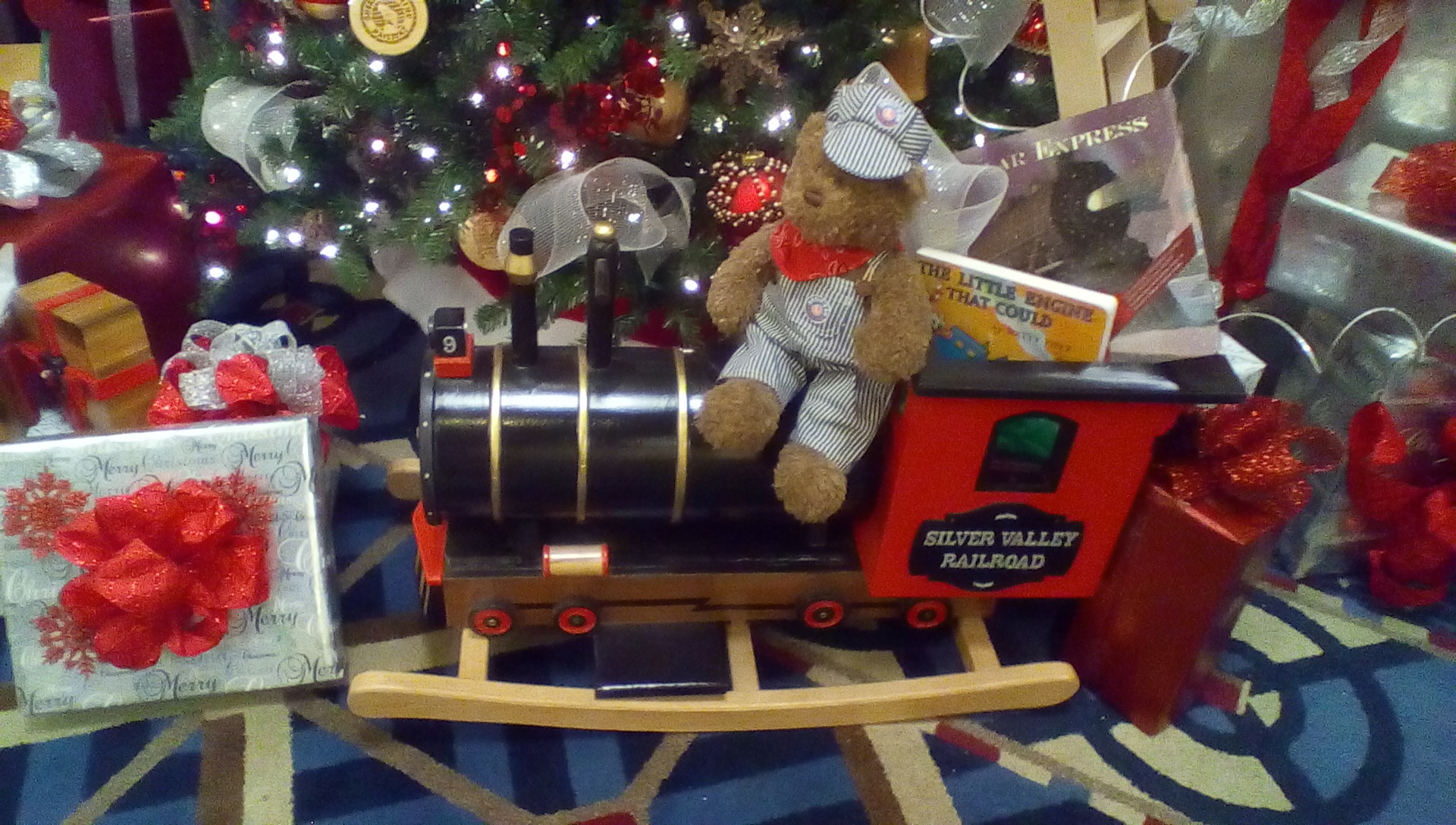
After the ladies left our design meeting, I received an email with a picture of a rocking engine and a request, “Could I make one like this?” The challenge was on. It took some time to scale the picture to child sized proportion. It came together in about two weeks complete with red oak runners, turned wheels, hollow coopered boiler, and an open topped cab suitable for storage. Debbie again provided the artistic paint job complete with engine number and name. An appropriately costumed engineer add a finishing touch.

13 engine

Early on the day after Thanksgiving the tree and ornaments were delivered to the hotel ballroom. The designers brought garlands, drapings, and other “bling” required to complete the scene. A rail crossing sign served as the tree topper. After four hours and much labor by an army of helpers, three tables of “stuff” magically made its way into exactly the correct placement. Faux wrapped packages and my wood boxes crowded around the tree bottom ready for Christmas opening.

14 completed treetree

15 crew

The auction was held the Saturday after Thanksgiving. Several of the decorated trees were awarded ribbons and we were fortunate enough to receive two. Much to my relief our efforts were rewarded with a substantial bid price. Hopefully, the new owners will be able to enjoy the tree for many years.

16 ribbons


Dec 102015
 

IMG_3994‘Tis the season to be jolly, merry, and ever so slightly stressed outparticularly when it comes to gifting.

The process of gifting can be fun and satisfying, but also terribly puzzling, especially if a friend or family member has a specialized hobby with a unique lexicon and complicated gizmos, gadgets and who-knows-whats to choose from.

For non-woodworkers, sifting through woodworking gifts can be like entering a foreign country. Highland Woodworking artisan Cooper van Rossum said it is helpful to have a few questions answered before starting the gift hunt.

For example, it is important to find out whether a person prefers hand tools or power tools or whether he or she is a fan of a particular design style or period.

“No one wants to do investigative reporting, but try to start a conversation with the person about their work,” Cooper said.

When shopping in-store for experienced woodworkers, Cooper said it is helpful to bring pictures of the work someone does so Highland employees can make better gift suggestions.

Below are some of Highland Woodworking instructor, Sabiha Mujtaba, and Cooper’s ideas to satisfy every woodworker on your shopping list.

The Never-touched-a-saw-before Beginner

For beginning woodworkers, Sabiha said it is best to avoid overly complicated tools or machines requiring extra inputs as these can overwhelm and turn off newcomers.

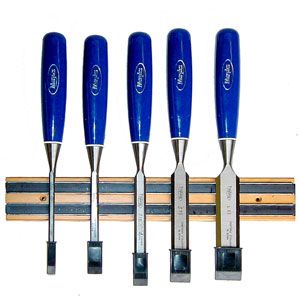
If your friend wants to start woodworking, but they do not yet know what kind of projects they like (turning, carving, furniture making etc.), Sabiha suggests starting with a basic boxed set of carving tools or chisels.

“Those give you all the different styles of tools and sometimes when giving a gift you want to start with something that has a complete set,” Sabiha said.

In addition, Sabiha recommends the carving sets as they are nicely packaged and have presence under the tree.

Even for skilled woodworkers, the sets never hurt as Sabiha said it is hard to have too many of a given tool.

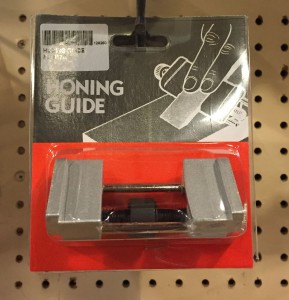
If you go with a chisel set, Cooper strongly recommends pairing it with a basic Honing Guide and “1,000/6,000” Combination Stone so that the recipient can sharpen his or her new prized tools.

Without sharp tools, the learning process can be unnecessarily challenging, Cooper said.

Honing Guide

Honing Guide

Combination Waterstone - Large 1000 / 6000 Grit

Combination Waterstone – Large 1000 / 6000 Grit

For experienced woodworkers, Sabiha and Cooper both said it is important not to stress about whether a person already owns an item.

“With some things like sets of drill bits, it really doesn’t matter is you have lots because they wear down,” Sabiha said.  

The Turner

For advanced or beginning turners, Sabiha recommends getting colored wood pieces for turning wine toppers, pens, or bowls. 

If someone usually turns furniture legs or items such as peppermills, it can be fun to get them gifts which introduce a new area of turning-such as bowl making.

Sabiha, a veteran carver, also suggests getting beginning carving items for any type of woodworker so that they can embellish their work, no matter the style.

The Organization King or Queen and the New Shop Owner

If someone just began putting together a dedicated shop at home or if they are one who likes an organized workspace, Cooper points people to Magnetic Tool Holders.

Magnetic Tool Holder

Magnetic Tool Holder

These are a fairly inexpensive investment that can clean up a shop, and they vary in style from basic metal strips to magnets camouflaged behind an elegant wooden cover.

The Eager Youngster

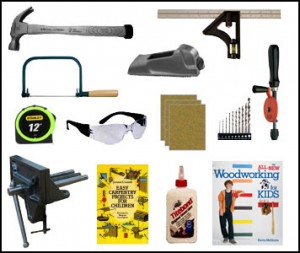
For kids who have already demonstrated an interest in woodworking, Highland also offers a complete Woodworking Tool Kit for Kids, which Cooper suggests pairing with a book to give a youngster a great starting point for a wider variety of projects.

Kids Woodworking Tool Kit

Kids Woodworking Tool Kit

The Seasoned Woodworker

When it comes to experienced woodworkers who already have extensive shops and all the tools you thought could exist, Sabiha suggests focusing on high quality items which people may not necessarily want to buy themselves.

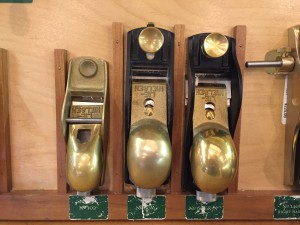
She recommends Lie-Nielsen Planes in particular, which she said people enjoy collecting and are a “pleasure for a woodworker to own.”

These come nicely boxed, adding to the gifting experience, Sabiha said.

Lie-Nielsen Planes

Lie-Nielsen Planes

Similarly, Cooper recommends going with Blue Spruce tools, which are a high quality upgrade for many woodworkers.

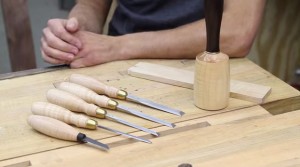
Blue Spruce Toolworks Hand Tools

Blue Spruce Toolworks Hand Tools

He is a particular fan of these because many of them have had their wood handles or mallet heads infused with a polymer resin for exceptional durability.

The Hands-On Novice

Woodworking tools can be a big investment, especially if you are unsure of what type of work someone might want to try.

Instead of going “down the rabbit hole” of finding the perfect tool, Cooper said pre-purchasing a class is a great option. For around $100, he said specialized classes let beginners identify their interests, from carving to turning to furniture making, and also allow them to get hands on help finding the starter tools they need.

The Picky Subject

If all else fails, Sabiha and Cooper both suggest going with a Gift Certificate and letting your friend or family member choose exactly the tool or item they have been saving up for. As an added bonus, Highland prints their gift certificates on actual wood!

Highland Woodworking Gift Certificate

Highland Woodworking Gift Certificate

To make a gift certificate more personable, you can pair it with a book.

For adults, Cooper recommends The Anarchist’s Tool Chest, which is a detailed guide to tools and what to have in your shop, or a period design book perfect for a coffee table conversation piece.

For younger, aspiring woodworkers, Zany Wooden Toys is a fun choice, Cooper said.

Toy Making Books

Toy Making Books

Stocking Stuffers

To fill up stockings, Sabiha said focusing on small safety items is a good route as they are not too expensive. For example, she suggests getting gloves, thumb guards, or safety masks, especially if you are also gifting woodworking tools.

The popular Elipse P100 Dust Mask

The popular Elipse P100 Dust Mask

Cooper also recommends inexpensive tools such as Center Finders, which can simplify work for recipients.

And if you need anymore gift ideas, take a look at the Highland Woodworking 2016 Gift Guide for dozens of more ideas!

Dec 082015
 

In my experience, fear of failure is the biggest obstacle to being creative or productive in my woodshop. It’s certainly not a lack of tools; I’ve got plenty of those. Nor is it a dearth of ideas; I’m literally bursting with them as well. What slows me down most, and sometimes stops me dead in my tracks, is the fear that whatever I’m trying to do will end up a failure.

Fear of failing is the biggest obstacle to moving forward on projects I long to build. Even projects well underway can be delayed for uncounted weeks, months or years as I wait for the “right time” to pick them up again. That’s the case with a set of bedside tables that have lain unfinished for far too long. Instead of plowing through to completion, other interests—in my case photography or even new woodworking projects—have sprung up to divert me from the need to finish the tables.

These fears also stifle creativity. We each carry around inspiration—perhaps hidden—for unique ways to express ourselves in our chosen media, be it woodworking or some other venue. But fearing failure, often coming as internal criticism, we may silence our own voices to prevent what seems like inevitable embarrassment. In my case, it convinces me that my own ideas can’t possibly stand alongside other designers’ creations as worthy of expression.

As a rule, our fear of failing results from old messages we received as children. Cautionary or critical comments by parents, teachers and other persons significant to our development often had the unintended consequence of convincing us that success lies beyond our grasp. In extreme cases, we may have learned to believe we lacked even the right to succeed and that we should not even try.

But these messages belie the truth. While unavoidable, failure is a normal part of life. Failing is no more than one result from an experiment. It is a key process by which we learn and perhaps the most reliable source of information available to us. And its consequences need not be inescapable. I learned this when I tried to join two pieces of teak with pocket hole screws, only to watch the teak split apart in every attempt. But because I tested the joinery on scrap pieces, I avoided destroying my project and things turned out just fine.

The hardest lesson to learn is that failure is, in fact, only about a trial and error method. It reflects only on our practice, our technique, our effort. It does not relate to us and our worth as persons. Failing does not mean that somehow it is we who are bad, only that something we tested did not work.

In the end, the only person who can define our success is ourselves. No one else can do it for us, and we should not let them try. To seek approval from outside sources—be it money or laudatory comments—is to subject ourselves to continued domination by the old message that we are not really good enough, that we do not have the right to succeed.

So here’s my advice—and I’m speaking now primarily for myself, for whom these lessons have come very hard. Give yourself permission to try and fail. Not only will it teach you useful things about what works and what doesn’t, but—even better—it is bound to unleash unexpected creativity and productivity in whatever you choose to undertake.

Dec 022015
 
No Southern-fried Southern boy wants to be called a Yankee, but we share the characteristics of shrewdness and thrift.  Thus, each month we include a money-saving tip.  It’s OK if you call me “cheap.”  
We’ve previously discussed an inexpensive way to keep one’s dust extractor hose and power cord above the project, allowing maximum versatility.
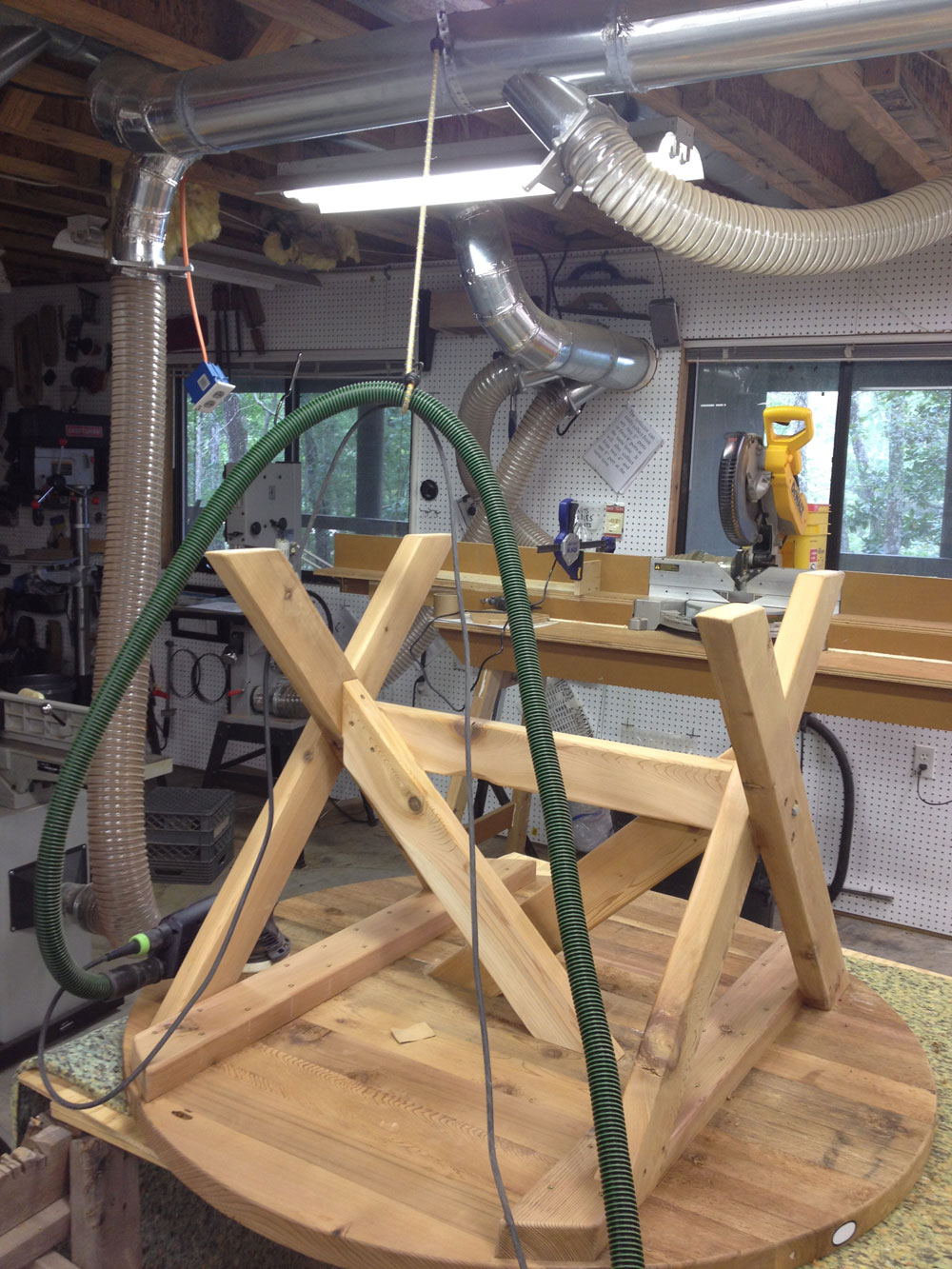
Here is the first generation of do-it-yourself overhead Festool dust extractor hose management.

Here is the first generation of do-it-yourself overhead Festool dust extractor hose management.

Of course, if you’re not a do-it-yourselfer, Festool makes the Festool Boom Arm ready-made to perform this function for you.
Now, Festool has come out with a new system that encloses the hose and cord in a cloth wrap that will prevent the hose from marring your workpiece.  You can order one by clicking here, and choosing the “Anti-Static – Sleeved with Power Cord type” in the options.
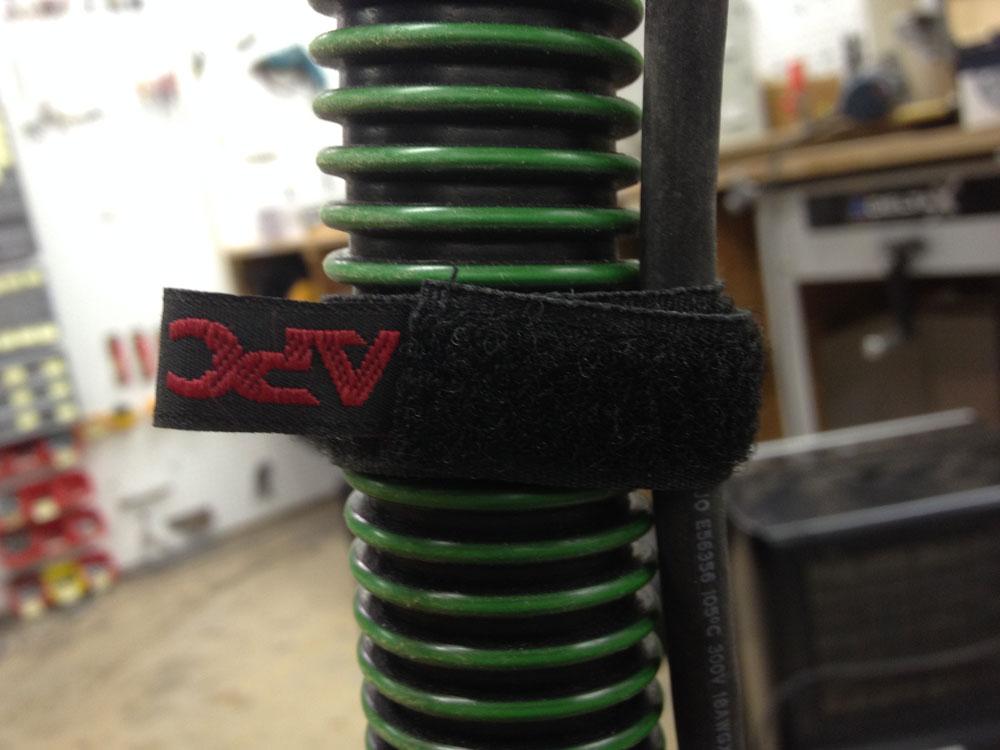
Here’s my El Cheapo version:  Use Velcro straps to tie Festool sander power cords to Festool vacuum hoses as they travel together to the Festool dust extractor.  The generously-long cords of Festool tools make this part easy.
I had a bunch of these Velcro cord wraps, with little use for them, until I stole this idea from Festool. Most of them came from uninterrupted power supply (UPS) units that power our computers when the electricity is off.

I had a bunch of these Velcro cord wraps, with little use for them until I stole this idea from Festool. Most of them came from uninterrupted power supply (UPS) units that power our computers when the electricity is off.

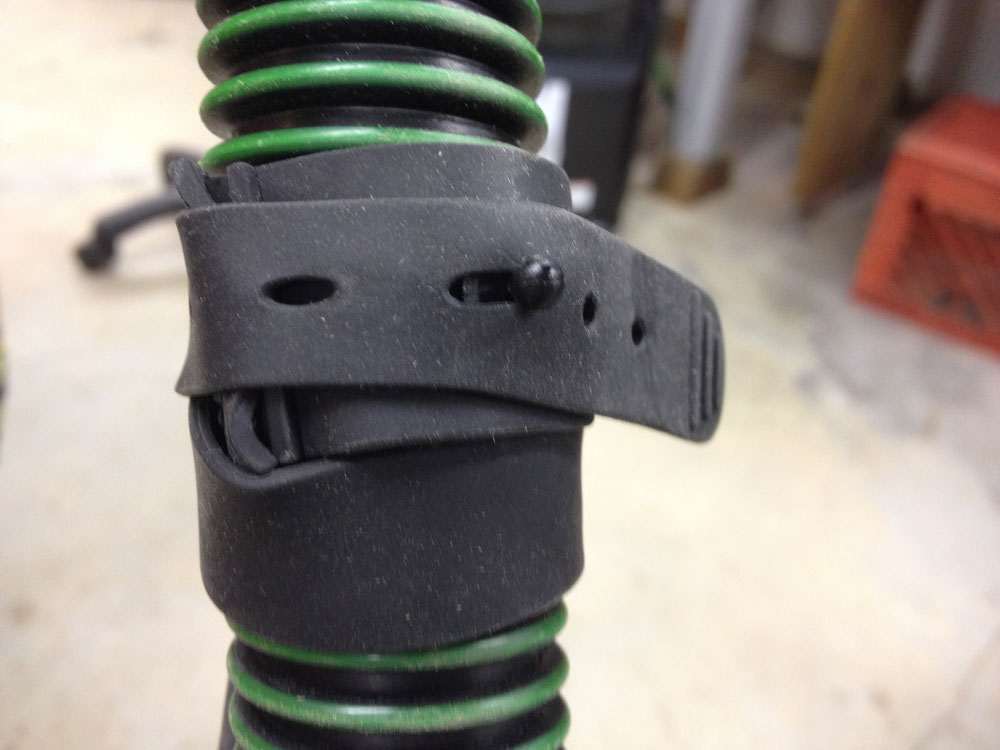
Alternatively, there is a rubber version of cord wraps that works just as well.

Alternatively, there is a rubber version of cord wraps that works just as well.

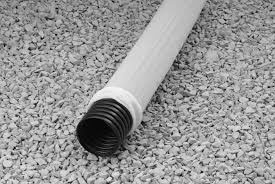
I looked for a small-diameter drainpipe sock that could serve as a cover, but was unsuccessful. Darn!
Just in case you don’t know what a drainpipe sock is, feast your eyes.

Just in case you don’t know what a drainpipe sock is, feast your eyes.

You have to hand it to those Festool designers:  they come up with some great ideas!

—-

Jim Randolph is a veterinarian in Long Beach, Mississippi. His earlier careers as lawn mower, dairy farmer, automobile mechanic, microwave communications electronics instructor and journeyman carpenter all influence his approach to woodworking. His favorite projects are furniture built for his wife, Brenda, and for their children and grandchildren. His and Brenda’s home, nicknamed Sticks-In-The-Mud, is built on pilings (sticks) near the wetlands (mud) on a bayou off Jourdan River. His shop is in the lower level of their home. Questions and comments on woodworking may be written below in the comments section. Questions about pet care should be directed to his blog on pet care, www.MyPetsDoctor.com. We regret that, because of high volume, not all inquiries can be answered personally.

Dec 012015
 
“There you go again, Jim Randolph.  You keep trying to make us believe you’re a cheapskate, then you admit you paid hundreds for Bose Noise-Cancelling headphones.  Now you’re going to tell us you’ve bought that high-priced Festool stuff, too?  We may have to come take away your membership card to the Cheapskates’ Club.”
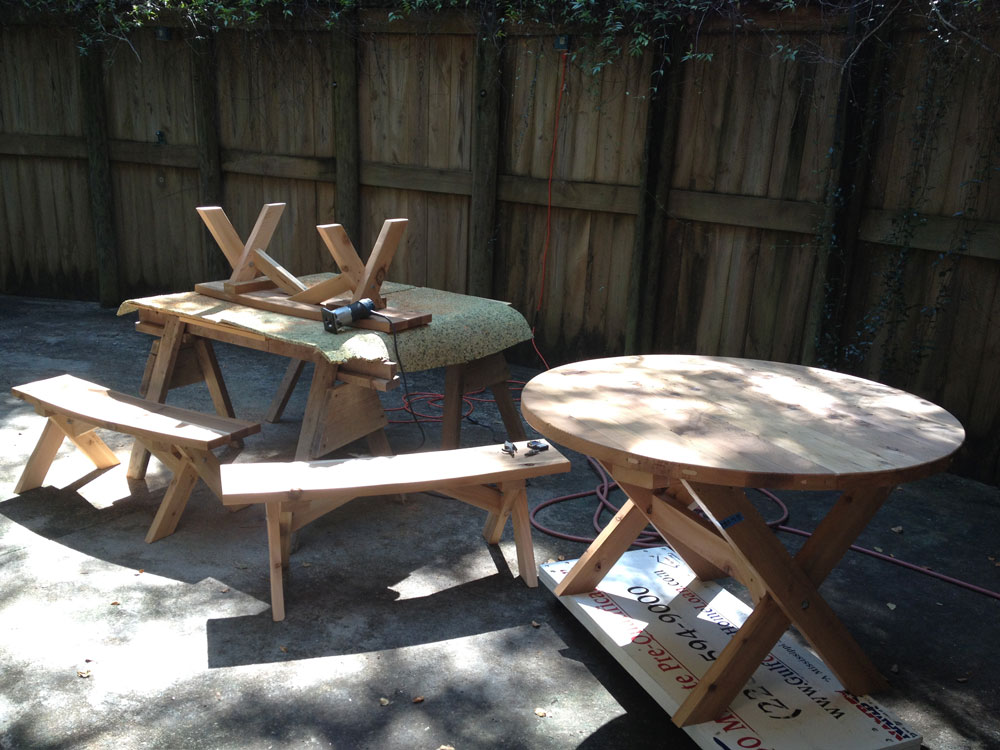
I’ve said before, I don’t mind paying more and buying the best if I’m getting value for the money I spend.  I’ve been building this round cedar picnic table with curved benches for our two youngest grandchildren.  It has helped to highlight the value of the Festool “system.”
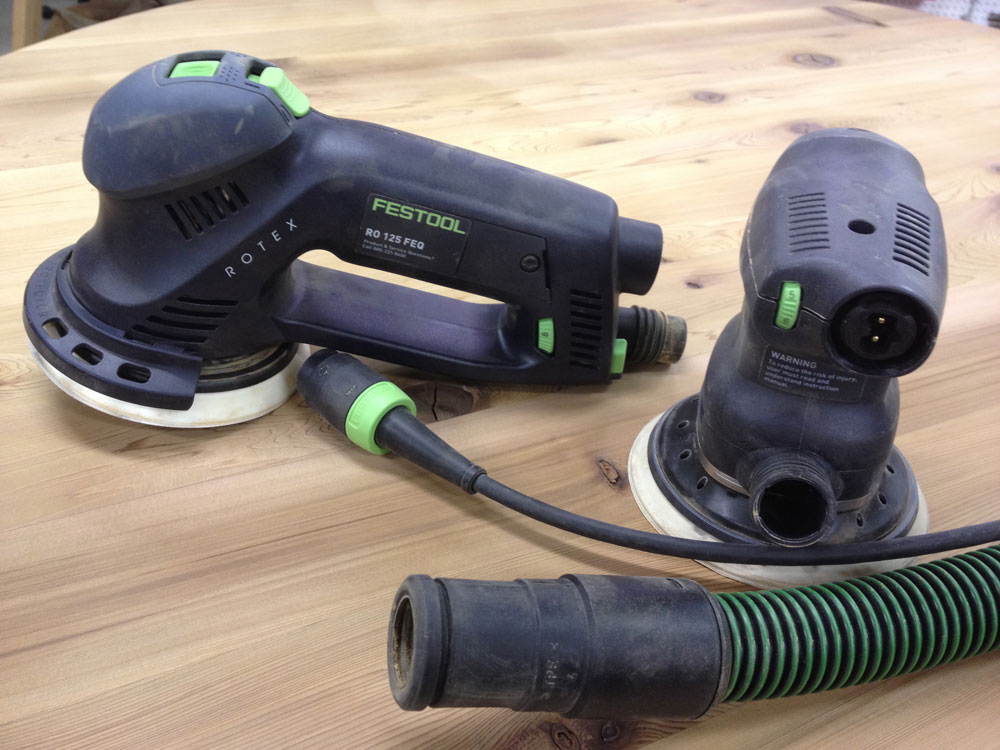
 Festool figured substantially in the construction of this diminutive picnic table set for our youngest grandchildren. Kapex, Domino, Rotex and ETS sanders with dust extractor. It’s worth spending money to get quality tools that make your job more beautiful, easier and/or faster.

Festool figured substantially in the construction of this diminutive picnic table set for our youngest grandchildren. Kapex, Domino, Rotex and ETS Sanders with dust extractor. It’s worth spending money to get quality tools that make your job more beautiful, easier and/or faster.

I timed it. I can change the power cord and hose from one sander to the other in 20 seconds. That makes it fast enough that I can work on a problem area and totally resolve it, then move on to another problem area, which is more efficient than coming back to each defect as a stage is fini

I timed it. I can change the power cord and hose from one sander to the other in 20 seconds. That makes it fast enough that I can work on a problem area and totally resolve it, then move on to another problem area, which is more efficient than coming back to each defect as a stage is finished.

Cedar.  It’s the wood I love to hate.  I love the color, in all its variations.  I love the smell.  (Everyone loves the smell!)  I love the durability of the heartwood, especially in projects intended for outdoor use.
Then, there’s the down side.
Or sides.
It’s soft, which makes it easy to mill.  But, the softness makes it susceptible to scratches, dents and dings.
Then, there are the knots.  Which are most definitely not soft.  And, around all those knots the confused grain tears out when the planer and jointer knives hit it. This is one of the places the Festool sanding system really shines.  As you sand a project like this, some areas, like tearout, need some aggressive Rotex action to whip them into shape, followed by some time with the less aggressive Rotex random setting.  The Rotex stroke length is longer than the ETS, so a quick switch to the same sandpaper grit on the ETS gives the fine, smooth finish sanding you want those grandbabies  meals and behinds sitting on.  I have a 5″ Rotex and a 5″ ETS and the system allows quick change from one sander to another without having two dust extractors.

—-

Jim Randolph is a veterinarian in Long Beach, Mississippi. His earlier careers as lawn mower, dairy farmer, automobile mechanic, microwave communications electronics instructor and journeyman carpenter all influence his approach to woodworking. His favorite projects are furniture built for his wife, Brenda, and for their children and grandchildren. His and Brenda’s home, nicknamed Sticks-In-The-Mud, is built on pilings (sticks) near the wetlands (mud) on a bayou off Jourdan River. His shop is in the lower level of their home. Questions and comments on woodworking may be written below in the comments section. Questions about pet care should be directed to his blog on pet care, www.MyPetsDoctor.com. We regret that, because of high volume, not all inquiries can be answered personally.

Nov 272015
 

Let me introduce myself:  “I am not a furniture maker…. yet.”

What I am though is very determined (stubborn) and passionate about becoming one.

I am a normal person with a full-time day job in IT, but who has had an interest in quality, handmade, solid wood furniture for the last 20 years.

I have read many online resources from expert furniture makers and they are wonderful and inspiring, yet I’ve not yet managed to gain much momentum with the craft due to some pervasive obstacles in my way which you may have in common with me:

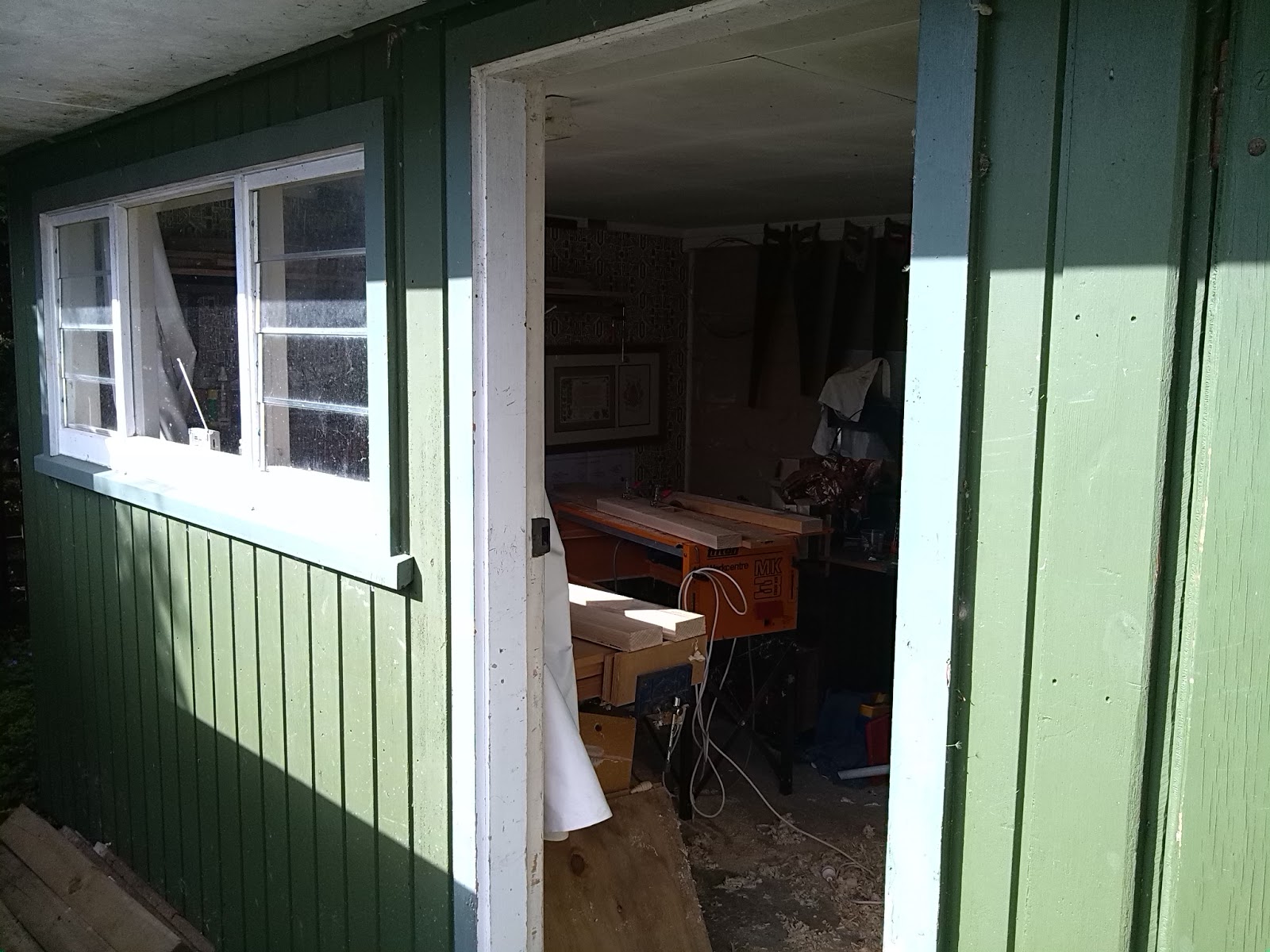
I’ve had only a small space to work in, and it’s not brightly lit, or warm, or even dry for that matter. I think most beginners have to deal with quite damp conditions available in external sheds.

I have a full-time job which I commute to in a neighbouring city. My family are a lovely bunch, but the time demands of family life are in conflict with the time demands of developing mastery in a craft such as furniture making.

In almost all instances I don’t have the spare cash to purchase a piece of equipment which would save me time. And last but not least, for most of the last 25 years I have put up with the disadvantages of rented accommodation. Each location has had pros and cons, but the ability to set up a lasting and well configured workshop environment has eluded me.

Despite all this, I’ve made some progress. I did make a small coffee table as a wedding present for an inlaw using handtools, as it was the best way to provide a valuable gift with the funds I had available. After that I was commissioned by another friend to make a dining table out of recycled floor joists. Lastly, I made a large shelving unit to host a hand powered grain mill which we purchased.

All three items have survived to this day in daily use, which I find encouraging.

However..

I aim much higher. I want, no.. need to master many classic furniture joining techniques, rather than just ‘screw things together’.  I’ve done the classic newbie mistake of purchasing some text books, but not implementing the contents.

I’ve decided to rectify this by creating a chopping board using mainly hand tools. This will provide me with the core and essential skills of flattening and joining 3 pieces of wood. It’s a critical step in my journey, and should result in a usable product.

If I had a jointer and thicknesser this would be child’s play no doubt, but even if I had such tools I think there will be a lot to learn in the process of using handtools. The tools I have to work with are basic but solid including number 4 smoothing plane, a jointer, a scrub plane, and a solid workbench. I’ve attached a cheap vice on one end. I’ve drilled some bench dog holes in the top of the bench, and chopped up some thick dowel as dogs. Progress at last.

The workspace is still cold, damp and small, but I have a pair of Brave Pants I shall wear.

‘The Cave of Glory’

‘The Cave of Glory’

So, if all goes according to plan, over the next year(s) I’ll demonstrate that even if you have many roadblocks and limitations everywhere you look, you can still achieve your furniture making dreams. Follow along with my future posts and learn from my mistakes and successes, and also give me good advice from your hard earned experience. We’ll both benefit as we go.


Marty is a full time IT worker from New Zealand who is continuing a long journey to learn furniture making despite the common obstacles of limited time, money & workspace.