Highland Staff

Jul 082016
 

Welcome to “Tips From Sticks-In-The-Mud Woodshop.” I am a hobbyist, not a professional, someone who loves woodworking, just like you do. I have found some better ways to accomplish tasks in the workshop and look forward to sharing those with you each month, as well as hearing your problem-solving ideas.

As I’ve mentioned previously, I have respiratory-tract allergy problems. That’s the reason I have Kleenex boxes (yes, I use the name brand, they’re just better, and completely worth paying more for) stashed all over the shop.  The obvious problem, of course, is that if one is allergic to dust, pollen and mold, and leaves his “facial tissues” unprotected, he is introducing dust, pollen and mold into his respiratory tract with every Kleenex.

The first solution that came to mind was to purchase some of those decorative covers for Kleenex boxes and put two strips of foil tape over the hole the tissues pop through, one layer of tape from the inside, one from the outside.

They come in plastic, wicker, and church-lady crochet.  The latter two styles would do nothing to keep out dust, pollen and mold, so I set my sights on a plastic cover.  A cheap plastic cover, that is.

I thought about going to the dollar store, but that was out of my way, so I looked at WalMart while I was there.  Nothing.  I asked someone in Housewares.  “We don’t have them over here, but you might look where the paper towels are.”  I assumed the clerk meant the paper towels and facial tissue were close to each other.  Or, WalMart had introduced a new, pop-up box for paper towels.

Whatever the situation, no decorative covers existed by the paper towels, either.

However, while I was searching in housewares, I saw a little plastic shoebox that I thought I could adapt.  Best of all, they were only 97¢.  When I got home I decided to try them in three different ways.

First, on my workbench, upside-down, as a simple cover for the Kleenex.  I instantly discovered an advantage to this box over the original idea:  The decorative cover would have been a tight fit, requiring two hands and a good bit of time to access.  The shoebox engulfed the Kleenex box, so it could be snatched off, a tissue retrieved, and quickly put back in place.
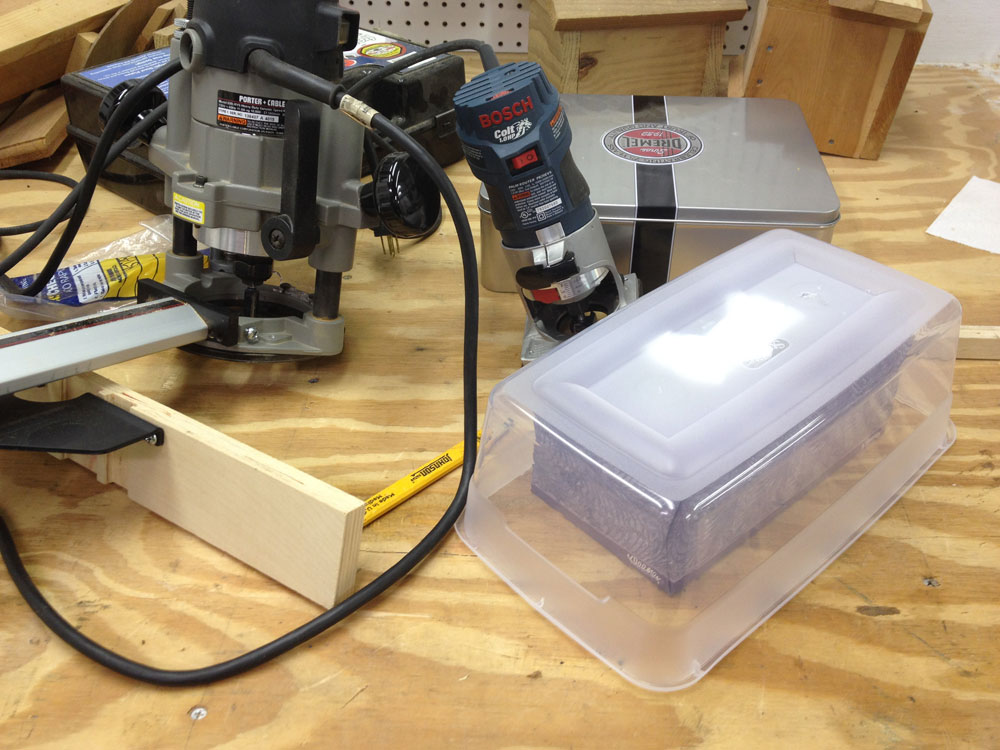
I keep a pretty clean shop, but I typically don’t clean except between projects. So, like any woodworking area, there is always dust around, leading to a runny nose and sneezing. I can never be far from a Kleenex box, but don’t want the Kleenex to make the situation worse. These shoeboxes protecting the Kleenex boxes should help.

I keep a pretty clean shop, but I typically don’t clean except between projects. So, like any woodworking area, there is always dust around, leading to a runny nose and sneezing. I can never be far from a Kleenex box, but don’t want the Kleenex to make the situation worse. These shoeboxes protecting the Kleenex boxes should help.

For the less-used box that lives on my rolling tool cabinet, I decided to put the Kleenex box inside the shoebox, with the lid on top.  It was a test to see how long my impatient self tolerated the extra step of removing the lid in exchange for possibly better dust protection.
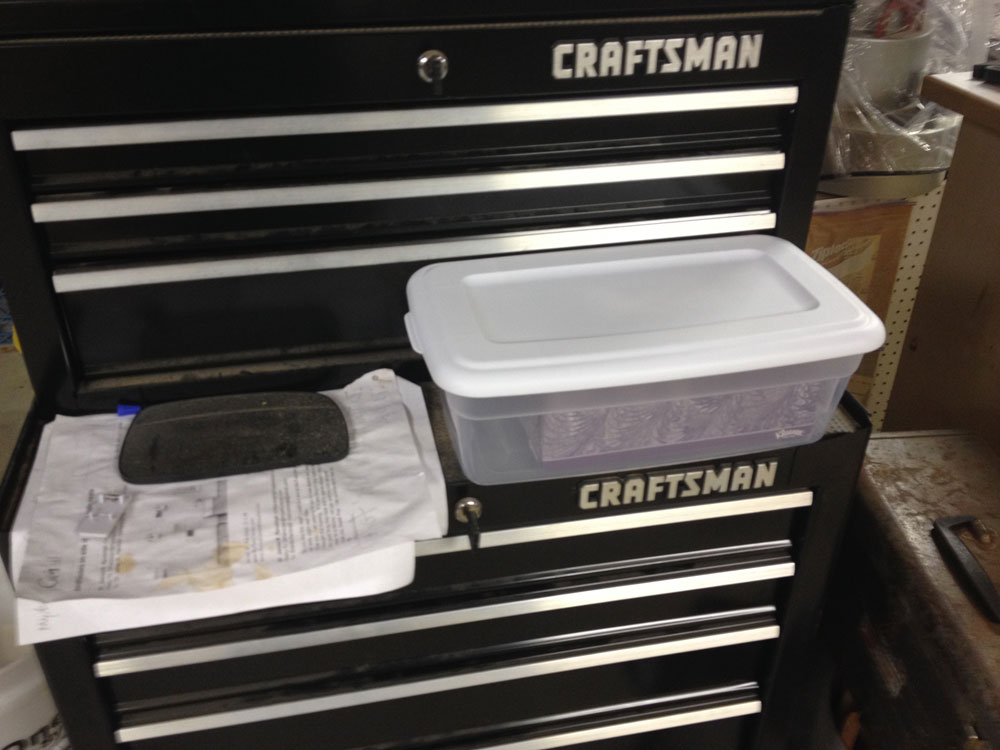
Now for the test: Will Mr. No Patience be willing to take the time to remove the snap-on lid in exchange for better dust protection for his Kleenex?

Now for the test: Will Mr. No Patience be willing to take the time to remove the snap-on lid in exchange for better dust protection for his Kleenex?

Trial style 3 was to attach the lid to a shelf near the sink, put the Kleenex onto the lid with the shoebox snapped into the lid.  It seems likely that, with the first two styles, dust is going to be stirred when exposing the tissues, partially defeating the purpose of the shoebox covers.  If style 3 proves itself, a compromise for the middle style would be to turn the Kleenex box upside-down in the dust-free shoebox.  Watch my tip column for an update in the coming months.
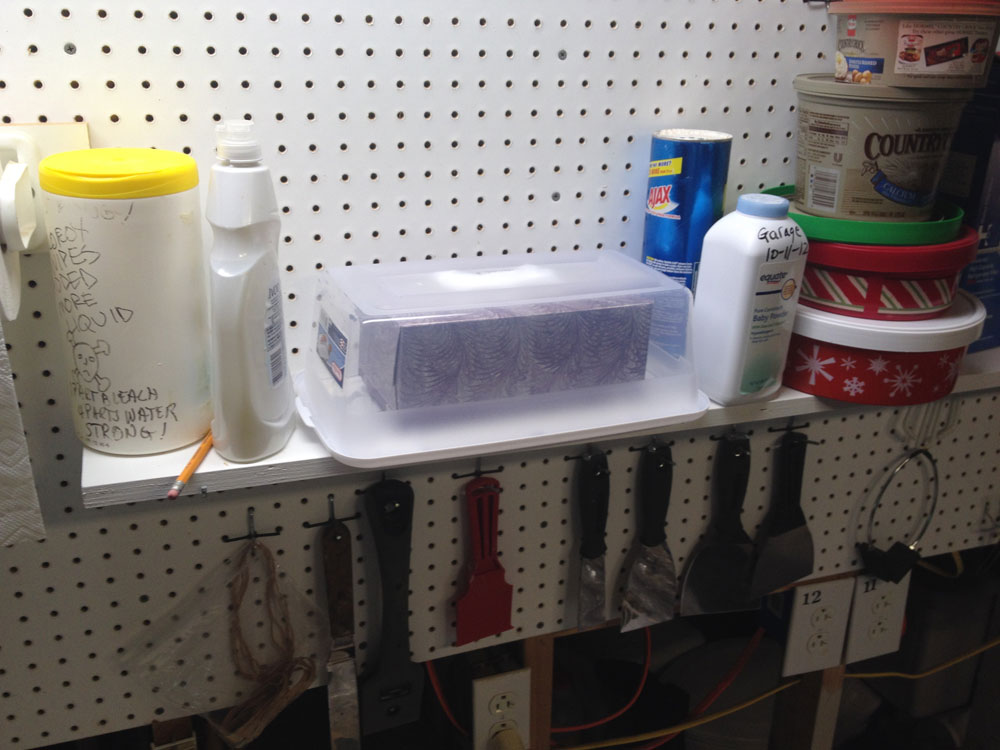
In my mind I’m picturing that I can squeeze the shoebox and pop it out of the lid, which is screwed to the shelf. Maybe that will be almost as fast as “Style 1,” but still enjoy the improved dust protection for the Kleenex.

In my mind I’m picturing that I can squeeze the shoebox and pop it out of the lid, which is screwed to the shelf. Maybe that will be almost as fast as “Style 1,” but still enjoy the improved dust protection for the Kleenex.


Jim Randolph is a veterinarian in Long Beach, Mississippi. His earlier careers as lawn mower, dairy farmer, automobile mechanic, microwave communications electronics instructor and journeyman carpenter all influence his approach to woodworking. His favorite projects are furniture built for his wife, Brenda, and for their children and grandchildren. His and Brenda’s home, nicknamed Sticks-In-The-Mud, is built on pilings (sticks) near the wetlands (mud) on a bayou off Jourdan River. His shop is in the lower level of their home.Questions and comments on woodworking may be written below in the comments section. Questions about pet care should be directed to his blog on pet care, www.MyPetsDoctor.com. We regret that, because of high volume, not all inquiries can be answered personally.

Jul 072016
 

We are very excited to be making our way up the coast to Warren, ME for the annual Lie-Nielsen Summer Open House. This one is a special one, celebrating 35 years of exquisite tool making.

We will be taking a look behind the scenes at the factory and talking to many great tool artisans who will be joining us in mid-coast Maine for the weekend, including Peter Follansbee, Chris Becksvoort, Peter Galbert, Chris Kuehn of Sterling Toolworks, Jeff Hamilton of Hamilton Woodworks, Josh Klein of Mortise and Tenon Magazine, and many more!

Take a look at the video below from last year’s open house to get a sense of what the event is like. And if you are free this weekend and nearby, come on out – we would love to see you!

Jul 052016
 
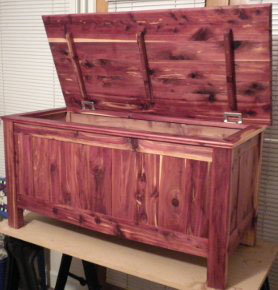
The last time I made a significant project out of cedar, a hope chest for our eldest granddaughter, I developed a cough that lingered for months.  Repeatedly, I went to my ear-nose-throat doctor, trying different medications.  I don’t think any of them made a difference; I believe it finally just went away.  We never identified a cause.
Truly a labor of love, a hope chest for our eldest granddaughter.

Truly a labor of love, a hope chest for our eldest granddaughter.

At that time I had an overhead room filter, and power tools connected to individual shop vacuums, but no other form of dust management.  Some of the time I wore a surgical mask when I sanded, but I was quite lax about the dangers of dust.
After the cough, however, I changed my ways.
I broke down and purchased a Oneida cyclone capable of collecting several machines at once via whole-shop ducting.  I bought the Elipse P100 Dust Mask and I wear it most of the time and all of the time that I’m creating fine dust.
The Ellipse Dust mask is highly rated and reasonably priced.

The Elipse Dust mask is highly rated and reasonably priced.

Recently I’ve been thinking of my best friend from my Air Force days, Ken Shellberg.  A native Ohioan, Ken taught microwave communications electronics with me at Keesler Air Force Base in the 70s.  Music was hugely important to both of us and we took full advantage of the deep discounts afforded us in military stores, stocking up on electronics and speakers.
After our service, Ken went back to Ohio and began building his own speakers, mostly from prefinished, veneered particle board.  Before long he had developed allergies to ingredients in the particle board and had to quit woodworking altogether.
Lately, I’ve been working on a round cedar picnic table with curved benches for our two youngest grandchildren.
And, the cough is back.
Well, of course, there is no way to know if it’s the same cough, because we never identified the cause for the previous cough, but it’s suspicious. I couldn’t help wondering whether, like Ken, I might have to give up woodworking. Giving up cedar would be bad enough, as it’s one of my favorite woods. Of course, if I sold all of my woodworking equipment, I could afford to get the transom fixed on my bass boat.
Jul 012016
 

We were very saddened to hear of the death of Master Woodworker Michael Gilmartin in May of this year.

Screenshot 2016-06-30 12.48.09

Michael was a long time customer and an acclaimed woodworker who lived and worked for decades in Atlanta.  He specialized in sculpted furniture, and was known for his unique and iconic plywood sculpted chair, which became a style known as the Gilmartin chair.

CUR.1992.96

We featured Michael in our Moment with a Master segment of an episode of The Highland Woodworker in early 2015, and enjoyed the opportunity to go into his shop and learn more about his techniques of stacking and finding cadence in the beautiful plywood furniture he created.

We will miss Michael’s visits to the store, and the woodworking world will miss a Master Woodworker, who inspired many in his time and will continue to do so.

Michael Gilmartin’s Obituary

Jun 202016
 

I have a bad habit of starting a book and then moving off and getting interested in something else. I have a stack of books with bookmarks in the middle that are always pending and I think it is safe to say that pending stack is my summer woodworking reading list. Maybe I’ll get distracted again and start to build something out of one of them again.

Why We Make Things and Why It Matters

Why We Make Things and Why It Matters by Peter Korn.

Don’t you always wonder why you make things? It’s kinda odd, isn’t it, that you can’t stop making things. Read this book and see why you make things. And then on top of that, you may be able to find out why it matters.

Coffin Making and Undertaking edited by Paul N. Hasluck.

This may seem a strange choice, but then I’m a little weird sometimes. My family has a long history in the funeral business and the genesis of that is likely my Great Grand Father who built buggies and wagons for a living. I am sure that when a casket was needed in the little town where he (we) lived, he was the one who was called. Things like making caskets do not change quickly, and this book first published in England about the turn of the last century is very likely similar to the way GG Father made caskets. With a chapter on lead caskets and another on how to move a casket down a narrow stairwell, this little book should be very useful if the need ever arises.

"Campaign Furniture"

Campaign Furniture by Christopher Schwarz.

I have been cycling through this book over and over. I built the three legged stool from the book and then later made the Roorkee Chair. Working with leather for the first time was a treat and both items turned out well. I will build everything in this book vicariously, I’m sure. I love the way Schwarz writes, the depth of coverage and research he does before he writes his books, and the way he makes the things he writes about as he writes about them. I’m definitely going to keep this one in the reading cycle.

Maybe someone will publish something new this summer. I always look forward to a brand new woodworking book.

Find more great Woodworking Books and Plans at the Highland Woodworking website.

Jun 172016
 

As the summer is rapidly approaching (although with quite a wet lead-in for some of us), I went through my bookcase to see what books I wanted to queue up for any slow periods, and possibly during any travel. I have a decent range of topics from which to choose, so I either try to pick something that is associated with some current work, or those that are new (to me) or haven’t had attention in some time. So with that, let’s get to my woodworking reading list:

  1. The Essential Woodworker (Revised edition) by Robert Wearing, Published by Lost Arts Press in 2010 – This is a book that was written as a “Pre-Textbook”, to help those who hadn’t obtain the school-provided woodworking basics, or is working alone (not having gone through an apprenticeship or other development process). Even if you have been woodworking for many years, there is still value in this book, as most that have not embarked on a formal learning path (myself included) can have gaps in their skills/knowledge. This is an enjoyable read.
  2. Japanese Woodworking: A Handbook of Japanese Tool Use & Woodworking Techniques by Hideo Sato, Published by Hartley & Marks in 1987 – I’ve had an interest in Japanese tools and the range of their building designs and methodology since I was a young teenager, and this was one of the earlier woodworking books I purchased. This book provides a good foundation on the Japanese tools and their care, characteristics of wood, layout and different types of joints and their uses. It has been a while since I’ve read through it, and it never seems to fail that I’ll find some nugget I’ve either forgotten or that escaped me on previous reads. This book was originally written in Japanese in 1967 and was translated into English in 1987.
  3. Shoji, How to Design, Build, and Install Japanese Screens by Jay Van Arsdale Published by Kodansha International in 1988 – While this is another book on Japanese woodworking, and has some very slight overlap regarding the tools and usage, it is quite focused on an area of design that adorns many Japanese houses (if you ever have the chance, go to Japan and check out some of the traditional housing). The Shoji Screen is used in many different ways and forms, and adds interest and beauty to any house no matter how plain or extravagant. This book goes into great detail and provides design elements, information on wood, paper and tools, instruction on creating a simple Shoji and possible uses, as well as sources for supplies.
  4. Woodwork Joints by Charles H. Hayward, Published by Sterling Publishing, Co. in 1979 – This book is relatively small, but it is chocked full of information regarding how to create joints from the basic to the complex, as well as the application. The explanations of the joints are assisted by illustrations, both photos and diagrams. This is a great “little” tome to have around.

Find more great Woodworking Books and Plans at the Highland Woodworking website.


Lee Laird has enjoyed woodworking for over 30 years. He is retired from the U.S.P.S. and worked for Lie-Nielsen Toolworks as a show staff member, demonstrating tools and training customers. You can email him at LeeLairdWoodworking@gmail.com or follow him on Twitter at twitter.com/LeeLairdWW

Jun 162016
 

Perhaps as a result of the impact of meeting Peter Korn in November 2015 at the meeting of NEMA (New England Museum Association) and then reading his book Why We Make Things and Why It Matters (David R. Godine, Publisher ©2015) in January, I have been steeped in reading books that reveal and explore the passion and spiritual richness of people who work with wood. Two other such passionate books from the winter (long periods of darkness and gloomy, cold days are not balanced by a too-steady diet of evening TV in mid-coast Maine) are George Sturt’s The Wheelwright’s Shop (Cambridge University Press ©1963) and Richard Sennett’s The Craftsman (Yale University Press ©2008). Also this past winter, I read (actually listened to – I am an addicted audible book listener in my shop and car) David McCullough’s The Wright Brothers (Simon & Schuster: ©2016). All four of these books represent the deep feeling for history, craft excellence, and exceptional accomplishment described many years ago for me by my artist wife’s guiding admonishment to our sons: “Life is too short to use poor materials or bad ingredients.” Time (life) is far too valuable to squander on anything less than performing at the highest level of excellence with a commitment to always improve to a new level.

My first plan for my summer woodworking reading is to go back in time to re-read Eric Sloane’s A Reverence for Wood (Ballantine Books: ©1965) and Museum of Early American Tools (Ballantine Books: ©1964). I remember reading these in the late ‘60’s and being tremendously filled with admiration for Sloane’s intensive research into the history, use, and spiritual connection to wood and the tools we work it with. I believe that at this point in my life I will find Sloane even more relevant and compelling. This must be why I have treasured these volumes all these years.

Michael Ruhlman’s Wooden Boats: In Pursuit of the Perfect Craft at an American Boatyard (Penguin Books: ©2002) is high on my list for this summer and new to me. As a woodturner, I am frequently asked to turn one or two replacement fixtures for wooden boats, and when I do, I feel a special connection to the boat and its journey. Boatbuilders, like woodturners, share a fascinating relationship with the fluid sculptural shaping of various types of wood as they practice their craft, sometimes weaving the wood with its bends and twists into a shape both beautiful and useful.

The passion for excellence that I suspect Ruhlman will describe in his book derives from the core example set by Joel White in Douglas Whynott’s A Unit of Water, A Unit of Time: Joel White’s Last Boat (Washington Square Press: ©1999). The driving energy of an exceptionally talented master of his craft to always seek to improve and to discover the magic balance of creating something impressively efficient by developing its beauty reaches the inner core of the creative spirit guided by years of expert and brilliant experience. Uniquely, wooden sailing craft link us to our ancestors, and the correlation between woodturners and sailors is naturally and understandably high.

As a coastal Mainer, I schedule a regular time for my reading and creative reflection in the late summer afternoons in our home as a retreat from the excess of vacationers from the south and travelers from around the globe. Although I am a regular book-listener (audible.com) in my shop, I also enjoy holding the physical volume and turning the actual pages of a good book late in the evening. Another similarly reflective and inspiring opportunity for me is to explore the talents of others in boat building and handling as presented by the folks at www.offcenterharbor.com. These video chronicles document the experience, knowledge, and skills of the talented men and women who dedicate themselves to beautiful boats and sailing.

As a professional woodturner, I find I am eager to reread George Nakashima’s The Soul of a Tree: A Master Woodworkers Reflections (Kodansha International/USA Ltd through Harper & Row: ©1981) because by speaking to the core of my experience processing a tree, splitting or sawing it into turning blanks, turning it to a new form with texture, color, shape, and beauty it will renew my understanding of why I have chosen to pursue the next tree, the next turning blank. With an ever growing number of years of woodturning behind me, I hope that by rereading this book I will create a new more focused perspective. “So much wood; so little time.”

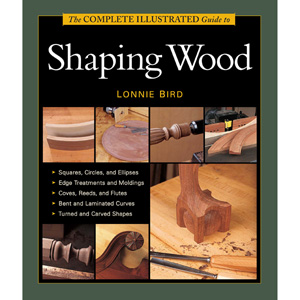
Lonnie Bird’s Shaping Wood (Taunton Press: ©2001) will be the groundswell of practical application for the summer. When standing with a new piece of freshly green wood and newly sharpened tools at the lathe, the creative vision challenges the practical reality of what I can achieve as a craftsman. The elusive ideal form seems forever just beyond my grasp, and the challenge fuels my effort.

Readers of this Highland Woodworking blog can appreciate the spiritual connection many of us are fortunate enough to have with our materials and tools through the deep sensuality of combining touch, smell/taste, sight, and weight with the imagined vision of a finished piece as wrought into reality by the touch of a master craftsman’s skill.

Find more great Woodworking Books and Plans at the Highland Woodworking website.