Highland Staff

Mar 032017
 

Are you a tightwad, like me?

I know there are many of us out there. We pinch pennies and we are so attached to them we lose our appetites when the government talks about doing away with them. (Can you imagine what a government program to discontinue pennies would cost taxpayers? I shudder to even think about it.)

I once asked Alan Noel a paintbrush-cleaning question. He replied that “Since I am the world’s cheapest !*&/$#?\, first I dip the brush into lacquer thinner then I use Ivory bar soap (very cheap!) and rub the brush onto it under water then lather it up, rinse and repeat until the lather is absolutely snow white. This is how I clean a brush”…. I knew I liked this guy for a good reason!

Last month we talked about how to sell tools, and this month we want to think about how much we expect to get for them.

As of this writing, 21% of us said they wouldn’t even try to sell their old tools, but would give them away as gifts to our fellow woodworkers, like Jimmy Diresta did in this video.

Another 11% of us couldn’t bear to part with their old tools. I can relate. I have some surgical instruments and an old stethoscope that have simply become worn out, but I won’t throw them out. Maybe I’ll make a shadow box collection one day.
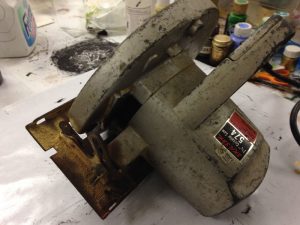
I could no more throw away this old Skilsaw than I could throw away my little Willie.
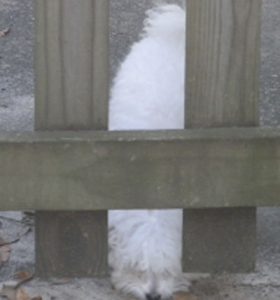
Somebody said you could get a pretty good price for a little poodle on Craigslist, but Willie’s not for sale. Or giveaway.
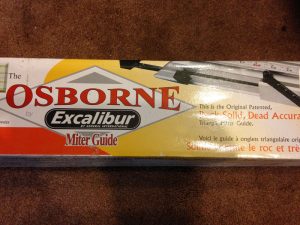
The Osborne Excalibur miter gauge I have, still in the box, sells for $120 to $140 at various outlets. I know no one will pay full price for it, even though it’s not “used,” which leaves me thinking, what would it take for me to part with it? For fifty bucks I’ll let it hang around, in case I want to assemble it one day, even though I couldn’t be happier with my Incra 1000.

Last month we asked how you sell your tools. This month, we’d like to know how much you expect to get for them:

Return to the March 2017 issue of Wood News Online


Jim Randolph is a veterinarian in Long Beach, Mississippi. His earlier careers as lawn mower, dairy farmer, automobile mechanic, microwave communications electronics instructor and journeyman carpenter all influence his approach to woodworking. His favorite projects are furniture built for his wife, Brenda, and for their children and grandchildren. His and Brenda’s home, nicknamed Sticks-In-The-Mud, is built on pilings (sticks) near the wetlands (mud) on a bayou off Jourdan River. His shop is in the lower level of their home.Questions and comments on woodworking may be written below in the comments section. Questions about pet care should be directed to his blog on pet care, www.MyPetsDoctor.com. We regret that, because of high volume, not all inquiries can be answered personally.


Mar 022017
 

Welcome to “Tips From Sticks-In-The-Mud Woodshop.” I am a hobbyist who loves woodworking and writing for those who also love the craft. I have found some ways to accomplish tasks in the workshop that might be helpful to you, and I enjoy hearing your own problem-solving ideasPlease share them in the COMMENTS section of each tip.  If, in the process, I can also make you laugh, I have achieved 100% of my goals.

“This call may be monitored and recorded for better customer service.” Apparently, it’s true. Ever the frugal consumer, when a battery company puts a guarantee on their packaging that says they will repair or replace equipment damaged by battery leakage, I found out they do keep track of those claims. How? One day, I got this notice in the mail:

Dear Mr. Randolph,

In covering our batteries’ warranty to repair or replace items damaged by leakage, we have reimbursed you many times for electronics you have sent us. Along with cash reimbursements, we have included coupons for free batteries, redeemable through local merchants.

Each time, we have advised you to be sure to change batteries prior to their expiration date, and to quickly remove batteries when their charge is exhausted. Your latest warranty submission contains leaky batteries that are far beyond their printed expiry.

Unfortunately, we are unable to continue to provide warranty protection when the end user repeatedly ignores proper battery use instructions. In gratitude for your loyal use of ‘XXX’ batteries, we have enclosed your ruined radio and coupons with which you may obtain new ‘XXX’ batteries.”

I now use two techniques to prevent having electronics become ruined by leaky batteries.

One, I put a reminder in my computer (a phone reminder would work just as well) that tells me to change the batteries in certain equipment every-so-often. Each piece of equipment has its own reminder. By dating the batteries as they are installed in each piece, I am able to determine how long the battery will last in that particular item.

Every battery-powered thing I own has dated batteries. It’s easy to tell when batteries have gotten old.

Dates on the AA batteries in this transmitting shop monitor have shown me, over time, that they will last about 8 months. A computer reminder tells me to change the batteries before they discharge and leak, ruining the device.

By contrast, the receiving half of the same unit has an internal monitor that turns on a light when its 9-volt battery is low. Why can’t everything be like that?

I don’t need a battery-changing reminder for the receiver, but I do need a Post-It Note reminder to tell me why I don’t need a reminder.

My Nissan key fob, this micrometer, the microphones in the breathing monitors at our clinic and the glucose meter all use the same button battery. I keep one brand new battery in the clinic and one in the car, always ready, rather than each item having its own standby, with all of them getting older, and weaker.

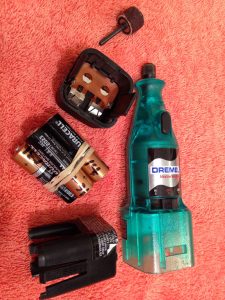
I don’t use this little battery-powered Dremel much, but when no wall power is available, or in wet locations, it’s mighty handy. It takes less than a minute to slide the batteries back into their holster and into the Dremel.

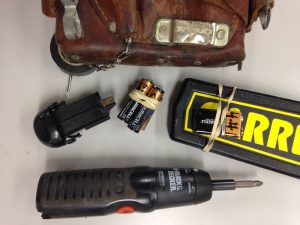
Months often go by that I don’t need to use the metal detector. Therefore, I take the battery out every time I use it. Ditto for the electric screwdriver in the electrical belt.

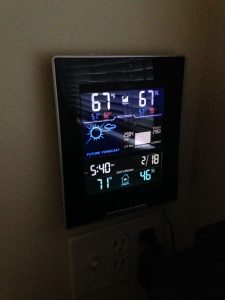
Some items need to have their batteries in all the time, especially devices requiring battery backup. For the bedside clock and weather station, we have computer reminders to change the batteries before they can go bad.

Return to the March 2017 issue of Wood News Online


Jim Randolph is a veterinarian in Long Beach, Mississippi. His earlier careers as lawn mower, dairy farmer, automobile mechanic, microwave communications electronics instructor and journeyman carpenter all influence his approach to woodworking. His favorite projects are furniture built for his wife, Brenda, and for their children and grandchildren. His and Brenda’s home, nicknamed Sticks-In-The-Mud, is built on pilings (sticks) near the wetlands (mud) on a bayou off Jourdan River. His shop is in the lower level of their home.Questions and comments on woodworking may be written below in the comments section. Questions about pet care should be directed to his blog on pet care, www.MyPetsDoctor.com. We regret that, because of high volume, not all inquiries can be answered personally.
Feb 282017
 

A highlight of my visit to Highland Woodworking a couple of years ago was the chance to spend a little time with the Kapex KS 120 EB Sliding Compound Miter Saw and make a quick video review of the tool.

In short, I liked it. I wanted it. But, alas, I couldn’t afford it. More accurately, I couldn’t justify it. While my brief time with the Kapex demonstrated some apparent advantages over my current miter saw, what I had was working fine. I will admit, however, to prolonged disappointment like a kid with a long list of toys for Santa that finds nothing but clothes under the Christmas tree.

Click here to read more…

Feb 172017
 

One of our favorite new tools this year is the compact dust extractor, the CT-SYS, from Festool. The portable unit makes workshop cleanup so easy (not to mention other cleanups around the house, in the car and anywhere else you can think of!)

Find out more about the Festool CT-SYS Dust Extractor in our 8 minute video.

Feb 162017
 

The Greek philosopher, Plato, was also a mathematician and he discovered and proved that there are only five regular solids. A regular solid is one that is made up of all the sides being made of one simple regular plane figure such as an equilateral triangle, a square or a regular pentagon. The five regular solids are:

  1. Tetrahedron made up of four equilateral triangular sides,
  2. Cube (or Hexahedron) made up of six square sides,
  3. Octahedron made up of eight equilateral triangular sides,
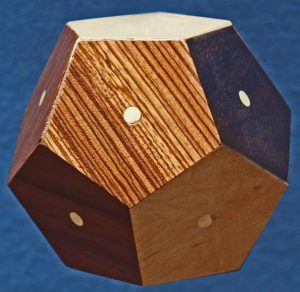
  4. Dodecahedron made up of twelve regular pentagonal sides,
  5. Icosahedron made up of twenty regular triangular sides.

Here is a picture of all five of them

These shapes have fascinated me for a long time and I decided that it would be an interesting project to make a set of these using different exotic woods for each face. The project required having to design and make two different fixtures to assure that every face was exactly the same size and that the side angles were also exactly the same. (The cube didn’t require any special fixture. I just used my normal table saw settings for that.)

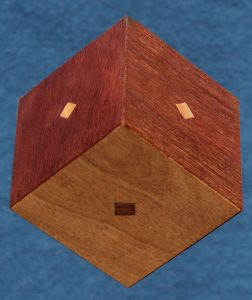
Here are pictures of my five Platonic solids made from different woods. (Each face is about 1/4″ thick.) As an added “secret” touch, I added small beads into each piece before adding the final face. Each piece has the same number of beads as it has faces, so for example: the cube has six beads and the tetrahedron has four beads.

Tetrahedron

Cube

Octahedron

Icosahedron

Dodecahedron

Feb 132017
 

Let The al fresco Dining Begin!

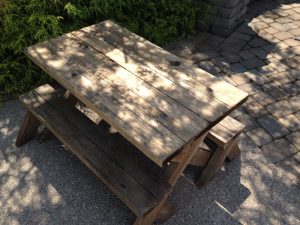
When our youngest grandchild, Sara Riley, was only a few years old, I got some rough-sawn cedar, planed and sanded it, and built the cutest miniature picnic table with two separate benches. A few years later our second grandchild, Charlie, came along, and his big sister now graciously allows him to sit with her.

After I finished this table, a lady saw it and said she wanted one for her grandchildren. She asked me, “How much?” I said, “For one exactly like this? Five hundred.” I put a lot of sweat and love into this little project. Unfortunately, I didn’t take any pictures while it was being built. Here, it shows the effect of aging in ten Kentucky summers and winters.

After I finished this table, a lady saw it and said she wanted one for her grandchildren. She asked me, “How much?” I said, “For one exactly like this? Five hundred.” I put a lot of sweat and love into this little project. Unfortunately, I didn’t take any pictures while it was being built. Here, it shows the effect of aging in ten Kentucky summers and winters.

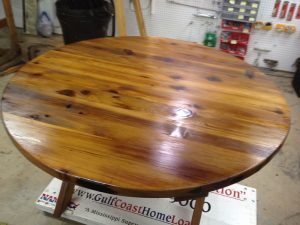
I wanted to make a picnic table for our two youngest grandchildren, Audrey and Owen, but I didn’t want it to be the same. When I found the plan for a round table with curved benches, I knew all I had to do was scale it down to their size.

The kernel of the project came from an old project book copyrighted 1970 titled, Wood Projects for the Home Handyman, by the editors of the Home Handyman’s Magazine. Its asking price was 60¢ at newsstands, 75¢ by mail. There is a collection of projects that you can make from the “durable, decorative and workable woods of the western lumber region.” To encourage the timid and the tightwad, the book proclaims “The table with benches can be easily constructed by the average home craftsman and will cost far less than comparable units available in retail outlets.”

I was shocked when I picked up the Western red cedar. So much for this project costing “far less.” Cedar had roughly doubled in price since the first table. But, so what? It was for the grandbabies. That’s always good justification.

Memorial Day weekend, 2014, I had the wood, the shop was clean, Brenda was out of town, the Forrest Woodworker II was sharp, and I thought, “I can start Friday night after work, go all day Saturday plus Monday and probably be finished by the evening of Memorial Day.”

I’m writing this January 25, 2017, and I just loaded the pieces onto the trailer last week. It was not a long-weekend task.

It was a fun project, though. One of the great things about having young grandchildren as your “customers”… they don’t keep track of time.

In fact, a serendipitous thing happened between 2014 and now. Granddaughter Audrey learned the term, al fresco, an Italian phrase that means “in the fresh air,” and she loves dining outside on the deck whenever she can. She and her little brother, Owen, will love sitting at their new al fresco table.

There were some interesting experiences during the two-plus years of this build, and I’d like to share some of them with you.

First, I learned that, although cedar’s price was up, the quality went down. Knots, on the one hand, are simply part of working with cedar. I knew that when I chose the medium. Other defects were not so expected.

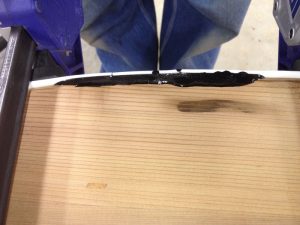
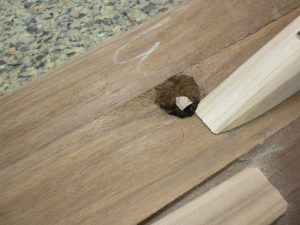
Like the giant void that appeared in the edge after circle-cutting the top with a router.

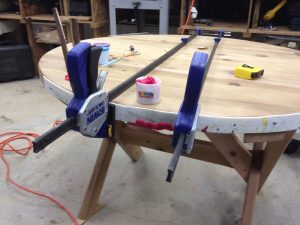
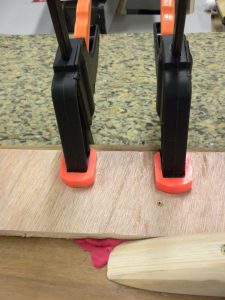
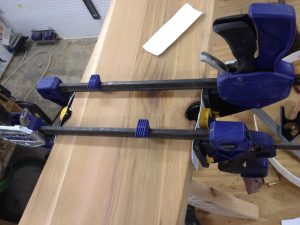
I suppose that black epoxy is going to become a “trademark” for me, as I seem to find a way to incorporate it in nearly every project, much like Ernie Conover uses ebony plugs in the center of his drawer pulls. But, I’m used to having a defect to fill that provides its own retaining wall, such as a knot that has fallen out. To fix this edge, I was going to have to provide a wall. As Steven Johnson would say, I “noodled” on it for a while, and came up with this plan. Start with a curved retaining wall. As someone who finds roadside buckets nearly every time he gets in the car, I wasn’t shy about cutting a bucket to pieces. The shape is already curved, and, even though it isn’t the same diameter as the 48″ top, it is flexible. I cut enough of it to go well beyond the defect, stretched it tight with clamps, then put pan-head screws through pre- drilled holes in the bucket-dam, into the edge of the table, applying even more tension. The defect was bad enough that it went all the way through, so I needed another dam on the bottom of the table. For that, I used some off-brand Play-Doh. Building up epoxy in seven layers, I gradually filled the void. I was hoping that I’d avoid bubbles by using thin coats of epoxy. Alas, there were some, but they were small and not terribly noticeable. Epoxy is sandpaper-friendly, so no techniques have to be changed to accommodate it.

The bucket strip is stretched tight against the wooden edge with clamps and screws. Dollar-store Play-Doh is acting as a dam against uncured epoxy dripping out, and we’re ready for the first layer.

The bucket strip is stretched tight against the wooden edge with clamps and screws. Dollar-store Play-Doh is acting as a dam against uncured epoxy dripping out, and we’re ready for the first layer.

Several layers have built up the epoxy.

Several layers have built up the epoxy.

The first two of seven coats of finish are on, and the repair looks more like an accent than a mistake of nature.

The first two of seven coats of finish are on, and the repair looks more like an accent than a mistake of nature.

Some of the bench boards had defects that went all the way through.

Some of the bench boards had defects that went all the way through.

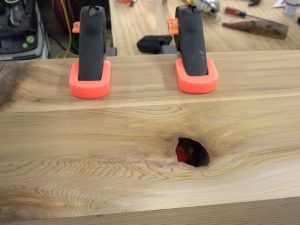
Repair of these through-knots started with fake Play-Doh, reinforced with plywood clamped in place.

Repair of these through-knots started with fake Play-Doh, reinforced with plywood clamped in place.

Then, the defect is ready to be filled. I use “charcoal” concrete-coloring powder in my epoxy to make it black.

Then, the defect is ready to be filled. I use “charcoal” concrete-coloring powder in my epoxy to make it black.

Sometimes you get lucky and two defects are right across from each other. Before filling, I used a Dremel tool with a burr to clean out all the loose material.

Sometimes you get lucky and two defects are right across from each other. Before filling, I used a Dremel tool with a burr to clean out all the loose material.

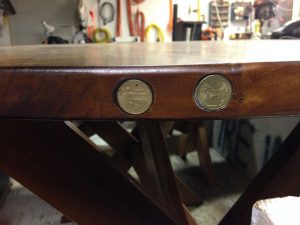
During the project I read about a home builder who epoxied a penny into the framing of houses he built. The year of the penny matched the year of the build. I expanded that idea and put state-specific quarters in the edge of the table. A “Kentucky” quarter from the years Audrey and Owen were born, a “Mississippi” quarter for the year the table was made, and a Texas quarter to represent the state of my birth. My Texas coin couldn’t be year-appropriate. Quarters hadn’t been invented yet.

During the project I read about a home builder who epoxied a penny into the framing of houses he built. The year of the penny matched the year of the build. I expanded that idea and put state-specific quarters in the edge of the table. A “Kentucky” quarter from the years Audrey and Owen were born, a “Mississippi” quarter for the year the table was made, and a Texas quarter to represent the state of my birth. My Texas coin couldn’t be year-appropriate. Quarters hadn’t been invented yet.

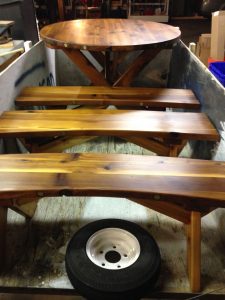
Loaded and ready for delivery. The finish is two coats of CPES: Clear Penetrating Epoxy Sealer, topped with three coats of gloss Epifanes and two coats of matte Epifanes.

Loaded and ready for delivery. The finish is two coats of CPES: Clear Penetrating Epoxy Sealer, topped with three coats of gloss Epifanes and two coats of matte Epifanes.

Return to March 2017 Wood News Online


Jim Randolph is a veterinarian in Long Beach, Mississippi. His earlier careers as lawn mower, dairy farmer, automobile mechanic, microwave communications electronics instructor and journeyman carpenter all influence his approach to woodworking. His favorite projects are furniture built for his wife, Brenda, and for their children and grandchildren. His and Brenda’s home, nicknamed Sticks-In-The-Mud, is built on pilings (sticks) near the wetlands (mud) on a bayou off Jourdan River. His shop is in the lower level of their home.Questions and comments on woodworking may be written below in the comments section. Questions about pet care should be directed to his blog on pet care, www.MyPetsDoctor.com. We regret that, because of high volume, not all inquiries can be answered personally.

Feb 102017
 

mcbrideIn this new monthly column the Madcap Woodwright, John McBride, invites both seasoned pro and novice woodworkers alike to stop and reevaluate their perspective on woodworking.

Each month, the Madcap Woodwright column will explore issues that encourage you to examine time worn attitudes and approaches to woodworking.

In his first column, John starts by telling the story of how he fell deeply in love with woodworking, starting from shop class in his sophomore year of high school.

John is also in the process of building a Roubo Workbench “with a Twist“, and documenting the build in stories and pictures in his column. Part 2 of that build is also included in this month’s column, along with a link to part 1.

Make sure you subscribe to Wood News and get the Madcap Woodwright and much more delivered to your inbox each month!