Highland Staff

Feb 082017
 

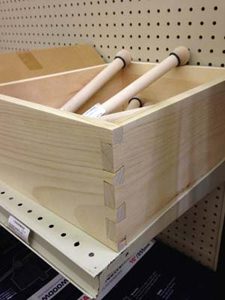
dovetails1smIn this month’s issue of Wood News, Amy Herschleb writes about her own journey learning how to cut a dovetail by hand. Amy is a staff writer for Highland and a relative beginner to woodworking, but her current surroundings working at the Highland Woodworking retail store make for a perfect environment to immerse herself in all things woodworking and learn various ways of approaching the basics.

Amy will be providing a beginner’s take on a number of different woodworking topics, including joinery, sharpening, hand planes, carving and much more. Keep your eye out here for more articles to come!

In the meantime, you can read about Amy’s entertaining exploration into different ways of cutting a dovetail.

Feb 062017
 

January is the month of resolutions.

February is the month in which you know whether you’ve kept up with what you’ve resolved, need to improve, or have failed miserably.

What are your resolutions for 2017?

I’m confident that a lot of woodworkers have intentions of being cleaner around the shop in the new year. We could sweep more, we could pick up cutoffs and other trip hazards as we create them, we could store the things that we use infrequently, and better organize the things we leave out.

Some of you might be like me, and have tools that you no longer (or never did) use.

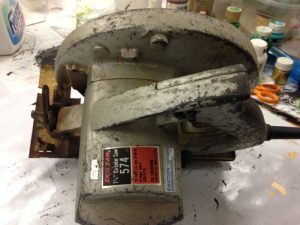
Take my first Skilsaw. It runs, but the bushings (I doubt it has bearings) seize on the armature and it howls when it spins. I might be able to send it somewhere to be rebuilt, but how would I justify the cost and effort? I have a TS75, and a newer Skilsaw. Still, I can’t seem to let it go. I bought it at the Keesler Air Force Base Exchange in the 1970s and, if I remember correctly, paid less than $25.

With the exception of the TS75, this is still the best circular saw I’ve ever had. Not for sale. If I could solve the seizing problem, it would still be my go-to all-around circular saw. It would beat the pants off the Skilsaw I bought in 2005.

With the exception of the TS75, this is still the best circular saw I’ve ever had. Not for sale. If I could solve the seizing problem, it would still be my go-to all-around circular saw. It would beat the pants off the Skilsaw I bought in 2005.

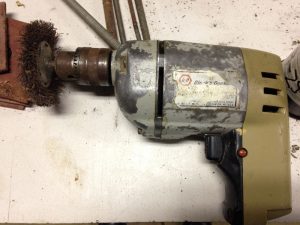
Speaking of the BX, I have a Black and Decker one-speed, one-direction (neither reversible nor variable speed had been invented yet, I don’t think) drill that I paid just $8 for, also in the 70s. It still runs as well as it ever did. Well, maybe a little noisier. I’ll probably keep it if it ever dies. It holds some really good memories.

This is one tough drill. It came with a 1/4" chuck, but I exchanged it for a 3/8" chuck from a dead drill. Not for sale.

This is one tough drill. It came with a 1/4″ chuck, but I exchanged it for a 3/8″ chuck from a dead drill. Not for sale.

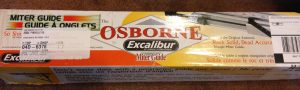
I have an Osborne Excalibur miter gauge that I’ve never used. Heck, it’s never even been out of the box. I won it in a contest and I already had a nice Incra miter gauge that I’ve always been happy with.

Somebody could have been using this fine miter gauge for all the years it’s been sitting in my office. I’d like to sell it, but I’m not sure where to start.

Somebody could have been using this fine miter gauge for all the years it’s been sitting in my office. I’d like to sell it, but I’m not sure where to start.

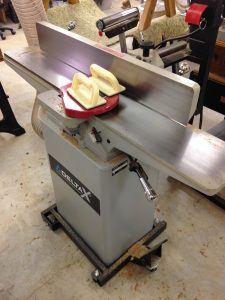
I’d like to have a bigger jointer than the 6″ Delta that I have, but what would I ever do with the old Delta? It would be cost-prohibitive to ship, but I could deliver it if I sold it locally.

Sometimes a 6" jointer is all you need, other times, it’s just not enough. Still, no one needs two jointers. Or does he?

Sometimes a 6″ jointer is all you need, other times, it’s just not enough. Still, no one needs two jointers. Or does he?

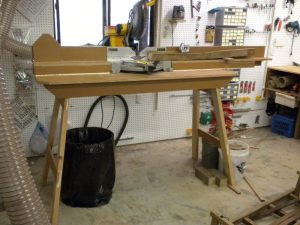
I’ve also been torn about miter saws. I took the plunge into a Festool Kapex, for a variety of reasons, but I’m still attached to my DeWalt. It’s not a sin to have two miter saws, is it?

There’s nothing wrong with the DeWalt miter saw, and the Norm Abram stand is the cat’s meow. But, does one need two power miter boxes? I doubt it.

There’s nothing wrong with the DeWalt miter saw, and the Norm Abram stand is the cat’s meow. But, does one need two power miter boxes? I doubt it.


Jim Randolph is a veterinarian in Long Beach, Mississippi. His earlier careers as lawn mower, dairy farmer, automobile mechanic, microwave communications electronics instructor and journeyman carpenter all influence his approach to woodworking. His favorite projects are furniture built for his wife, Brenda, and for their children and grandchildren. His and Brenda’s home, nicknamed Sticks-In-The-Mud, is built on pilings (sticks) near the wetlands (mud) on a bayou off Jourdan River. His shop is in the lower level of their home.Questions and comments on woodworking may be written below in the comments section. Questions about pet care should be directed to his blog on pet care, www.MyPetsDoctor.com. We regret that, because of high volume, not all inquiries can be answered personally.

Feb 052017
 

No Southern-fried Southern boy wants to be called a Yankee, but we share the characteristics of shrewdness and thrift. Thus, each month we include a money-saving tip. It’s OK if you call me “cheap.

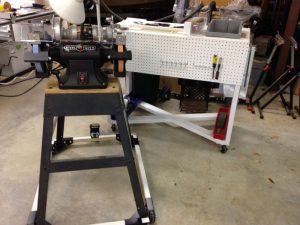
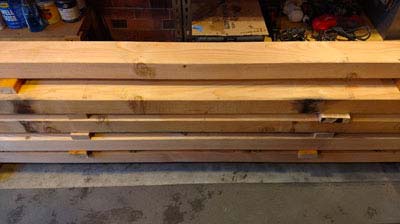
How cheap can a project get? Let’s look at the mobile grinding station featured in this month’s 1st tip. It starts with a free Craftsman tool stand from a Sears dumpster. Then, use some 2x2s salvaged from a friend’s trash down the street.

All of these 2x2s were already cut and painted, sitting by the side of the road for someone to pick up and give them a home. I was happy to oblige. To boot, I got them on my predawn walk; no pride was sacrificed in the making of this project.

All of these 2x2s were already cut and painted, sitting by the side of the road for someone to pick up and give them a home. I was happy to oblige. To boot, I got them on my predawn walk; no pride was sacrificed in the making of this project.

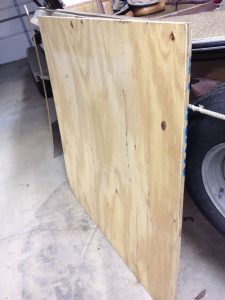
Add a scrap piece of plywood for the top.

Some of my best finds occur in the dark. I toted this back home one morning, adding calorie burn to my walk and a beautiful half-sheet of CDX plywood to my stores.

Some of my best finds occur in the dark. I toted this back home one morning, adding calorie burn to my walk and a beautiful half-sheet of CDX plywood to my collection.

A half-price grinder, a full-price mobile base, a few bolts and the rest was free. Not a bad deal for a mobile grinding station.

A half-price grinder, a full-price mobile base, a few bolts and the rest was free. Not a bad deal for a mobile grinding station.


Jim Randolph is a veterinarian in Long Beach, Mississippi. His earlier careers as lawn mower, dairy farmer, automobile mechanic, microwave communications electronics instructor and journeyman carpenter all influence his approach to woodworking. His favorite projects are furniture built for his wife, Brenda, and for their children and grandchildren. His and Brenda’s home, nicknamed Sticks-In-The-Mud, is built on pilings (sticks) near the wetlands (mud) on a bayou off Jourdan River. His shop is in the lower level of their home.Questions and comments on woodworking may be written below in the comments section. Questions about pet care should be directed to his blog on pet care, www.MyPetsDoctor.com. We regret that, because of high volume, not all inquiries can be answered personally.

Feb 042017
 

Welcome to “Tips From Sticks-In-The-Mud Woodshop.” I am a hobbyist who loves woodworking and writing for those who also love the craft. I have found some ways to accomplish tasks in the workshop that might be helpful to you, and I enjoy hearing your own problem-solving ideasPlease share them in the COMMENTS section of each tip.  If, in the process, I can also make you laugh, I have achieved 100% of my goals.

Mobile bases are terrific. I like being able to move a tool to the location of the work, or, sometimes, just move it in order to clean.

Last month I posted about the new sharpening center. This month, I finalized something I’ve been wanting to do for a long time. In the sharpening center post, I mentioned that I’d considered putting a low-speed grinder on the deck, but worried that it might be crowded, as well as the risk of mixing water and electricity. Still, I wanted to have the grinder close by when it was needed, and this is how I fixed it…

When our Sears store had a local repair center, their dumpster was sometimes a gold mine. They would throw out things that seemed to be perfectly useful. One day I’d been there to drop off my dehumidifier for annual maintenance, when a grey object caught my eye. I wheeled around to check and, sure enough, a Craftsman tool stand was just outside the dumpster. As the proud owner of a Craftsman radial arm saw, I thought I’d pick it up in case I wanted to mount the saw on it. I’d already built the saw into my “saw table,” but it was a prize too good to pass up.

Over time, the stand was in my way, and I was happy with the saw table setup, so I started looking for other uses. It seemed ideally suited for a grinder, so I took a scrap of plywood and bolted it securely. To the plywood I attached my little Craftsman grinder. It was a good working height as- is.

For many years after I started woodworking, I was a terrible sharpener. In an effort to improve, I looked at a Work Sharp 3000 Sharpening Center, Scary Sharp sandpaper and several Tormek sharpening options. While I’m convinced that Tormek is worth every penny, I just couldn’t quite convince myself to drop the necessary coin. Since Steven Johnson’s excellent video on the Tormek T-4 Sharpening System, I’m now a believer, but I was already committed to a slow-speed grinder.

When my Steel City slow-speed grinder arrived, I was at first elated, then deflated. During shipping, the grinder must have fallen on its left side, because there were several parts bent. I called the company, and they were glad to take care of the problem. In fact, they sent me an entirely new grinder, and didn’t even want the old one back! I couldn’t be happier with the replacement. It was easy to unbolt the Craftsman, move it 90i, and have grinders back-to-back.

As Christmas approached, my wife asked me repeatedly what I wanted. Since I didn’t need anything, it was hard for me to produce ideas, but I settled on a DMT diamond plate and a universal mobile base. In no time I had a moveable grinder setup that could follow my wet sharpening system around the shop whenever and wherever they were needed.
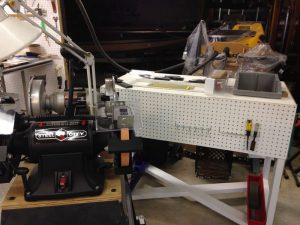
Mounted on a mobile base, this grinder setup is ready to go wherever the work is, or just get out of the way of an oncoming vacuum cleaner.

Mounted on a mobile base, this grinder setup is ready to go wherever the work is, or just get out of the way of an oncoming vacuum cleaner.


Jim Randolph is a veterinarian in Long Beach, Mississippi. His earlier careers as lawn mower, dairy farmer, automobile mechanic, microwave communications electronics instructor and journeyman carpenter all influence his approach to woodworking. His favorite projects are furniture built for his wife, Brenda, and for their children and grandchildren. His and Brenda’s home, nicknamed Sticks-In-The-Mud, is built on pilings (sticks) near the wetlands (mud) on a bayou off Jourdan River. His shop is in the lower level of their home.Questions and comments on woodworking may be written below in the comments section. Questions about pet care should be directed to his blog on pet care, www.MyPetsDoctor.com. We regret that, because of high volume, not all inquiries can be answered personally.

Feb 032017
 

davidbarronIf you are struggling to get a good fit on your dovetails with a handsaw, the Barron Magnetic Dovetail Saw Guide can help. Use the guide as an assist if you are just starting in your dovetailing, or keep it in your toolbox for foolproof angle cutting even when you have your technique down.

In the video below, Mike Morton takes a closer look at the Barron Guide, demonstrating how it works and showing us the best way to use it to cut pins and tails on your next set of dovetails. If you have been frustrated in your attempts to cut close-fitting dovetails, try the Barron Magnetic Dovetail Saw Guide, available at Highland Woodworking.

Feb 012017
 

If you are overwhelmed by all of the choices for sharpening and honing your plane irons and chisels, we can help. In the video below, Justin Moon takes a closer look at the many different options for sharpening, including water stones, diamond plates, oil stones, ceramic stones, sandpaper and more.

Watch the video to learn pros and cons of each sharpening method, and get started sharpening with confidence in your own shop today.

Jan 272017
 

John McBride is a self-described hopeless addict when it comes to vintage woodworking equipment, hand tools, and building workbenches. Already well-versed in European style workbenches after building two and working on several others, John discovered Chris Schwarz and launched the build of his “Madcap Roubo”.

Follow John’s journey in this build series – click here to read part 1 of The Madcap Woodwright’s’Roubo Build with a Twist’