Highland Staff

Apr 202017
 

In the April issue of The Highland Woodturner, we are featuring Ray Bissonette, a favorite contributor from past issues.

After having his turnings featured in the June 2013 issue of The Highland Woodturner, Ray Bissonette used his earned store credit toward a new Spindle Gouge, which helped him add a new design element to his already “eccentric” woodturned candelabras.

CLICK HERE to see how he made them

Apr 132017
 

Most folks will use 9″ x 11″ sandpaper sheets at some point in their sanding endeavors. And most of us typically will cut the sheets down in size to suit some particular sanding pad size, or to make a more appropriately sized piece of sandpaper for hand sanding.

Ways to tear sandpaper paper down in size range from the “fold a crisp crease”, then pull it apart like spreading continental plates method, to folding it over a sharp 90 degree table edge (like on a machine’s cast iron table) and yanking down to tear the sheet. There is also the “use your spouse’s fabric scissors” method to cut sandpaper and is definitely one way I can attest to that should be avoided. Sometimes these methods give a clean “cut” and other times the “tear” ends up being ragged, jagged and anything but straight.

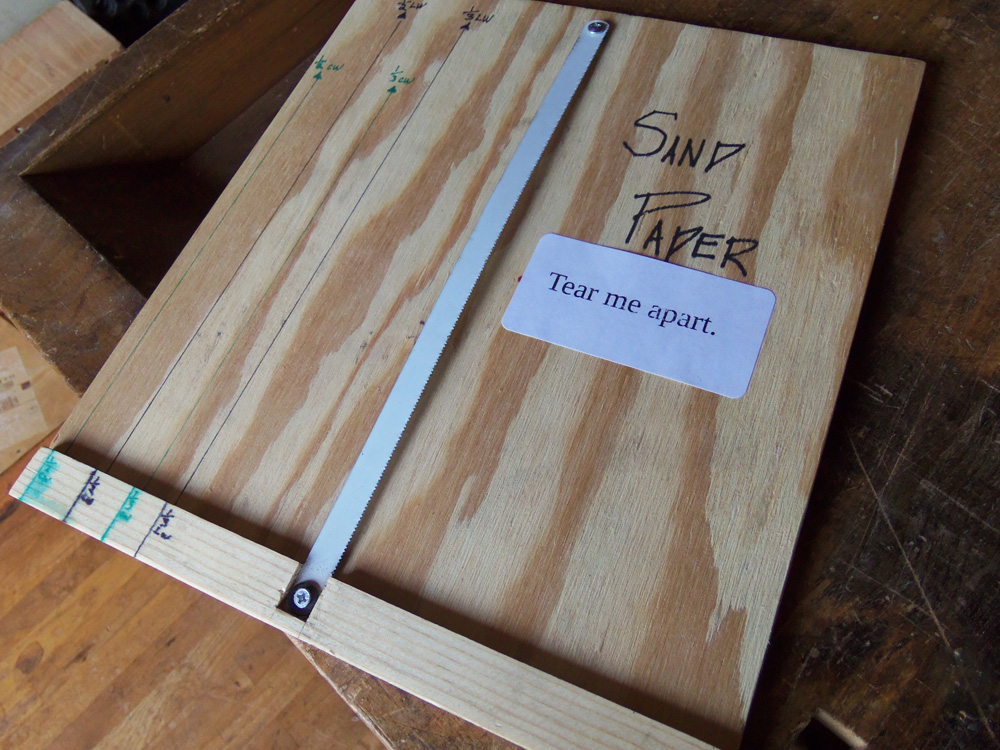
Wise use of a consumable commodity like sandpaper can save money in the long run and the more your sheets can be cut nice and clean, at just the right size, the farther your sandpaper budget is stretched. To that end, take some scrape wood and an old hacksaw blade (or a new one if your budget allows) and make yourself a sandpaper sheet cutting jig for making straight & clean sheet tears, right on your mark, every time.

Sandpaper tearing jigWe used 1/2″ plywood and glued on some 3/4″ scrap at the bottom to give a 1/4″ high lip to be a reference fence. Chisel out a small mortise to “let-in” the blade to the fence, keeping the mortise depth about 1/16″ above the plywood. Square the hacksaw blade to the fence and use a washer under the blade at the top before you screw it down, leaving space between the plywood and the blade for easily sliding your sandpaper underneath the blade. We oriented the teeth on the blade so pulling up the paper goes “into” the rake of the teeth.

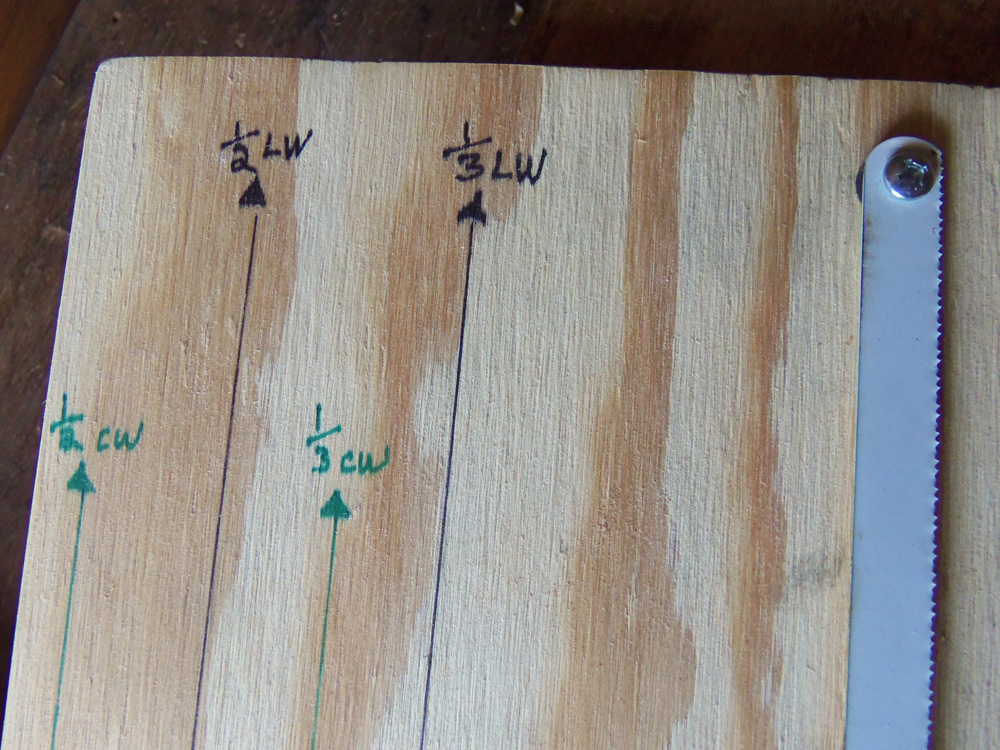
Size marks on sandpaper tearing jig

Using a fine line marker, draw witness lines at measured dimensions from the blade’s cutting edge for half a sheet and 1/3 a sheet, in both lengthwise and crosswise measurements. Add any other dimensions you use regularly when cutting sheet paper down to size.

Avoid doing what we did, don’t spray lacquer onto the Sharpie marks to “seal” them. The lacquer made the marks run like the makeup on a crying mime.

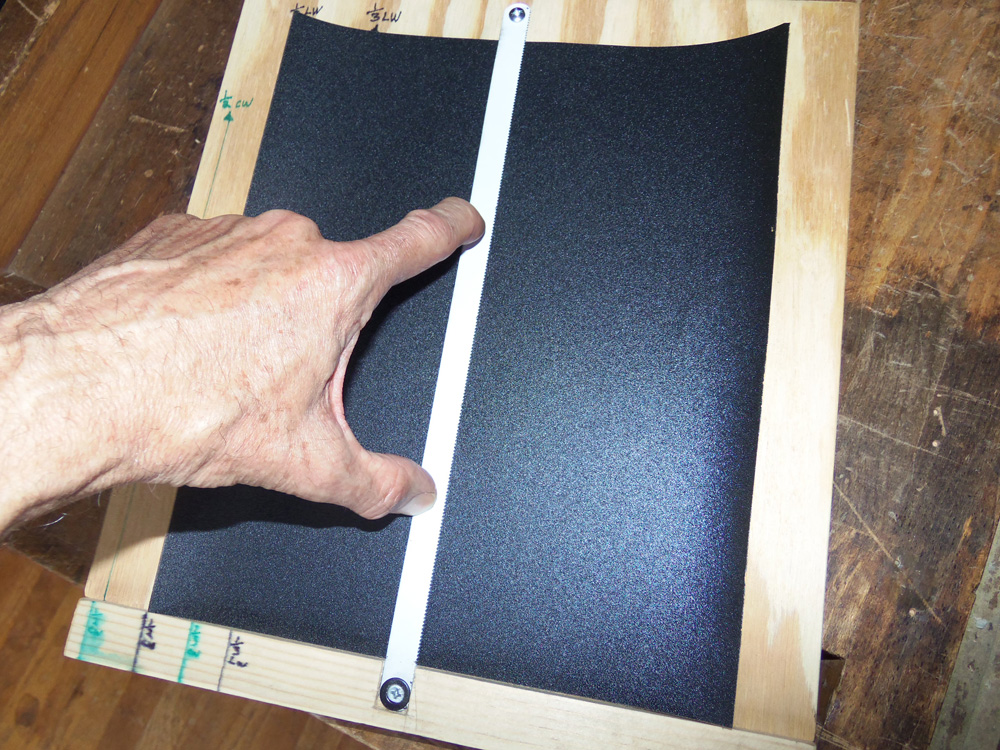
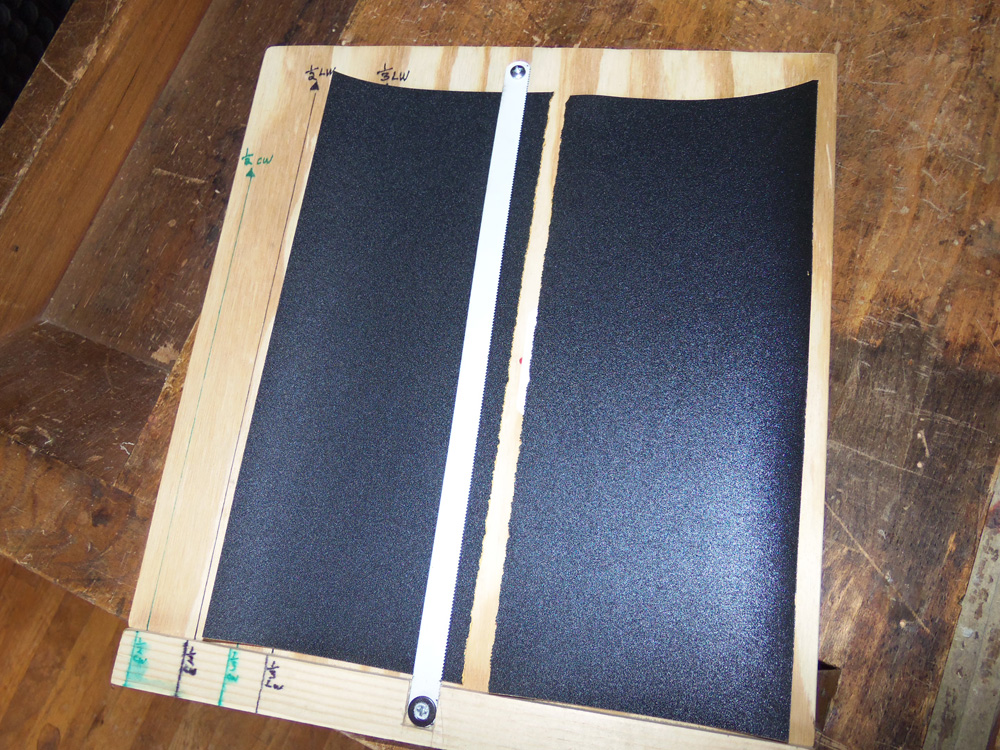
How to use the sand paper tearing jig

Now go tear up your sandpaper in highly predictable ways!

Apr 102017
 

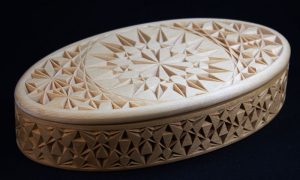
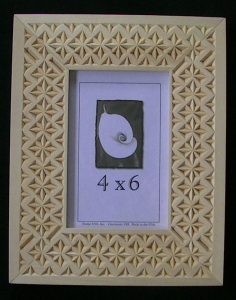
chip carvingChip carving has been around for hundreds of years, has been practiced by men and women of all ages and from all walks of life, and continues to grow in popularity around the world. There are a number of reasons why this is the case. Chip carving has a low startup cost, does not require any special artistic ability, can be done anywhere, and does not take a long time to learn and to achieve good results.

Getting started in chip carving does not necessitate a large investment. Many styles of carving require the need for a wide variety of assorted straight chisels, bent chisels, round nose chisels, gouges, v-tools, skews, parting tools, mallets, vises, carving benches, aprons, gloves, thumb guards, paints, and brushes. This expense can quickly add up to many thousands of dollars. Chip carving appeals to hobbyists/carvers/beginners with any size budget. Complete chip carving kits are economical and include everything needed to get started.

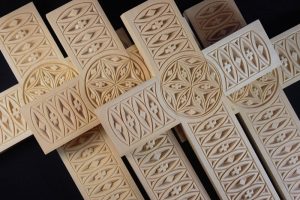
chip carving crossesMany people I interact with who see my chip carved items respond, “I could never do that. I’m not artistic.” The good news is that no artistic ability is needed to become a skilled chip carver. It is all about technique! While some chip carvers enjoy the design aspect of creating patterns, this is not a requirement. A lack of artistic ability is no excuse for anyone wanting to learn how to chip carve.

Chip carving is also ultra-portable! At home you can chip carve indoors, outdoors, on the porch, in the workshop, in the living room while relaxing with your family, in the family room in front of the fireplace, in the kitchen, and in your favorite chair in the den. Pack your knives and project in a bag and bring your project with you on your next camping trip, when you take a road trip, or as a nice way to spend some down time on vacation. All it takes is your set of knives, sharpening kit, and projects and you’re all set. An important reason why chip carving can be done anywhere is because it does not make a big mess. Of the various types of carving, chip carving is probably one of the cleanest because there are fewer chips created. I chip carve regularly on a chair in my family room and simply vacuum up the chips when I’m done. The clean up is quick and easy.

Another reason why chip carving is a great style of carving to learn is because it does not take a long time to learn how to produce nice carvings. Chip carving is really quite easy. If you practice good technique, use beginning patterns, and regularly practice the basic skills, good results can be obtained in a matter of months. When I teach chip carving classes, my beginning students are always impressed with the good results they are able to obtain in just their first day, often in the first hour or two! Most students will have that “Ahhh” moment when their first chip pops out. This is much different than other styles of carving that can take several years and require a natural artistic ability to attain proficiency. This is one of the advantages of chip carving that makes it appealing to so many.

Learning how to chip carve is not difficult. You will quickly find that chip carving is a very enjoyable pastime and rewarding hobby that eventually you will want to pass on to your friends and family.


Marty Leenhouts has 30 years of teaching experience and is the owner of MyChipCarving.com and EZcarving.com. His videos have 2.5+ million views and he is the author of Chip Carving Essentials: A Step-by- Step Guide to Successful Chip Carving.

Apr 052017
 

What tools do you have that you wish you hadn’t bought?

The Wood Whisperer, Marc Spagnuolo,  says one is his Dremel tool.

I, on the other hand, use my Dremel tool and attachments all the time: cutoffs, buffing small items, engraving/signing my work, routing small areas with the burr, cleaning out knots to ready them for epoxy, the uses are endless.

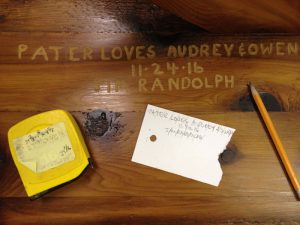
Requiring no talent and almost no practice, a Dremel motor with a little round burr allows you to sign your work permanently.

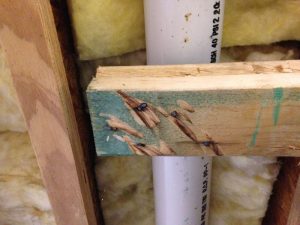
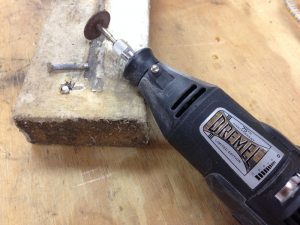
A 4-inch or 9-inch grinder will cut off a nail in a hurry, flush or below the surface, if you don’t mind massive burning of the wood, but …

…a Dremel fitted with a cutoff wheel can cut a nail and never mar the surface.

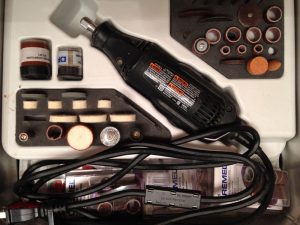
My wife got this 75th Anniversary Dremel set for a birthday gift for me. As Hazel (Shirley Booth) would say, “It’s a doozie!” It also came with two grits of sanding drums, nylon and steel brushes, buffing wheels and compound, and a felt wheel. I added chainsaw sharpening stones, and they will put a super sharpening on a chain in nothing flat. It also features an adjustable speed.

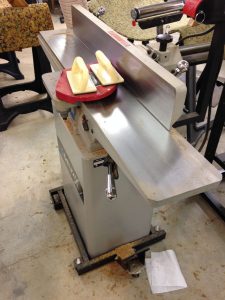
For me, it would definitely be my jointer. I bought the little 6″ Delta because I thought it was sufficient. When Katrina took my first one, I bought another just like it. I really wish I’d stepped up to at least an 8″, possibly with a spiral cutterhead. Regret might be a term too strong, but I really would like to have a better jointer.

This Delta jointer does 90% of what I need it to do, but it’s definitely an entry-level unit.

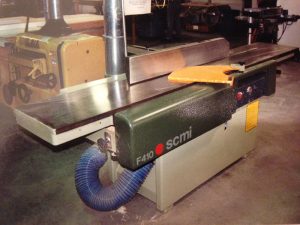
Now, if someone wants to buy me this jointer, I promise I will never complain! It’s what dreams are made of.

Return to the April 2017 issue of Wood News Online


Jim Randolph is a veterinarian in Long Beach, Mississippi. His earlier careers as lawn mower, dairy farmer, automobile mechanic, microwave communications electronics instructor and journeyman carpenter all influence his approach to woodworking. His favorite projects are furniture built for his wife, Brenda, and for their children and grandchildren. His and Brenda’s home, nicknamed Sticks-In-The-Mud, is built on pilings (sticks) near the wetlands (mud) on a bayou off Jourdan River. His shop is in the lower level of their home.Questions and comments on woodworking may be written below in the comments section. Questions about pet care should be directed to his blog on pet care, www.MyPetsDoctor.com. We regret that, because of high volume, not all inquiries can be answered personally.

Apr 042017
 

No Southern-fried Southern boy wants to be called a Yankee, but we share the characteristics of shrewdness and thrift. Thus, each month we include a money-saving tip. It’s OK if you call me “cheap.

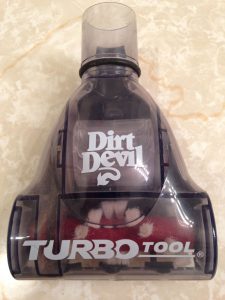
I got this little vacuum attachment, you guessed it, for free.

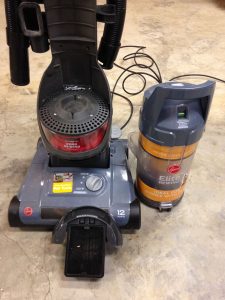
I picked up this discarded vacuum on my daily walk, intending to set up the cyclone on a bucket for use with a shop vacuum. I saw a project like that on YouTube.

This little attachment came with my free vacuum at no extra charge!

I’d never used one before, but, when our regular carpet attachment (borrowed from inside the house) wasn’t working, and I needed to clean a rug in the garage, I decided to give it a try on the end of our whole-house vacuum hose.

Man! I had no idea!

There is a similar attachment on our vacuum at work, and I’d noticed it only in passing.

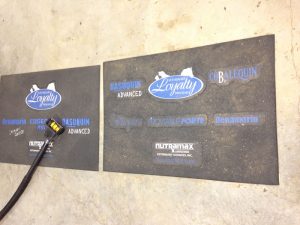
For some time I’ve fretted over getting these pads clean. Not any more! The little beater-bar attachment doesn’t grab the rug like the full-size floor attachment does. The difference in the cleaned and uncleaned rugs is more dramatic than the photo depicts.

My new “rug routine” is to gather all of them into one place (on top of an old card table) and put the attachment on the end of my Shop-Vac’s Dust Deputy-filtered hose. Then, I can clean the rest of the workshop, floors and all, separately.

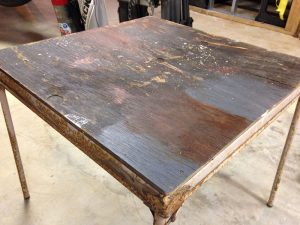
Decades ago, I got this card table for free from the roadside. I use it for all kinds of trashy jobs. I replaced the original cardboard top with some salvaged 3/8″ plywood. It’s stored, folded, with my collapsing sawhorses, within easy reach.

Return to the April 2017 issue of Wood News Online


Jim Randolph is a veterinarian in Long Beach, Mississippi. His earlier careers as lawn mower, dairy farmer, automobile mechanic, microwave communications electronics instructor and journeyman carpenter all influence his approach to woodworking. His favorite projects are furniture built for his wife, Brenda, and for their children and grandchildren. His and Brenda’s home, nicknamed Sticks-In-The-Mud, is built on pilings (sticks) near the wetlands (mud) on a bayou off Jourdan River. His shop is in the lower level of their home.Questions and comments on woodworking may be written below in the comments section. Questions about pet care should be directed to his blog on pet care, www.MyPetsDoctor.com. We regret that, because of high volume, not all inquiries can be answered personally.

Apr 032017
 

Welcome to “Tips From Sticks-In-The-Mud Woodshop.” I am a hobbyist who loves woodworking and writing for those who also love the craft. I have found some ways to accomplish tasks in the workshop that might be helpful to you, and I enjoy hearing your own problem-solving ideasPlease share them in the COMMENTS section of each tip.  If, in the process, I can also make you laugh, I have achieved 100% of my goals.

Recently, I was working on a little stool for an employee’s niece and it was a blast to make! To give it an extra sentimental connection, I chose 150-year-old pine salvaged from our clinic’s old baseboards. It was great material, except for the fact that its age makes it somewhat brittle.
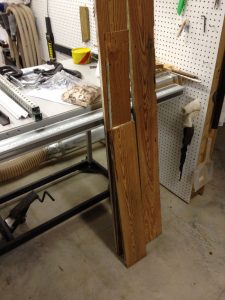
I like the character of this ancient pine, but it has its challenges. However, the beautiful end products make the struggles worthwhile.

To give it plenty of stability (we didn’t want little Kessa taking a tumble!), I mortised the top to accept the legs.
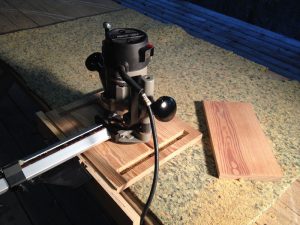
When I make stools, I take the time to mortise all of the parts together for maximum strength. There’s no such thing as overkill when it comes to children’s safety. Sometimes I use the stationary mortise chisel, but other times I use the router, followed by cleanup with a sharp chisel.

The two sides were not interchangeable, as the legs were not exactly the same thickness. Frequently, antique lumber isn’t uniform. There wasn’t enough difference for one’s eye to tell, but enough that the mortise fit wasn’t identical.

To keep myself straight, I put chalk marks on all the pieces through the milling process. I’ve seen chalk used by a lot of very talented and successful woodworkers, and it had to be easier to remove than pencil marks, so I thought I’d give it a try.
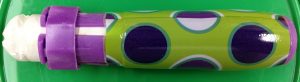
Chalk is cheap if you get it at the everything’s-a-dollar store. Four huge sticks of chalk and a holder for a buck. A cheapskate’s dream.

As the kids nowadays say, “How’s that working out for you?”

Not so great.

I managed to keep the top on the top and the center section in the middle. Additionally, the center puts its best face forward, which also establishes the front and rear of the stool.

Somehow, though, in the middle of gluing up, I managed to get the big leg in the small mortise, which wasn’t the end of the world because it fit, nothing split, and its mortise for the center section fit, too. But, when the little leg went into the bigger mortise, the slop was immediately evident.

And, the gap around the leg was evident. Not huge, mind you, but evident.

Like a Lego fort, the interlocking parts already installed and glued were too intimate to disassemble, so rearranging was out of the question at this point.

While there might be other projects where chalk is a viable marking option, I’m going with bits of blue shop tape next time.
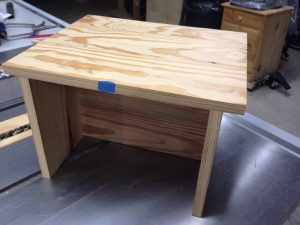
As long as you’re sure it’s not going to fall off, there’s no down side to blue-tape marking. More robust than chalk and unlikely to be accidentally removed.
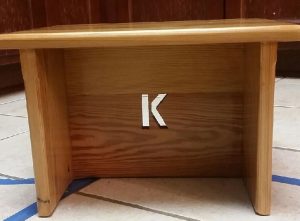
As Olive Oyl once said, “All’s well that ends in the well.” I think everyone is happy with this end product.

According to Steven Johnson’s study on adhesion and cohesion, we shouldn’t need to worry about residue interfering with finish after using painter’s tape, because its cohesion exceeds its adhesion. Of course, tape sticks better to smooth wood better than rough, so, it’s not going to be the universal marking answer. I’ll let you know how the tape works out.

And, I won’t be throwing my pencils away. Did you know that acetone is an excellent graphite remover?

  • Be generous when applying the acetone to a rag or paper towel.
  • Work quickly, because acetone evaporates rapidly.
  • Keep moving. By that, I mean, once you’ve removed some or all of a mark with a spot on your paper towel, don’t try to continue using the same spot. Apply more acetone to a clean area and begin again.
  • Remember, acetone is an organic solvent, and, thus, is subject to spontaneous combustion. Allow the vehicle to air-dry in an open area and/or immerse it in water in a plastic bag.
  • Some woodworkers report that mineral spirits are also effective at removing pencil marks.

     Return to the April 2017 issue of Wood News Online


    Jim Randolph is a veterinarian in Long Beach, Mississippi. His earlier careers as lawn mower, dairy farmer, automobile mechanic, microwave communications electronics instructor and journeyman carpenter all influence his approach to woodworking. His favorite projects are furniture built for his wife, Brenda, and for their children and grandchildren. His and Brenda’s home, nicknamed Sticks-In-The-Mud, is built on pilings (sticks) near the wetlands (mud) on a bayou off Jourdan River. His shop is in the lower level of their home.Questions and comments on woodworking may be written below in the comments section. Questions about pet care should be directed to his blog on pet care, www.MyPetsDoctor.com. We regret that, because of high volume, not all inquiries can be answered personally.

Mar 312017
 

Jim Dillon has been involved with Highland Woodworking for quite some time now as both a customer and a class instructor in the Highland Woodworking classroom, where he teaches monthly classes ranging from hand tool skills to building bookcases, and much more!

He became a full-time woodworker in 1998 after he taught writing, which stemmed from his college English degrees. When not teaching at Highland, you can find Jim as the resident cabinetmaker at Fernbank Science Center here in Atlanta.

Jim keeps up a regular blog, The Thousand-Dollar Shop, where he discusses his current projects, new tools, and how he accomplishes woodworking “on a less than infinite budget,” something I’m sure we all strive for.

If you’re in Atlanta anytime soon, sign-up for one of his classes! Below is his upcoming class schedule. All classes are held at Highland Woodworking.

Saturday, April 1st – Build a Tool Storage Box

Tuesday, April 18th – Wednesday, April 19th – Build a Bookcase

Sunday, May 7th – Using Hand Planes

Saturday, May 13th – Hand Cut Dovetails

Tuesday, May 16th – Hand Tool Sharpening

You can follow Jim on Twitter (@jimdillon6) and Instagram (@from_ogema), and make sure to check out his blog!