Highland Staff

Aug 032017
 

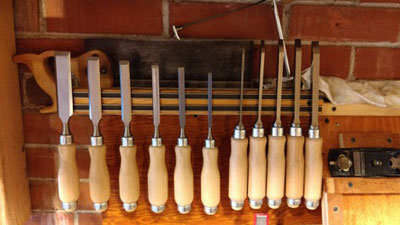
In the August 2017 issue of Wood News, John McBride, The MadCap Woodwright, reviews his new set of Narex Bench Chisels and Narex Mortise Chisels. He offers a lot of useful thoughts on setting them up for use and gives his initial impression on working them into his shop rotation. If you have been looking for a new set of chisels, read his thoughts!

Click here to read more

Aug 012017
 

I’m not known for being a wishy-washy person.
In fact, I’m often thought of as an all-or-nothing type.
But, on this matter, I like it one way sometimes, and sometimes the other way.
Edges

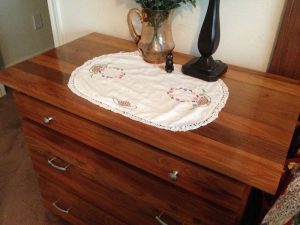
An argument could be made that the bedside table in the photo below should have had its edges rounded. Infrequently, I have bumped into the table on my side of the bed and, if I ever hit the corner, I know it’s going to hurt.

It just hasn’t happened yet.

I’m not sure what made me think in the beginning that I wanted these edges sharp, but, it came to be a challenge to keep them from becoming damaged. I think they came out nice, while, at the same time, I recognize the advantages of rounded and chamfered edges.

When I made a matching pair of tables from old, recycled oak flooring, I made up my mind early, I would try to maintain the squareness of all of the corners. After all, if something went bad where it showed, I could always whip out a router and a roundover bit.

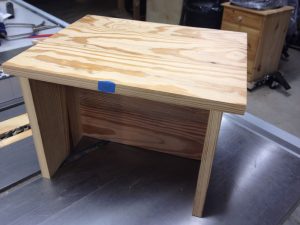
On the other hand, I’ve never made a child’s stool without easing the edges. Just common sense, I’d say. Even if I liked the look of the acute junction, I wouldn’t jeopardize a kid’s safety for my taste.

Now that I think about it, sharp edges might not even be attractive in this stool.

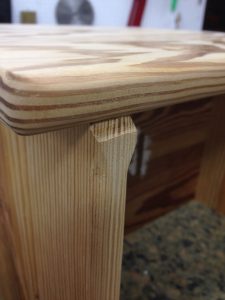
Before rounding over these edges, this antique pine didn’t look like anything special, but …

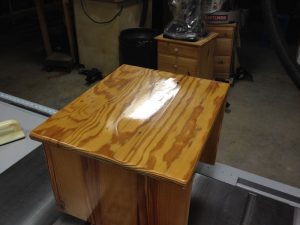
…just a few minutes in the router table and a little sanding, and the grain flowing over the edge comes to life.

Then, the finish makes it shout.


Jim Randolph is a veterinarian in Long Beach, Mississippi. His earlier careers as lawn mower, dairy farmer, automobile mechanic, microwave communications electronics instructor and journeyman carpenter all influence his approach to woodworking. His favorite projects are furniture built for his wife, Brenda, and for their children and grandchildren. His and Brenda’s home, nicknamed Sticks-In-The-Mud, is built on pilings (sticks) near the wetlands (mud) on a bayou off Jourdan River. His shop is in the lower level of their home.Questions and comments on woodworking may be written below in the comments section. Questions about pet care should be directed to his blog on pet care, www.MyPetsDoctor.com. We regret that, because of high volume, not all inquiries can be answered personally.

Jul 312017
 

No Southern-fried Southern boy wants to be called a Yankee, but we share the characteristics of shrewdness and thrift. Thus, each month we include a money-saving tip. It’s OK if you call me “cheap.

A few days ago I was looking for a big piece of paper to trace an outline on. I didn’t have any paper that big, so I found some 8 x 10 advertising sheets that came with a product I’d ordered, taped them together and that worked fine. When I’m putting newspaper into a cage at work, if I run across the funny papers, I’m inclined to stop and read a few strips before moving on. When I picked up these sheets, I couldn’t help noticing that a company was selling sawdust for you to use to color your glue and epoxy.

Don’t fall for that! You’re already making sawdust just about every time you’re in the shop. All you have to do is collect it. Here’s how I do it.

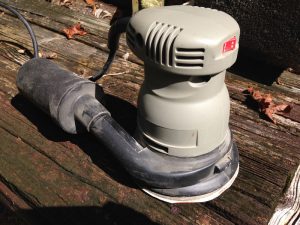
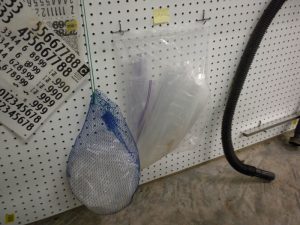
First, I get a zipper-locking bag. No, not a brand new one! You do have a collection of free used bags, or bags that came in tools or parts that you saved, don’t you? Using a Magic Marker, label one red oak, one white pine, redwood, cedar, etc. Before you start collecting for your collection, vacuum the dust bag on your random orbit or vibrating sander. It doesn’t have to be sterile, you just don’t want a contrasting color of sawdust diluting your specimens.

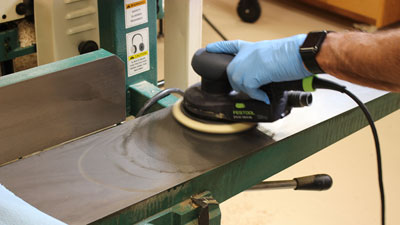
Clean the bag on your sander thoroughly before beginning to collect for sanding dust to use for future coloring.

Sand normally.

Continuing to wear your dust mask, pour the sanding dust into the plastic bag.

Don’t be wasting your woodworking budget on Ziploc bags…find a used one in your collection.

The natural question arises, “Why not just take the dust from the vacuum or dust extractor?” That might work, if you use your dust extractor for nothing but sanding. But, if you’re like me, and you clean your shop with it, too, there is a high likelihood of “stuff” being in the mix you wouldn’t want on your project.

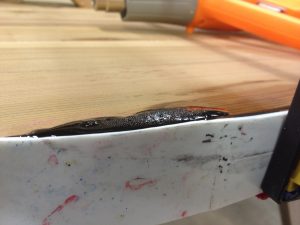
Be prepared to do some experimentation prior to using sanding dust on a project. For example, when you add this, or any other foreign material into epoxy, it changes the curing behavior, and you don’t want surprises on an actual project.

I like coloring epoxy, but there are challenges to determining how the coloring, the wood and the epoxy will all gang up against you. Some wood, for example, makes epoxy produce more bubbles. Some additives make the epoxy cure very rapidly.


Jim Randolph is a veterinarian in Long Beach, Mississippi. His earlier careers as lawn mower, dairy farmer, automobile mechanic, microwave communications electronics instructor and journeyman carpenter all influence his approach to woodworking. His favorite projects are furniture built for his wife, Brenda, and for their children and grandchildren. His and Brenda’s home, nicknamed Sticks-In-The-Mud, is built on pilings (sticks) near the wetlands (mud) on a bayou off Jourdan River. His shop is in the lower level of their home.Questions and comments on woodworking may be written below in the comments section. Questions about pet care should be directed to his blog on pet care, www.MyPetsDoctor.com. We regret that, because of high volume, not all inquiries can be answered personally.

Jul 302017
 

Welcome to “Tips From Sticks-In-The-Mud Woodshop.” I am a hobbyist who loves woodworking and writing for those who also love the craft. I have found some ways to accomplish tasks in the workshop that might be helpful to you, and I enjoy hearing your own problem-solving ideasPlease share them in the COMMENTS section of each tip.  If, in the process, I can also make you laugh, I have achieved 100% of my goals.

I got started making stools for grandbabies, and I just can’t stop. Now, I like making a variety of styles.

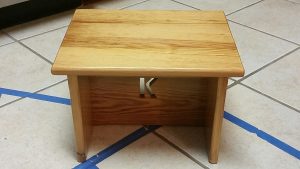
The last stool I made, for little Kessa, the legs were rather close to the edge of the top; wide for stability.

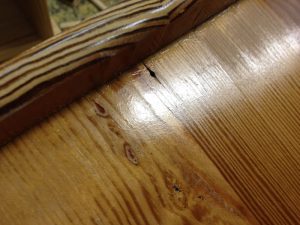
I ran into a problem when I began to sand that little area of the top’s underside, though, between the leg and the edge. I started out going back and forth, like one usually would when sanding, but there was just no way I could make my hand go straight enough not to cross the grain, even though the angle was very, very slight.

I discovered, though, that if I put the sandpaper up against the leg and simply pulled it away, in one direction, that the scratches were invisible, because they were perfectly in line with the grain of the wood.

Little scraps of saved sandpaper came in really handy for that job.

Vintage pine made a beautiful project, even if it was challenging to sand.

Funny story: I don’t always have paper handy to write myself notes, so I often dictate notes to myself on the iPhone. To keep myself from forgetting to write this tip, I dictated, “Sand in One Direction.” Why, I wondered, did iPhone capitalize One Direction? Then, I thought of our eldest granddaughter, who loves the boy band, and figured it out.


Jim Randolph is a veterinarian in Long Beach, Mississippi. His earlier careers as lawn mower, dairy farmer, automobile mechanic, microwave communications electronics instructor and journeyman carpenter all influence his approach to woodworking. His favorite projects are furniture built for his wife, Brenda, and for their children and grandchildren. His and Brenda’s home, nicknamed Sticks-In-The-Mud, is built on pilings (sticks) near the wetlands (mud) on a bayou off Jourdan River. His shop is in the lower level of their home.Questions and comments on woodworking may be written below in the comments section. Questions about pet care should be directed to his blog on pet care, www.MyPetsDoctor.com. We regret that, because of high volume, not all inquiries can be answered personally.

Jul 252017
 

Prevent rust from taking over your tools with these simple tips.

Summer heat and humidity can be tough on our woodworking tools, especially if you store them in an unconditioned space. The absolute best way to eliminate rust from the surfaces of machines and other tools in your shop is to stop it from ever really getting started in the first place. If you’ve already got a rust issue, we’ve got some solutions for how to completely remove it once it’s already formed.

Click here for rust prevention methods for all of the tools in your shop!

Jul 182017
 

I have a lot of interests, only some of them related to woodworking, so my reading plans for the summer are somewhat diverse. But let’s start with woodworking.

First on my list is David Esterly’s The Lost Carving: A Journey to the Heart of Making. Having read this one previously, I know it to be a lyrical exploration of the craft of fine carving to replace a Grinling Gibbons carving burned in a Hampton Court fire. I am relishing the chance to revisit this favorite of mine. I also plan to read Aldren Watson’s classic Hand Tools, as much for his finely-executed drawings as for the many ideas contained therein. I recently bought the Stanley Tools Catalogue No. 34 from Lost Art Press and plan to spend some time perusing Stanley’s classic offerings. Finally, I have a copy of Joshua Vogel’s The Artful Wooden Spoon that is another fine example of the craft of making things of utility and beauty.

I’ve developed a passion for black & white photography and have set a goal for myself to master fine art B&W printing. I have a stack of books on this subject, the principal of which are Harold Davis’s Monochromatic HDR Photography, Michael Freeman’s The Complete Guide to Black & White Digital Photography, and George DeWolfe’s B&W Printing. There are others in my library, but I’ll commence with these.

I’ve also set myself on a course to better understand the roots of creativity and the creative life. I’m starting with Mihaly Csikszentmihalyi’s classic Creativity, a study of notably creative people and the factors that characterize their lives. I’ll follow this with historian Daniel Boorstin’s The Creators, which recounts the lives of historically important creators. I’ve already begun Michael J. Gelb’s How to Think Like Leonardo da Vinci, though because it is replete with exercises that will take me time to work through, I have no expectation of completing it this summer.

As if this weren’t fun enough, I’ll listen to audio books while working in the woodshop—my usual practice. Here my tastes run the gamut from Greek and Roman philosophy to military history and the latest Michael Connelly mystery. It should be an informative and entertaining summer of reading.


Norm Reid is a woodworker, writer, and woodworking instructor living in the Blue Ridge Mountains with his wife, a woodshop full of power and hand tools and four cats who think they are cabinetmaker’s assistants. He is the author of the forthcoming book Choosing and Using Handplanes. He can be contacted at nreid@fcc.net.

Jul 112017
 

No Southern-fried Southern boy wants to be called a Yankee, but we share the characteristics of shrewdness and thrift. Thus, each month we include a money-saving tip. It’s OK if you call me “cheap.

This little modification will make your portable air tank infinitely more useful: Where it originally came with an attached hose, turn the air-flow shutoff to the closed position, then remove the hose at the fitting, using a tubing wrench. Save the hose.

New, portable air tanks come with the air hose attached. You don’t want to ruin the hose or the fitting, so utilize a tubing wrench to disconnect the hose. Be sure the tank is empty, or the air valve is in the closed position, or both.

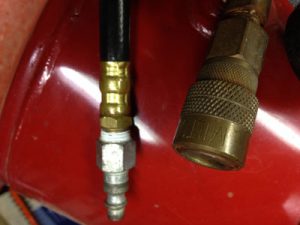
Using the appropriate-sized brass nipple, attach a female quick disconnect to the tank. Be sure to cover the threads with Teflon tape or pipe dope, because you don’t want any air being wasted through leaks.

A quick disconnect will allow you to attach any sort of air tool to your portable air tank.

Now, install a male quick disconnect on the supplied hose. You did save the hose, didn’t you?!

Congratulations, you just increased the utility and versatility of your little tank!


Jim Randolph is a veterinarian in Long Beach, Mississippi. His earlier careers as lawn mower, dairy farmer, automobile mechanic, microwave communications electronics instructor and journeyman carpenter all influence his approach to woodworking. His favorite projects are furniture built for his wife, Brenda, and for their children and grandchildren. His and Brenda’s home, nicknamed Sticks-In-The-Mud, is built on pilings (sticks) near the wetlands (mud) on a bayou off Jourdan River. His shop is in the lower level of their home.Questions and comments on woodworking may be written below in the comments section. Questions about pet care should be directed to his blog on pet care, www.MyPetsDoctor.com. We regret that, because of high volume, not all inquiries can be answered personally.