Highland Staff

Sep 042018
 

Welcome to “Tips From Sticks-In-The-Mud Woodshop.” I am a hobbyist who loves woodworking and writing for those who also love the craft. I have found some ways to accomplish tasks in the workshop that might be helpful to you, and I enjoy hearing your own problem-solving ideasPlease share them in the COMMENTS section of each tip.  If, in the process, I can also make you laugh, I have achieved 100% of my goals.

One day Brenda said, “I think Frida Kahlo is too wide to sit on the 2x4s on the cedar deck now.”

She was referring to the kitten we rescued two years ago. Frida and Maxx like to prowl on the screened area off our bedroom, walking on the framing so they can be as close to the outdoors as possible without being in harm’s way.

Brenda’s idea was for a little corner shelf, something unobtrusive. That meant brackets were out, and a floating shelf was in.

Now, you can buy floating shelf hardware, and there are some nice metal pieces available that make the job nearly foolproof. For starters, their brackets are already perpendicular to the supporting rod, so you don’t have to worry about your shelf pointing “up” or “down.”

Regular readers, though, know that I’m not going to spend money when I have a solution on hand already. And, in this case, I did.

The Domino came to mind. After all, those metal items are essentially tenons, as is every means of mounting a floating shelf.

To use Steve Johnson’s term, I had to “noodle” on this for a bit to decide exactly how to pull it off. After all, a 90i corner wasn’t going to allow moving a board onto tenons that are also 90i to each other without some compensation. It soon became clear that Dominos on one side could slide right into Domino slots, but the other side would have to have some sliding accommodation. This called for a mockup.
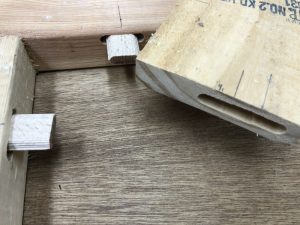
Cedar is expensive, and cutting into one’s house can be scary. I wasn’t up for any mistakes. I had this old 2×4 frame sitting in lumber storage. I figured it would suffice to test my theories on Domino placement. And, it did!

The plan wasn’t too geometrically challenging. With the biggest Dominos a Festool DF500 uses, one side of the board would need to slide about 3/4″ in order to seat the tenons on both sides. Two adjacent Domino slots on the sliding side and we were set.
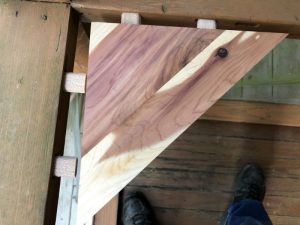
The real test: cutting into the cedar and the house. I was lucky, everything worked exactly like it did on the mockup.
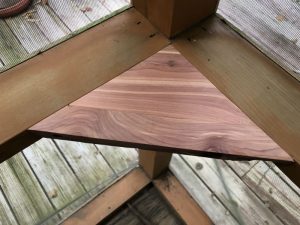
The dry fit is good. Glue and clamps should make the fit even better.

Now it was time to “noodle” (no, Steve, I’m not threatening to steal your word) on a way to clamp this thing. The obvious-but-impractical way was to cut holes in the screen and attach the clamps directly to the 2x4s. I immediately ruled that out. Then, I just held a clamp up to the shelf and it came to me: attach a temporary board with screws where the holes won’t show, under the 2x4s, and hook the clamps to those.
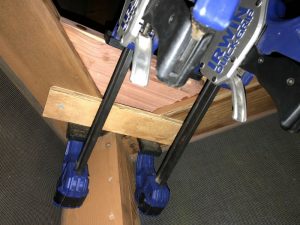
It worked!
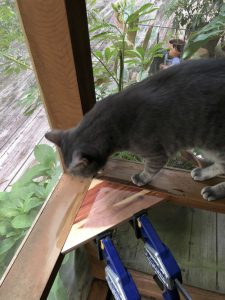
For a finish to look good on the shelf, it’s imperative that every bit of glue is cleaned. Max helps ensure I don’t miss any places. He looks out for his little sister’s interest. Construction was too much noise and commotion for her. A little semi-transparent stain and Frida will be sitting on her new shelf in no time.)


Jim Randolph is a veterinarian in Long Beach, Mississippi. His earlier careers as lawn mower, dairy farmer, automobile mechanic, microwave communications electronics instructor and journeyman carpenter all influence his approach to woodworking. His favorite projects are furniture built for his wife, Brenda, and for their children and grandchildren. His and Brenda’s home, nicknamed Sticks-In-The-Mud, is built on pilings (sticks) near the wetlands (mud) on a bayou off Jourdan River. His shop is in the lower level of their home.Questions and comments on woodworking may be written below in the comments section. Questions about pet care should be directed to his blog on pet care, www.MyPetsDoctor.com. We regret that, because of high volume, not all inquiries can be answered personally.
Aug 312018
 

Nobody ever interviews me so sometimes I interview myself. Plus even if someone did interview me, they would never know the right questions.


I love that show called “Best Thing I Ever Ate”. What’s the best thing you ever ate?
My Mother-in-Law’s chocolate pie. She could make the fool out of a chocolate pie.

What is it you like about woodworking?
I like carrying around that fantasy of making anything I want out of a piece of wood. Like some young fellow came to the shop one time and looked around and asked “So, you just get a tree out of the woods and make something!?” Well, yeah.

What specifically do you like best?
I like that finishing touch on a piece. I like taking my little Lie-Nielsen block plane signed by the man himself with an engraving pen the day I bought it, and breaking a sharp edge on a completed piece. If, a hundred years from now, someone turns the piece over and finds my name or initials on the bottom of it, and then touches that rounded edge and realizes that the guy who signed it took the time to round the edges with a hand plane, then my life will be complete, even if I am dead and gone.

What do you not ever eat?
Boiled okra.

What part of woodworking do you not like?
I don’t think anybody likes sanding. I certainly do not. Nothing even remotely fun about sanding. That and cleaning the shop. I despise cleaning the shop.

Favorite material?
Cherry. I love the way cherry looks two hundred years old within two hours after you put finish on it. I love the way it oxidizes from light. I stacked some pieces of a chest on top of one another one time and left them for a few weeks until I got back to the project and you could see the shadow of every piece on the one beneath it. I think it is lovely.

Least favorite material?
Particle board and plywood are tied for first place. None of either in my shop. I bought some plywood imported from eastern Europe one time – I guess it was real cheap. It smelled like a wet dog when I cut it, even though it was perfectly dry. I threw it away, recycled it back to the earth. Reminds me of trying to turn a bowl out of locust wood near the beginning of my turning career. That stuff smelled so bad, I took it back to the place I got it and returned to sender, so to speak. Life is too short for stinky wood.

Most remembered lessons from woodworking?
Two things, incidentally from the same guy, Mike Dunbar. Many years ago, Mike came to Highland to teach a class on Windsor chair making. Now understand, I am an Engineer and a Land Surveyor. I measure things and make engineering drawings to solve problems, and if you build things from my plans as I drew them, it will fit together and work as it should. Inevitably, those lessons transferred to woodworking, so it was a total revelation to me when Mike made a piece of his chair and instead of going to the plans, simply made the next piece to match the first. Totally opposite to my work philosophy, it changed my woodworking.

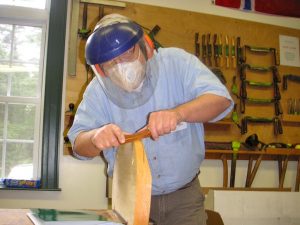
The other lesson from Mike was twofold. I went to his classroom in New Hampshire to make a chair and the first day he showed us two things. First, he clamped a board in the bench, took a wooden hand plane and flattened the board – the first time I ever heard a properly sharpened hand plane make that wonderful snick snick noise. No earplugs, no dust collector, no electric planer, no setup, no dust, just wonderful long curls of hard maple drifting to the floor. Second, he drilled a hole in the flattened board and used a reamer to taper the hole. He drove a tapered pin into the hole and picked up the end of the whole workbench by lifting on the pin. No glue, no nails, no fasteners, nothing but friction on the pin. Amazing.

And all that changed things how?
Life works well for me when I do the chair thing like Dunbar. I start from where I am, accept what I have, and then go to the next piece. Like the GPS in my car when I make a wrong turn, I recalculate and go from there. And I don’t have to invent everything. Someone has probably had the same problem before and found a solution — all I need to do is find it. Not bad ways to operate, I’d say, based on making a chair.

Anything you want to add?
You can’t make a cobbler out of strawberries. It’s just wrong.

Aug 292018
 

Earlier this month we announced the winner of our Tormek T-8 Giveaway, Greg Williams from Birmingham, AL.

Since he has had his new Tormek T-8 in his shop for a few weeks now, we thought we’d check in and see how it is working for him.

I have seen the Tormek demonstrations at the different woodworking shows for years and always wanted one. I was so surprised when I got the email from Chris Bagby of Highland Woodworking informing me that I had won the Tormek T-8 in their giveaway. I have had a hectic few weeks and it has been hard to get in the shop to set it up. I watched a few videos of setting the Tormek up for use and read the enclosed literature (very good instruction manual) After some time, I was able to get a nice sharp edge on an old estate sale bargain chisel. I am sure that like most skills, with time I will be able to produce a nice useful edge on many other of my chisels and planes. Once again, thanks to Chris and Highland Woodworking for a wonderful prize -Greg Williams, LEED AP

Make sure to enter our current SawStop Router Table Giveaway for your own chance to win! Deadline for entry to our next contest is Noon ET on September 25, 2018.

Aug 222018
 

Justin Moon takes a closer look at the Narex Hand Stitched Cabinet Rasps and some of the Hand Stitched Riffler profiles. These indispensable stock removal tools will make your woodworking preparation more efficient and precise.

Click here to watch

Click here to learn more about the Narex Hand Cut Rasps & Rifflers

Aug 132018
 

Festool has a variety of training programs for Festool dealers like Highland Woodworking. One of our managers, Sam Rieder, recently attended their Festool 201 training in Indiana and was able to offer a tip on stacking systainers. One of Festool’s trainers, Brian “Sedge” Sedgeley just shared Sam’s tip on their YouTube channel.

Aug 102018
 

Congratulations to the winner of our 2018 Tormek T-8 Sharpening System Giveaway, Greg Williams from Birmingham, AL.

Thank you to everyone who entered. Be sure to enter our new contest for a SawStop Router Table. Entries are being accepted now on our website. Click here to enter. Last day to enter is September 25, 2018 at Noon ET.

Aug 062018
 

People are of two minds about sharpening, I believe. Some hate sharpening. They despise having to stop working, even though they realize that sharp tools are safer and easier to use. Like other necessary things we wish we didn’t have to do, we recognize the value, even as we’re wishing.

Others might not mind sharpening, but I don’t think anyone loves it.

I’ll go one step further: I believe the former group struggles with getting a good edge and the latter is good at sharpening.

Sadly, I’m in the first group.

For a long time, I was looking for a way to sharpen that wasn’t just easy, it was automatic. I got some really good advice from my friends Steve Johnson and M. Scott Morton. It can be summarized with an old saw: “If it sounds too good to be true, it probably is.”

We conversed about machines that might help, and they encouraged me to just concentrate on hand sharpening with stones. And, to practice, practice and practice some more.

Not long after that I was watching a Matt Cremona video, and noticed he had one of those little blocks some folks use that sets the distance from the front edge of one’s chisel to the sharpening jig. Having that jig allows perfect repeatability for the sharpening angle. I made a block like that for 25i and I was off to the proverbial races. It seemed I could do no wrong in sharpening my chisels.

Then, one day, something happened. I sharpened a chisel I’d put an edge on with that same technique, and it wouldn’t cut worth a hoot. I figured I’d just gotten in too big a hurry, overconfident, and messed up the edge. So, I went back and honed it up from 1000 to 8000 and tried again.

Dang! Still won’t cut!

Some people just have it. I took a class at Arrowmont College once, and the instructor was working with one of my chisels and said, “I just can’t use this. Do you mind if I sharpen it?” What was I going to say, “No, I like it like that way?” She took it to a high-speed grinder and shaped it the way she wanted it. No, she did not blue the edge. She spent a few minutes on a wet stone and the chisel cut like she’d been honing for hours. I asked her to sharpen two other chisels, which she pleasantly did, spending about the same amount of time on each one.

I’m not exaggerating when I say I didn’t need to sharpen one of those chisels again for a year!

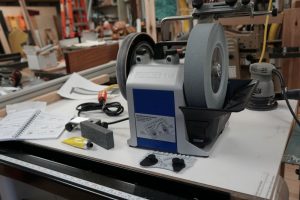
After Steve Johnson did a video review on the Tormek T-4, I thought it might be just the breakthrough that I needed, a machine to get a good shape on my chisels and plane irons that would allow me to just fine-tune on stones.

It might still be my sharpening salvation, but I’ve been so busy since it arrived that I’ve only had time to unbox and assemble it, and there hasn’t been time to do anything else with it.

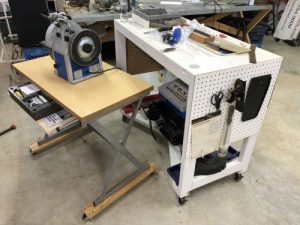
It didn’t take long to figure out the Tormek Sharpening System can’t be up as high as sharpening stones. I found this desk up the street when some folks moved out in the middle of the night and left a lot of their stuff for the garbage man. With a top and some wheels, I hope its height will be ideal.

Maybe I can become one of those people who is good at sharpening and doesn’t dread it.

I’ll let you know when I do my review of the new Tormek.


Jim Randolph is a veterinarian in Long Beach, Mississippi. His earlier careers as lawn mower, dairy farmer, automobile mechanic, microwave communications electronics instructor and journeyman carpenter all influence his approach to woodworking. His favorite projects are furniture built for his wife, Brenda, and for their children and grandchildren. His and Brenda’s home, nicknamed Sticks-In-The-Mud, is built on pilings (sticks) near the wetlands (mud) on a bayou off Jourdan River. His shop is in the lower level of their home.Questions and comments on woodworking may be written below in the comments section. Questions about pet care should be directed to his blog on pet care, www.MyPetsDoctor.com. We regret that, because of high volume, not all inquiries can be answered personally.