Highland Staff

Feb 052019
 

No Southern-fried Southern boy wants to be called a Yankee, but we share the characteristics of shrewdness and thrift. Thus, each month we include a money-saving tip. It’s OK if you call me “cheap.”

You want something free? Well, almost free.

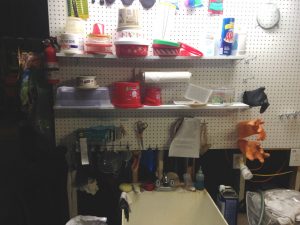
If you eat whipped butter, margarine, Cool Whip, or other foodstuffs that come in plastic tubs, you can make use of those tubs in the shop and they won’t cost you an additional dime.

Now, if you, like me, don’t eat any of those above items, you, like me, probably know someone who does. It’s not hard to talk them into saving some containers.

What are they good for? A kazillion uses! (Sorry, Steve.)

Probably the thing I use them for most is parts washing.

Over the utility sink turned out to be the best place for some shelves to store my “butter containers.” If I need to wash something, there is one close by. If I need the lid, I know right where it is.

From cleaning paint brushes to wheel bearings, they’re impervious to every solvent I’ve ever used, which means if you’re cleaning parts in batches you can use the same cleaner repeatedly until it’s dirty.

They’re neither air-tight nor water-tight, so you shouldn’t store liquids for the long term.

Speaking of liquids, they’re great for decanting from a large container of finish into one you can work from. If you need to go to the door to sign for a UPS package, and you’re coming right back, you can pop on the top to slow drying and evaporation. However, don’t plan to store finishes in these containers; the lids don’t fit securely. Over a short amount of time oxygen will enter and ruin the finish, and, if it falls from a height, finish is going everywhere.

Component storage is a good use for the long and short term. If you’ve taken a piece apart for restoration and you want to save
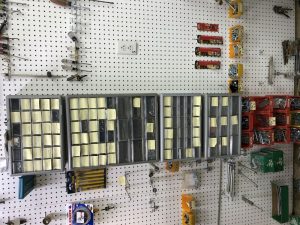
all the screws, bolts, nuts, washers and hardware, an old butter container will keep them together with your project until you’re ready to reassemble. Most aren’t see-through, but, with a proper label, or even a temporary Post It Note, you can store any sort of small hardware. Personally, I prefer organizers with drawers, but these still beat my Uncle Sam’s old system of “throw everything into a coffee can.”

These organizers with plastic, see-through drawers won’t break the bank, either. I have screws in one, nails in another, nuts and bolts in the third.


Jim Randolph is a veterinarian in Long Beach, Mississippi. His earlier careers as lawn mower, dairy farmer, automobile mechanic, microwave communications electronics instructor and journeyman carpenter all influence his approach to woodworking. His favorite projects are furniture built for his wife, Brenda, and for their children and grandchildren. His and Brenda’s home, nicknamed Sticks-In-The-Mud, is built on pilings (sticks) near the wetlands (mud) on a bayou off Jourdan River. His shop is in the lower level of their home. Questions and comments on woodworking may be written below in the comments section. Questions about pet care should be directed to his blog on pet care, www.MyPetsDoctor.com. We regret that, because of high volume, not all inquiries can be answered personally.

Feb 042019
 

Welcome to “Tips From Sticks-In-The-Mud Woodshop.” I am a hobbyist who loves woodworking and writing for those who also love the craft. I have found some ways to accomplish tasks in the workshop that might be helpful to you, and I enjoy hearing your own problem-solving ideasPlease share them in the COMMENTS section of each tip.  If, in the process, I can also make you laugh, I have achieved 100% of my goals.

Steven Johnson has a bag of tools he carries when he’s working in someone else’s house. Think of them as “beaters.” There are no Japanese chisels in that bag. Even the screwdrivers, he admits, are barely worth having.

The disadvantage is obvious: you don’t get to have the nice feel of a quality tool as you’re working.

The advantages are just as obvious: If you lose them while you’re out, you won’t shed a tear. Also, if someone other than you uses, or abuses, them, you won’t have to create a scene, like I did once when I came home from work to find the air conditioner installers had “borrowed” one of my good chisels to dig through our home’s outside wall to run their refrigerant line. Not surprisingly, they ran into one or more nails. My 3/4″ chisel had a U-shaped divot in what had been a very sharp edge.

The workers were long gone by the time I got home, but I couldn’t contain my rage. I called their boss. They called me the next day with a sincere apology.

With that in mind, had someone else done with my Irwin clamp what I did one day, I would have hit the roof.

Last summer I built a couple of screech owl nest boxes, one for home and one for the clinic. What I didn’t realize at the time is
that not only do owls not make their own nests, they don’t add their own bedding material, either. I had to take them down to add nest material, but I had designed it to be removable because the box would require annual cleaning.

The home nest box is attached to a post in the bulkhead of our boat ramp. The location is a combination of the little open air in our yard and a place we can see from the house, as well as being beyond jumping distance for squirrels. Yes, I know the squirrels can climb the pole, but don’t tell them, because they haven’t yet.

However, the location makes working a little treacherous, because I have to balance on an 11-1/2″ wide board right over the water.

Taking the nest down is the reverse of installing it: apply an Irwin bar clamp at the top and bottom of the post, remove all but one of the six construction lags attaching it, lever it down carefully. Everything was going fine until I removed a clamp, set it on the deck and my toe nudged it into the Bayou. Well, I couldn’t stop what I was doing, so, when the contraption was safely on the ground I went to the house and put another clamp in harm’s way. Within 15 minutes the beautiful pine shavings were in the nest and it was back in the air.

Now, to find the missing and presumed drowned clamp.

I was sure it had not gone far, so I started with a garden rake, which yielded a bunch of pine needles and leaves.

Not yet panicking, I got the biggest magnet I own, a real honker from a blown-out woofer stereo speaker. It had no means of attachment, so I had to drill a hole in the middle first. And find some stout string in order to go “fishing.”

I fished. And I fished. And I fished some more. I had just about decided that I was going to strike out when, finally, I felt “clink” in the line and some extra weight when I pulled the string.

My next predicament was saving the clamp from its exposure. This is good practice for any time one of your steel or iron tools becomes wet.

Step One is get it clean. Dirt holds moisture, so you want all of the grime off. After a plain-water rinse, I scrubbed it really well with Dawn and a stiff brush. You’re going to re-oil it soon, but you need all of the oil off because oil holds dirt and dirt holds, well, we covered that.
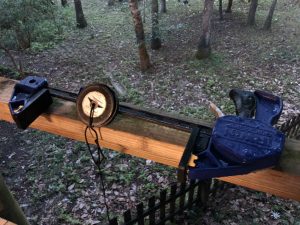
A good rinsing with a hose made the clamp (and the magnet) look pretty good. However, Dawn, a brush and some elbow grease are going to remove dirt you can’t see.

Now that we’ve got the clamp good and wet, let’s get as much water off as we can. One of the first jobs I learned as a budding auto mechanic was cleaning and repacking wheel bearings. In that job, as in this, an air hose can remove a lot of water in a short amount of time.
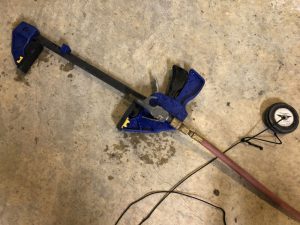
Blow and blow and blow until the clamp is dry in all its hiding places. Don’t forget your magnet. Take good care of it and it can serve you again one day.

Now, let’s remove even more water. Do you know what “WD” stands for in “WD40?” Here’s a hint: It doesn’t stand for “oiling, lubrication and protection.” WD40 isn’t something you should put on a tool or item for long-term use. It contains solvents and the solvents chemically and physically drive moisture away from objects it touches. “WD” stands for “water displacement.” Its inventors made 40 formulas before they got it just right. It’s great in a situation like this, where we might not be able to completely remove all of the water from the inner workings of the handle and hidden spaces such as around the split pin. Disassemble as many parts as you can, then hose that baby.
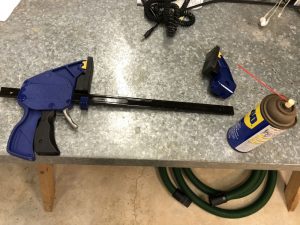
The same procedures you use to turn a clamp into a spreader can be used to partially disassemble it. I wasn’t brave enough to dismantle the squeeze mechanism. I could just see parts going BOING and never getting them back together again. WD40 loves for you to use their product like this, maximum volume!

Lubricate all of the parts with a quality spray oil mixture and you’re ready for reassembly. Wipe off the excess.
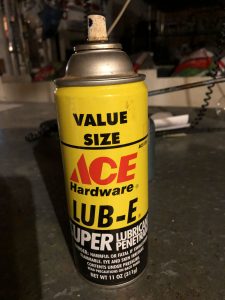
I never let myself run out of this Ace Hardware spray lube. It comes with a tube, or you can spray a big area with the nozzle.


Jim Randolph is a veterinarian in Long Beach, Mississippi. His earlier careers as lawn mower, dairy farmer, automobile mechanic, microwave communications electronics instructor and journeyman carpenter all influence his approach to woodworking. His favorite projects are furniture built for his wife, Brenda, and for their children and grandchildren. His and Brenda’s home, nicknamed Sticks-In-The-Mud, is built on pilings (sticks) near the wetlands (mud) on a bayou off Jourdan River. His shop is in the lower level of their home.Questions and comments on woodworking may be written below in the comments section. Questions about pet care should be directed to his blog on pet care, www.MyPetsDoctor.com. We regret that, because of high volume, not all inquiries can be answered personally.

Feb 012019


There are web sites and YouTube channels that run down Festool.

There are channels that run down your favorite YouTuber.

I get that.

Not everybody likes the same thing, and not everyone can keep their opinion to themselves, or follow Mama’s advice: “If you can’t say something nice, don’t say anything at all.”

I’ve even found a couple of internet posts critical of Norm Abram.

I don’t get that.

Talented. Accomplished. Easygoing. What more could you want in a wood shop hero?

When I first started more serious woodworking in an actual shop, as opposed to working out in the yard on sawhorses, I tried wearing the carpenter’s apron I bought to begin my carpentry career. After all, it was more than just a fixture on the homebuilding site, it was a necessity. There was simply no way to carry everything in pockets, especially the volume and variety of nails used back in the days before air nailers.

Once indoors, however, I was never very far from the things I needed. I wear overalls, and the huge pockets easily accommodate the 25′ Stanley tape I like to carry. My phone is in another pocket and I keep four pencils on me all the time. I don’t nail much in my work, and it’s easy enough to keep a box of screws and a cordless drill-driver on the bench.

I find the sticking-out nature of a nail apron to be a hindrance. It makes me stand a bit away from the bench or table I’m working on. And, nothing makes a back tired and strained like leaning over.

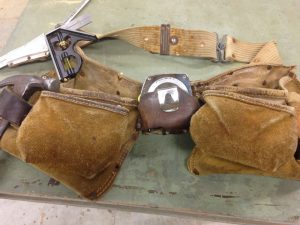
I bought this nail apron in 1973, the year I left the Air Force and began working with Jack  English, building houses. A few years ago I took it to a shoe repair shop to see if he could sew the parts that needed repair, explaining that the antique item was an old friend. He said, “It’s beyond help. You should have taken better care of it along the way.” Not only did I take it home and fix it myself, I never went back to that grouch.

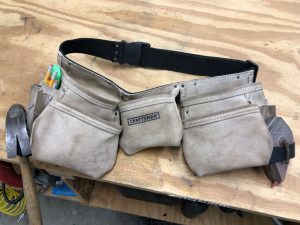
I did, however, purchase a new carpenter’s apron. It lacks the character (read “miles”) that the old one has.

This month we have an easy-answer poll: “Yes,” or “No.” I’m interested in what percentage of woodworkers and furniture makers wears a carpenter’s apron (not to be confused with a shop apron, that covers one’s entire front) inside the shop, like Norm. As always, we welcome your comments below.


Jim Randolph is a veterinarian in Long Beach, Mississippi. His earlier careers as lawn mower, dairy farmer, automobile mechanic, microwave communications electronics instructor and journeyman carpenter all influence his approach to woodworking. His favorite projects are furniture built for his wife, Brenda, and for their children and grandchildren. His and Brenda’s home, nicknamed Sticks-In-The-Mud, is built on pilings (sticks) near the wetlands (mud) on a bayou off Jourdan River. His shop is in the lower level of their home.Questions and comments on woodworking may be written below in the comments section. Questions about pet care should be directed to his blog on pet care, www.MyPetsDoctor.com. We regret that, because of high volume, not all inquiries can be answered personally.
Jan 282019
 

We’ve got another episode of The Highland Woodworker premiering shortly, but in the meantime you can watch a preview of the upcoming episode now!

If you ever want to catch up on any past episodes, check out The Highland Woodworker Archive offering hours of past episodes and woodworking fun!


Jan 242019
 

You can get so much done in a shop with a quality router table, and the Kreg Router Table System can help woodworkers of all levels finish their projects faster, more easily and with greater precision than before.

Mike Morton offers a thorough tour of the Kreg Router Table System in the video below, helping you figure out how to adjust the stand, how to use the new style of insert plate and much more!

Click to find out more about the Kreg Router Table System, available at Highland Woodworking.

Jan 232019


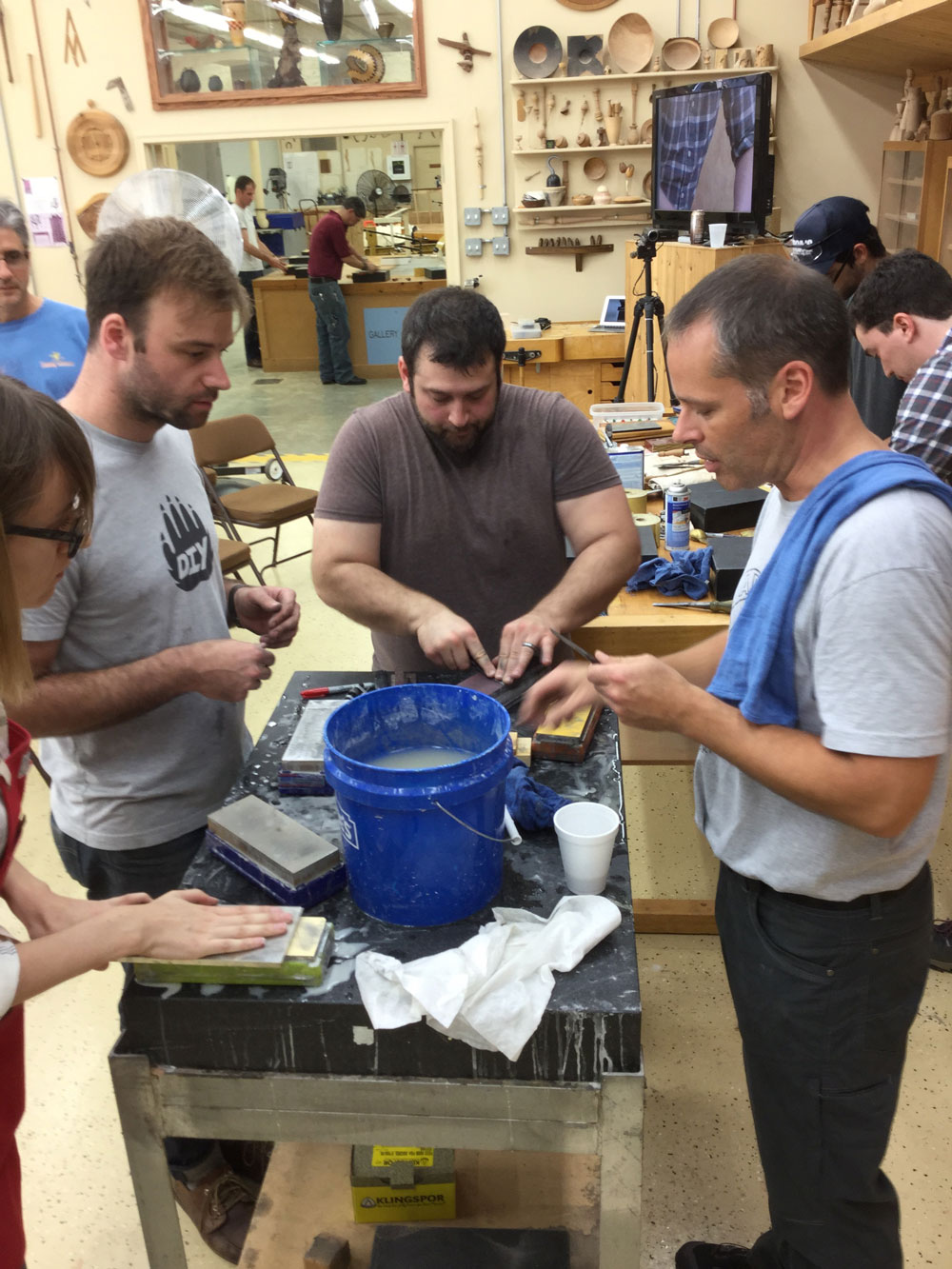
At Highland Woodworking, we are pretty fanatical about sharpening, and we know Chris Schwarz shares our feelings about this. When Chris was updating his Sharpen Up or Shut Up keynote address for us to publish in Wood News last month, he suggested to us that our readers might be interested in his entire ‘Sharpen This’ series, so we thought we would share those articles and continue to spread the word that sharpening really is the key to happiness, at least where woodworking is concerned.

In Part 1 of the series, Chris offers what he believes to be the current state of sharpening in the woodworking world, and offers a few suggestions to get started. This whole series is a gold mine of useful information, as most Chris Schwarz articles tend to be, and the introduction pulls no punches and jumps right in to set things straight. We hope you will enjoy it as much as we did.

Click here to read Part 1 of the Sharpen This series

Jan 172019
 

In this classic video, Roy Underhill, patron saint of extreme hand tool woodworking, takes the SawStop PCS for a drive with a piece of southern fried chicken during a visit to Highland Woodworking. Take a look, below!