Highland Staff

Mar 302011
 

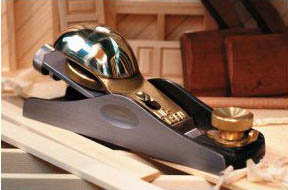
I talk a lot about both setting up and using hand planes. Probably about 95% or more of my audience will either go to their favorite shop to buy a plane, or work to restore an old family heirloom or a garage sale find. There is another way to obtain a plane, and it brings with it the chance to hone some extra skills: Make a wooden plane.  The majority of my personal planes are manufactured, but I did make a wooden plane about five years ago, and have made a couple more recently. For some reason, the thought of making a plane can seem pretty daunting, but most can make one successfully.

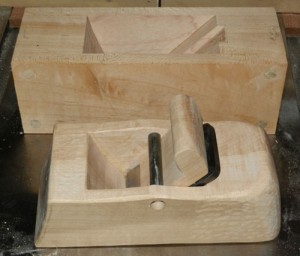
Now, there are really two types of wooden bench planes, in my opinion. One requires a bit more skill than the other.  The first is what you’d likely find in workshops in the 1700s on into the  invention of the metal hand plane (and even beyond for many).  This plane type requires wood to be evacuated from the area that will become the mouth of the plane and up through the body.  In most cases, the body of the plane retains most of its structure.  The second, and in my opinion less demanding plane to make, is one where the wooden body is cut into three base pieces.

Two outside “faces” are removed from the center core. The center core is again cut into three pieces (toe, heel and a left-over that will make the wedge). By having the core separate from the other two pieces, you can easily use saws (table saw, band saw, hand saw…) to make the cuts establishing the “heel” piece which will create the bed for the iron, and on the “toe” piece, the curved relief opposite the bed, so shavings can easily be removed from the plane. The bed is what the iron rests on, while it is in the plane.  Many bench planes utilize a 45 degree angle for the bed, as this is good for the majority of work. If you are working with very figured wood you can change this bedding angle from 45 degrees up to 50, 55 and even 60 degrees. It does become more difficult to push a plane that is bedded at these higher angles, but they do an outstanding job of handling some of the most figured woods.

The wood for the body should be a dense hard wood.  There are many different types of woods that can be used, so it’s basically up to the maker. You can make a plane out of 8/4 wood, with the thickness of the wood as the maximum height of the plane, or you can laminate any thickness of wood where the wood thickness is now the width, rather than the height. This provides more flexibility in the design phase, removing the body height limitation you incur with non-laminated wood bodies, while also keeping the cost down as thicker wood blanks (10/4 and thicker) usually command a higher cost.  One last thing to remember, relating to the wood grain, is you want the grain running from the toe down towards the heel.

Before you make any cuts, I like to drill holes for alignment dowels, in the four corners of the plane blank.  These will allow you to get the pieces back into their original orientation when you are gluing up the pieces, after you’ve cut the blank into the required pieces. The next step is to do some layout. For this stage, it is best if you already have the iron you will use in the plane in your possession. This allows for direct measurement, so things actually fit together after the glue-up. Measure the width of your iron, and then add on between an 1/8” and 1/4”, so you can adjust the iron slightly when setting the plane for work. Center your measurement on the plane blank. Mark lines down the length of the plane, as reference, before beginning your cuts.  One reminder, always cut on the outside of your line, as any material removed from the center section could diminish the available adjustability, or even send you to the grinder in order to remove metal from the iron so it will fit the opening.

Next is cutting the center section into the three sections.  First, choose the angle you want for your iron.  Mark the angle on the outside edge of the center core, with the angle intersecting the sole about a third or so back from the toe.  This cut can be done on a table saw, which can leave a glass smooth surface, or you can use whatever means are available to accomplish the same end results. The other cut line is to a slight arc, coming up from the sole with enough angle so you can reach in to get out shavings. There is nothing hard and fast about which angle you choose.  I chose between 60 – 70 degrees, but you can try some different, if you wish.  This second cut, since it is a curve, is best made with a band saw, or something else that can handle the curvature.  Remember to keep the extra “triangle” piece, for your wedge, and it also comes in handy to back up the side walls when drilling the hole for the cross bar.
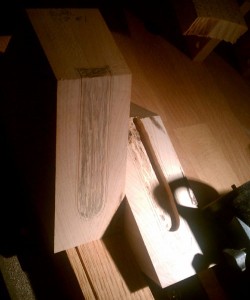
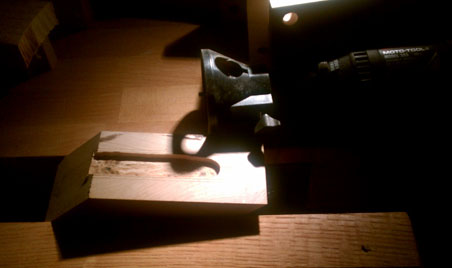
Next up is removing material on the bed of the heel piece, so the screw for the chip breaker has enough room for the iron to sit flat on the bed. Measure the screw head and then mark out with a little buffer added on, centered on the bed, from the top down to about a half-inch or so from the sole. This will give you enough range so your plane will function for a long time, even after many many sharpenings. I used my dremel, with a flat bottom bit, to remove the necessary material. I did use one of the attachments that allow the dremel to work much like a mini router, so it kept the depth of cut consistent.

Join us here tomorrow to read the rest: I’ll talk about the process for gluing up and finishing my homemade wooden plane!

This is Part one of a two-part post. To continue to Part two, click here.


Lee Laird has enjoyed woodworking for over 20 years. He is retired from the U.S.P.S. and works for Lie-Nielsen Toolworks as a show staff member, demonstrating tools and training customers.
Mar 292011
 

Router Table Setup

Don’t “Duh” me please. And why would you say “Duh”? Because it took me this long to figure I can make my own moldings. Until the last couple of years I only made things where I could use stock moldings from the big box store. That beginning point limited me severely and I could only do things which were going to be painted or where finger joints are acceptable (a small portion of fine woodworking to be sure). I finally figured out from watching Mr. Norm and then getting a good router table in my shop that I can make many very nice moldings out of any wood I choose. And I don’t have to paint it or try to explain to all my friends that finger jointing is a tree saving environmentally correct methodology and the reason I am charging more for my work.

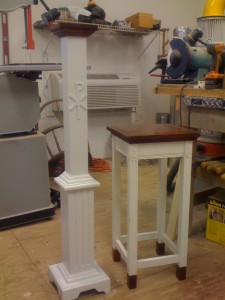
Over the past couple of months I have been making some small furniture pieces for my church and I wanted them to match the existing pulpit furniture. Both of the latest pieces are from oak, one red oak and the other quarter sawn white oak. Needless to say, there are not many custom moldings from those two species and I really wanted them to match.

Can’t buy this!

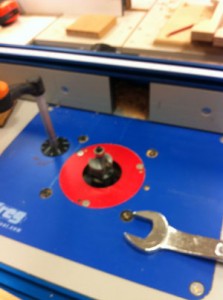
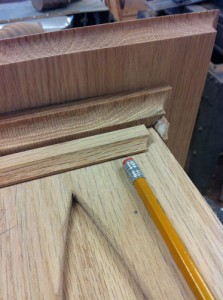
A few months ago, I purchased the Kreg router table with a new Triton Router from Highland. What a beautiful setup that is. I already had a set of half inch router bits and I figured I might as well try the molding process. It worked!! I came up with some beautiful stuff and it made the finished project look good. What works for me is to plane a board to a good thickness and then rout one edge (or both edges) by running it at the router fence. I then cut the molding off the edge of the board at the table saw and it is done. I can make as much as I want and it is always the right size and species for the project. Miter it up, nail it up and stand it up.

Waiting for Stain and Finish

One of the great joys of woodworking is doing the final fit of those last little delicate moldings on a project. There is a timelessness about it which feeds my soul, particularly when I think about spending an extra half hour doing something really well, so people a hundred years from now will touch it and run a finger along it and recognize that someone cared enough to do it really well. Isn’t that why you do woodworking?

Mar 182011
 

Do you know what it means when something is “redacted”?  I think of  documents the federal government reluctantly gives up under the Freedom of Information Act where they don’t want you to know what or who they are talking about, so they black out every other word of it and send it to you so they have met the letter of the law but you really don’t know what they are talking about once you see it.

Last year I found a new sales avenue for my Etsy site.  I wanted you to know about it, but I don’t want you intruding on my sales so I decided to write about it and then redact it.  Here it is.

Candle Stand

It turns out there is a pretty good market for we semi-pro woodworkers in the _______ furniture market.  This all got started last year when my son graduated from a Master’s program and at his first job decided he needed a candle stand to enhance the services.  He and I designed one and I mocked up a couple of them to get the scale right and then made one to match the _______ furniture where he works.

I popped it up on my Etsy site and lo and behold, I sold five more of them all over the country.  Actually got tired of making them before it was over.  Then last summer, one of the _______ who bought a candle stand wanted me to make an Advent candle stand to match their _______ furniture.  That turned out pretty well and they were happy with it.  I left it up on the Etsy site and maybe next year I will get some additional sales out of that one too.  It is such a thrill to know that _______ all over the country are using my stuff.  I’m making two more this season, one for my own _______ and another for a friend up the road who is Pastor of a _______.

Advent Stand on the Left (Sudbury UMC, MA)

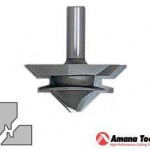
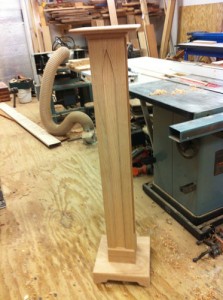
In making the new stands, I found a new router bit.  When I make a column of four pieces joined at right angles, a lock joint router bit is the thing to use.  These bits cut a joint with a tongue and a slot which fit together when turned at ninety degrees to each other.  The joint locks together and is so firm that clamping is almost not necessary.   The bit is a little bit touchy to set up correctly and it does require a router table.  But man, this thing works like a charm.  You can buy it at Highland.

Lock Miter Bit

The point of all this is you never know where sales  will come from.  There is a market out there for your stuff – you just have to find it and work it.  Buy more tools, make more stuff, sell it, and buy more tools.

Feb 272011
 

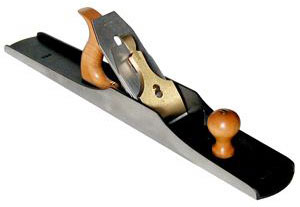
It’s interesting how many of our show customers will gravitate towards our largest plane, the #8 Jointer Plane.  Even those who are not woodworkers, and may just be accompanying a friend or colleague, seem to have the same tendencies.  I guess it shouldn’t be too surprising, as this is one massive tool.  The #8 plane weighs in at 10 lbs, which sounds like it would be unwieldy to use, but in actuality the mass is very beneficial keeping the tool moving through the cut, and if you’ll remember to hit the sole with a bit of paraffin wax, the effort used drops dramatically. The #8 Jointer is the longest of the metal bench planes and the length of the sole is what makes it such a good choice for flattening wood.

I’ll use a sea/boat analogy to describe why this extra length makes a difference. When out on the ocean, there are usually waves to navigate.  Let’s say you have a 240 ft boat, and a 60 ft boat. If there happens to be 70 feet between waves, then the 60 ft. boat will just ride up and down the waves, but the 240 ft. boat will span across 2+ waves at a time, so it will just ride on the tops of the waves, and will not follow the large up/down undulations. This is very much like comparing a #8 Jointer and 60 1/2 block plane (actually, since the #8 is 24” and the 60 1/2 is approx 6”, I chose the boat sizes as larger scale sizes of these two planes) working wood that is not yet flat and true.  The hills and valleys in the wood can be seen as the waves in water, even though they are obviously much smaller.  The concept, though, is similar.  If you are trying to make a rough piece of wood flat, then you need something long enough to span across the tops of the “hills”, and not just continue to follow the existing contours, like planes with shorter soles.

Beyond the flattening role of this plane, it can handle other work as well.  Another job in which this massive plane excels, is when it is used to “shoot” edges using a shooting board. For those not familiar, there are plans showing how to make a shooting board available for download at the Lie-Nielsen website. Shooting can work on end grain to sneak up on the exact dimension (a thousandth of an inch or so at a time), can work on long grain, or with fence modifications, can shoot angles (miters) other than 90 degrees on the ends of boards.

The Jointer plane is set up similarly to most of the other bench planes. The blade should be razor sharp (which is the same on all cutting tools), and many will want to apply a small camber (curvature across the width of the iron). This small cambering prevents the all-dreaded plane tracks, which are left when the corner(s) of the iron cut deeper into the wood than the surface adjoining it. The shaving thickness should be in the 4 – 5 thousands of an inch range, and so the camber should be sufficient that neither of the corners will make contact with this thickness of shaving. Similarly, the opening between the cutting edge and the front of the mouth shouldn’t be too wide, but just enough for this thickness of a shaving to pass without clogging.

Another thing I always try to remind people, is how this plane can always sub in for a fine smoother (just remember that statement doesn’t go both ways, as the shorter smoother can’t adjust its length). The only thing I’ll adjust in the setup, if I’m intending to perform smoothing functions, is the depth of cut.  I’ll back the iron out and then advance it until I have a 1 – 2 thousands of an inch shaving. Since the throat opening is usually still in the 6 – 7 thousands of an inch range, this will give decent support for all but the most figured woods. If the wood does happen to be too difficult to prevent tear out, then I’ll just switch over to one of my dedicated smoother with their super tight throat settings. Most of the time though, the jointer can do an adequate job, and depending on how large the area being worked is, it may just save the extra couple of steps over to your toolbox.

I hope to see some of you at our events across the country.  Feel free to come up and say hello and make sure you try out our #8 Jointer.


Lee Laird has enjoyed woodworking for over 20 years. He is retired from the U.S.P.S. and works for Lie-Nielsen Toolworks as a show staff member, demonstrating tools and training customers.
Take a look at our full selection of Lie-Nielsen Hand Tools.

Feb 232011
 

I remember when I first started woodworking and purchased some hand planes and chisels, no matter what I did, they never would work as I expected. I know many, if not most, woodworkers have had at least some period of time where they were less than happy with the results of their edged tools. One of the main reasons that mine initially didn’t work as expected nor as I’d seen in videos, was the fact that what I thought was sharp, wasn’t truly sharp at all. It’s funny how you can spend time on a sharpening stone (or insert just about any other method of sharpening here) and see polished surfaces, which I interpreted as “sharp”, but still make almost no progress. One of the missing puzzle pieces, for me, was when I finally got to try using a truly sharp plane iron and chisel. This completely opened my eyes as to whether or not my tools were sharp. NOPE! First thing that ran through my head was “So that’s what it feels like when it’s truly sharp”.

When I first started out I was trying all sorts of methods to get a sharp edge, from old carborundum stones (also known as a silicon carbide stone) and then on to some King water stones, scary sharp via sandpaper…The carborundum stone was slow removing material and the main reason I tried it was someone had left it in our garage when we bought the house. The King stones dished out so quick that soon all of my chisels and plane irons looked like they were smiling at me, since the surface shape of the stone is directly copied to the tool. I assumed I could just sharpen without needing to flatten the stone. What an eye opener. I had also watched master craftsmen sharpen their tools freehanded and I thought it would work for me, too.  I remember looking at some of the bevels on both my plane irons and chisels, and you’d think I was practicing at being a gemologist or something with all of the facets I made.

Let me step back for a moment and provide a definition of sharp. It is the intersection of two highly honed surfaces, coming to a point with zero radius. As far as I know, the zero radius is an ideal, but the closer you can get to the ideal, the better. I know there are those of you out there that get great results sharpening all their tools freehand, and that is a really good skill to learn, but I normally will only freehand sharpen the tools that don’t work well in a honing guide. (Think corner chisels and other similar tools…)

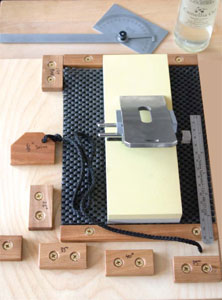
I sharpen almost every tool in my shop with a micro bevel about 5 degrees stronger than the main bevel. This does a couple of things. One aspect is with the micro bevel’s higher angle, the edge is somewhat stronger and may resist breaking down as quickly as a weaker lower angled edge. Another is the fact that only the very tip of the cutting edge is sharpened, which makes it much faster than working to sharpen the whole primary bevel surface. This last aspect also makes it trickier to sharpen freehanded, since the micro bevel is so narrow, that I can’t “feel” it on the stone to know I’m registering the correct angle. I’ve found that for most sharpening needs, I have complete repeatability using an inexpensive honing guide like this one sold at Highland Woodworking, in conjunction with a free plan for building a sharpening jig available for download. I personally sharpen on a Norton combination 1000/8000 water stone. I put my tool into my honing guide and register the sharp edge against the wooden stop on the jig, with the bevel facing down, appropriate for the angle I’m working, and tighten the guide. Next I’ll make sure my stone is flat, for which I normally use an x-course diamond plate. You could easily do the same thing with sandpaper on a flat surface, but that is up to you. One method we use to verify the stone is flat, is to take a regular pencil and mark a grid across the length and width of the stone. When all of the pencil is removed by your diamond plate or sandpaper, the stone is flat. Now, I’m ready to sharpen the bevel side of the tool, starting on the 1000 grit side of the stone. Many of our show attendees ask how we know when we’ve sharpened enough on any one grit. I use my thumbnail, moving along the back of the iron towards the sharp edge (just be careful and never move across the sharp edge). When I feel the burr or wire edge across the full width of the tool, then I know I’ve sharpened all the way to the edge, which is what is needed. I’ll then move on to the 8000 side of my stone, repeating the same steps.

The micro bevel will grow wider after honing multiple times, which can negate the time-savings of the micro bevel touch up. When this occurs, it is best to re-establish the primary bevel, so you can again utilize the micro bevel benefits. I reinitialize the primary bevel by placing sandpaper onto a flat surface like some thick float glass, some granite or the bed of a jointer. Use a second honing guide, so the grit isn’t transferred to your stones, and set the blade to the correct angle and work it back and forth until the original bevel is restored and the micro bevel is gone. Some prefer to utilize a grinder, but I like the strength of the flat primary bevel, compared to the slightly dished bevel caused by a grinder. Ultimately, this is a personal preference, so use whichever works best for you.

Now I’ve talked about sharpening one side of the iron/chisel, but as I mentioned in my definition of sharp, both sides must be highly honed. Without that, the lesser of the two will dictate the sharpness of the tool. I’m sure some of you out there are starting to cringe, at least those of you who have spent countless hours honing the backs of plane irons, to the point of a mirrored surface. Been there, done that! While this does fit the sharpening definition for the back, for plane irons it is unnecessary. We utilize a technique that David Charlesworth shared with us, called the ruler trick, that allows us to hone just the area nearest the cutting edge on the back, and still create a razor sharp tool. This does create the very smallest micro bevel on the back of the iron but is so small as to be negligible in function. (Do not use this technique on chisels, as you want to retain the ultimately flat reference surface. Just work the first half-inch or so of the back when honing.) In the ruler trick, a metal ruler with an extremely thin cross-section is placed on a prepared honing stone, along one of the long edges. The ruler is held in place by the surface tension created by the water applied during preparation. The plane iron is placed across the stone, so that the sharp edge is slightly hanging off the stone, while the remaining portion of the iron is across the stone resting on the ruler. If you were to put the sharp edge directly on the stone, the iron could easily gouge it. Now, keeping the iron flat against the stone and ruler, slide the sharp edge off and on (only about a 1/4” onto the stone) the stone repeatedly until the burr or wire edge is removed. This usually takes about 10 or so strokes, but test to make sure you are finished. When the burr or wire edge is gone, you should have a razor sharp tool.

With this method of sharpening, the beginner is immediately vaulted to a new level and will find their tools working as they were intended. They will also be able to quickly and reliably either refresh or initialize plane irons and chisels. Come out to see us at one of our shows if you still don’t feel comfortable sharpening, or if you’d like to try out some tools we’ve sharpened with this method. I hope to see some of you at our events across the country.  Feel free to come up and say hello.


Lee Laird has enjoyed woodworking for over 20 years. He is retired from the U.S.P.S. and works for Lie-Nielsen Toolworks as a show staff member, demonstrating tools and training customers.
To watch a great demo video of the sharpening process, click here.
Check out the great selection in Highland Woodworking’s sharpening department.

Jan 312011
 

Generally, the block plane is one of the most reached for planes in most shops. Most block planes are small enough to live in an apron pocket, so it is never more than an arm’s length away. Besides the convenient size, they are extremely flexible in their usages.

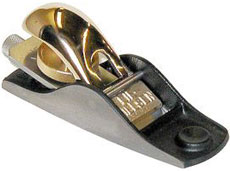
Specifically, the 9-1/2 block plane is the regular angle (as opposed to the low angle) block plane with the adjustable mouth. The “regular angle” refers to the angle at which the blade iron sits in the plane body, which is 20 degrees. The “low angle” version of this plane is the 60-1/2 block plane, and its blade iron sits at 12 degrees. The primary difference between the two is the low angle’s ability to trim end grain, like when working on a butcher-block top.  The only other difference is the feel of these planes in your hand. The 9-1/2, with its slightly higher angle lifting the back of the blade and cap iron, can stretch the smallest of hands a bit more than the 60-1/2.

The adjustable mouth on these planes allows you to easily bring the throat in tight when working to remove extremely thin shavings, supporting the wood to prevent tear out. Just as easily, the mouth can be opened up allowing a thicker, less refined shaving fit through, when working to remove material more quickly. If a thicker shaving was attempted, If the throat set too tight, the shaving would jam and you’d have to stop and clear the shaving, before continuing. This would certainly slow down your work.

As you might have already imagined, these block planes have a wide range of functionality. You can easily use it to put a chamfer on tenons and along the long grain surfaces, breaking the edges of any carcass or box, use it as a smoother on small scale work for face, edge or end grain. The block plane can certainly fill in for a wide range of tasks, even though it may not rise to the level of replacing specific purpose made planes. A pinch hitter can always come in handy.

Since the block plane has its iron in a bevel up configuration, you can also buy a spare blade or two that you can use to hone higher angles. This would allow you to just swap out the irons, if you were working on some really figured wood, as the higher bevel angle on the iron is in essence the same as changing to a higher frog angle in the bench planes (which use the iron in a bevel down orientation). Highly figured woods respond better to a higher angle of attack, which (without getting too deep into the science of it) allows the shaving to release without the normal tear out.

Don’t overlook the 9-1/2 adjustable mouth block plane for your shop.  I think you will find it a go-to for a multitude of jobs.

I hope to see some of you at our events across the country.  Feel free to come up and say hello.


Lee Laird has enjoyed woodworking for over 20 years. He is retired from the U.S.P.S. and works for Lie-Nielsen Toolworks as a show staff member, demonstrating tools and training customers.

Jan 292011
 

Ok, let’s get all the puns out of the way. Try not to skew this up. The taming of the skew. Situation normal, all skewed up. Is that all of them? Can you think of any more?

Can You Do This? Scares Me to Look at the Picture!!

What all this is coming to is, I am finally taking a turning class on using the skew. Can we be honest here for just a moment? I am scared of the thing. I won’t use it in my shop. When I pick up my skew, it catches before I even walk over to the lathe. You can imagine what happens when I actually touch the wood with it. Then when I finally turn on the lathe, well, things just start to happen without warning. I watch other people use it and it is magical. They make all those coves, rounds, and steps and it is beautiful and so beyond me. When I took Peter Galbert’s chair class last fall at the High, he was the best I had ever seen with the skew. We had the option of bringing our own premade chair legs or using ones Peter made for us. I would have been out of luck if I tried to make my own before the class. Just for funsies, Peter made a chair leg during the class and I couldn’t believe how quickly and easily he turned it out. Wow!! After he completed it with just the skew, it was so smooth that he had to rough it up (not smooth it out, mind you) with sandpaper so it would take a finish. I may get there in about ten years of practice.

On February 9th Hal Simmons will teach a class at Highland on Taming the Skew. It is three hours from 5:30 to 8:30 pm. When I was in the business world, our staff sat down together and took a careful inventory of all the skills we needed to satisfy our clients. Any skills we did not have, we acquired by either hiring or training. I look at my woodworking skills the same way, except I don’t plan to hire anybody. That is why I keep a close eye on the classes offered at the Highland web site. This class will complete most of my turning skills and after that, it is a matter of practice. Sometimes you just need a little bit of help to keep from really skewing something up. Come on down and meet me there.