If you’ve been looking for a better way to finish your work, look no further than the humble card scraper. Card Scrapers can cut finishing time in half, removing glue squeeze-out, leveling across joints and eliminating tearout, while providing a great surface for applying finish.
In the video below, Matt Cremona takes a closer look at Card Scrapers, the unsung heroes in the workshop. Watch the video below to learn the basics for adding a card scraper or two to your own tool kit.
We agree on one surprise area, though, and that is neither of us likes gift surprises. We know what we like, we know what we want, and we don’t see the point of getting something we can’t use or don’t like.
For example, one family who brings their two Dachshunds to us has a delightful jewelry store. A few years ago they ran an ad for a ring and, when Brenda saw it, she said she just had to have it.
Obviously, I got it. I love her too much to say no.
Recently, the wife of the couple was in the clinic with her little girl Dachshund. At the end of the visit she said, “Come get Brenda some nice earrings to go with that ring.”
That night, Brenda and I were talking about Christmas presents, and I mentioned what the lady said. “That wouldn’t interest me,” Brenda opined, “because I want something I can hold out in front of me and see, like a bracelet.”
See what I mean? Why spend money in jewelry-sized aliquots of dough, just to have it be something she doesn’t like?
Brenda quit buying me surprise gifts when she discovered that I was secretly returning them for credit and getting something else. I mean, what if your wife bought you a left-tilt table saw when you wanted a right-tilt? You’d never be completely happy with it.
If you’re going to spend $3000 on a tablesaw, you might as well get what you actually want, and forget the surprise component.
To me, the principle is the same whether you’re spending $14 on a premium paint brush or $500 on a professional Earlex 3-stage Spray System. I don’t want a one-stage sprayer, and, if I get one, I’m going to trade it in toward the unit I actually want, even if I have to save up and do without until I can afford it.
Now, I’m off to print out the photo of the 14″ Rikon Bandsaw and leave it lying around.
Did you know Highland Woodworking has a Wish List feature? Just click here to access the Help page that will walk you through the registration process. You can also print your Wish List, making it easy for your sweetie to order exactly what you want.
No Southern-fried Southern boy wants to be called a Yankee, but we share the characteristics of shrewdness and thrift. Thus, each month we include a money-saving tip. It’s OK if you call me “cheap.”
If you’re really cheap, like me, you don’t like paying for internet access when you’re away from home or work. When I’m traveling, I usually write in the airport and write on the plane. There’s not much else to do and I’m not bothered by distractions.
However, sometimes I’m in the mood for being entertained by some good old woodworking reading. Now, that’s easy if the terminal has free WiFi, but you’re not going to get free WiFi once you board the plane, unless you’re in first class, in which case, you ain’t cheap!
To get around that, I’ll open a browser, and enough browser pages to fill my flight time with reading.
Key point: You can still power down your device if you put it in “Sleep Mode,” because, when you restore power, everything will load just like you left it. If you simply shut down the entire computer, you’ll lose everything you loaded.
It may take a few minutes to load enough pages for a two-hour flight, but it’s free!
Jim Randolph is a veterinarian in Long Beach, Mississippi. His earlier careers as lawn mower, dairy farmer, automobile mechanic, microwave communications electronics instructor and journeyman carpenter all influence his approach to woodworking. His favorite projects are furniture built for his wife, Brenda, and for their children and grandchildren. His and Brenda’s home, nicknamed Sticks-In-The-Mud, is built on pilings (sticks) near the wetlands (mud) on a bayou off Jourdan River. His shop is in the lower level of their home.Questions and comments on woodworking may be written below in the comments section. Questions about pet care should be directed to his blog on pet care, www.MyPetsDoctor.com. We regret that, because of high volume, not all inquiries can be answered personally.
Welcome to “Tips From Sticks-In-The-Mud Woodshop.” I am a hobbyist who loves woodworking and writing for those who also love the craft. I have found some ways to accomplish tasks in the workshop that might be helpful to you, and I enjoy hearing your own problem-solving ideas. Please share them in the COMMENTS section of each tip. If, in the process, I can also make you laugh, I have achieved 100% of my goals.
Why do we pour finish from the can into a separate container? Because we know that dipping our brush into the original container, applying finish to our project, then dipping into the container again will carry debris from the project surface back into the can.
It’s a practice that can lead to some waste if you have finish left in the secondary container, but it’s better than ruining an entire quart or gallon of expensive varnish or paint. To say nothing of ruining the surface of your project!
Still, what if, when transferring finish, you introduce dirt or dust? That really defeats the purpose of the extra step, doesn’t it? There are some things you can do.
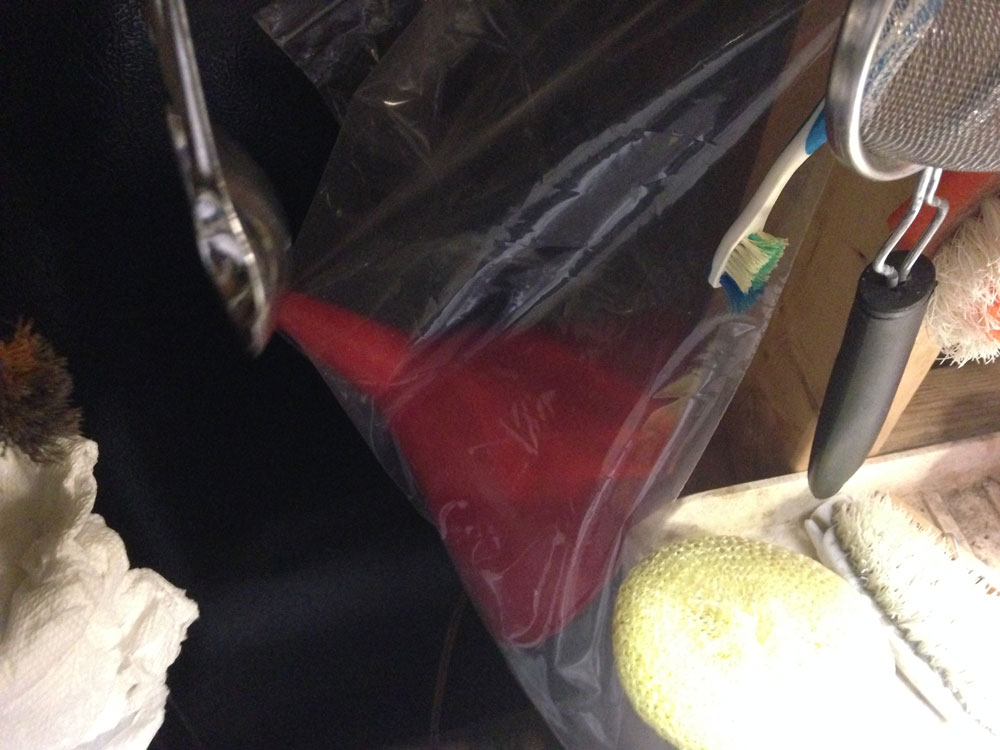
For example, when you finish cleaning your funnels, don’t just toss them onto a shelf to collect dust. Small and medium funnels will fit into zipper-locking bags and be fresh and clean the next time you need them.
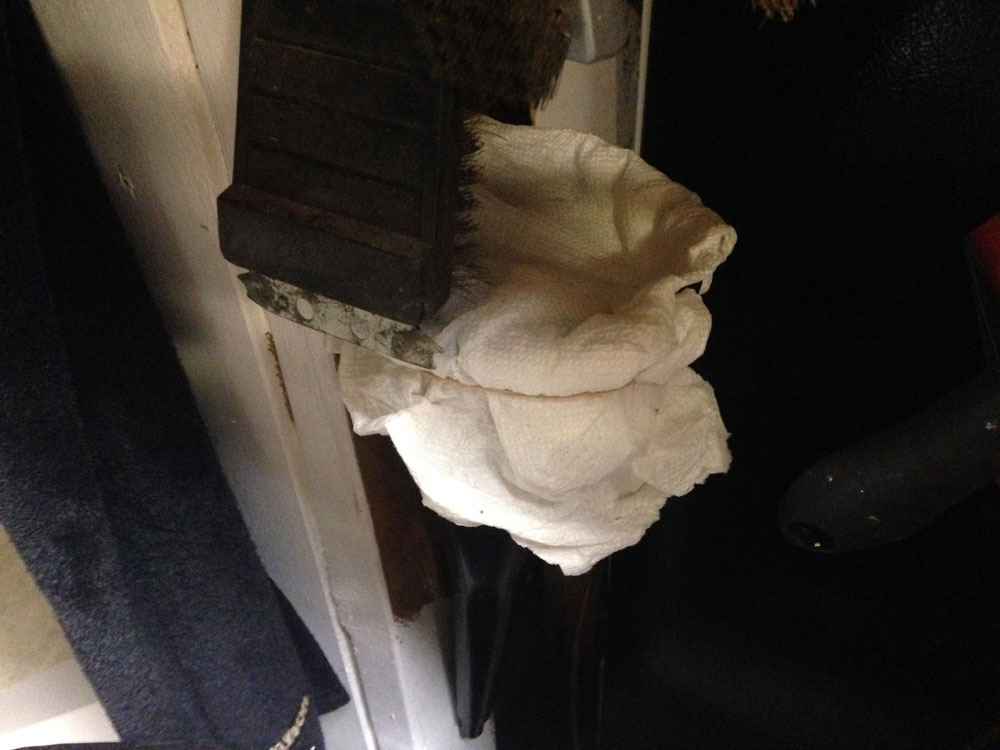
Wider and longer funnels may require a different approach. For example, with my long, black funnel I put a used paper towel over the top, secured by a rubber band. The little end is sealed with a portion of a sheet of paper towel forced into the opening.
No dust is getting into this baby. Even though I don’t have a Ziploc bag large enough for it, the funnel is effectively protected by a used paper towel on top and a smidgen of a towel blocking the exit.
And, what of the container decanted into? Leave that lying around and it’s going to be full of dust, cobwebs and insects. Maybe even worse.
For that reason, I save only containers with lids. They can be stored indefinitely and still be clean inside.
I try to save every jar I can, especially if the lid is rust free. After they leave the dishwasher, I turn them upside down on this ventilated shelving for a couple of weeks to allow them to dry completely. Then, the lid goes on and they wait for their opportunity to serve.
Jim Randolph is a veterinarian in Long Beach, Mississippi. His earlier careers as lawn mower, dairy farmer, automobile mechanic, microwave communications electronics instructor and journeyman carpenter all influence his approach to woodworking. His favorite projects are furniture built for his wife, Brenda, and for their children and grandchildren. His and Brenda’s home, nicknamed Sticks-In-The-Mud, is built on pilings (sticks) near the wetlands (mud) on a bayou off Jourdan River. His shop is in the lower level of their home.Questions and comments on woodworking may be written below in the comments section. Questions about pet care should be directed to his blog on pet care, www.MyPetsDoctor.com. We regret that, because of high volume, not all inquiries can be answered personally.
Not sure what all you can do with that pile of Toggle Clamps sitting in your shop? Wondering why you should own them in the first place?
A few years ago, we invited Highland customers to submit their toggle clamp jig designs to Wood News. We were very impressed with the creativity exhibited in many of these designs.
Take a look through the Toggle Clamp Jig Gallery to get inspired – maybe you will find a few good ways to use toggle clamps in your own shop.
And if you have any great jig designs that aren’t shown in the gallery, we’d love to hear about them. Drop them in the comments below!
The interview focuses on the evolution of Highland Woodworking, started by Chris and Sharon Bagby, who have been joined by their daughters, Kelley and Molly, in helping to run the family business.
We are honored to have been featured and we strive to continue supporting our Atlanta community and the woodworking community throughout the world by providing quality woodworking education and customer service.
Karyn and Tom Lie-Nielsen of Lie-Nielsen Toolworks pictured with Chris, Kelley, and Molly Bagby
If you’ve been looking for the ultimate professional woodworking workbench, look no further. Sjobergs Elite Workbenches come in a number of different configurations, and are all constructed with dense, clear European beech. Every Sjobergs bench comes equipped with two massive 29″-wide vises that open to 5-3/4″, won’t rack and can be configured for left- as well as right-handed use.
Steve Johnson, the Down to Earth Woodworker, took a closer look at a Sjobergs Workbench. Watch the video below to find out more!