
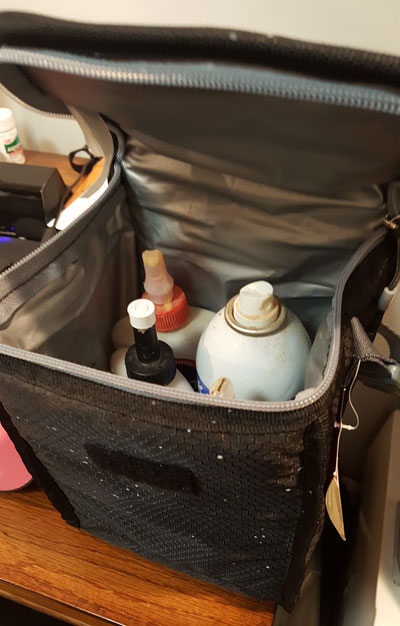
 In the December issue of The Highland Woodturner, Phil Colson shared his quick tip for storing wood glue when you are in a climate where it gets below freezing in the winter.

In the December issue of The Highland Woodturner, Phil Colson shared his quick tip for storing wood glue when you are in a climate where it gets below freezing in the winter.
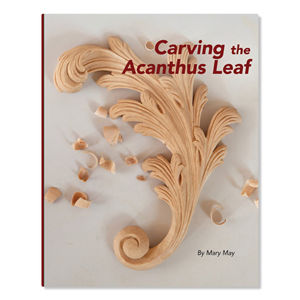
Review by J. Norman Reid
“As a regular book reviewer, I have the good fortune to read a steady supply of the best books on woodworking. I can say in all honesty that none of the books I review are bad books. Every one of them has something of value to offer woodworkers. Still, every now and then there arrives in my mailbox a book of such excellence that it stands head and shoulders above the rest. Mary May’s Carving the Acanthus Leaf is such a book.”
Reader Garry D. Meador writes: “I am a recent subscriber to Wood News and have a hard time waiting for the next issue. So much info presented in so many different ways. Love it. This may have been done in the past but I would like to see a poll of what woodworkers did in their former life. I was a high school band director that grew up working with Dad in wood. My first thoughts on retirement were to get really involved in wood, which I did. I see lots of different retirees that seem to be unrelated to woodworking but realize that everyone has an opportunity to return or relearn the joy of wood.”
Garry, thanks for the great suggestion. As we reflect on the end of last year and this year’s New Year’s resolutions, the time couldn’t be better to think about this exact topic.
Many woodworkers are retired. Some dream of being retired. Some are living the dream by working in wood as their vocation.
There is no pigeonholing woodworkers; our backgrounds are extremely varied. Just watching the final episode of The Highland Woodworker and seeing Charles Brock’s extensive library of interviewees shows a bit of the diversity that exists in our pastime.
Many of us worked wood with family as youngsters. Some took shop classes in junior high and high school. Home construction backgrounds are over-represented. While blue-collar foundations abound, plenty of doctors, lawyers and clergy like to express our creativity in wood.
Wood News Online has an international subscriber base. The world of woodworking is so much bigger than our United States. We get emails, questions and online comments from all over the globe. Below you’ll find a broad list of occupations, but the real results of this poll will be seen in your comments. Stories about how you came to woodworking will be most appreciated if you would like to share them in the comments below.
No Southern-fried Southern boy wants to be called a Yankee, but we share the characteristics of shrewdness and thrift. Thus, each month we include a money-saving tip. It’s OK if you call me “cheap.”
That genius philosopher, Plato, was the smart guy who said, “Necessity is the mother of invention.”
On the eve of New Year’s Eve, I was painting some corner molding and found it really difficult to cut in because where it met the wall, it had a rounded profile. I needed a guard, but didn’t have a commercial one. I could have used a putty knife, but the widest knife I had was only 5″, which would have been tedious.
I remembered having one years ago that looked for all the world like a 12″ Venetian blind, but, if I still own that, I couldn’t find it.
What I could find, though, was… a Venetian blind.
When we were building our house, 22 years ago, we splurged a little on blinds for the garage windows so they would present a uniform appearance from the outside. Of course, I’m much too cheap to start cutting up blinds, but I remembered that they have two little valance slats at the top. No one would care if I borrowed one slat for a few days, would they?
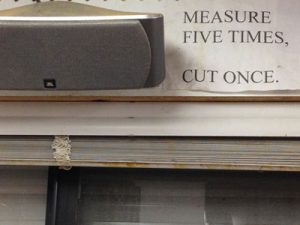
See the two little slats at the top that make a valance? I borrowed one, temporarily.
Surprise! It worked so well that I forgot all about going to the store to buy a guide. The bonus is that the slat is almost 4 feet long, so it can be put in place and left there until a long piece of molding is painted.
Now I just have to make sure nothing happens to it before I get it back on the window!
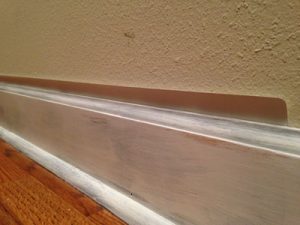
This little Venetian blind slat saved the day on this painting job.
Jim Randolph is a veterinarian in Long Beach, Mississippi. His earlier careers as lawn mower, dairy farmer, automobile mechanic, microwave communications electronics instructor and journeyman carpenter all influence his approach to woodworking. His favorite projects are furniture built for his wife, Brenda, and for their children and grandchildren. His and Brenda’s home, nicknamed Sticks-In-The-Mud, is built on pilings (sticks) near the wetlands (mud) on a bayou off Jourdan River. His shop is in the lower level of their home.Questions and comments on woodworking may be written below in the comments section. Questions about pet care should be directed to his blog on pet care, www.MyPetsDoctor.com. We regret that, because of high volume, not all inquiries can be answered personally.
Welcome to “Tips From Sticks-In-The-Mud Woodshop.” I am a hobbyist who loves woodworking and writing for those who also love the craft. I have found some ways to accomplish tasks in the workshop that might be helpful to you, and I enjoy hearing your own problem-solving ideas. Please share them in the COMMENTS section of each tip. If, in the process, I can also make you laugh, I have achieved 100% of my goals.
One of my writing heroes is the late James J. Kilpatrick. He wrote a syndicated newspaper column, The Writer’s Art, and published a book by the same name. Famously, he had three pieces of advice for writers new and old, “Read your copy. Read your copy. Read your copy.” Simply reading one’s written material allows us to catch problems with flow, syntax, grammar, and spelling.
Today, I’m thinking of a corollary to Mr. Kilpatrick’s admonition because of an event that occurred yesterday. That warning is, “Wear your safety glasses. Wear your safety glasses. Wear your safety glasses.”
Regret is a terrible thing. The crazy part of this story is that, as I was walking across the shop to perform the function that led to my injury, I was thinking, “I’m going to be working over my head. I should protect myself, especially my eyes.”
I was putting up some new hatches in the place I store empty Festool Systainers and Festool hand tools not currently in use. In the process of making these hatches, screws for the hatch side of the hinge are invariably too long and have to be shortened. Now, I could do that in some really neat, fancy fashion, but my want is to get it over with quickly, so I use a 4″ angle grinder. There is about a quarter of an inch of screw sticking through, and it takes about three seconds to grind it off. The process, however, creates a hot little remnant that sometimes burns right into the wood and sometimes goes flying who-knows-where. That’s typically not a problem when working on a benchtop, but, above your head? That’s a different matter!
The craziest part of all was, in my advance thinking, I even thought, “Man, if that slag got on my cornea (clear part of the eye), it would be curtains for that eye.”
But, I was in a big hurry, as I usually am, and I had reading glasses on and, having planned ahead, I thought I’d be really careful.
Yeah, right.

I squinted so hard that the upper lids were pressed against my face just below my right eye, causing the hot screw tip to burn me in three places.
There were 4 screws to grind down, and the first three went flawlessly. Few things are more dangerous to one’s behavior than success, and the success on those three screws may have led to some complacency. Whatever the cause, I got to the fourth one and ZING! Out flies the hot piece of metal, and it’s headed straight for my right eye. Thank God in Heaven for the autonomic nervous system, the complex network that controls all of the body’s functions that we don’t think about: breathing, heartbeat, and our bodies’ functions in the face of danger. Before I even knew there was a problem, my eyelid had slammed shut, leading to the three burn marks you see, which represent folds in the heavily-squinted eyelid.
I went upstairs to get a good look in the bathroom mirror, praying all the way, and was impressed with how little damage was present. Surprisingly, there wasn’t much pain, either. And, thankfully, there was no damage to the actual eyeball.
Clearly, it could have been much worse. And, much more painful.
There was a little more grinding to do, so I reached for the nearby safety glasses, this time, and finished the job.
Right after I said a prayer of thanks for my deliverance.
Happy New Year!
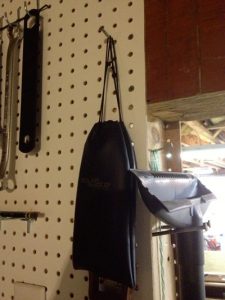
The stupidest part? Safety glasses were right next to the table saw, just two steps away.
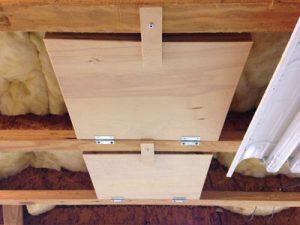
New hatches, not yet assigned Festool equipment.
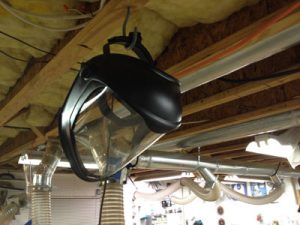
Now, if I’d been really smart, I would have put on my face shield for full protection!
Jim Randolph is a veterinarian in Long Beach, Mississippi. His earlier careers as lawn mower, dairy farmer, automobile mechanic, microwave communications electronics instructor and journeyman carpenter all influence his approach to woodworking. His favorite projects are furniture built for his wife, Brenda, and for their children and grandchildren. His and Brenda’s home, nicknamed Sticks-In-The-Mud, is built on pilings (sticks) near the wetlands (mud) on a bayou off Jourdan River. His shop is in the lower level of their home.Questions and comments on woodworking may be written below in the comments section. Questions about pet care should be directed to his blog on pet care, www.MyPetsDoctor.com. We regret that, because of high volume, not all inquiries can be answered personally.
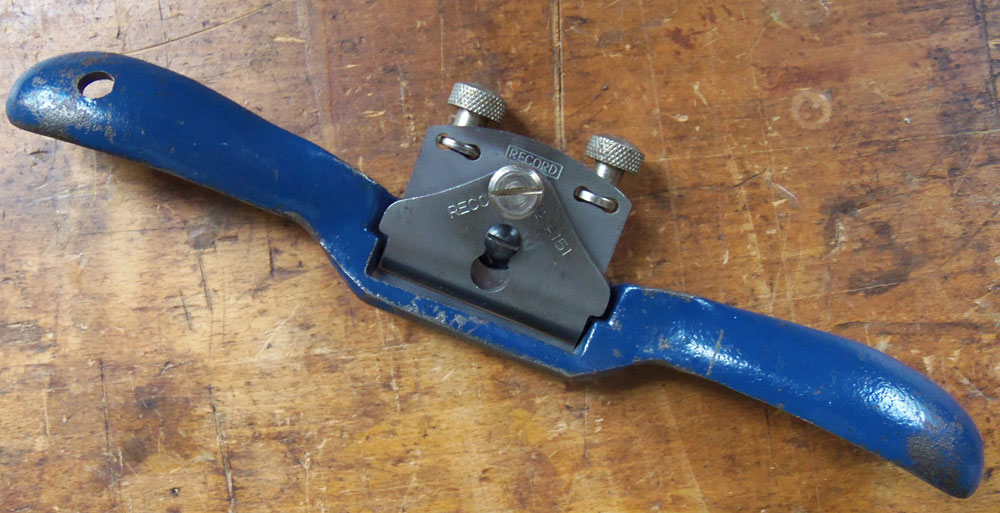
If the Adjustable Spokeshave is still a mystery to you, this article will help you out. The Highland Woodworking staff has clarified the setup and use of the helpful spokeshave in this short piece.
If you’ve been looking for a new project to tackle, why not try making one of the Hock Kitchen Knife Kits? In the video series below, you can follow along as Mike Morton goes through the entire build process, from initial shaping to applying finish. Make some great gifts for friends and families, or get one of these kits for an aspiring woodworker you know!
Watch the videos below to find out more!