Highland Staff

Jan 132015
 

To read Part 1 of Terry’s Benchcrafted Leg Vise installation, CLICK HERE

I am still working on my Benchcrafted Leg Vise.  Going a little slow what with Thanksgiving, Christmas, and traveling to my son’s wedding up north, but the vise is probably further along than it seems at times.

Since the last update I have mounted the vise to the right rear leg of my bench by cutting a hole in the tool tray and running the vise leg up through the bottom of the tray flush with the back rail.  I will attach it to the bench leg below and set a couple of screws through the rear board of the tool tray into the top of the vise.

I spent a lot of time reading the instructions and making sure I had a good layout for the mortise slots for the criss-cross and the screw hole for the vise screw.  I only had one piece of thick walnut lumber for the leg and I did not want to screw that one up.  You will need a deep slot for the criss-cross to drop into, and a wider mortise at the top of the slot for the bracket which holds the criss-cross.  This slot is 1-7/16 inches deep which is why they recommend you use 2-1/2 inch thick stock.  Simple 4/4 stock will not do and the legs need to be at least 4 inches wide for the Retro.  You can glue up stock using 8/4 plus a 4/4 and put the joint on the up side so you cut the mortise through the glue line and the brackets are mounted in solid material.
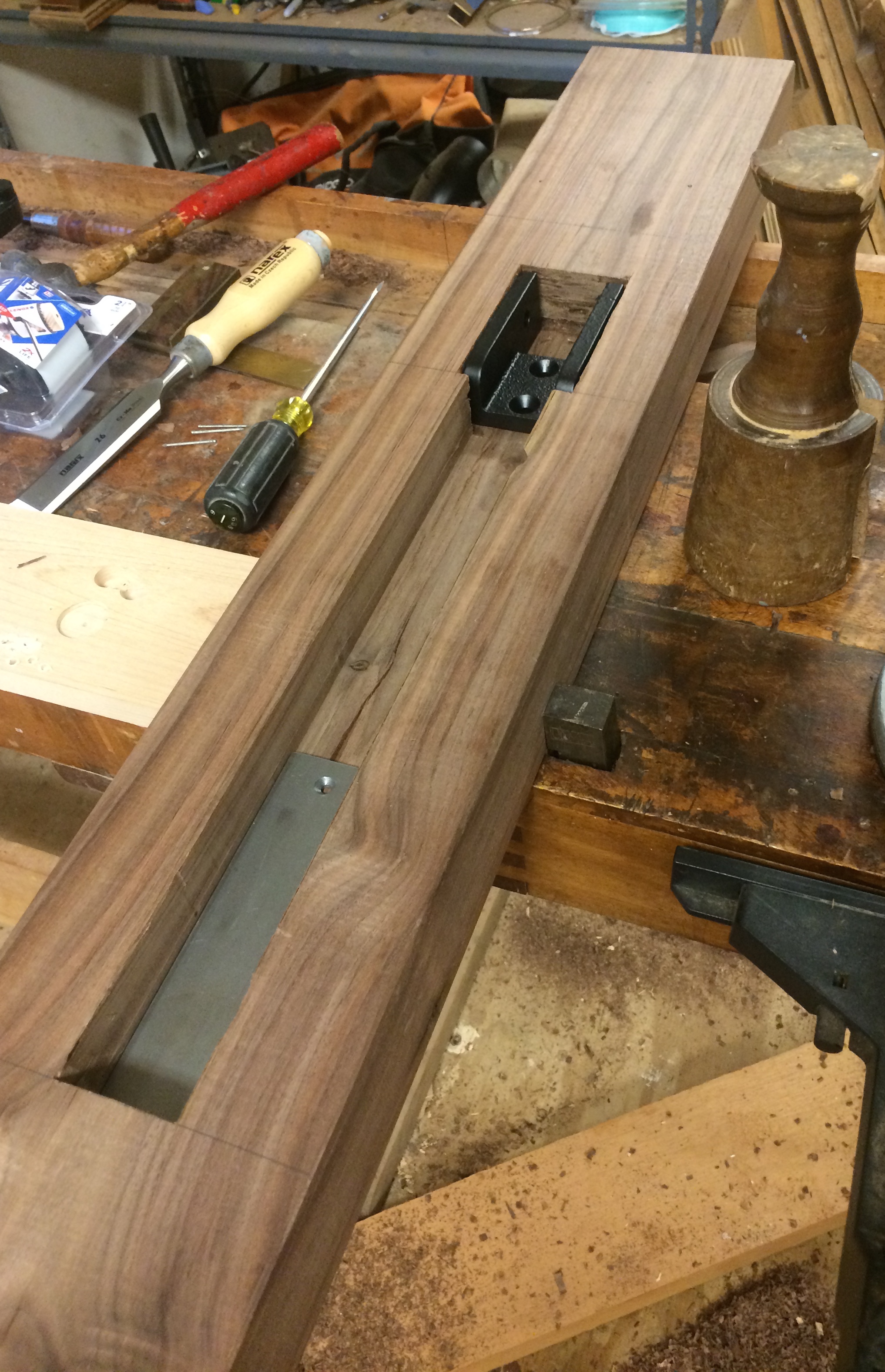
Leg with Mortise

Leg with Mortise

I ended up going to the local big box for a couple of odd (for me) tools.  I needed a spade bit with a 1-1/4 diameter, a hole saw at 2-5/8 diameter, and a 5/16-18 bottoming tap.  Taps are not something I normally keep, and tapping a screw hole in wood is outside my experience.  But hey, I’m game, so I headed to the store to get what I needed.  I asked three clerks and searched all over the tool section until I finally happened to ask the right guy.  He pointed me toward the display stand right in the aisle labeled “Tap and Die Sets” by Irwin.  It came in a set with the proper drill bit and cost just a few dollars.  I also needed a longer straight router bit to reach the full depth of the mortise.
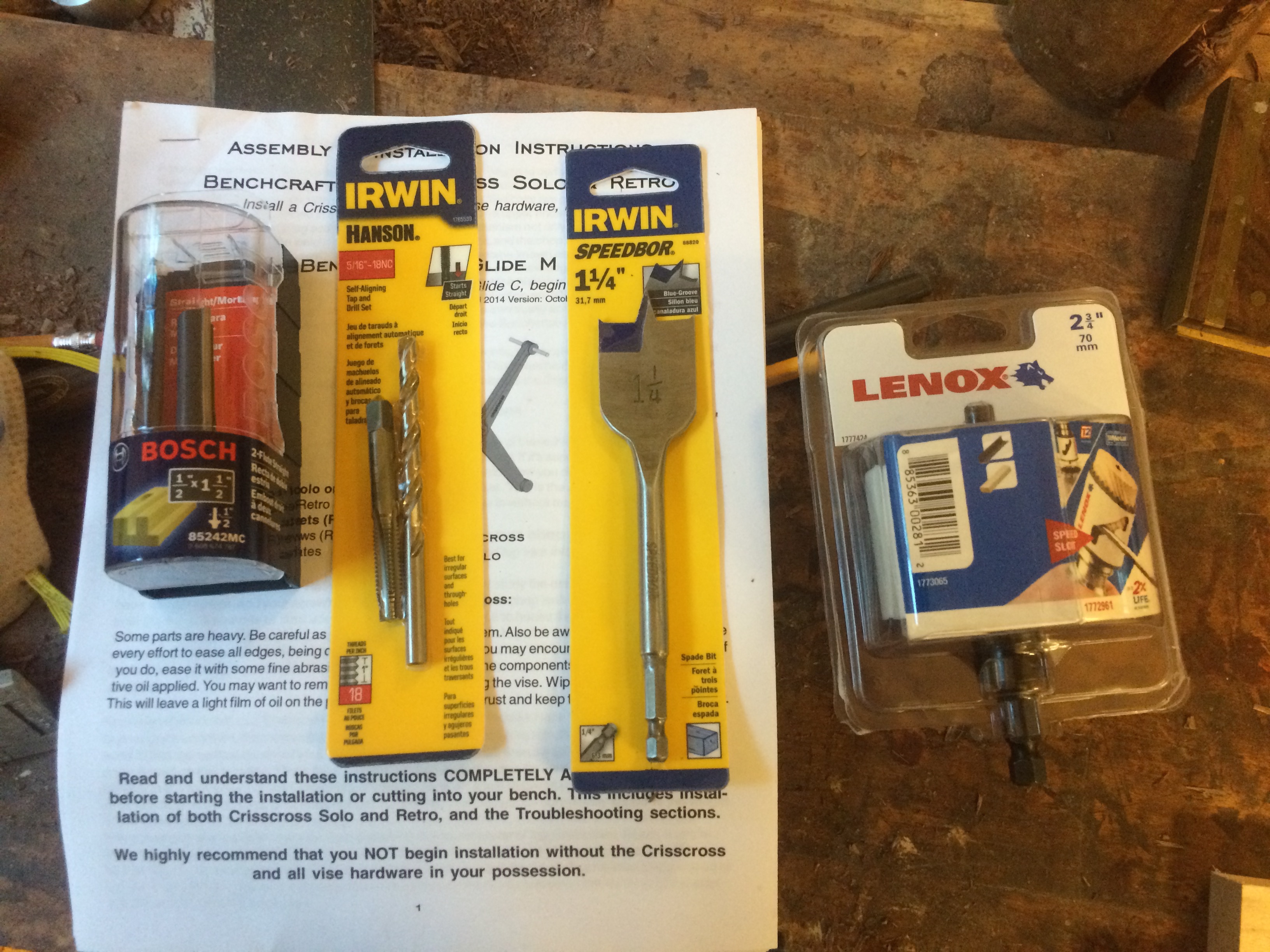
Additional Tool Required

Additional Tools Required

I paid lots of attention to the layout for the criss-cross and its bracket.  I used my router with a fence to cut the mortise and then cleaned it up with chisels and a mallet.  I tested out my new tap set on a scrap piece of walnut and then marked the spots and drilled pilot holes to mount the brackets.  Time will tell, but when I put the screws into those wooden threads, it tightened up like I have not seen in a while.  You need to give it a try.  They offer extra directions in the download from the website, so it is easier than you think.

I cut a hole to fit in the bottom of the tool tray, unscrewed the bench from the shop floor and slipped the leg into place, complete with bracket and half the criss-cross.  I glued up the chop from some old African Mahogany (nasty wood if you have never tried it) lying around the shop and cut the mortise in it.  After mounting the bracket and the other half of the criss-cross, I put it together temporarily and it appears to work like a champ.
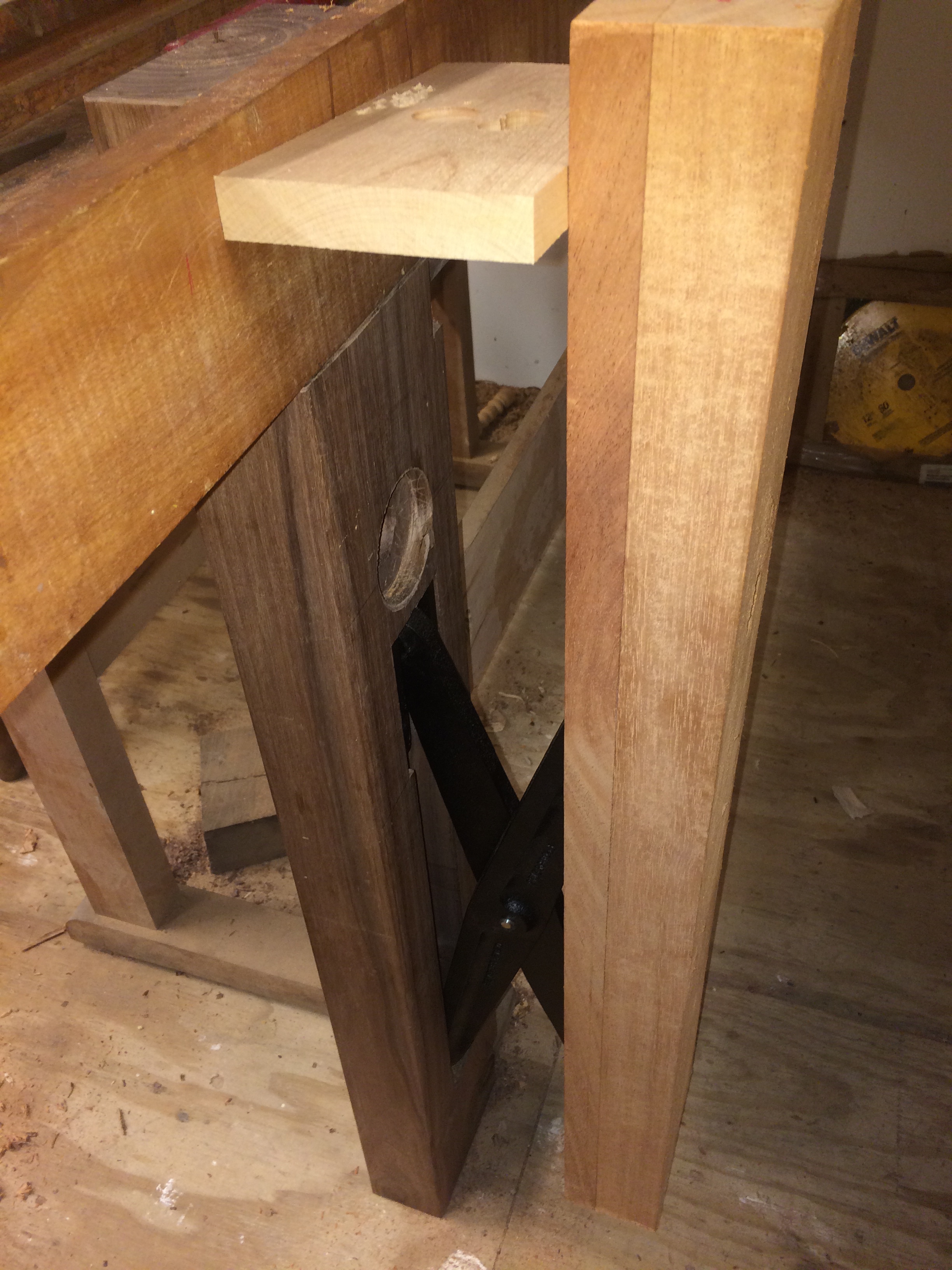
Glued-Up Chop with Temporary Mount

Glued-Up Chop with Temporary Mount

The next step is to mount the screw and nut and add the hand wheel to the chop.  Once I get it all aligned and tested according to the directions from Benchcrafted, I will add some shaping to the chop, trim the top flush and get some finish on it.  Note the small gap at the bottom which is built into the crisscross so the top will grasp thin pieces of wood.

Little more work to do and then I think it is going to be all right!
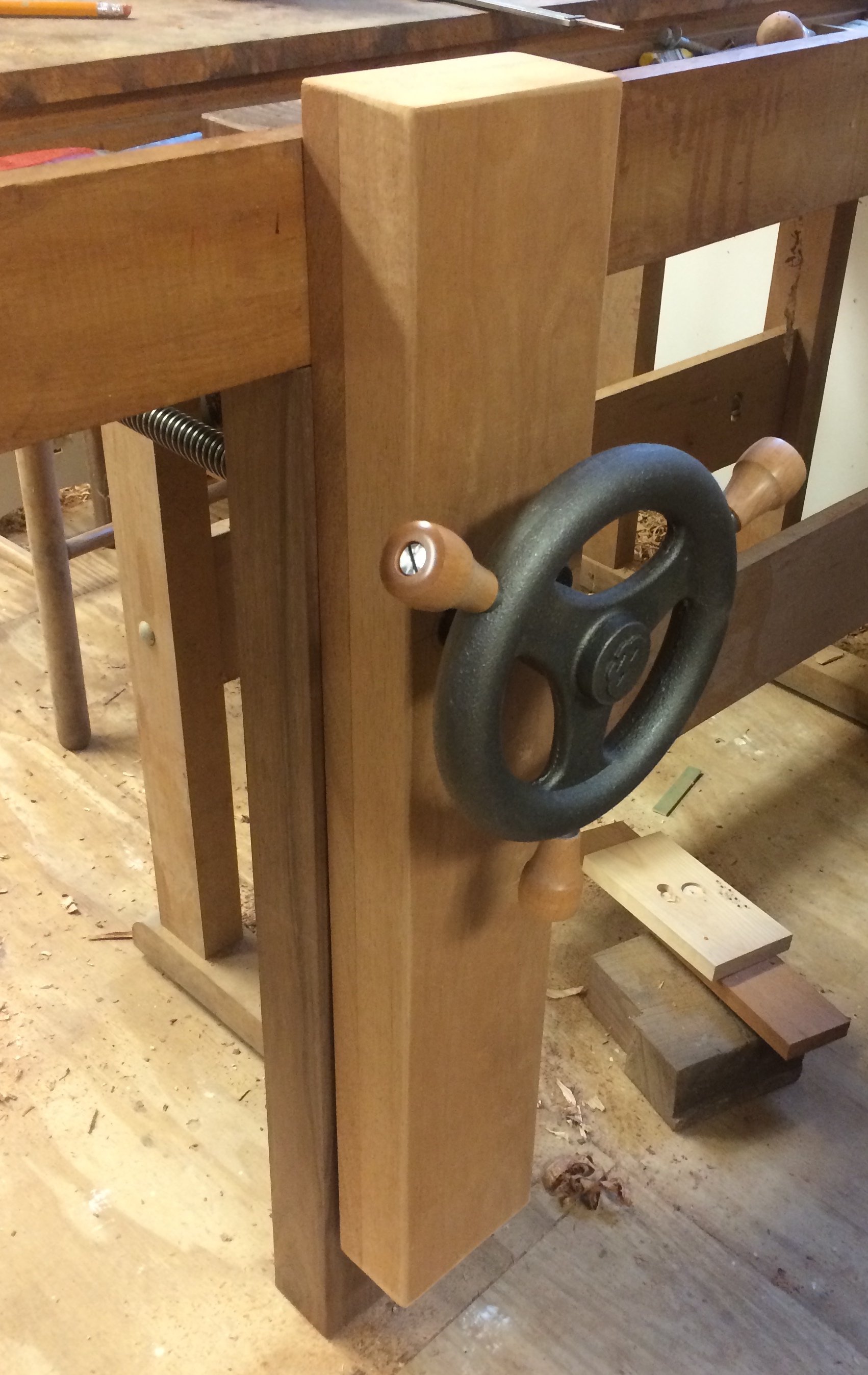
Mounted with Glide Wheel "C" Waiting for Final Trim

Mounted with Glide Wheel “C” Waiting for Final Trim

CLICK HERE to read Part 3

CLICK HERE to go back to Part 1

Jan 082015
 

wnblog2015 is well underway here at Highland Woodworking and we’ve got a great new issue of Wood News Online.

This month’s issue includes:

Project Idea: Tippmann Boss Wooden Table– A Tippmann Boss Sewing Machine requires a very sturdy surface, so Arthur Stevenson decided to build his own table specifically for his Tippmann Boss.

Building an Electric Bass Guitar: Final Details– Lee Laird has spent the past few months chronicling the build of his electric bass and in this final segment he discusses installing the strings and plugs, adding the finish, and more.

Show Us Columns:

Show Us Your Shop– Richard Korte has a beautiful 28’x34′ workshop in Olympia, WA, where he builds wooden boats and a variety of other projects.

Show Us Your Woodworking– Michael Sweet is a self-proclaimed hoarder of wood that he uses to create a variety of woodworking projects including detailed dollhouses, games, portraits, and ornaments.

Show Us Your Carving– Richard Cheek, who we featured in our May 2012 issue of Wood News, is back with several more detailed carvings.

Our monthly tip contributors include:

The Down to Earth Woodworker– This month Steve discusses the Six Degrees of Woodworking (and how every conversation can eventually lead to woodworking), his outlook for the 2015 woodworking year, a test between wax paper and freezer paper and which one works better for the workshop, his new purpose-built shop storage series, and his upcoming visit to Highland Woodworking.

Two Minute Safety Tip– Raymond Randall has contributed a follow-up to the November 2014 Safety Tip on adjusting bandsaw height by suggesting to make sure the blade is no longer moving before touching it.

Tips From-Sticks-In-The-Mud-Woodshop– Tack rags and plastic bags, Jim has tips on how these two things can be reused and recycled within your shop.

Q:A Ask the Staff– Bob asked our staff if you need to remove the iron from wood-bodied planes when you’re not using them. Check out the answer here.

We’ve also got a look back at the best tool reviews of 2014, a book review on Beautiful Boxes, and a variety of tool specials and discounts for the month of January!

All of this and more in our January 2015 issue of Wood News Online.

Jan 072015
 

Welcome to our 2015 Woodworking Resolutions blogger series. Every year we invite our bloggers to share their resolutions specific to their woodworking goals for the new year. Click each link below to read our bloggers’ resolutions!

Lee Laird

It’s that time of year again (already), and I thought I’d share my resolutions for 2015.

For those who don’t know (and anyone that read last year’s resolutions), I needed a second back surgery in April of 2014 (yep, almost all of the resolutions were a bust), which ended up being a game changer. This second back surgery resolved a number of issues that had persisted since my 2012 surgery, and thankfully most are a fading memory. I’m back (no pun intended) to getting around much more like I did before the back problem originally raised its head. I find it very interesting how quickly one can change their “norms” (e.g. Most people inherently know they can run if something requires it, like an emergency of some sort. This changed for me, when I knew I couldn’t run due to my calf muscles being non-responsive.) and how the body/mind will sort things into “I can do that” or “I can’t do that”. I’m now successfully working to shift as many of my “norms”, as possible, all back to “I can do that”. And for those who might ask, yes, I have actually “run” a bit. I’m sure anyone that might have seen me wondered why I moved so strange, and certainly nowhere near the sprinter speed of my teens and 20’s, but I was moving at a brisk pace compared to the last couple of years. No matter what it looked like, I was stoked to do something that had been completely out of reach. So, based on that long diatribe, my resolutions are as follows:

1. Stay healthy and work out regularly – This used to really be an automatic thought for me, as I loved to exercise and be active all of the time. It was so easy, before my initial back surgery. After the first surgery, it was amazing how hard it was to make myself go through the motions, as every little thing required crazy levels of effort. Now that the second surgery “reconnected” my calf muscles, I vow to keep applying healthy habits and work to regain/retain my strength to better enjoy a long retired life.

2. Upgrade my workbench – Still on the agenda from last year, but I purchased a BenchCrafted tail vise, so this will be part of my bench design. As I mentioned last year, my current workbench is fairly small, even though the base is sound and of decent size. I’ll update the top so it has more landscape to make working on larger projects much easier. Better work holding can directly relate to your safety and quality of work. Imagine what might happen when a workpiece dislodges during a powerful/critical operation.

3. Update my Moxon Vise – I made my current Moxon vise using some small press screws, but just received a birthday gift of the BenchCrafted Moxon Vise kit. The press screws have a fairly fine pitch, which require more time and effort to tighten, so the update will make it both quicker and easier to hold/release any workpiece.

4. Better storage for my hand tools – This is an issue I’ve had on my plate for quite a while, and was on last year’s resolutions list, but didn’t happen. This is totally doable this year!

5. Elevate my instrument building efficiency – My first guitar was the project of all projects, or at least it seemed to me at the time. About three years after the start, I finally completed a nice Les Paul guitar. Earlier this year I started building a Bass guitar of my own design, and I’m just finishing it. While this  4 – 5 month build time is significantly shorter than my first instrument build, I’m sure with focus, I can still improve my efficiency. This may transition into more than just building for my own use, so the efficiency is important.

6. I’ll continue to strive to make my writings (Blog articles, both for Highland and personal) easier to read, and still provide valuable information and entertainment to all.

I hope some or all of my intended resolutions might hit a chord with some of the readership, and we all make next year even better.


Lee Laird has enjoyed woodworking for over 20 years. He is retired from the U.S.P.S. You can email him at lee@lie-nielsen.com or follow him on Twitter at twitter.com/is9582

Click below for more bloggers 2015 Woodworking Resolutions:

Jan 062015
 

Welcome to our 2015 Woodworking Resolutions blogger series. Every year we invite our bloggers to share their resolutions specific to their woodworking goals for the new year. Click each link below to read our bloggers resolutions!

Matthew York

Every year when the calendar turns from December back around to January people make resolutions, promises that they hope to keep for the New Year. These also tend to serve as goals that they hope to strive for as the New Year marches along. As a woodworker we often make resolutions associated with our hobby, and I am certainly no different. For the year 2015 I have a few resolutions that I would like to focus on getting accomplished.

First I would like to apply some of the principles that the Down to Earth Woodworker discusses in his videos on 5S in the workshop. I like the idea of organizing my shop and cementing some habits that make working in my shop easier, safer, cleaner and more enjoyable. If you haven’t already I highly recommend checking out what Steve discusses in his 5s videos.

Another resolution I have lined up is my desire to show my work at more arts and crafts festivals. I love making things, and I find joy in what I do. I would also love to find a way to do woodworking full time instead of just as a hobby. While this may not be a realistic end goal right now, the idea of showing my work more often and gaining some customers is something I hope to accomplish in 2015.

I also want to focus on spending more time in my shop on a regular basis. I often go through spurts where I will work in the shop every day after work, and then there are days where I hardly touch a single tool. I’d like to work toward making it a habit to spend at least an hour or two every day or every other day in the shop. I think by spending more time working at a steady pace and less time working in spurts and manic phases I can accomplish more of the goals I am setting for myself.

Lastly I want to set aside some time this year and learn a new woodworking skill. In 2014 I took a class at Highland taught by Scott Meek over at Scott Meek Woodworks on making wooden hand planes. This January I am continuing that education by taking the Advance plane making class that Scott offers online. My goal for 2015 is to find something else in the wide woodworking world and learn how to do that. Currently I am leaning toward finding a chair making class and learning how to make chairs. I think chair making could be a lot of fun and it will complement some of the skills that I already possess.

Resolutions are often something that we make and then break within the first few weeks of January. Instead of setting myself impossible tasks or lofty goals I want to focus on taking small steps and building habits. By focusing on the little things, like organization steps within 5s, or spending more days but less time per day in the shop I can work to ingrain those habits. Make them muscle memories and by doing so advance along my journey as a woodworker.

Does anyone else have any woodworking resolutions for the coming New Year?


Matthew York has been a woodturner since 2004 and has been interested in woodworking since he was a teenager. He currently lives in downtown Atlanta and has a small shop in his basement. He is an avid woodworker and is always available to talk about the craft. He can be contacted at fracturedturnings@gmail.com or visit his website at fracturedturnings.com. You can also follow him on twitter at @raen425

Click below for more bloggers 2015 Woodworking Resolutions:

Jan 022015
 

Welcome to our 2015 Woodworking Resolutions blogger series. Every year we invite our bloggers to share their resolutions specific to their woodworking goals for the new year. Click each link below to read our bloggers resolutions!

Steve Johnson

Like about 99.9% of people, my New Year’s resolution list includes the usual casually made, easily ignored, and quickly forgotten promises… lose weight, exercise more, be nicer to my wife (well, maybe I’ll work on that one). But I added one to the list that I am determined not to forget or ignore.

In 2015 I want to find ways to reach more beginners and potential new woodworkers. It has become, in fact, what you might call a “grand obsession.” And there are several good reasons for it.

Woodworking attracts good people. Or perhaps woodworking makes people good. Either way, we need more good people. In everyday walking around life, a significant percentage of people are just real jerks. But, I’ve met thousands of woodworkers and only a couple fit that less-than-pleasant description.

Woodworkers speak the same language worldwide. We use similar tools, we use the same joinery, and we enjoy the craft and work hard to get better. I’m convinced that people who speak the same language, share a common bond so to speak, are much more likely to get along. The world could use a little more “getting along.”

More woodworkers translate to more of everything (except maybe wood!). More woodworkers lead to more innovation, more tools, more magazine subscriptions, more newsletters, videos, and classes. Sometimes I feel like I’m on overload already, but bring it on. I would rather be inundated than starving for my daily woodworking fix.

As a woodworker, my skills are probably slap in the middle of a big range, from beginner to master (closer to the bottom quartile, I often think). But I do like to share my knowledge and experience. There is not much, if anything, I could teach the great ones, but I could impart some tips, tricks, wisdom, and experience to newbies.

Probably due to the inordinate amount of time we spend doing mind-numbing things, like sanding, woodworkers are deep thinkers. We ponder and we analyze. Less tweeting and texting and more thinking would also likely make the world a better place.

Whether you consciously try or not, we woodworkers are pretty good stewards of the environment. Frugality seems to be a common trait, and there is never (almost never) a scrap of wood haphazardly tossed away. We fret over what to do with our woodchips and sawdust, we cry when a finish hardens in a can. We save nuts and bolts like they are family heirlooms, and we find creative ways to use stuff other people cast aside.

And, perhaps most importantly, woodworkers are generous with their time, talents, tools, projects, tips, techniques, and of course, opinions. If you think opinionated sounds negative it is not at all… because we also say, “bring it on”… we woodworkers love to have a healthy debate.

More new woodworkers… that’s my sincere resolution for 2015 and beyond. I think I’ll go text my wife and tell her how great she is… right after I eat that last cinnamon bun and take a nap.


Steven Johnson is retired from an almost 30-year career selling medical equipment and supplies, and now enjoys improving his shop, his skills, and his designs on a full time basis (although he says home improvement projects and furniture building have been hobbies for most of his adult life).

Steven can be reached directly via email at downtoearthwoodworks@me.com.

Click below for more bloggers 2015 Woodworking Resolutions:

Jan 012015
 

Welcome to our 2015 Woodworking Resolutions blogger series. Every year we invite our bloggers to share their resolutions specific to their woodworking goals for the new year. Click each link below to read our bloggers resolutions!

Terry Chapman
It is the traditional time of the year to make Resolutions and we are no exception at Highland.  We do try to make them related to woodworking, however, since that is what we do.

In my profession as a Land Surveyor, I often was tasked to write a “Legal Description” of a parcel of land.  One technique regularly used is to reference a previously recorded plat drawing, which pulls everything from that drawing into the description.  I do that here by referring you to last year’s list of resolutions and incorporating them by reference.  I think that is a valid technique since very few of them have been completed.

Resolution #1.  I am going to finish something before I start another project.  There are these wonderful projects sitting all around the shop and most of them deserve to be finished.  The problem is that I want them to be perfect and they are not and my skills are not always up to the task.  Plus, I really do not like to throw out good wood cause I might finish the job one day.  Maybe.

Resolution #2.  I need to sweep the shop. Still. Really well. Once.

Resolution #3.  I want to take some more classes in woodworking this year.  I got so busy building houses with my Habitat Affiliate, that classes moved down the list for the last few months and I intend to correct that this year.

Resolution #4.  I intend to expand my Festool collection.  I broke the ice this year with a Track Saw and it is a wonderful piece of equipment.  Buying Festool may answer my built-in sense that getting things right one time and then not having to change is the best way to go.

Resolution #5.  I will continue to expand my tool sharpening skills.  Can it really be all that hard?

Resolution #6.  I may perhaps start considering possibly maybe eventually throwing some stuff out of the shop.  I look at pictures taken in the shop and quite often I can’t see the project for the stuff in the background.  What’s the old rule? — if you haven’t used it in 25 years, you probably are not going to use it and maybe perhaps you should consider throwing it out.

On second thought, perhaps that is a resolution for next year — what’s one more year after 25?

Did you make any woodworking resolutions this year?  Let us hear from you in the comments below!


Terry Chapman is a Professional Engineer (Civil) and Land Surveyor who lives south of Atlanta. He has done woodworking for many years and particularly enjoys bowl turning and making Windsor Chairs. He currently works as Site Development Manager for a local affiliate of Habitat for Humanity and has one son who pastors a Church in Connecticut. You can email him at cdeinc@mindspring.com.

Click below for more bloggers 2015 Woodworking Resolutions:

Dec 312014
 

No Southern-fried Southern boy wants to be called a Yankee, but we share the characteristics of shrewdness and thrift.  Thus, each month we include a money-saving tip.  It’s OK if you call me “cheap.”

Speaking of reusing bags I was in a department store the other day, waiting my turn to check out, when I overheard a lady asking an employee, “Where would I find plastic bags for storing a comforter?”

I wanted to scream!  “Lady!  The comforter probably came in a plastic bag, complete with a nice zipper.”

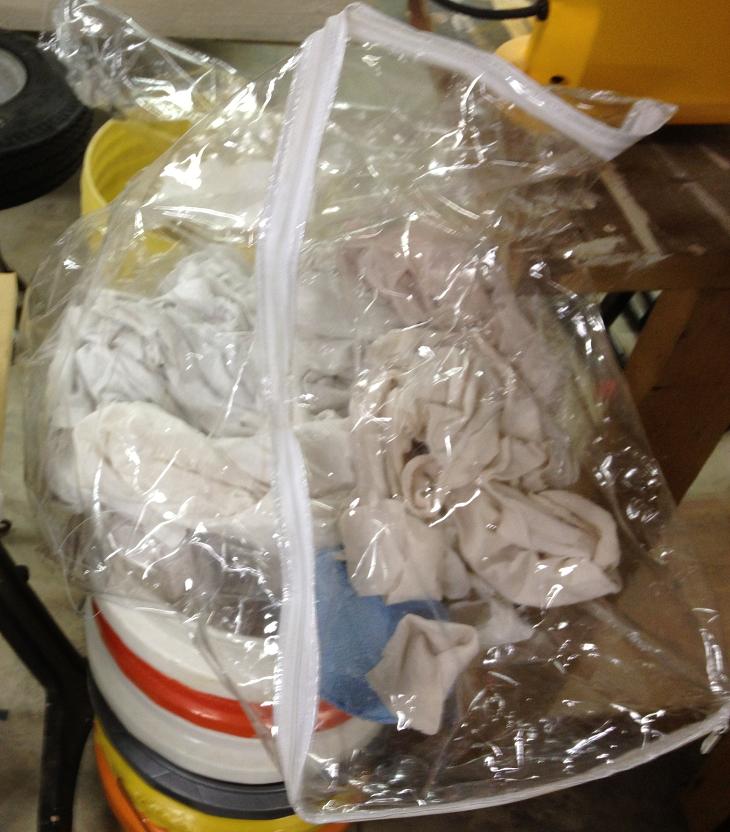
When we purchase sheets, electric blankets and other bedding I always nab the zippered bag.  See the big one?

An electric blanket came in this bag and it holds my never-ending supply of old T-shirts used for finishing, cleaning and a kazillion other tasks.

An electric blanket originally came in this bag, but now it holds my never-ending supply of old T-shirts used for finishing, cleaning and a kazillion other tasks.

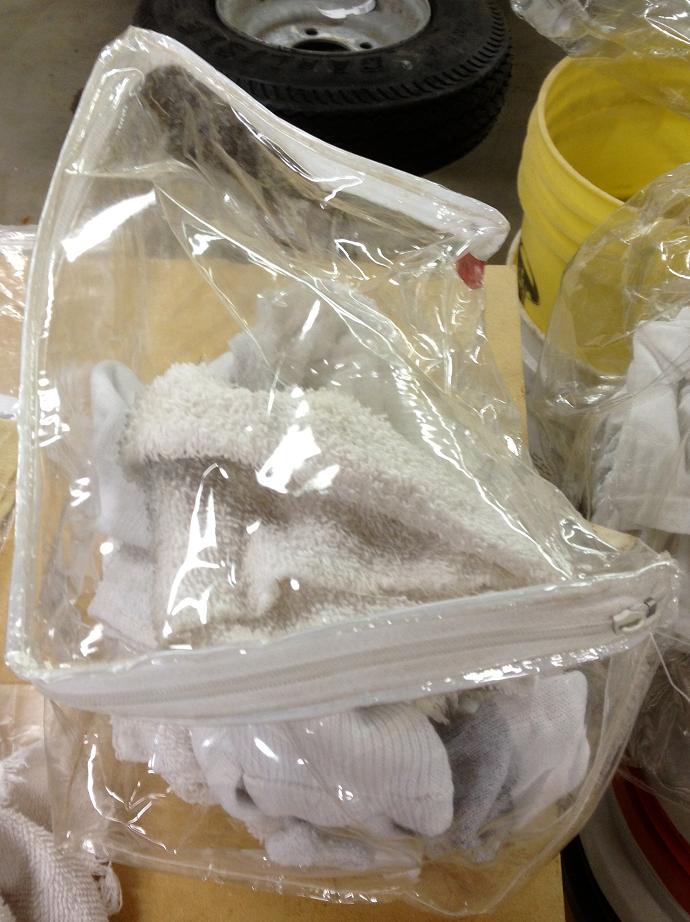
The little one below came full of washcloths from Amazon.  I honor its heritage by storing the retired washcloths until it’s time to use them in the shop, too.

Pay for a plastic storage bag? Sorry, I just can’t make myself do it! These old washcloths and socks served me well, but the boss said they had to go.

Pay for a plastic storage bag? Sorry, I just can’t make myself do it! These old washcloths and socks served me well, but the boss said they had to go.


Jim Randolph is a veterinarian in Long Beach, Mississippi. His earlier careers as lawn mower, dairy farmer, automobile mechanic, microwave communications electronics instructor and journeyman carpenter all influence his approach to woodworking. His favorite projects are furniture built for his wife, Brenda, and for their children and grandchildren. His and Brenda’s home, nicknamed Sticks-In-The-Mud, is built on pilings (sticks) near the wetlands (mud) on a bayou off Jourdan River. His shop is in the lower level of their home. Questions and comments on woodworking may be written below in the comments section. Questions about pet care should be directed to his blog on pet care, www.MyPetsDoctor.com. We regret that, because of high volume, not all inquiries can be answered personally.