Highland Staff

Oct 082015
 

While attending Woodworking in America 2015 (#wia15), the Highland Woodworking staff had an opportunity to take some video of all of the action happening at The Marketplace and in a few of the classes. We put it all together and wanted to share it with those who were unable to attend this year (and to reminisce with those who did).

Enjoy!


Oct 072015
 

No Southern-fried Southern boy wants to be called a Yankee, but we share the characteristics of shrewdness and thrift.  Thus, each month we include a money-saving tip.  It’s OK if you call me “cheap.

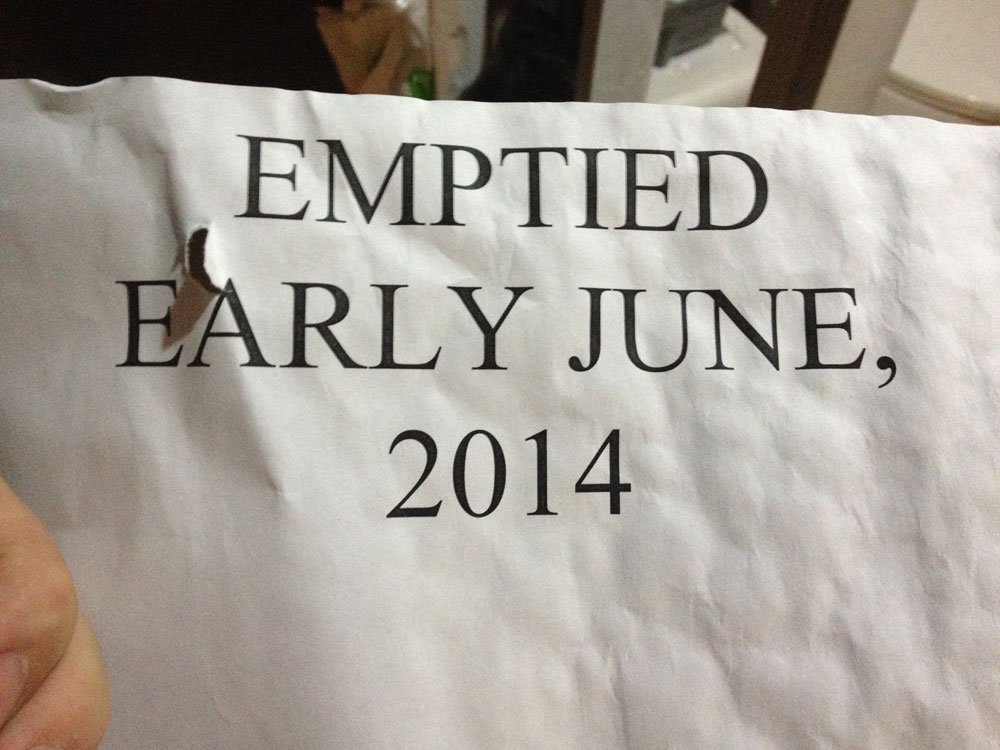
Steven Johnson once asked me, “With a trash can that big, how often do you empty it? Once a year?”  I told him I really didn’t know, so the last time I put in a new bag I marked the date.  Turns out, Steve was very close, as the can didn’t fill up for 13 months, and that includes emptying the other trash cans into it periodically.

July of this year the can was full, and it was time to empty it and let Steve know he’s a good guesser.

July of this year the can was full, and it was time to empty it and let Steve know he’s a good guesser.

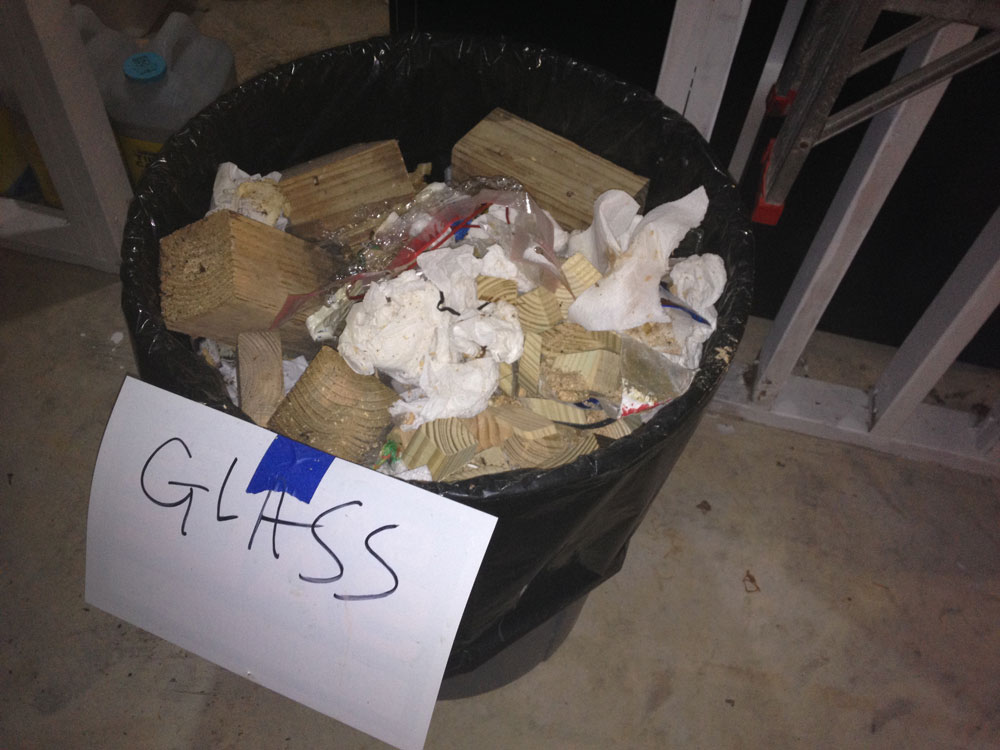
Sometimes we generate refuse in our woodworking shops that may hold the potential for harm to your sanitation workers.  A few months ago I had some broken glass in the shop.  I protected myself from it by placing a sign on the bag, ensuring I wouldn’t put my unprotected hand in harm’s way.

I don’t empty this can very often, so I didn’t want to take the chance that I’d forget the broken glass inside. A sign was a continual reminder.

I don’t empty this can very often, so I didn’t want to take the chance that I’d forget the broken glass inside. A sign was a continual reminder.

If you have a Dumpster, the emptying of your trash is fully automated, and your garbage man never touches your refuse.  At our office, the street side can is picked up by an arm remotely controlled by the driver, swinging the can into the air, then upside down, then back to the ground.  A different company picks up our home refuse, though.  While the emptying process is mechanized, the hopper, (as the man riding on the back of the truck is called) has the option to reach in the can to pull out plastic bags he judges to be light enough to speed the emptying process.

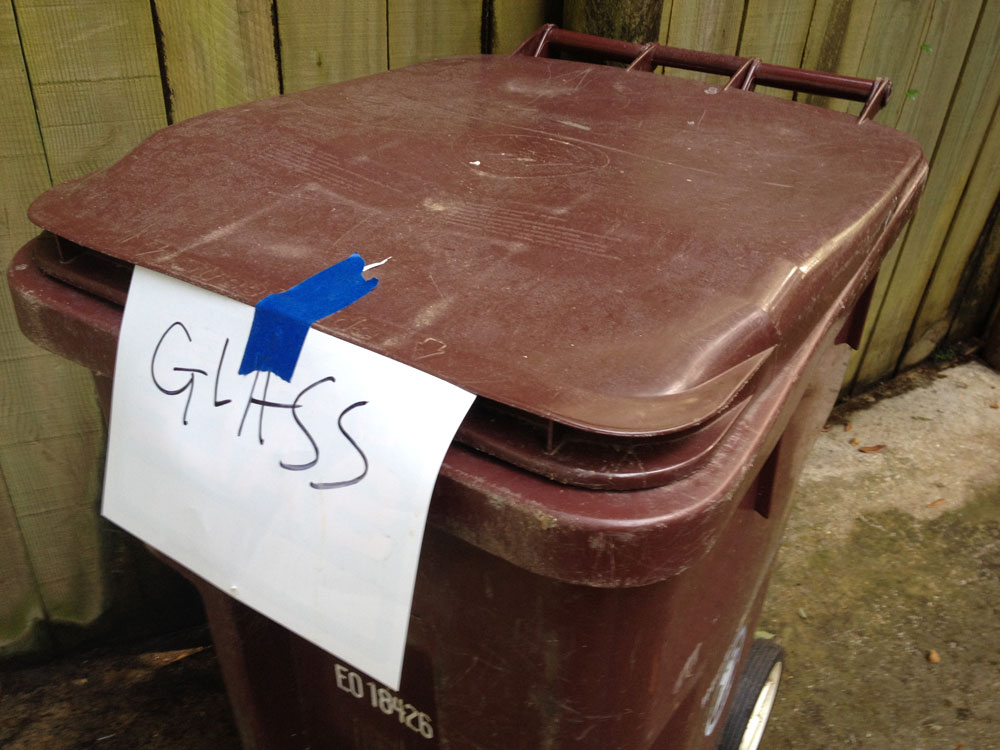
No one wants to allow harm to come to his fellow man. To protect the sanitation workers from harm if they reached into the can for the bag with glass inside, I warned them by transferring the sign from my indoor can to the outdoor one.

No one wants to allow harm to come to his fellow man. To protect the sanitation workers from harm if they reached into the can for the bag with glass inside, I warn them by transferring the sign from my indoor can to the outdoor one.

Sometimes the danger isn’t sharpness, but weight.  If you have placed a lot of treated-lumber cutoffs into the bag, a large can will become quite heavy.  We recycle so aggressively that our usual garbage-day load is one small bag, so our man is used to latching on to a light can.  When we produce a lot of weight for the can, I always take a moment to make a sign to warn him so he doesn’t hurt himself.

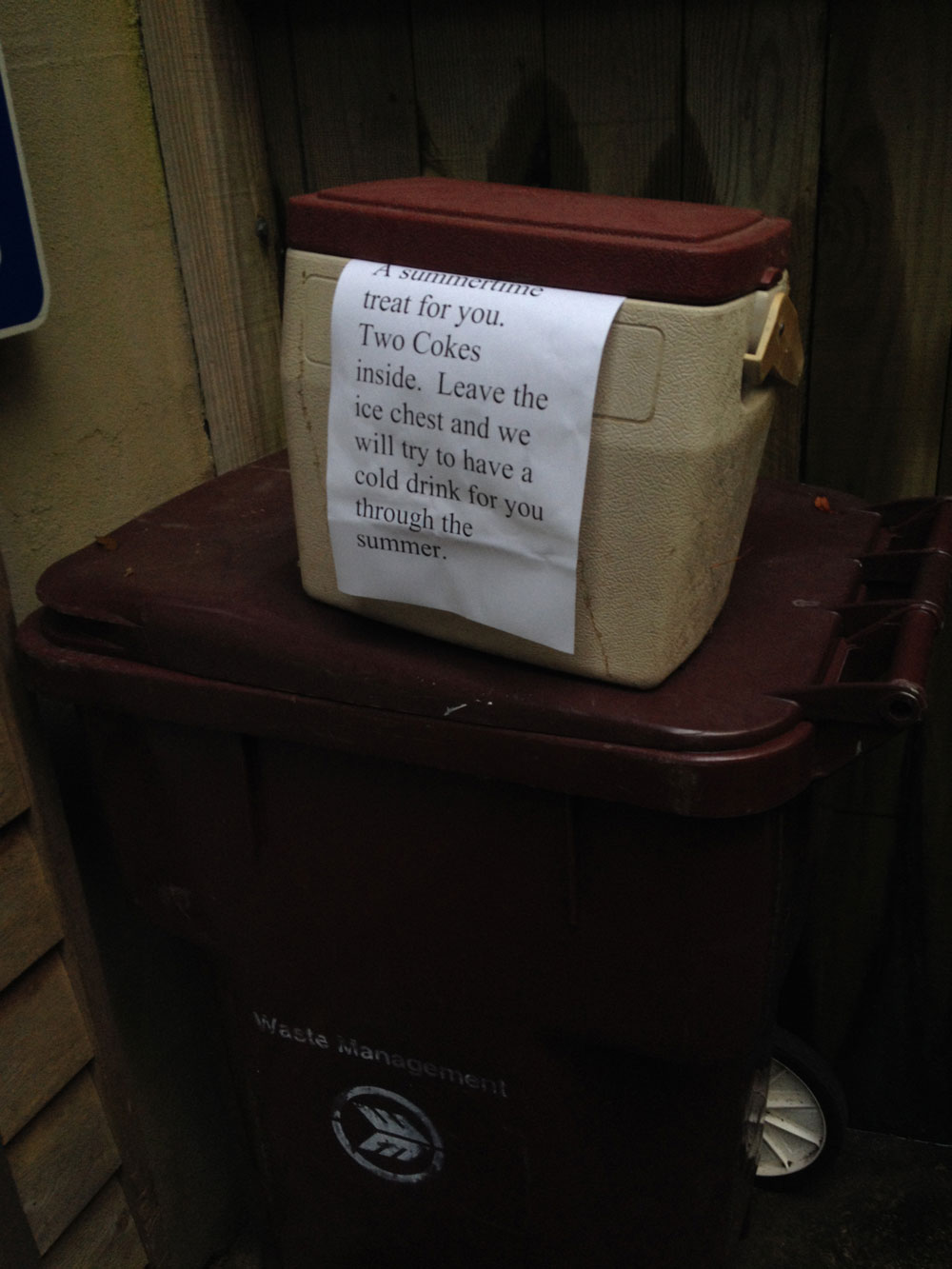
Another appreciated thing you can do for your local sanitation engineers:  Cool them off.  During the summer I ice down a couple of Coca-Colas as a treat.  And, a little check every Christmas.  They have a hard job that no one wants.  It’s not asking too much for us to be extra nice to them.

Recent temperatures approaching 100, with 90% humidity makes for a stratospheric heat index. Cool off the sanitation workers with a welcome cold treat.

Recent temperatures approaching 100, with 90% humidity makes for a stratospheric heat index. Cool off the sanitation workers with a welcome cold treat.

—-

Jim Randolph is a veterinarian in Long Beach, Mississippi. His earlier careers as lawn mower, dairy farmer, automobile mechanic, microwave communications electronics instructor and journeyman carpenter all influence his approach to woodworking. His favorite projects are furniture built for his wife, Brenda, and for their children and grandchildren. His and Brenda’s home, nicknamed Sticks-In-The-Mud, is built on pilings (sticks) near the wetlands (mud) on a bayou off Jourdan River. His shop is in the lower level of their home. Questions and comments on woodworking may be written below in the comments section. Questions about pet care should be directed to his blog on pet care, www.MyPetsDoctor.com. We regret that, because of high volume, not all inquiries can be answered personally.

Oct 062015
 

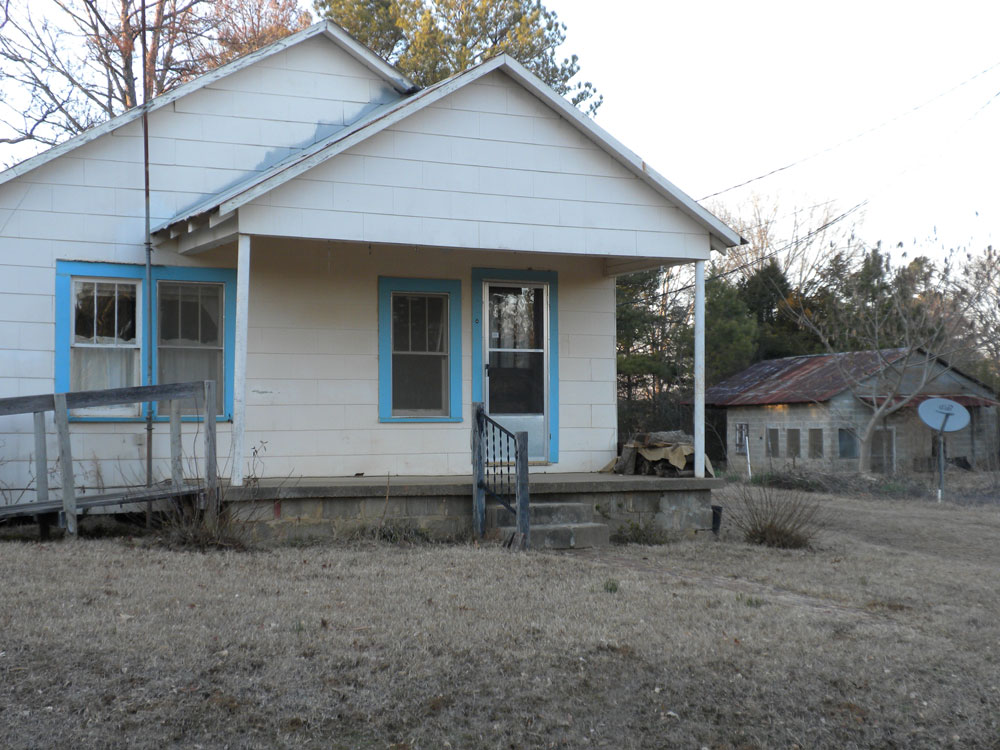
I learned early in life that I have to write things down.  For me, it didn’t come at “a certain age,” unless 10 qualifies.  The dairy farm I spent a good bit of my childhood on was, well, in farm country; a long way from town.  Trips to the city were strategically-designed events.  Some destinations were givens:  a stop at the co-op for dairy feed, a stop at Sunflower for groceries we couldn’t grow or make, Fred’s Dollar store for sundries.  Fred’s was one of my favorite stores because once a year I got new black rubber boots.  Having my own black rubber boots made me feel “in.”  It’s a dairy-farmer thing.

My Aunt Polly put the “strategy” in strategically-designed.  If she didn’t accompany Uncle Sam and me to town, something was going to be forgotten.  Never mind that she gave us a list with everything on it; we would still manage to miss something.
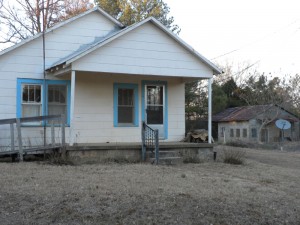
There was a lot of love and Christian devotion in this house, and a lot of hard work in the barn in the background. There is nothing in the world for which I would trade one minute of those experiences.

There was a lot of love and Christian devotion in this house, and a lot of hard work in the barn in the background. There is nothing in the world for which I would trade one minute of those experiences.

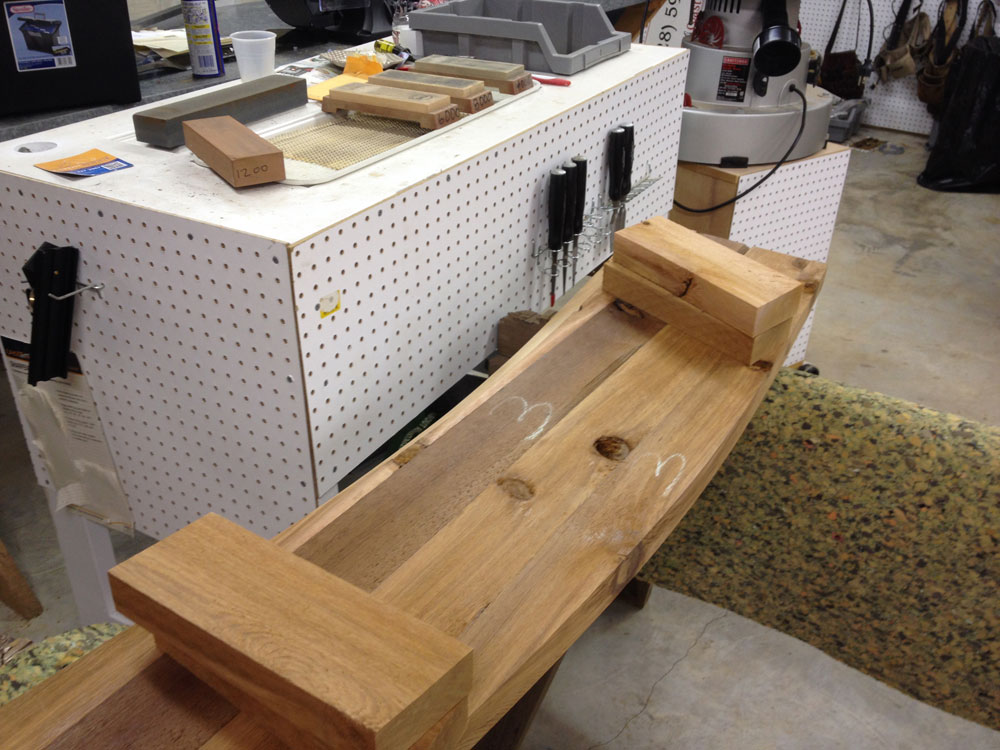
It is not unusual for a lot of time to pass between my visits to the shop.  Sometimes so much calendar goes by that I forget what I was last doing, so I always write myself a note before quitting for the night.  “These cleats are ready to mount to the underside of the benches.  Cut slotted screw holes to compensate for wood movement, round over, then sand.  Then cut legs.”  Otherwise, I’m scratching my head, looking at the pieces, wondering, “What was I going to do with those?”
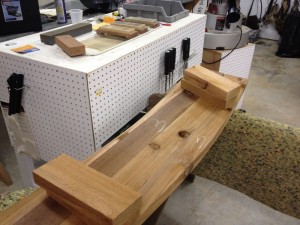
Can’t you just picture it? A month goes by, you get back into the woodshop and say to yourself, “Why did I cut these little blocks?”

Can’t you just picture it? A month goes by, you get back into the woodshop and say to yourself, “Why did I cut these little blocks?”

For tasks subject to being repeated, I have permanent notes to myself.  Usually, I’ve worked out details of how best to accomplish the task, most commonly learning from my own mistakes and/or oversight.  Learning the same lesson twice is unpleasant.  I keep those instructions in Word Perfect.  Short, simple tasks’ instructions reside in a file named “signs.”  Other tasks have their own files, such as “decklattice.”

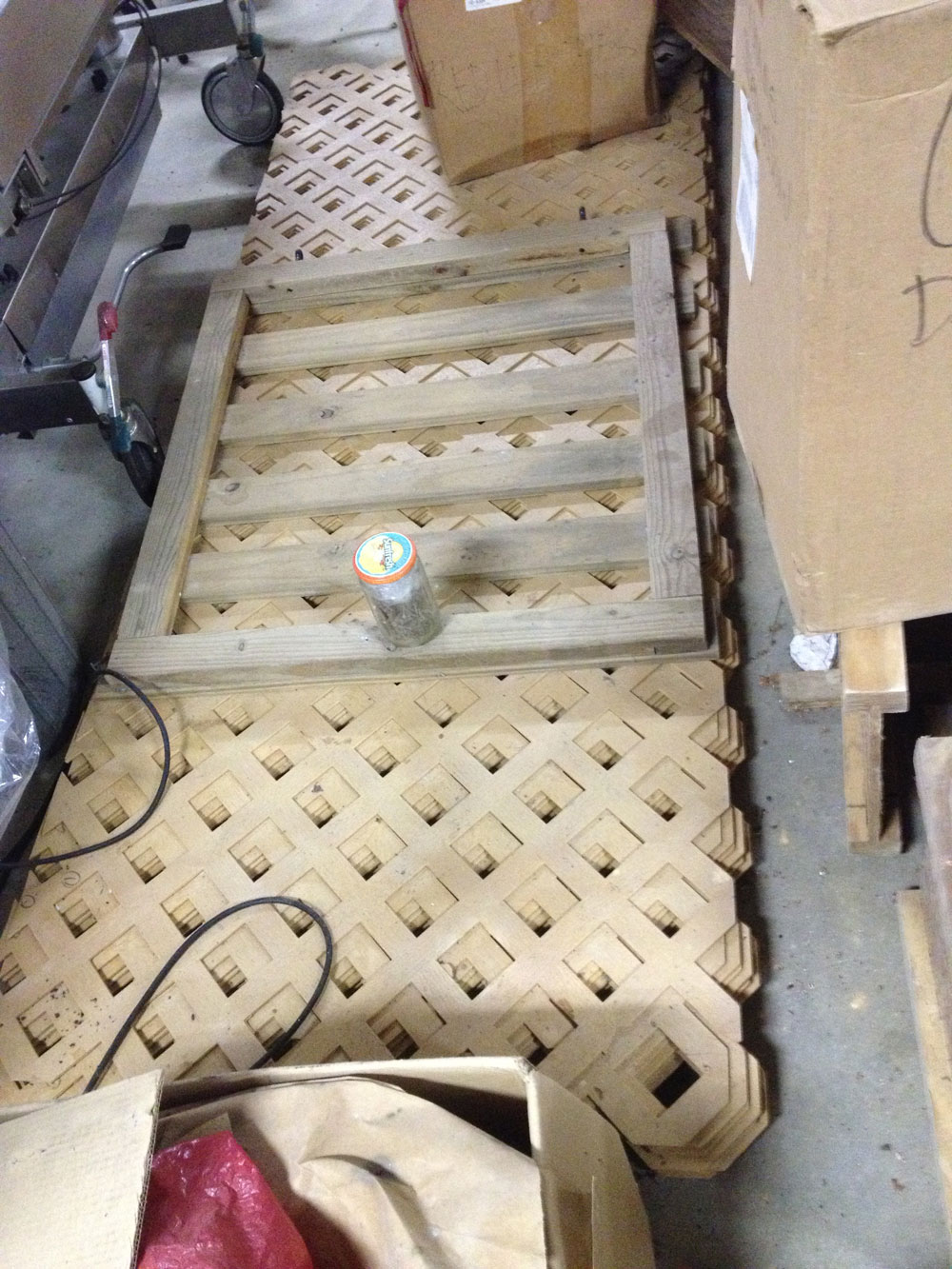
Since our house is 30 feet in the air and our deck rails have no balusters, before the grandchildren come I install PVC lattice that is numbered, pre-cut and pre-drilled for easy installation.  After I had a systematic method of removing the lattice from storage, installing it in the proper order, taking it down when the kids left and re-storing it, I wrote down the steps as I went, then typed them up while the steps were fresh in my mind.  Now, I can have one hundred linear feet of lattice up in less than an hour, de-installed and stored in 45 minutes.
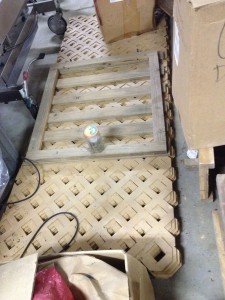
As the grandchildren have gotten bigger we don’t put the deck lattice up as often as we used to, so it tends to get other stored “stuff” on top of it.

As the grandchildren have gotten bigger we don’t put the deck lattice up as often as we used to, so it tends to get other  “stuff” stored on top of it.

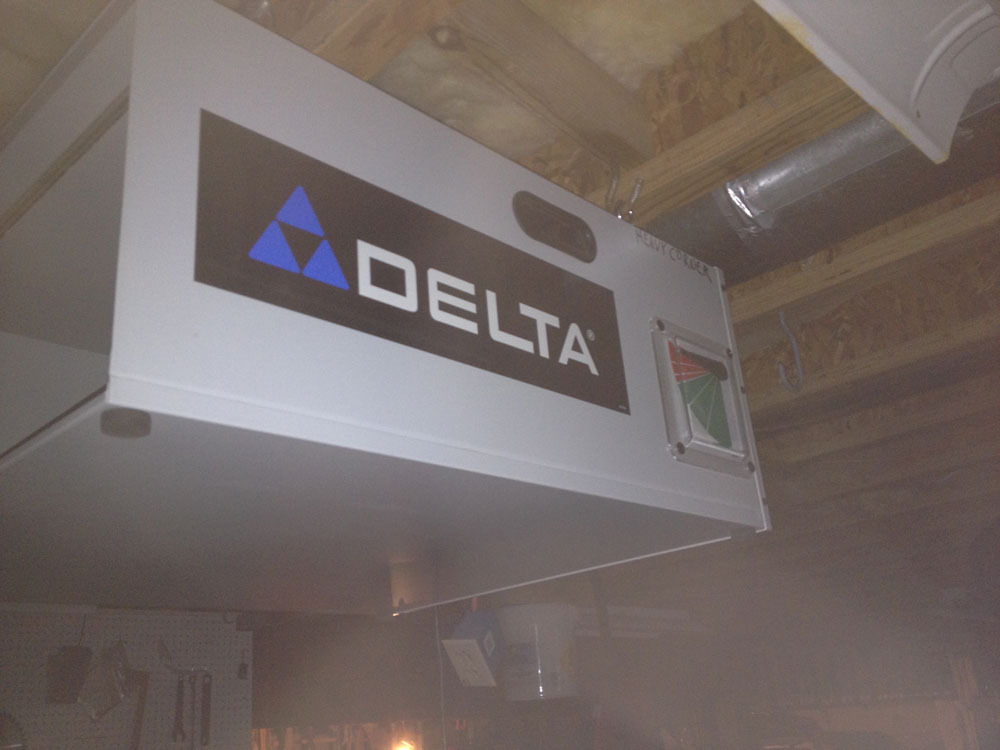
Sometimes I have a need to take the ceiling-mounted Delta air filter out of the shop and into the house.  Recently, we had new oak floors installed in our living room, and the filter made the experience bearable, while capturing untold quantities of dust.  But, the instructions that come with the filter suggest having two or more people to install it.  I have neither “two” nor “more.”  I did figure out, though, after hanging this filter twice, that there was an easy way and several hard ways to accomplish the task.  Having worked out the details, I typed them up and attached them to the filter for easy reference the next time the unit needs to come down.
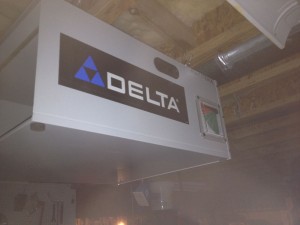
Mounting this air filter by yourself is a bear, but it’s not impossible. Once you figure out how to do a hard job, write down the steps so you don’t have to “learn” again.

Mounting this air filter by yourself is a bear, but it’s not impossible. Once you figure out how to do a hard job, write down the steps so you don’t have to “learn” again.

—-

Jim Randolph is a veterinarian in Long Beach, Mississippi. His earlier careers as lawn mower, dairy farmer, automobile mechanic, microwave communications electronics instructor and journeyman carpenter all influence his approach to woodworking. His favorite projects are furniture built for his wife, Brenda, and for their children and grandchildren. His and Brenda’s home, nicknamed Sticks-In-The-Mud, is built on pilings (sticks) near the wetlands (mud) on a bayou off Jourdan River. His shop is in the lower level of their home. Questions and comments on woodworking may be written below in the comments section. Questions about pet care should be directed to his blog on pet care, www.MyPetsDoctor.com. We regret that, because of high volume, not all inquiries can be answered personally.

Oct 052015
 

Roy Underhill is coming to Highland. Really.

Many years ago before DVR and tape players for TV, my wife used to get so mad because we had to schedule our Saturday afternoons around The Woodwright’s Shop. It used to come on in Atlanta about 2:30 on Saturday and even if we had gone to lunch somewhere, we still had to hurry and get home so I could watch it.

Last week when I told my thirty year old son I was going to a class with Roy Underhill, he said immediately without any prompt from me, “Oh, I wonder if his half brother is still around.” His remembrance was a proud moment for me, because that stupid joke must go back 25 years. Roy was demonstrating the use of a drawknife with a shaving horse, and as he pulled the knife towards his belly, he explained that you need to be careful to not pull it too far. That’s what happened to his half brother.

My other favorite thing is how he always cut himself on the show, Many times he would get in a hurry and slice his finger and then spend the rest of the show wiping blood off his work. I suppose to keep down expense, they tape the show straight through with no cuts or edits so they would never stop for him to put on a bandage. One time he even had his wife, Jane, on the show as a guest, and she cut her hand. Such devotion you hardly ever see these days.

You can see his 20 year retrospective on the show here. I recommend it to you.

Roy

Roy

On top of that, Roy’s daughter, Eleanor, is the banjo player (claw hammer style) in the Bluegrass Band called Underhill Rose. See what you think. I like them a lot.

All this to say Roy Underhill is coming to Highland on Sunday October 18th for a full-day class. The class size is limited to 25 and the cost is $95 for a full day. Be sure and sign up quickly, because you know this thing will sell out. I’m going to be there and I can barely wait. I am going to write down all the stupid jokes and pass them along to my son. It is time he got a new one.

Oct 012015
 

As many will clearly recognize, using powered drills with twist bits can at times grab the wood and very rapidly pull itself deeper than expected. With the recent Walnut table that I made for my son being almost complete minus attaching the base, I didn’t want to take any chances that all of my hard work could end up with a hole through the top.

The best scenario is to drill any needed holes using a Drill Press with the depth stop set appropriately. Unfortunately, the size of this table wasn’t really lending itself to using my drill press, so I came up with a jig that would easily prevent disaster. I chucked up the drill bit that I intended to use for the provided fasteners and made sure to leave that same bit in the drill with absolutely no adjustments to how deep the bit is in the chuck until all holes were drilled. This made certain that the jig I was creating would work as required.

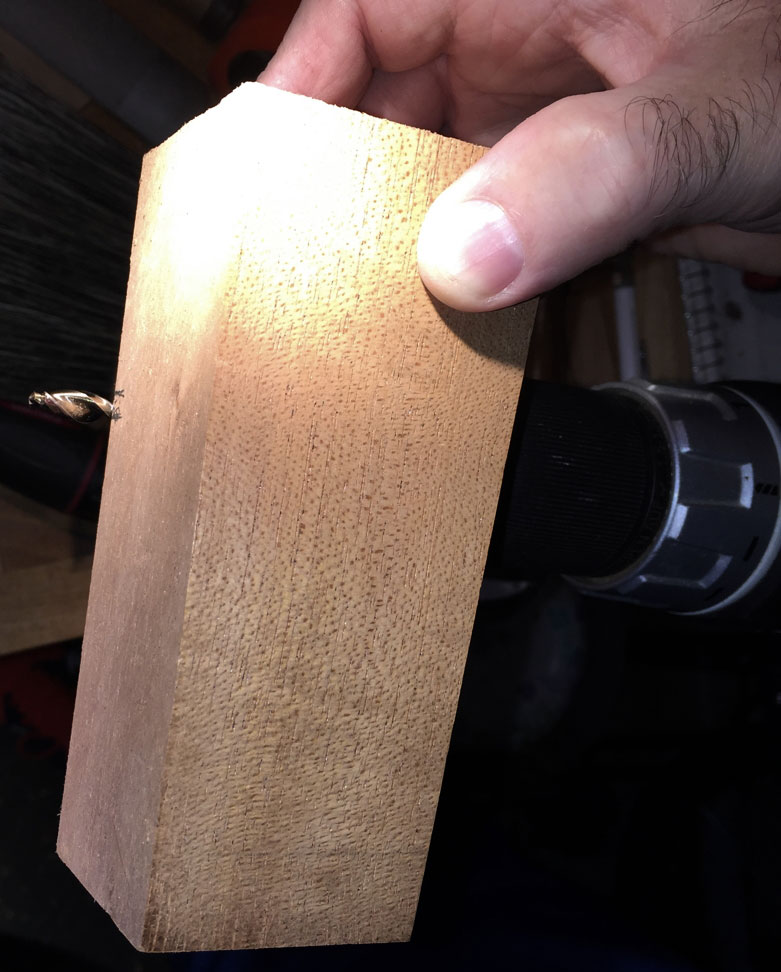
I found an off-cut of some Ash I used to build a draw bench a number of years ago. This piece had a gentle slope on one edge and the opposite edge was square to the end and both face sides. With the chuck against the sloped side, I moved my drill along until the drill bit protruded the amount that I wanted. I made a couple of marks on each side of the drill bit and brought them across to the sloping edge (see photo 1 below). I took my off-cut over to the drill press that had a bit just slightly larger than the one I had in my drill, so the pilot hole was just large enough for my drill’s bit to spin freely. With the square edge of my off-cut on the drill press table, I drilled the pilot hole all the way through.

Bit extending beyond the jig, just long enough for the screws, but too short to drill all the way through the Walnut.

Bit extending beyond the jig, just long enough for the screws, but too short to drill all the way through the Walnut.

I tested my new jig on a few scrap pieces of wood prior to using on my table, as I wanted confirmation nothing could cause it to fail. It proved to be rock-solid, which kept me moving on the build with no extra trips to buy accessories.

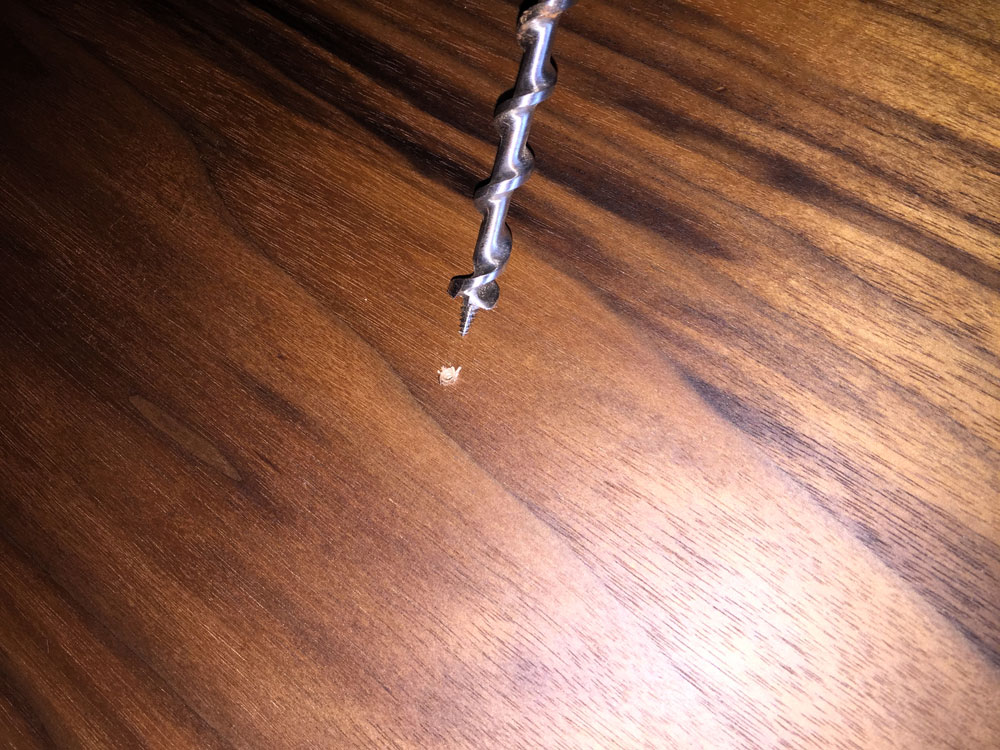
With the location of all six mounting holes marked with an awl, I followed with a hand-powered drill and a bit just large enough to capture the special lead tips on my DeWalt bits.

2

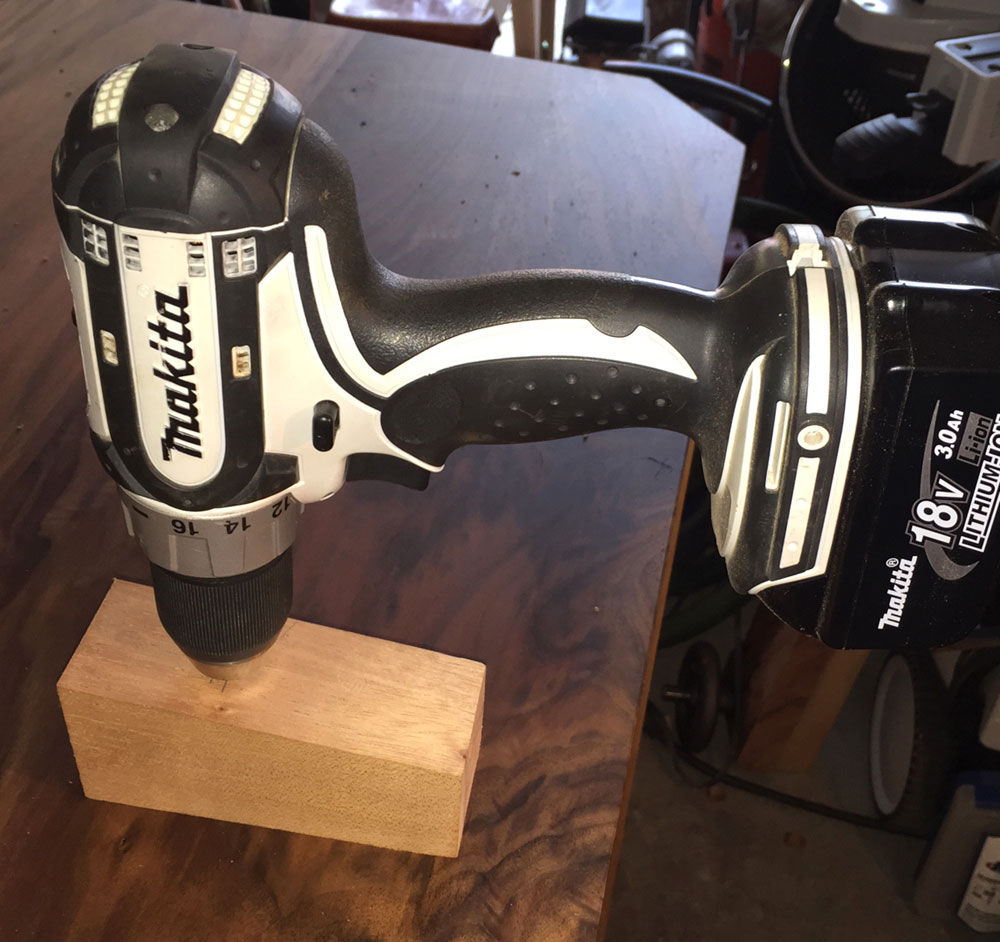
With this accomplished, I centered the jig over each hole, and while holding my new jig so the bottom edge was flat on the table, drilled down until the chuck on my drill contacted the wooden jig.  Since I drilled the hole through the jig at the drill press, and my press is setup to drill at a right angle, all of the mounting holes were the correct depth and perpendicular to the table’s surface.

Drill at full depth, with the sole of the jig flat on the table’s surface.

Drill at full depth with the sole of the jig flat on the table’s surface.

There are a number of different types of accessories available that can limit the drilling depth, and some work quite well, but I’ve personally experienced a few depth-stop designs that slipped during use, and of course happened to occur at the worst time possible.

I hope you decide to give this jig a try, or perhaps it will give you an idea for a jig of your own design. Thanks for checking out my article. Please let me know if you have any questions or comments.


Lee Laird has enjoyed woodworking for over 25 years. He is retired from the U.S.P.S. and worked for Lie-Nielsen Toolworks as a show staff member, demonstrating tools and training customers. You can email him at LeeLairdWoodworking@gmail.com or follow him on Twitter at twitter.com/LeeLairdWW

Sep 252015
 

During my recent build of a 4’ Walnut Table for my son, I needed some extra space to work, as well as a place to leave the table horizontally after applying finish. I made a pair of saw horses (even though the name may be mostly correct, this style of horse is just so much nicer than what I see in my mind when thinking about a saw horse) a number of years ago, and since the majority of my woodworking has been with smaller boxes and musical instruments, they’ve been static a good portion of this time.

After gluing the top together the next operation (for which I needed to use the horses) was sanding the table, and as I was flipping from one side to the other (and this was with me being as careful as is possible), I noticed some light denting/abraded areas. In this early stage of working the surfaces it certainly wasn’t the end of the world, but if these same types of issues occurred after a final sanding or after finish was applied, I’d be very upset.

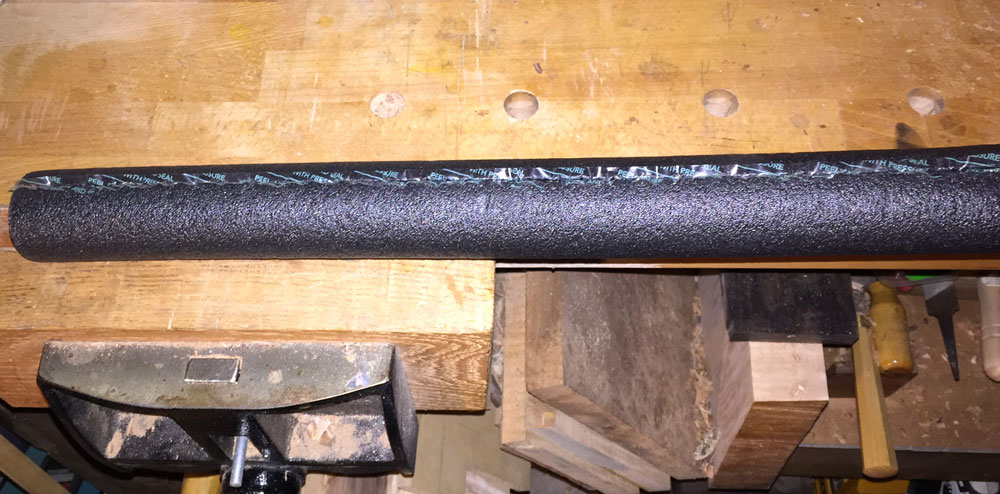
I looked around the shop to see if I had anything other than an old towel that I could secure over the hard edges of the horses. After a few minutes, I remembered I had an extra foam water pipe-insulation sleeve stored on a shelf.

Waterpipe insulation.

Waterpipe insulation.

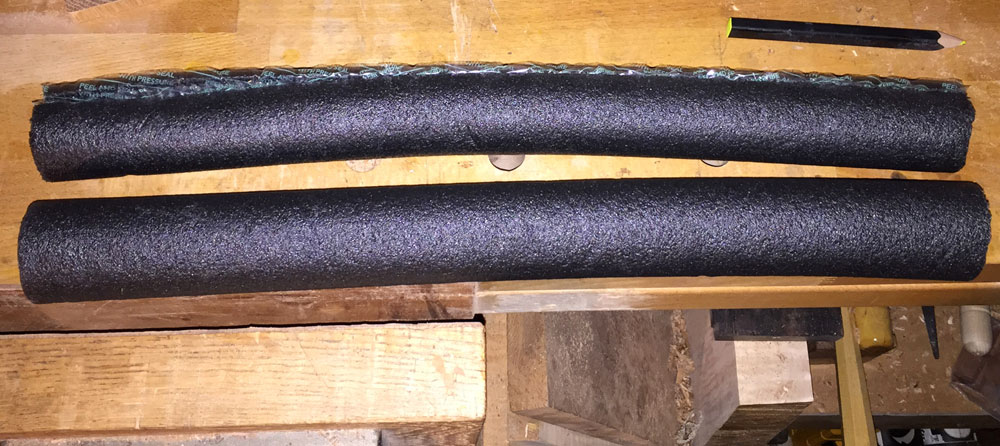
I got it down and it was one that had some fairly dense foam, compared to some I’ve seen that were a bit more open-celled. After holding the sleeve up to the horse’s rails I could see I had enough to cover around ¾ of both horse’s rails. I used a utility knife to cut it in half at its midpoint, which left me two pieces of the same length.

Insulation cut into two equal lengths.

Insulation cut into two equal lengths.

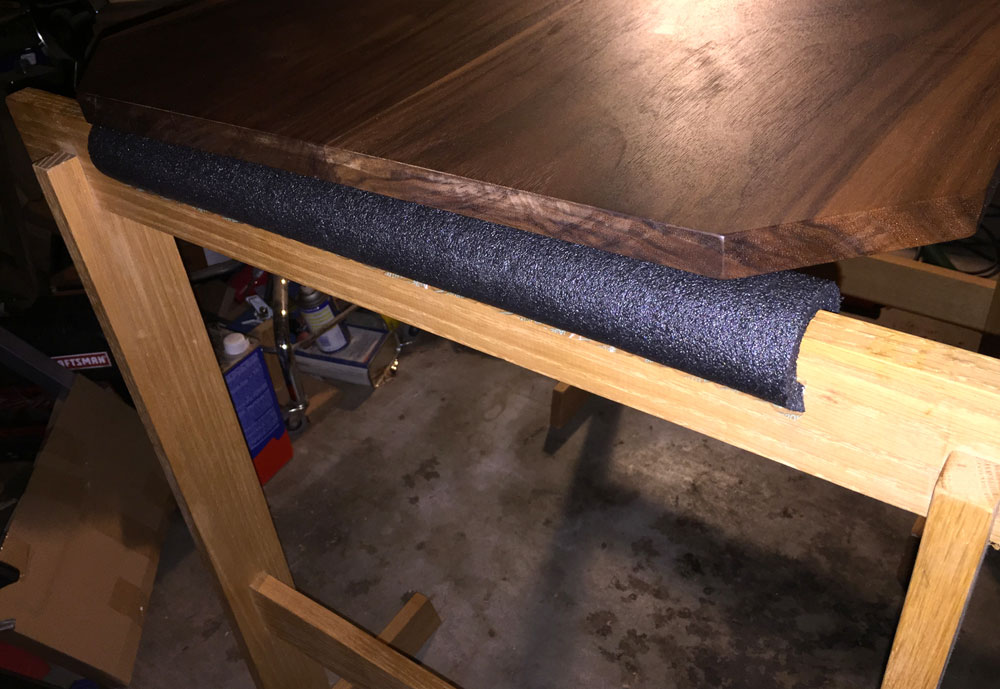
After placing the two respective pieces on their horses, I put the table on it to see how it behaved. Everything felt nice and solid, and it was obvious there was a nice amount of protection.

Table shifted to better show the insulation in place.

Table shifted to better show the insulation in place.

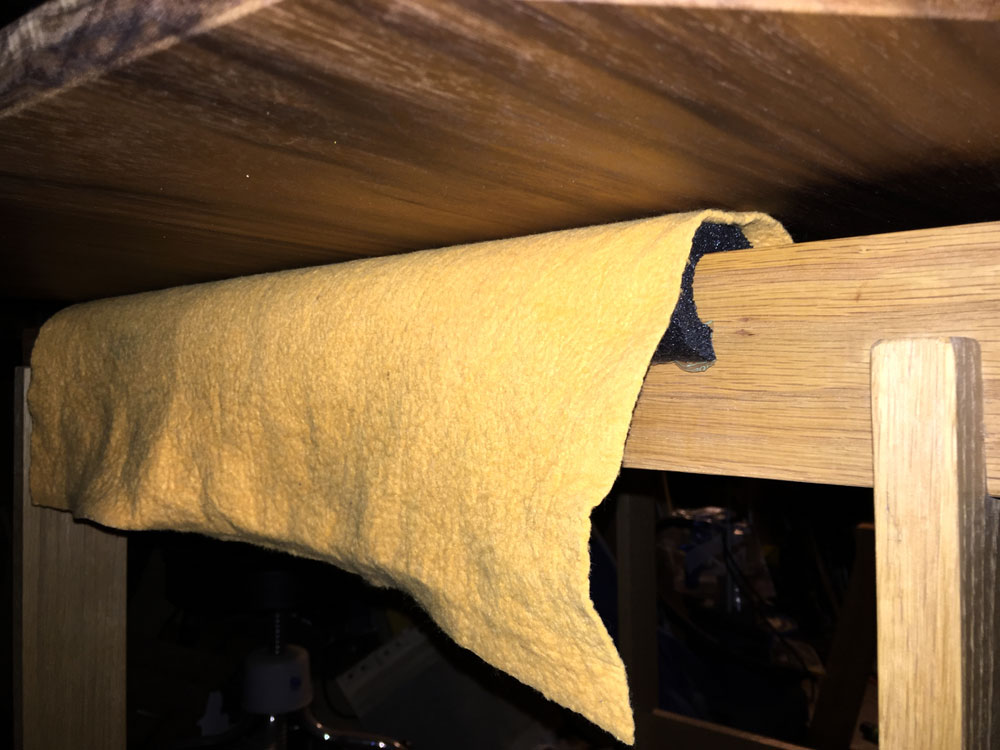
Since I planned to use an oil finish on the Walnut table and I wasn’t sure how that might directly interact with the foam (even after drying to the touch), I found I had an un-used Shamwow (sold at many places as a replacement for a leather chamois) and when I checked its dimensions, it was almost exactly what the size I needed. A quick split down the middle and I was able to lay the material over the foam and lightly tack it on the bottom of the horse’s upper rail. The Shamwow doesn’t have much lint, so I was comfortable using it for the short term, but I may decide to change the cover to lightweight leather in the future. We’ll see how the current material holds up and behaves with what is presented to it.

Shamwow laying across the insulation, prior to tacking it to the rail.

Shamwow laying across the insulation, prior to tacking it to the rail.

The padding and cover for the padding I’ve talked about are both options, but you could easily replace them with alternate materials, like using towels or old shirts as the padding, and then cover it with something that won’t interact with the products you are likely to apply on your projects.

I hope you enjoy this article and might try it yourself. Please let me know if you have any questions or comments.


Lee Laird has enjoyed woodworking for over 25 years. He is retired from the U.S.P.S. and worked for Lie-Nielsen Toolworks as a show staff member, demonstrating tools and training customers. You can email him at LeeLairdWoodworking@gmail.com or follow him on Twitter at twitter.com/LeeLairdWW

Sep 232015
 
This is the second installment about Project CreepClick here to read the first installment.

This job started out as a handrail for a deck on our home.  Simple enough.  Quick enough.  Doesn’t need to be fancy.  Then, project creep said, “Why not practice fine furniture techniques while making the handrail?”  That turned into the first level of project creep from the last blog post, making nice dado joints.  The second level was making even nicer dado joints.

If I were going to do that, a whole new project was going to have to happen.  As luck would have it, the monsoon we had been experiencing was still going on, so indoor work was indicated anyway.

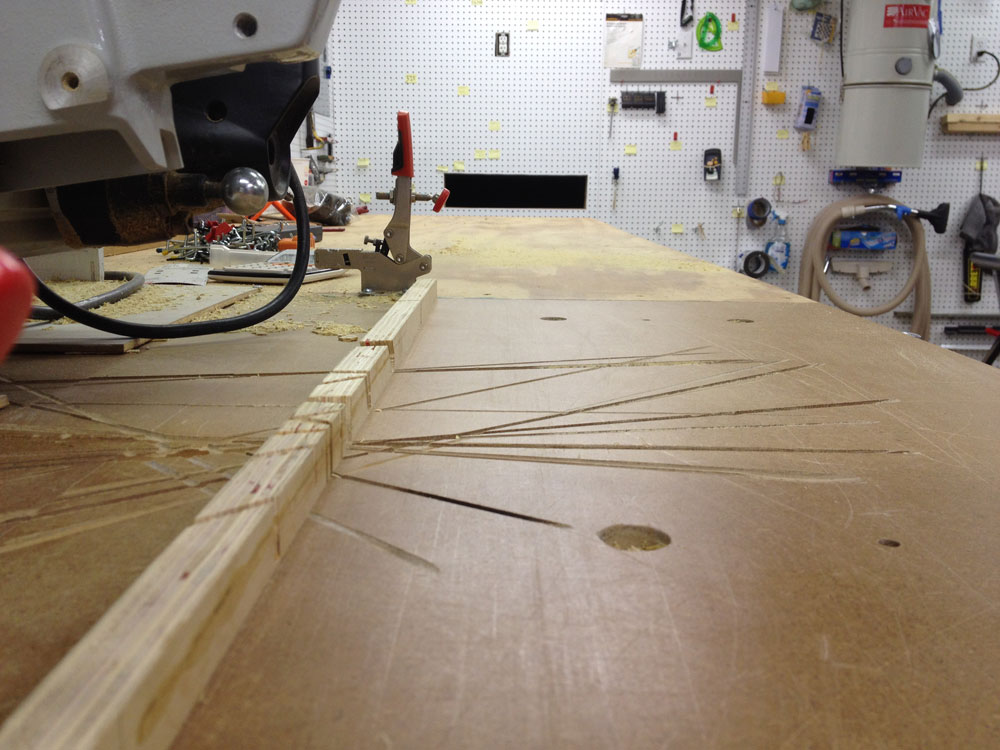
As stated in the first post, the longest measurement from the radial arm saw blade to the wall was about 13′.  The 20′ 2x4s were about 20’2″.  For the dado blade to cut a half-lap all the way to the end of the board would require a hole in the wall.  I’ve seen stories about woodworkers with garage workshops who cut holes in their homes’ walls to accommodate long boards.  One fellow fenestrated the wall into his laundry room for the purpose.  He made a little flap of a door to close off the passageway when he didn’t need it, in order  to keep out dust and noise.  Fortunately, my hole just had to go from one side of the garage to another garage area.  No family meeting required.

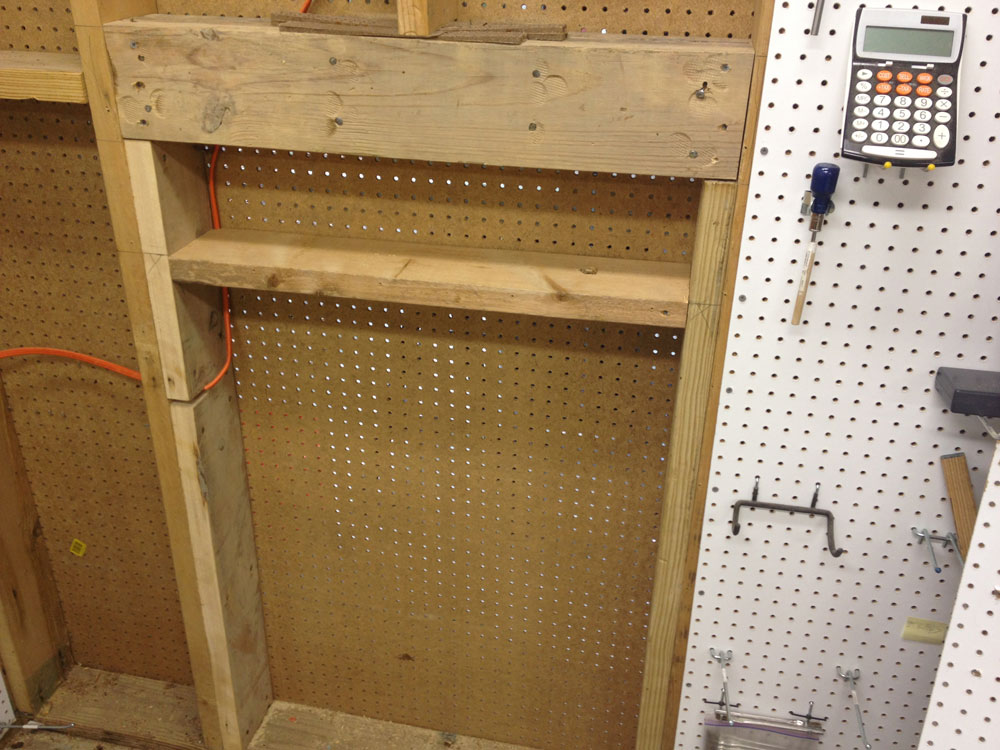
What was required, however, was support for the “missing” part of the wall because it is a  2×6 wall supporting the entire middle of the house!  So, I fashioned a header from three 2x6s, jacked up the top plate temporarily, installed a pair of jack studs under the header, framed in a rectangle and I was ready to go.
I didn’t see any reason to put the pegboard back on until the opening has been used several times, just in case I need to modify it. It’s big enough to accept a 2x12 or 4x4, just in case I ever work with bigger long boards. I also allowed a little extra room because sometimes wide and/or long boards can be unstable, and may bend off to one side, or have twist in them.

I didn’t see any reason to put the pegboard back on until the opening has been used several times, just in case I need to modify it. It’s big enough to accept a 2×12 or 4×4, just in case I ever work with bigger long boards. I also allowed a little extra room because sometimes wide and/or long boards can be unstable, and may bend off to one side, or have twist in them.

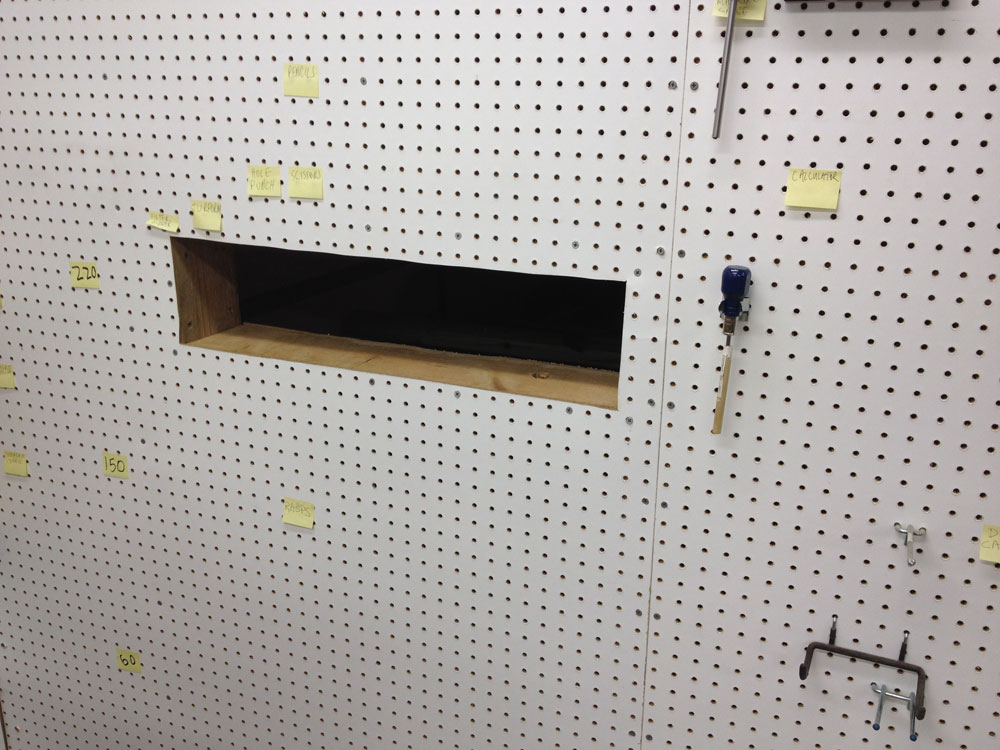
The bottom lines up with the top of the saw table.

The bottom lines up with the top of the saw table.

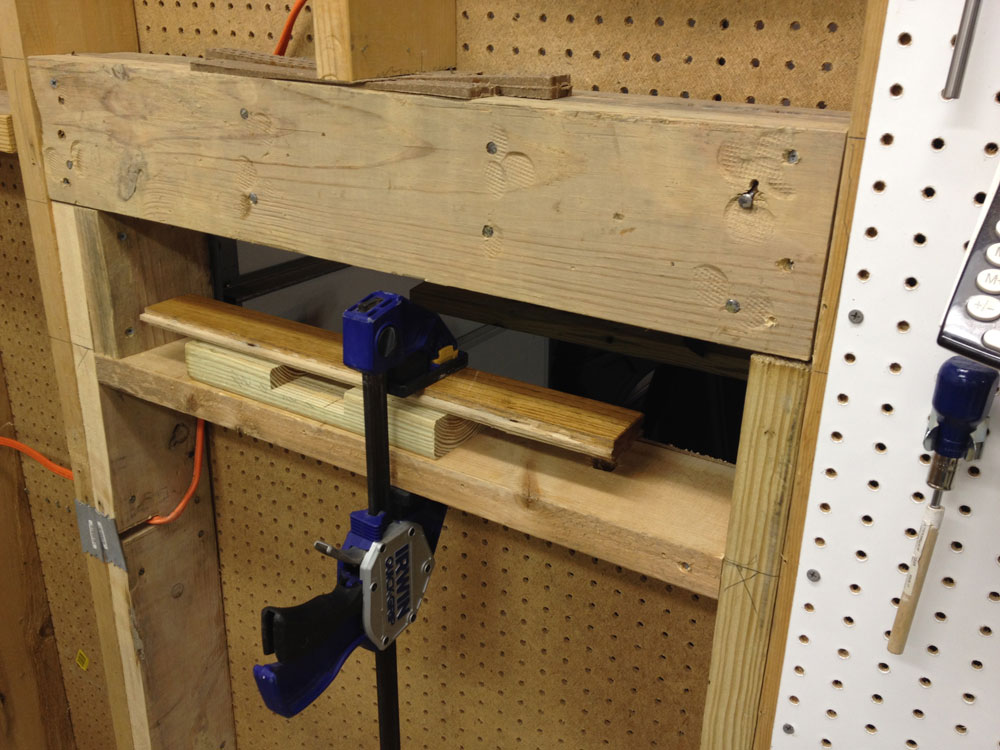
It is not unusual for long boards, especially fast-growing treated pine, to be crooked and/or twisted.  For that reason, sometimes lifting the end opposite from the end you’re working on will help the “business” end lie flatter.
In this case, lifting the “other” end of the board, 1½” wasn’t enough and 3" was too much, so a piece of oak flooring on top of a 2x4 was just like the Little Bear’s soup, as my Uncle Sam used to say.

In this case, lifting the “other” end of the board, 1½” wasn’t enough and 3″ was too much, so a piece of oak flooring on top of a 2×4 was just like the Little Bear’s soup, as my Uncle Sam used to say.

Nearly finished now, with both the handrail and the pass-through, I would have to say this case of project creep had a happy ending.  The wall space I gave up was affordable, on both sides of the wall and I gained the ability to work with nearly unlimited-length materials at the same time.
blog4

My wife likened the completed opening to the food pass-through in a jail cell door. Time ran out for the blog deadline, but I will paint the exposed wood surfaces white and put everything back on the pegboard. Assuming I can figure out where everything was! I would have stopped to take a picture before taking everything off, but, as I said, I was on a deadline.