Highland Staff

Sep 092011
 

For September we have a couple new BRAND NEW video product tours on our Youtube channel!

This month, Morton starts with a thorough review of the setup and use of one of the more versatile tools you can have in your shop – the Rikon 14″ bandsaw. Take a look here:

Next, Morton takes a look at the Highland Woodworking Woodslicer resaw bandsaw blade in three different lengths, and compares its usage across a range of Rikon bandsaws, including the 10″, the 14″ and the 18″ models. Check it out:

Sep 062011
 

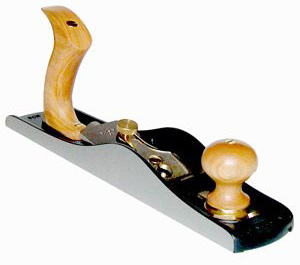
I regularly visit with the customers who attend our Lie-Nielsen events around the country. We have a wide range of attendees, from the well-seasoned woodworker checking if we’ve released a new tool (so they can keep their sets complete) to the new woodworker. We often hear the same question from this latter group: “What is the first plane I should buy?” I like to discuss a customer’s interests and current tools at length so I can provide the best answer. Some who ask this question truly are looking for their first plane, while others are looking to find the best bang for the buck. Many times, both groups will end up finding the #62 Low Angle Jack Plane as a good fit for their needs.

The #62 can be a chimera of sorts, in the plane world. The plane iron is bedded at 12 degrees with the bevel up, and the mouth is easily adjustable, all features recognizable in a Low Angle Block Plane. The length of the plane (14”) kicks it into the Jack Plane category. There are three types of irons available (one standard iron comes with the plane), the standard iron with a 25 degree bevel, the toothing iron and the scraping iron. The low bedding angle of the iron provides excellent end grain planing, with a standard iron honed with a 5 degree micro bevel, finalizing at 30 degrees. With this setup, and the addition of the Hot Dog handle, shooting the ends of boards to that final fit is extremely easy and comfortable. Using the same style standard iron, you can add in some camber and open up the mouth to handle a thicker shaving, and you’re ready to handle some quick stock removal. The toothing iron, with all of its little teeth, works wonderfully on highly figured or crazy grained wood. Since the iron has lots of small teeth, it can remove material without the tendency to dive down into the grain. The surface left by the toothing iron is not what most associate with planing, as it is rough, yet flat. If you follow up use of the toothing iron with a freshly sharpened standard iron, honed at an angle between 30 and 45 degrees, you can make that instrument grade curly maple look like it belongs on that exquisite table/chest of drawers or even high-end guitar. Some woods might not need the extra “toothing” attention, but could still use more than the standard iron alone. For these, the scraping iron can be just the tool for the job. With the low bedding angle, the scraping iron doesn’t sit in the plane like most dedicated scraping planes, but it still presents its edge to the wood in a manner that does a great job.

With the capabilities of the #62, from heavy wood removal in the early stages of stock prep, to finishing wood with a glassy smoothness, to shooting end grain, this is one of the most versatile planes around. If a customer works on smaller scale projects, the length of the #62 could also flatten the wood sufficiently, without the need for a full-sized jointer. Those that are looking for the “most bang for their buck” will easily see why purchasing a #62, along with the additional irons and Hot Dog handle, can make a lot of sense. Even those that don’t think they’ll need the toothing and scraping irons, might include an extra standard iron to keep honed at the higher 45 degrees. This will expedite going between mild grain work to the extreme grain with nothing more than an iron swap.

I hope to see some of you at our events this season, listed on the Lie-Nielsen website.

To take a closer look at the low angle jack plane, click here.

To see Highland Woodworking’s entire selection of Lie-Nielsen hand tools, click here.


Lee Laird has enjoyed woodworking for over 20 years. He is retired from the U.S.P.S. and works for Lie-Nielsen Toolworks as a show staff member, demonstrating tools and training customers.


Aug 162011
 

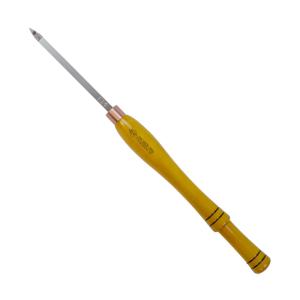
I am working my way through the rest of the Easy Wood Tools products.  This month I tried the Easy Detailer while turning a spindle and making a bead and cove with some other details which one might use while making a candlestick or a Windsor chair leg or a stair spindle.  It works like a champ.

I started with a piece of rough limb which had been lying around the shop for a good while.   It was very dry and still had the bark on it, so I squared off the ends on the chop saw and then punched a hole in each end with the awl to give the drive head and the live tailpiece a place to bite.  I mounted it in the trusty Oneway and turned the speed up pretty fast once I found it was balanced.  As you can see in the attached video, I rounded it off with the Easy Wood Tools Full Rougher, which is turning into my tool of choice when I need to rough something out quickly and easily.  It is certainly my preference over a large roughing gouge since it does not bounce around when cutting and I don’t have to worry about sharpening.   If it gets dull, simply rotate the tip to another side and keep on cutting.

Watching the instructional videos on the Easy Wood Tools web site is the best way to learn to use the tools.  I was interested to see how they use the Easy Rougher to start making a bead and/or a cove by using the corner to start a groove.  You know already my apprehension about skew chisels and using this tool to start a groove is certainly a better option than my skew technique.

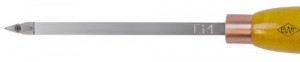
After getting a bead or a cove started, the Easy Detailer is a marvelous tool.  It has a slightly rounded point at the end of a triangular cutting head and lends itself nicely to making coves and beads.  I was able to dig pretty deeply into a cove and the only limitation was the size of the tool.  They make a smaller one which would be really nice on a finely detailed candlestick, for example.

All in all, the Detailer is a fine tool and very easy to use.  In addition, the Easy Finisher has a round cutter which may fit the bottom of your cove and make cleaning up any roughness a real “easy” task.

Take a look at the video attached and see if the Easy Wood Tools from Highland fit your needs.  Give them a try, and I feel sure you will like them.

Aug 022011
 

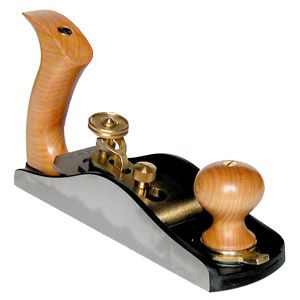
OK, so what plane do most people think about when someone mentions a smoothing plane? A #3 or #4 seems to be most common, but the “smoothing plane” moniker does reach from a #1 on up to the #4-1/2. All are good planes, but there is another choice that is often overlooked, and it just happens to have a bit more flexibility, as well. The plane I’m referencing is the #164 Low Angle Smoother.

The #164’s iron is ground at 25 degrees, and is bedded at 12 degrees with the bevel up. This configuration is ideal for planing end grain, but can do so much more. Many times I will utilize this same configuration of honing angles to plane reasonably straight face grain, with good results. If I start to encounter some difficult or crazy grain, increasing the honing angle of the iron can easily resolve any tearout. Specifically, honing the iron with a 45 degree bevel, which along with the bedding angle, will present a 57 degree cutting angle, resolves many issues with crazy grain. One other feature on this plane that makes a huge difference is the adjustable mouth. This feature allows the end user to dial in the ideal balance of fiber support and chip clearance.

If you are working to flatten a board with very figured grain, another alternative is to use a specialty blade – the toothing blade. The toothing blade has a large number of very small teeth (.030” wide and .030” between teeth) and due to this configuration, does not have the tendency to dive into the grain, like normal irons can. As you might imagine, after using a toothing blade, the wood surface is rough even though the wood has been flattened. You will want to follow up with a freshly sharpened standard iron to finalize the surface. There is one more specialty iron available for the #164. The 90 degree scraping iron. This still beds at the same 12 degree angle, but the edge of the blade is presented to the wood in a scraping orientation, and even though it looks different than many scrapers, works very well.

When I write about sharpening plane irons, there is usually very little difference between one plane and another. The #164, however, has a very unique and sweet blade adjustment system. When preparing the iron for the #164 for the first time, there is one thing you’ll want to do before sharpening/honing. There is a small metal plate attached to the top-side of the iron. This plate interfaces with the overhead Bailey type iron adjuster, and its placement is critical for proper function and retaining the intended full adjustment range. To ensure the plate is the same distance from the cutting edge every time you sharpen, create a reference block on a piece of MDF. To set the block in the correct location, take the iron/plate combo out of the plane, and lay the iron on the MDF. Place it with the bevel facing down towards the MDF, the cutting edge of the iron towards the block, and the non-sharp end off the edge of the MDF. From this position, gently slide the iron forward until you feel the edge of the metal plate, closest to the cutting edge of the iron, make contact with the edge of the MDF. Since the metal plate protrudes slightly, it is easy to feel when the two meet. Now slide the stop block gently up against the cutting edge of the iron. Attach the block in this position, using whatever method available to retain this exact position. I have successfully used a small amount of superglue, on the bottom of the block, to initially hold it in place. Following this, I will use a couple of screws to make the connection solid. Pre-drilling the holes in the stop block is usually a good idea, so there is less chance of splitting the wood. I’ve written elsewhere in this blog about general sharpening. Take a look at that post for more info!

When I work with the #164, I prefer to have a couple of the standard irons, with one honed at 30 degrees and the other at 45 degrees. This expedites the change from end grain work to crazy grain work in moments, by simply swapping out the irons. Then, based on the work, the specialty irons can add to the effectiveness of the #164, getting more bang for the buck, and widening the flexibility of this single plane.

I hope to see some of you at one of our upcoming events, listed on the Lie-Nielsen website.

To take a closer look at the low angle smoother, click here.

To see Highland Woodworking’s entire selection of Lie-Nielsen hand tools, click here.


Lee Laird has enjoyed woodworking for over 20 years. He is retired from the U.S.P.S. and works for Lie-Nielsen Toolworks as a show staff member, demonstrating tools and training customers.


Jul 132011
 

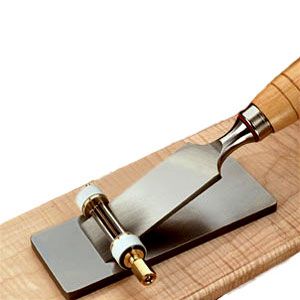
I’ve written elsewhere in this blog about general sharpening. (For example, read “Why Doesn’t This Plane/Chisel Work Like It Should??”). This article will focus on a special honing guide for handling some of the blades/irons that don’t play nice with my usual guides.

I have a couple of new spoke shaves, both of which need an initial sharpening. With the length and width of the irons, they require special attention. If you aren’t using a micro-bevel, hand sharpening is at least within the realm of possibility for many. The bevel is fairly wide, with the iron ground at 25 degrees, so it’s not too difficult to feel whether you are riding the bevel. Since I do utilize a micro-bevel, to minimize the time I spend sharpening, I started looking for a new honing guide compatible with these irons (as well as some other irons/chisels).

I read about a couple of interesting honing guide designs made by Richard Kell.  Both are very similar, with the only difference in the maximum blade holding width. The smaller version will hold chisels/irons up to 1” wide, where the large version will hold items up to 2-5/8” wide. Both versions have two separate wheels that ride just wider than the work being held.  The wheel configuration does limit the guide’s ability to apply a camber. Since my primary intended usage is in sharpening the spoke shave irons, I knew the iron’s width demanded I have the large Kell honing guide. Even with the larger capacity, I can still use this guide to sharpen even my narrowest chisels. With this information, some might question why anyone would buy the smaller guide. On extremely narrow blades/irons, the shorter guide rails of the small version may feel less cumbersome to some, but this is a personal preference.

The Kell guides are unique in that they utilize the guide rods as a reference surface, with the iron/blade riding below them, and the bottom surface against the rods. This can be a benefit if the top surface isn’t parallel to the bottom surface. Many other honing guides hold the iron in the opposite orientation. Just next to the inside surfaces of the wheels, there are replaceable polycarb washers. These washers are what directly contact the outside surfaces of the iron/chisel when clamping. These units place adequate pressure to the iron/chisel, with only hand tightening. Each Kell honing guide comes with a instruction sheet, including data relating to sharpening a range of angles. The data specifies how far the iron should project for each angle. I like to make quick-reference blocks so I can set the projection exactly the same each time. When making my reference blocks, I first set my iron so it rubs the whole bevel when touching the stone. For my irons, the projection distances required just a bit of tweaking to match exactly. Once I have it right on, I put the iron over the edge of a piece of MDF. I then apply some super glue to what will be the bottom surface of my reference block. I put the block up against the leading edge of the iron, and hold it until it is set. This first one is for 25 degrees, so I can refresh the grinding angle, after the micro-bevel has grown with multiple sharpenings. Next, I repeat this procedure for my 5 degree micro-bevel (30 degrees total), on the opposite side of the MDF.

For the actual sharpening techniques, read “Why Doesn’t This Plane/Chisel Work Like It Should??” for a thorough explanation. I still use the same 1000/8000 Norton waterstones for both the micro-bevel (and primary bevel when needed) and removing the burr from the back.

The Kell honing guide is quick and easy to use, and provides repeatable results. I’ve used the guide on some of my Japanese chisels and plane irons, too, with good results. So far I’ve not found any detracting features that would prevent a positive recommendation.

I hope to see some of you at one of our upcoming events, listed on the Lie-Nielsen website.


Lee Laird has enjoyed woodworking for over 20 years. He is retired from the U.S.P.S. and works for Lie-Nielsen Toolworks as a show staff member, demonstrating tools and training customers.

To watch an excellent demo video of the sharpening process, click here.
Check out the great selection in Highland Woodworking’s sharpening department.


Jul 122011
 

From the publishing schedules and tables of contents of the woodworking magazines it would seem we woodworkers are expected to slow down and shift gears in the summertime. We are expected to be gardening, golfing, fishing, or, if we build anything at all, it is supposed to be deck furniture, gazebos, or lawn games. Don’t despair, however, it’s summertime, and as DuBose Heyward wrote and George Gershwin set to music in 1933-34, the “livin’ is easy.”

Summertime,
And the livin’ is easy
Fish are jumpin’
And the cotton is high

Your daddy’s rich
And your mamma’s good lookin’
So hush little baby
Don’t you cry

No doubt there are plenty of summer distractions for us woodworkers. The lawn must be mowed, the garden tended, and the lure of the biking and hiking trails is strong. Golf clubs and fishing poles call our names and beg us for outings. But hang in there and “hush little baby, don’t you cry,” ’cause summertime can also be awesome shop time.

Sunshine & Air

Supreme Court justice Louis Brandeis’ advice that “Sunshine is the best disinfectant” is often quoted but seldom followed in our nation’s capital. Here in the North Country where we seem locked in a multi-month state of constant cold, rainy, and overcast conditions, we have no evidence that the judge’s advice is true either. Yet, as best we can remember, sunshine is a wonderful disinfectant.

If you are lucky enough to have some sunshine this summer, fling open those shop windows and doors! Roll your equipment out and maybe do a little springtime cleaning. I read about one woodworker who opens the door on his shop when the weather gets warm and blasts it clean with a leaf blower. Your shop may not need disinfecting, but a little sunshine and fresh air won’t hurt!

For me, summer is a great time to do some equipment maintenance. Clean, lube, sharpen, and calibrate machinery. The things you can see in the bright sunshine may surprise you. Sort all the hardware and fasteners that have accumulated. A pleasant way to spend an hour or so is sorting screws while sitting on the deck sipping your favorite beverage. Have a driveway sale and clear out unused tools and gadgets. Need to strip a finish? It is so much more pleasant to do that nasty, smelly job outside. Want to run your belt sander over the top of your workbench? Let the wind take away the sawdust in the wide, open spaces. All those wood chips and sawdust you collected over the winter will make great compost or mulch, so get to work. Best of all, just let the sounds of summer envelope you as you quietly plane a board to perfect flatness.

Summer brings out the neighbors. Passersby may take a peek into your shop, and with a little luck, may be intrigued. Your summertime woodworking may start another soul down the path of this outstanding hobby.

Stock Up On Materials

Buying wood is almost always fun. Combing through the stacks, looking at boards, imagining the pieces and placement in your next masterpiece is all part of the excitement of woodworking. But for those of us in snow country, the wintertime buying experience is fraught with potential for turning a normally pleasurable experience into at best an ordeal, and at worst, a misadventure.

Clearly I remember the day last winter when I purchased some stunning black walnut. The looking and buying experience was great…the loading and unloading experience, not so much. By the time I kibitzed with the guys at the mill for an hour or so, spent an hour or so picking my boards, and drank coffee for another hour with my buddies, the weather had taken a turn.

I loaded long, wide 10/4 boards into my truck in 35MPH, 20 degree wind blowing thick snow. All the way home I faced the dual worries of (bad) slipping off the road and (worse) damaging my new boards. My stress was exacerbated when I got home and couldn’t get into my drive or unload my lumber until I shoveled what, by then, was a foot of snow. Boards that might normally take a couple of days to acclimate took several days just for the snow and ice to melt and to dry out. Summertime is a much better time to stock up on wood for all those winter projects that are noodling around in the back of your head; and with a little luck, you may even get a bargain since most other woodworkers are busy doing “summer stuff.”

Summertime can also be a great time for tool buying. Many people start to conduct and to shop garage and estate sales in earnest when the weather improves. Many retailers run promotional sales, since traditionally wintertime is shop time and the summer business is slow. Take advantage of the slow business season for your favorite supplier. In addition to that shiny new power tool, stock up on glue, finishing supplies, and sandpaper.


One of these mornings
You’re going to rise up singing
Then you’ll spread your wings
And you’ll take to the sky

But till that morning
There’s a’nothing can harm you
With daddy and mamma standing by

Do Something BIG to Improve Your Shop

Constantly tweaking, rearranging, and generally “perfecting” your shop? Then summer is a great time to make major changes. Add a window, replace a door, or just go ahead and knock out that wall and add on – you know you have been wanting to!

A friend of mine is plumbing his walls for air and adding a central air compressor. Another is changing from portable dust collection to a big, more sophisticated central dust collection system with all its attendant pipes, blast gates, and fancy remote controls. One guy has pulled everything in his shop out into the driveway, covered it all with a big tarp, and is epoxy coating his concrete floor. Summertime is great shop expansion and rejuvenation time!

Keep on Woodworking

Most of all, summertime is a great time to just keep on woodworking. Although now in late-June we still have the heat on where I live, at least in many parts of America you can work comfortably in your shop this time of year. The fresh air and summer breezes will likely help to oxygenate your creative brain cells, and new ideas will abound.

There are practical reasons to not take a summer hiatus, too. It seems that almost every year I belatedly give shop-crafted holiday gifts about a month late. Planning on giving a gift of your craftsmanship this winter? Start early (like now) and make sure you have plenty of time to get the project finished. One year I had to warn everyone to let their gifts sit for a while, preferably in the garage, before they used them – the finish wasn’t fully cured.

If summertime woodworking makes you feel guilty about all those outdoor projects languishing on the to-do list, don’t despair. You have always been creative enough to get a new tool purchase past your frugal spouse…you can probably figure out a way to justify hiring someone to clean the gutters, trim the bushes, or paint the house. How much do you love woodworking? If you figure paying the kid down the street a few bucks to mow your lawn is stimulating the economy and giving you more shop time, you are an avid woodworker. If the grass grows to the point the neighbor mows it for you, you are obsessed, and we are undoubtedly kindred spirits.

It’s summertime, and I think the magazines all have it wrong. Summertime is prime woodworking time!

Summertime Memories

Figure 1 – Sam Cooke

By the way, if the Porgy and Bess tune “Summertime” is conjuring pleasant memories, download a few versions of the song and give them a spin while you do something enjoyable in your shop. It seems almost everyone has recorded this song at one time or other (from Billie Holiday to Willie Nelson and Ella Fitzgerald to The Zombies), and almost any version is guaranteed to put you in a good woodworking mood.

Figure 2 – Janis Joplin

Need a recommendation? No music collection is complete without the Sam Cooke version, of course, but my current faves are alternating between the jazzy scat-infused Billy Stewart version (that man had soul and definitely felt the music!) and Janis Joplin’s bluesy, earthy, and dare I say it, sensual version. By the way, Janis’ version has some of the most raw and gutsy guitar work I ever heard on any Joplin song. I only wish I could have seen her perform it live.

Figure 3 – Billy Stewart

This article was originally published in The Down to Earth Woodworking column in the July 2011 edition of Wood News Online.

Jul 052011
 

I know a guy who used to laugh about “living large”. Two things remind me of what he meant. A while back I heard a guy on TV talking about people complaining about flying. People gripe about baggage fees and having to buy drinks, and he was incredulous. Think about it, sitting in a chair five miles above the earth flying at 600 miles an hour in air conditioned comfort. What is there to complain about?

I bought a new car a couple of weeks ago, and as long as I have the key fob in my pocket, the doors unlock at a touch, and the engine starts with a push button. Seats and mirrors adjust when the car recognizes me and it automatically connects my phone to the navigation system while it stays in my pocket. What is amazing about all this is how easily we are spoiled to living large. I walked to the door of my house this week and found myself standing there waiting for the door to the house to unlock. I knew I had the key in my pocket and had a real moment of frustration when the house door did not unlock as the car does.

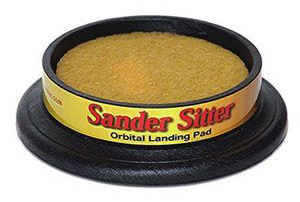
In my shop, I have one particular living large item. It is the coolest little thing called a “Sander Sitter Carousel” and its sole purpose in life is to provide a place to set your orbital sander while it quits turning. I mean, come on, is that living large or what? Instead of waiting 15 seconds every time you put it down,or stopping it with your hand, you just set it down on the Carousel and go do whatever else you want. The crepe rubber inside and the ball bearing base below clean the sanding disk and absorb the rotation. That’s all it does and it is marvelous. I could get used to this living large stuff.

Now if I can just get the house to open when I walk up to the door.