Highland Staff

Nov 012011
 

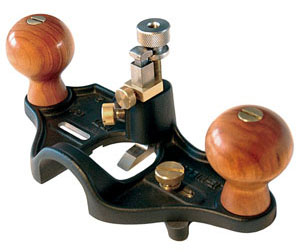
The Lie-Nielsen Large Router Plane is nicely upgraded from its Stanley roots. This plane comes with a cutting iron, fence, finely adjustable depth control, a very useful depth stop and some comfy handles.

As with just about any other plane, even though the #71 may not immediately trigger its plane heritage, sharpening is the first step to setting up this plane. I’ve had quite a few customers at our events, a bit perplexed as to how the iron is sharpened. The cause of this doubt usually originates with the shape of the iron.

Its “L” shape dictates hand sharpening, as it doesn’t readily “fit” in honing jigs or systems, at least those of which I’m aware. When I sharpen this iron, I usually stick to the original bevels, as they are fairly large and if you take your time, are not too hard to register on the stones.

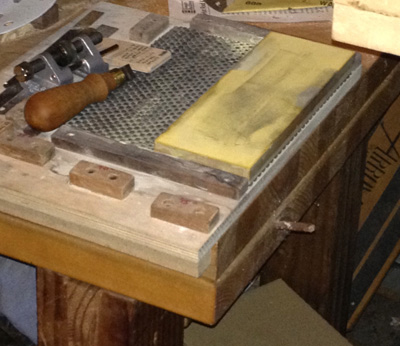
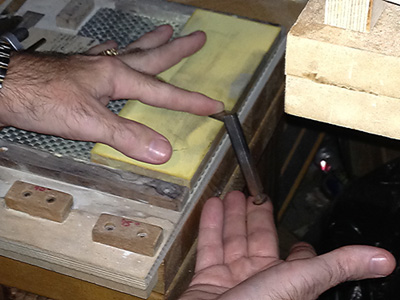
One “trick” I use when working the bevel of the cutter, is to move my sharpening stone so the long edge is flush with the sharpening table. This allows me to ride the bevel on the stone, while the other portion of the iron hangs off the edge.

I also prefer to hold the cutter so its body is about 45 degrees askew to the stone. There is less chance I’ll rock the cutter as I’m moving up and down the length of the stone, than if the cutter points directly across the stone (still moving the iron up and down the length of the stone). After working the bevel, it’s time to work the back. The back is easier, since there is more surface area on which to balance. I’ve worked the complete back of the iron for the majority of my woodworking experience, but recently have played around with adding in a back bevel, much like the concept of sharpening the back of my plane irons. When I work the complete back surface, it’s very easy to stabilize with either my thumb or finger, depending on what feels comfortable. Similarly to the bevel, I will work the back with the cutting edge about 45 degrees askew to the stone, even while still moving the cutter up and down the length of the stone. When trying the back bevel sharpening technique, it was readily apparent that the length of cutter was translating into a larger bevel, even with the very thin material we use when working the backs of plane irons. Knowing this, I’ll continue to work the complete back, until I find a good solid reason to change. I’ll report back if/when I do change.

The next part of setup is to re-assemble the iron in the plane. When preparing to use this plane, I will do one more step. Once I know the limit of the depth of cut for which I’m using the #71, I’ll set the iron to this depth. This makes it so I can gradually work my way down to final depth, without fear I’ll accidentally advance the iron too deep, and remove material that will either be unsightly or weaken my structure. Once the iron is at final depth, I move the depth stop so it is up against the plane body, and lock it tightly in place. Now I’ll retract the iron, so I’m prepared to take a light cut. Taking light cuts is good practice, since a heavy cut can have the potential for tear out and less than optimal results.

If the included fence is necessary for my project, I always set it up directly from my work piece, so no measurement errors are introduced.

That’s about it for setting up the Lie-Nielsen Large Router Plane, which I think everyone will find to be a very useful tool in his or her arsenal. I hope this helps get your plane prepped, so it is ready for all the action I anticipate you’ll find for it.

I hope to see some of you at our upcoming events, listed on the Lie-Nielsen website.

Click to take a closer look at the Large Router Plane.

Click to see Highland Woodworking’s entire selection of Lie-Nielsen hand tools.


Lee Laird has enjoyed woodworking for over 20 years. He is retired from the U.S.P.S. and works for Lie-Nielsen Toolworks as a show staff member, demonstrating tools and training customers.

Oct 312011
 

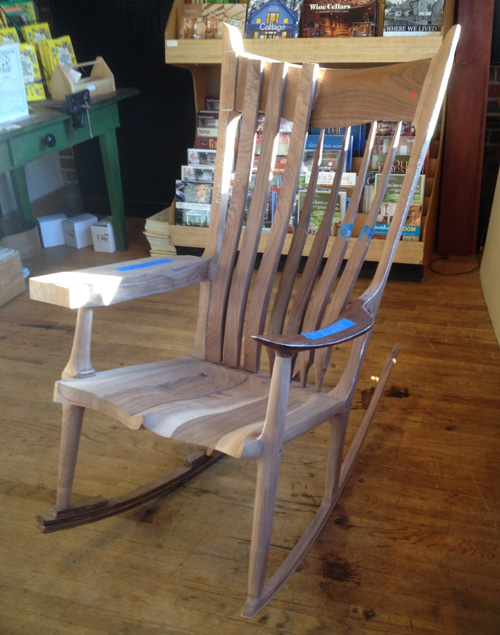
Let me announce a new display at Highland featuring the Sculptured Rocking Chair in kit form as presented by Charles Brock. If you recall, last fall and winter I started putting one of these kits together and began shaping the chair. Unfortunately (with apologies to Charles and his suppliers) I got sidetracked with some heavy Habitat activity and the project slipped. For the purposes of preparing an exhibit to put on display at Highland, I decided to finish half the chair and leave the other half in essentially the shape it comes in from the kit. Last week I was able to deliver the chair to the store so the staff could prepare a display for everyone to see and get a feel for the size and scale of the chair. The chair is imposing and I promise you will be impressed with its sensuous shapes, fine curves and subtle details. I also left the patterns which come with the kit, plus the forms I used to make the rockers assume their marvelous compound curve shape, probably my favorite part of the chair. If you have any chance at all, come by the store and get your hands on this chair.

With a lot of assistance from Charles, the left side of the chair is shaped and ready to get the final sanding and finish. As a matter of fact, if you buy Charles’ latest DVD on shaping a chair, you will see this very chair as the star of the show. (If you listen closely, you may hear me coughing in the background from the dust.) The chair will be on display at the store for several months and then I will bring it back to my shop and do the hard task of making the right side match the left side. Should be fun!!

By the way, if you want to present this chair to someone at Christmas, don’t delay getting your kit. I would hate for you to miss Santa because you are still up on Christmas Eve waiting for the finish to dry.


Terry Chapman did a whole series of blog posts on his experience with the Sculptured Rocker Chair kit – if you want, you can start from the beginning of the Sculptured Rocker build blog post series!
Oct 242011
 

Wow, talk about deja vu all over again!! Remember last week we were talking about the Moulthrop family and wood turning? Well I saw an ad on my local PBS station for an episode of Craft in America, a series produced for PBS in 2007, and I set it up to record on my DVR. When the program information came up, I was pleased to see it included the Moulthrops. There is a five minute interview with President Carter and he introduces the Moulthrops and a full third of the program is all about them. It is a wonderful show. Then on top of that, as President Carter is doing his introduction, he is sitting in a Maloof Rocker, an original, I am sure, but eminently recognizable. (Buy your sculptured rocker kit right here at the High.) I feel like Forrest Gump tiptoeing around the outskirts of history.

Go to pbs.org and click “watch video” in the top menu bar. Select Craft in America and look for Episode VII:Family. You can watch the full hour show right there on the web site or wait until it shows on your local PBS station. While you are there, you can watch Episode I with Sam Maloof, or you can watch all the latest Woodwright’s Shop episodes. Course if you do, maybe you ought to send some money to your local PBS station.

Oct 172011
 

At one of our events, I had a customer who wanted to create heavier duty tongue and groove joints. We discussed the possibility of using our No. 48 or No. 49 and as good as they work, the scale was just too small. My customer asked me for suggestions as to an alternate method to using tongue and groove planes.

I suggested to the customer the option of using a back saw, if he felt comfortable with his sawing skills, since it would ultimately only require four length-wise cuts to make the tongue. Based on his facial response, I thought it best to move on to another possibility. (By the way, if the backsawing technique does interest anyone who is reading this, leave a note in the comments and I’ll look into writing a small step by step on this technique.) The second method only requires two tools. The No. 71 Router plane and a Marking Gauge that slices rather than scratches. I should preface by saying that this method is somewhat slow, but you can end up with a pretty decent final product.

Start with the two (or more) pieces of wood sized so they are the same thickness, square and flat. Take the board that will have the groove, and clamp it in a shoulder vise, so the work surface is facing up. I like to start out making the grooved piece first, since I find it easier to adjust the tongue to fit, rather than trying to adjust the groove. Now, before marking for the groove, setup your No. 71 with the iron you plan to use. (*Note: there are different sizes and shapes of irons for the Router Planes) I like to choose a square ended iron that is as wide as possible, fitting with your plans. If you have a fence for your No. 71, it can help prevent the damage caused by a momentary loss of focus, where you accidentally remove material outside your marked/scribed lines. At least when just starting, and the groove isn’t deep enough to “trap” the iron. Set the fence so the iron is centered on the board, or if the groove is more than double the width of the iron, set it so you remove material next to one of the marked lines. (NOTE: If you don’t want an overall centered groove, then a second marking gauge really comes in handy.) If you don’t have a fence, then measure so the two edges of the iron will be equal distance from both faces. Make a small mark on each side of where the iron will cut along the edge of the board.

Set your marking gauge to these marks. Before assuming this setting is perfect, mark a small section, from each edge. Check to make sure the iron will not only fit, but also completely fill the area between the two marks, if you aren’t trying for really oversized tongues/grooves. I think about it similarly to when I’m making a mortise, the width of the mortise chisel should dictate the mortise/tenon widths. Once the marking gauge is set, mark the full length of the board, from each face. This will establish the boundaries for the material that will be removed, and the scoring will minimize tearout. Set the board you are working with so the No. 71 will cut with the grain. It makes it easier to get good results if you are not working against the grain. Before you start to remove material with your No. 71, mark the final complete depth of cut on the end grain at both ends of your board. This will be helpful as you approach your target depth.

Take a pass or two with your No. 71, with a sharp iron set for a relatively light cut, removing some material. Now come back in with your marking gauge. This time make two or three strokes on each side, with decent pressure. The idea is to score the wood fairly deep, so the No. 71’s iron can just remove the material between the scored marks. Some woods behave nicely and can handle a thicker shaving than others, so testing the wood early on will prevent problems later in your work. Continue to alternate between the marking gauge and the No. 71, until you are at your final depth.

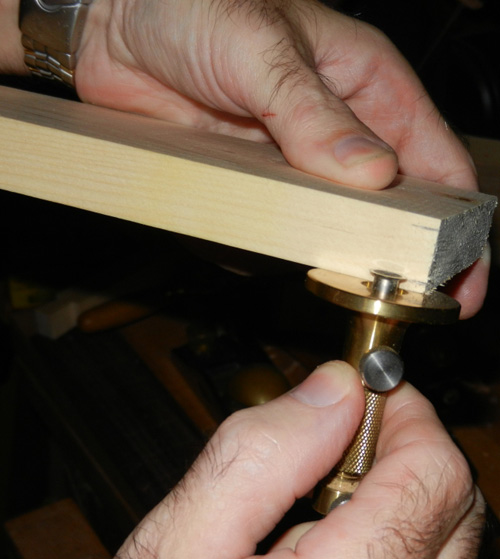
With the marking gauge still set as it was for the boundary of the groove, readjust it so the cutter is just slightly closer to its fence. What this will ultimately accomplish is to increase the thickness of the tongue slightly, providing material on the tongue to sneak up on a perfect fit. Mark the long edge of the board that will fit into the previously made groove, working from both faces. Now adjust the marking gauge directly from the previously created groove, so it is set for the depth of the groove. With this setting, mark the tongue’s shoulders, from the edge that will have the tongue. This will establish a clean shoulder. For the cleanest shoulder, repeat this marking after every couple of passes with the No. 71.

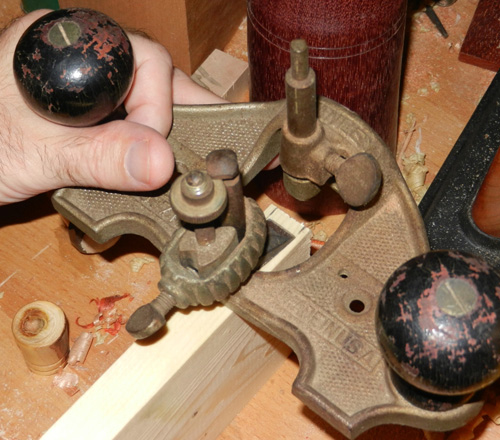
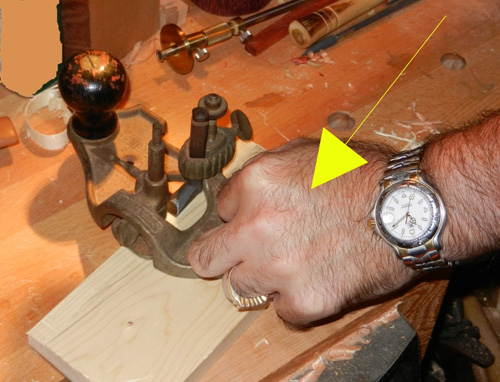
Now, to create the tongue. Check to make sure you are working with the grain on this board. To use the No. 71 for this portion of the process, make sure you apply pressure to the handle that is riding on the face of the board. This will keep the No. 71 level and ultimately the side of the tongue parallel to the face of the board. Incrementally remove material until you are getting close to the depth mark on the tongue. Flip the board over and continue removing material until you are close to the mark. Check to see if the tongue is close to fitting in the groove. Likely it will still be too thick. If it does not yet fit, advance the cutter slightly and remove a small amount of material. Check the fit after working each side, as it is easy to overshoot a good fit. Continue this process until the tongue fits as desired. One thing to remember is that working one side at a time can sometimes lead to one side having a bit more material than the other. Make sure to test your depth of cut when shifting to the opposite side of the tongue. If you don’t check this setting, when moving to the other side of the tongue, you may end up removing too much wood. And we all know it’s easier to take it off, than put it back on!

FYI – for the picture shown just above to the right, I should note that the cutter I used was much too large for the wood. Unfortunately I couldn’t find a cutter that matched exactly what I wanted for demonstration purposes.

When both boards are finished (one with the tongue, the other with the groove) it is time to see how things fit. If the tongue is too long, so there is a gap at the shoulders that doesn’t close up, take a few light shavings off of the end of the tongue. Again, take baby steps. Here’s another tip you can use if you are uncomfortable trying to keep the end of the tongue square while making this adjustment: Lay the board that has the tongue onto a very flat bench or table, so the tongue is horizontal. Set one of your planes for a very light shaving. I tend to like a Jointer plane # 8 for this, but it isn’t usually that critical, especially since you hopefully won’t need to remove very much. Lay the Jointer plane onto its side, with the iron towards the tongue. Slide the plane along the tongue, allowing the orientation to keep the tongue square on its end. Test often and take very light shavings.

I hope to see some of you at our upcoming events, listed on the Lie-Nielsen website.

To see Highland Woodworking’s entire selection of Lie-Nielsen hand tools, click here.


Lee Laird has enjoyed woodworking for over 20 years. He is retired from the U.S.P.S. and works for Lie-Nielsen Toolworks as a show staff member, demonstrating tools and training customers.


Oct 132011
 

You may have heard the name Moulthrop in regards to wood turning, especially if you live near Atlanta. Even if you don’t live near Atlanta, you may have seen the name at the White House, the Smithsonian, the Museum of Modern Art, the Metropolitan Museum of Art, and the United States Department of State, as well as numerous other similarly prestigious institutions.

I drove up to Marietta just northwest of Atlanta to visit the Marietta/Cobb Museum of Art to see “Moulthrop — A Southern Legacy”. I spent several hours there, and I came away with mixed feelings ranging from intense despair at my turning inadequacies to high ambition at the possibilities if I just keep pushing my craft. I took lots of pictures and have included a slide show (below) for you to see what I am talking about. What is difficult about simply seeing the photos is one cannot fully appreciate the scale of the objects. They are huge. In fact, the book I purchased at the front desk (Moulthrop, A Legacy in Wood, by Kevin Wallace) explains the methods and tools used by the three generations of turners. The Grandfather, Ed, started turning in the 1960’s when the craft was not widespread. He made his own tools and tried new methods and when he could not turn as large as he wanted, he simply built his own lathe. He laughs in the book about the heavy pieces of wood and the tools that resemble whaling harpoons, and actually getting flipped across the shop when the tool would catch in the wood. His Architect’s eye and natural talent served him well and soon people started to notice. One of my favorite pictures is of the grandson, Matt, at about 10 years old, standing inside a large scale chalice that Ed had made. After a while, his son Phillip took up the work, and then astoundingly, Matt, the third generation also picked it up.

It is remarkable: three generations, all rising to the highest levels of their field, and all very accomplished to my eye. In fact, I like Matt’s work the best. To my thinking, it is cleaner and more delicate than that of his father or his grandfather. But then, you can decide for yourself. Look at the pictures I took, but the book yourself, and then keep an eye on their expedition schedule and check them out in person yourself if they make it to your neck of the woods.

I’ve been turning a good while, but this stuff is amazing. Take a look at the slideshow below to see for yourself.

Oct 032011
 

Many of my customers have come to me, wanting advice on which of our many block planes they should buy. Often this is prefaced by the fact that they would like the plane they buy to provide a great deal of functionality, as this may be the only plane they purchase. With this in mind, I frequently find myself suggesting our Low Angle Rabbet Block Plane ( 60-1/2RN with nicker). When you first see this plane, you’ll notice it looks a little bit different from the majority of block planes. Just in front of the bronze cap, there is a half circle of metal on both sides of the blade. Since the blade on a rabbet plane reaches the full width of the plane (plus about .005″), this unique structure is the most efficient way to attach the front section of the plane.

This block plane will obviously perform admirably in most of the “normal” uses, such as taking wispy thin shavings from long grain or applying a quick chamfer. With the low bedding angle (12 degrees), it can also handle end grain quite well, too. Now since the blade reaches all the way to both edges of the plane body, you can also use it to clean up rabbets and the face side of tenons up to the shoulder. A rabbet is a groove cut at the edge of a board, often so another piece of wood will fit into the removed section at 90 degrees, like the back of a cabinet. When working on rabbets or tenons, the blade should be set exactly flush with whichever side of the plane will be working against the edge. This is so the plane will remove material all the way up to the mating edge, without scoring the connecting face. A quick and easy setup method is to lay the plane on its side, on a known flat surface, making sure the side that will be used against the edge is the side that is down. Loosen the spin wheel just enough so you can push the blade laterally. Then gently press the opposite edge of the blade (the flat, non-sharp section), while keeping the side of the plane flat, so the side of the plane and the blade line up together.  Don’t forget to re-tighten the spin wheel before using the plane. Just add about a 1/4 turn after reaching the point where the blade doesn’t move around.
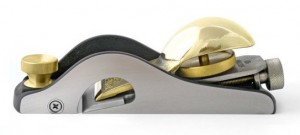
The Lie-Nielsen 60-1/2RN (with nicker)

The nicker on the 60-1/2RN is a small cutter that is almost completely round, attached to both sides of the plane body in front of the mouth. A portion of the nicker’s edge is flat, allowing it to line up flush with the sole of the plane, ultimately disengaging it from cutting. You would set the nicker in this position when using the plane to work flat areas, not up against a raised edge/shoulder. To set the nicker when working against an edge/shoulder, like the rabbet and tenons scenarios I spoke about earlier, first loosen the nicker’s Phillips screw. With the screw loosened, but not removed, rotate the nicker enough so the non-flat portion is down below the sole, on the side of the plane you’ve already set the blade flush to the body. Now re-tighten the screw. With the nicker(s) in this position (normally only one is set to cut at a time), it only protrudes by about .010″. The nicker, when engaged like this, will score the wood fibers just in front of the edge of the iron, and just slightly deeper than the iron is normally set to cut. This creates a very clean rabbet or shoulder/tenon face intersection, depending if you are working on a rabbet or a tenon, without the need to follow after the plane with a knife or a chisel. If you do not have nickers, the wood doesn’t get scored in the corner/shoulder area, leaving a ragged surface. After using the nicker for a while, they may stop cutting as cleanly as they did originally. To resolve this, just loosen the screw slightly and rotate the nicker about 90 degrees, which will present another fresh sharp surface. After rotating all the way through the arc, you can quickly resharpen the nicker. Remove the screws and nickers. Get out an 8000 grit stone (or equivalent) and lay the nicker on the stone, with the nicker’s flat outside facing surface down. With light pressure and circular movements, it only takes about 15 – 30 seconds to hone. Reattach each nicker, with its Phillips screw, and you’re back to work. It usually takes me longer to put the nicker back on than to do the actual honing.

Now that everyone understands what the nickers are, and the basics of what they do, I’ll share a technique I use on occasion, but don’t ever recall reading anywhere. There are times that I’ve had multiple rungs on the back of a piece, that ultimately were nothing more than long dowels. Each of these required a hole of a precise size to allow the end of the rung to fit snuggly when glue was applied. Who hasn’t drilled a series of holes, (in a test piece of course!) only to find none of their bits provide that exacting fit? Well, here is a work-around that can get you your desired results, but you can probably find some other uses for it as well. To start out, I find whichever drill bit is closest to the correct size, while still being smaller than the ideal. I drill my holes both in a test block, and in my final project. Then I’ll set up my 60-1/2RN so it is removing shavings of about a thousandth of an inch. I take this plane, flip it on its back, and clamp the sides of the sole in my face vise. Now, from my plans, I determine how long the portion of the rung is that needs to fit into each hole. I mark each end of the rung with this measurement, and take it to the plane (instead of the other way around). You’ll need to be extra careful on this next part, so the rung is the only thing the plane removes. Lay the rung down on the plane, so the depth line you marked is in line with the nicker, while the end needing adjustment is against the cutting iron. Now, while applying just a small amount of pressure on the back-side of the rung (on the portion that will contact the plane iron), slowly rotate the rung in the direction that allows the iron to engage. Check your progress regularly, since you don’t want to overshoot your target. I like to use the test block for checking. And since I’ve planned to glue each rung and am not looking for a friction fit, it is easy to test simply by presenting the end to the hole. If it doesn’t go in with easy hand pressure, just continue removing small amounts until it fits. Since this plane cuts all the way up to the marked depth, what is now ultimately a shoulder, you can remove material exclusively at the ends that fit into the holes. The remainder of the rung continues to stay at the pre-existing diameter, so others may never know you used this technique.

Always remember to sharpen the blade on any newly purchased tool. We grind the blades to 400 grit at our factory, which will cut wood, but a quick honing to 8000 grit will provide results that will make you smile, and utter uncontrollable little things like “Wow” or “Amazing”. Feel free to take a look at our sharpening demonstration video on Youtube, or stop by any of our events, and we’ll be glad to show you in person.

*One caveat I like to bring up, especially for those of you who may not have any other planes besides the No. 60-1/2R(N) Rabbet Block Plane. Do not use a rabbet plane on a shooting board. The small band of metal on both sides of the mouth on regular planes is what prevents those planes from continually cutting into the edge of the shooting board. Since the rabbet plane’s blade cuts full width, it would continue to remove material, ultimately destroying your shooting board.

I hope to see some of you at our upcoming events, listed on the Lie-Nielsen website.

To take a closer look at the low angle rabbet block plane with nicker, click here.

To see Highland Woodworking’s entire selection of Lie-Nielsen hand tools, click here.


Lee Laird has enjoyed woodworking for over 20 years. He is retired from the U.S.P.S. and works for Lie-Nielsen Toolworks as a show staff member, demonstrating tools and training customers.

Sep 122011
 

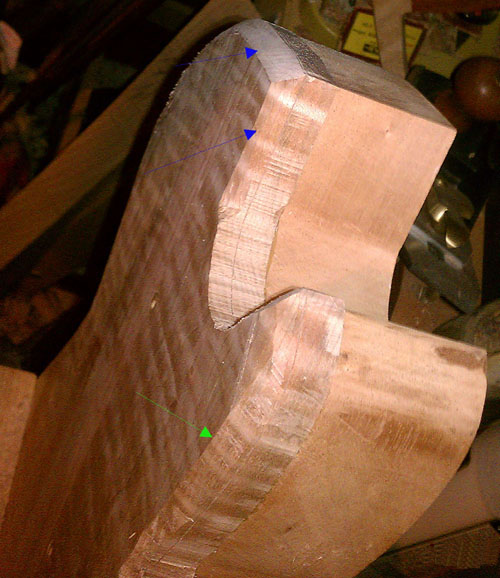
I was working on a future guitar body, and decided I wanted to remove about 3/8” of wood, taking the top wood down to about 1/2” thick. The top is highly figured and already glued up to the body, so I wasn’t sure what I was going to use to make this happen. First up, I decided I should mark the edge of the top, to set the final dimension. For this, I used a Titemark gauge, leaving the mark just a bit proud of the final dimension. After the mark up, I decided to examine a couple of new additions to my personal toolbox. I recently bought two Lie-Nielsen Boggs spoke shaves (one with the flat bottom and the other with the curved bottom) as well as a 3/16” bed float. I’d just put the initial sharpening on both the shaves and the float, so they were ready for action.  First thing that went through my mind was “I wonder how fast this float would remove this excess curly maple”.  I hadn’t tried the bed float on any wild figured wood, so it was yet to be seen. Just to be clear, the bed float was originally designed for plane makers, but I enjoy finding additional usages for my tools.

The first couple of strokes were a bit bouncy, but that was just the wood and tool giving me feedback, and telling me I was pressing too hard. I backed off of my pressure and found the float was just zooming through the wood. I decided I’d work a bevel on the edge, removing almost the full 3/8” of material, so I could test it for potential future usage. I worked the forward edge of the guitar top until it had a nice consistent bevel. This only took a couple of minutes. The wood didn’t blow out or splinter, which was one of my concerns. Certainly different than if I’d decided to use an aggressive toothed rasp.  After checking out the surface, I thought I’d follow it up with my flat bottom spoke shave. Again, it was like a dream, even across the end grain surface on which I was focusing. So even though I’m still going to excavate the whole surface down to the lowest level of this bevel, I used a current project and its excess dimensions to assess the new tools in my inventory.  I like testing them in a situation similar to what I’m expecting in real life. It’s just not the same picking up a 2” x 4”, or other wood completely different than what you’d normally use for projects, to try to get used to a new tool.

The arrows in the above picture point to the two focused surfaces, where I removed the gross volume of wood with the float, followed with a few passes with the shave.

I’d suggest this type of “live fire” practice for anyone who is adding a new tool to their repertoire. I know I won’t have any worries when it comes time to integrate these tools with future projects.

I hope to see some of you at our events this season, listed on the Lie-Nielsen website.


Lee Laird has enjoyed woodworking for over 20 years. He is retired from the U.S.P.S. and works for Lie-Nielsen Toolworks as a show staff member, demonstrating tools and training customers. Follow him on Twitter at twitter.com/is9582.