Highland Staff

Jun 302011
 

When I first started out, I had no formal fine woodworking training, nor any mentors from which to draw. I remember watching a woodworking video (yep, VHS back in the day) with Frank Klausz showing just how quick and easy it is to hand cut dovetails. Of course, after watching that, I had to go buy a back saw, so I could make some exquisite dovetailed pieces. I went to our local fine woodworking store and bought what looked like a reasonable candidate. NOT! I practiced and practiced with my saw, but I just didn’t seem to get any better. The saw cut extremely slowly and seemed to have a mind of its own when I tried to cut to a line.

OK, fast forward to present day. I bought my first Lie-Nielsen dovetail saw (15 ppi .020 thick plate) about five years ago. I had the opportunity to briefly try out one of the new Lie-Nielsen dovetail saws when a friend brought his into our club meeting. It felt like it could make a difference in my skills. After deciding to make my purchase, I couldn’t wait to try out my new saw. The first thing I noticed was just how good the beautiful maple handle felt in my hand. I started out by marking some vertical cuts and a series of angled cuts to run through to get the feel of my new saw. Next I laid out a couple of tails on a board and started cutting. It was just amazing how much difference my Lie-Nielsen saw made. After grabbing a second piece of wood, and verifying that my first dovetailing attempt wasn’t just a lucky fluke, I decided to see what was different about my two saws.

First off, the dovetailing operation is usually cut with a rip tooth configuration, since the cuts are primarily with the grain. When I checked my first saw, I noticed it was filed with cross-cut teeth rather than with rip teeth. (There was that lack of experience on my first purchase!) The thickness of the saw plate was a bit over 1 1/2 times as thick as my Lie-Nielsen saw. My original saw was .032” thick, while my first Lie-Nielsen saw is .020” thick. One other difference that really seemed to be a deal breaker was the amount of set each tooth has, which is where each alternating tooth is bent slightly to the opposite side. My old saw had about .005” of set on each tooth, which allowed the saw to float around in its own kerf, making accuracy extremely difficult. The Lie-Nielsen saw has .003” set on each tooth. This provides enough room so the saw plate doesn’t bind, but not so much that it wanders on its own. Once you start sawing with the Lie-Nielsen saw, it tracks extremely straight.

Lie-Nielsen has an extended line of dovetailing saws. Their first pistol grip handled version has 15ppi teeth and a saw plate thickness of .020”, the next in this line has a progressive pitch tooth pattern (16ppi at the toe progressing to 9ppi at the heal) with the same .020” plate, and the most recent version has the 15ppi teeth but a .015” thick plate. Lie-Nielsen also makes a dovetail saw with a straight handle. This saw has 15ppi and the saw plate is .015” thick. All of these saws do a great job and ultimately choosing becomes a personal preference. I personally prefer the pistol gripped version, compared to the straight handle, as the pistol grip style provides direct feedback as to the position of the saw plate. I would suggest coming to one of our events and trying all four saws, so you can each determine your own preference.
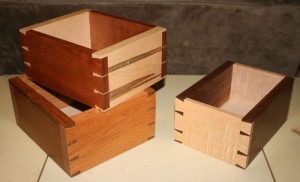
A few of the dovetailed boxes I’ve made
Oh, and just a brief blurb from Frank Klausz, while demonstrating cutting dovetails at our local club meeting a couple of years ago. Frank mentioned the Lie-Nielsen dovetail saw seems to be a bit too sharp when it is new. After he’d used it to cut a couple of hundred dovetails, he said it felt about right. I think this provides a bit of insight as to just how long the Lie-Nielsen saws may stay sharp.

I hope to see some of you at one of our upcoming events, listed at Lie-Nielsen.com.

To take a closer look at the Lie Nielsen dovetail saws, click here and here.

To see Highland Woodworking’s entire selection of Lie-Nielsen hand tools, click here.


Lee Laird has enjoyed woodworking for over 20 years. He is retired from the U.S.P.S. and works for Lie-Nielsen Toolworks as a show staff member, demonstrating tools and training customers.
 

Jun 272011
 

While remodeling what he eventually dubbed the “unhandy house”, our own Down to Earth Woodworker, Steve Johnson, found there were a few things he would have done differently if he had a second chance.

The Mistakes I Made in the “Unhandy” House

It is probably a bit early to do a full post-mortem on the work done in the “unhandy house” remodeling project, since there are still a lot of unfinished items. Still, mistakes are truly instructive, and lest I forget one of my many “teachable moments” I thought it wise to share now.

Plan for Unforeseen Situations…

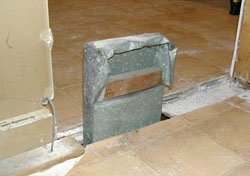
Figure 1 - Who would have known? This clumsily sealed and hidden air duct took a day to resolve.

Every step of the project was planned in what was, I thought, infinite (almost obsessive) detail. Sheet after sheet in my notebook detailed entries like “Day 37, 38, 39 – sand and prep floors.” My mistake was to not fully anticipate and plan for unforeseen problems. The floors took 4 days to sand, not three. The time budget was blown. The dollar budget was also blown with added sanding machine rental costs and additional sanding pads. There truly is no way to make up a day when you are on a tight schedule and working mostly by yourself.

Re-routing a hidden air duct embedded in a wall cost me an extra day. Electrical problems cost me three or four days of lost productivity. In the midst of it all, the sump pump began spewing water on the walls from a dry-rotted rubber coupler, and a rush trip to the hardware store and the ensuing repair and cleanup cost me another half a day. No matter how skillful one might be at estimating the time required to do each project, it is wise to add some “buffer” or contingency time to every project.

Penny Wise and Pound Foolish…

It was, I thought, fortunate to have a recycling center only fifteen miles away where I could dispose of a brimming pickup truck load of material for just $7. In retrospect, 30 miles round trip in my truck with current gas prices equals roughly $10 in gasoline cost. That translates to $17 per load, and so far, I have disposed of 13 loads, or $221 in real cost. Almost every trip to the dump entailed a swing through the donut shop drive-in window for coffee and sugary baked treats, so add another five bucks or more per load. In reality, my misplaced frugality cost me close to $300.

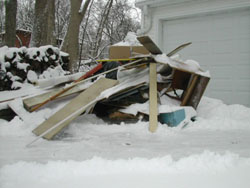
Figure 2 - Piles of trash get handled multiple times. Get a big open top dumpster and handle the waste only once.

Each trip took roughly two hours, with loading, driving, unloading, and driving back. Those 26 hours of time would have been much better spent working. There is a safety consideration as well. Demolition is dangerous work, and the potential for injury is multiplied by handling the waste material multiple times. I carried materials to the driveway and stacked the garbage until it looked like a full truckload. Then I loaded the mess into the truck, one additional handling. Then, at the dump, I unloaded everything, marking the third handling of material that was filthy, full of rusty nails, and possibly other noxious “stuff.” With an open top waste container in the driveway, I would have handled the waste material only once.

Checking locally, renting a 30 cubic yard capacity roll-off open-top dumpster costs about $550. Considering the time saved, the safety, and the convenience, if I ever take on another project like this, I will order a large dumpster.

Rip It All Out First…

Most of the base trim in the house had to be removed for floor work, but it was an older profile, not readily available, and it looked like it was going to take a lot of time to replace. The trim was covered in multiple coats of paint. I removed a lot of the trim, but decided to try to “save” some and some I left “in situ,” thinking that it would be easier to paint in place rather than cut, fit, and attach new baseboard. All of that thinking was a giant mistake.

As the project continued, I found myself removing more and more of the base, until all that was left was a small section in the hallway. That small section proved difficult and time-consuming to paint, and there was no really “seamless” way to transition from the old profile to the new. I would have been better off to just remove it all in the beginning and be done with it.

In fact, my original decision to haul things to the dump, rather than order a dumpster, made the process of ripping things out gradually seem logical. In real life, it caused me undue and extended heartburn later as problem after problem was revealed. The gradual exposure of problems wasted time since many extra trips to the supply stores were required to buy unexpected needed supplies. On a major remodeling job like this, bite the bullet and rip everything out at once. Most problems will be revealed early, and it will be easier to make more complete “to do” and “to buy” lists.

No Matter How Good The Sale Is…

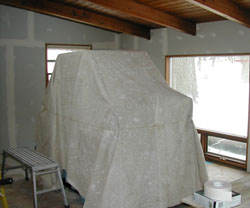
Figure 3 - How do you work around this? A way-too-early delivery of appliances created problems throughout the project.

From the first visit to the “unhandy” house, I could visualize a gleaming new stainless refrigerator and dishwasher to accompany the fairly awesome and relatively new stainless oversize stove the former owner had installed. As luck would have it, the perfect fridge and dishwasher went on sale a week after taking the keys to the house. Buying these items early was a big mistake. Unable to install either, they were in the way.

As soon as the items were delivered, I inspected them for physical damage and, finding none, repackaged them as best I could, covered them in moving blankets and a drop cloth, and set them to the side. As the project moved along, more tools took up temporary residence in the house, and things began to get crowded. The appliances were moved at least four times for different projects, and slowed down the work as we took care not to damage them.

As fate would have it, when the time finally came to install the appliances, the refrigerator did not work. The equivalent of an entire day was wasted arguing with the dealer, the manufacturer, and the delivery service until the unit was eventually replaced. Had I waited to purchase, the refrigerator would have been delivered, hooked up, and its defect would have been noted immediately and the unit would have been replaced quickly. Had I waited, these bulky appliances would have been out of the way and in no danger of damage. There would have been more “elbow” room, and the work could have progressed more quickly. A few dollars of savings proved to be a point of frustration and wasted time.

Simple Steps to Avoid Remodeling Frustration

  1. Everything is going to take longer than you think – plan for it, then add a few extra days
  2. While the words frugal and cheap may technically mean almost the same thing, they do not – don’t be “penny wise and pound foolish”
  3. Do demolition all at once – you may discover all kinds of new challenges all at once, but you will be better able to plan and execute and you will save time!
  4. Even if you catch a good sale, think long and hard about buying things before they are needed. Where will you store them? Will they be in the way? Could they be damaged during the renovation?

This article first appeared in the Down to Earth Woodworker column in the June edition of Wood News.


Jun 232011
 

If the weather had been better, if I had planned (or executed) better, if the former owner had not been the quintessential “unhandy” man, if I had not been only 20% effective for a week or more with the flu, if, if, if…

As a buddy of mine used to say, “If a frog had a tail he wouldn’t bump his butt every time he hopped.” And if everything had gone right, I would have remodeled the house and the garage before time to move in, and I would be building furniture by now. But, frogs don’t have tails, and my remodeling project took longer than expected, and the garage had to wait.

What to do with all my equipment while the shop was under construction became the pressing dilemma. The answer, my friends, was blowing in the wind. Literally.

I remember the day well. I left about 5:30 AM for the unhandy house, ready for another full day of remodeling work, undoubtedly to be filled with additional surprises. The pressure was building. Every day the drop-dead date for being out of the old house was nearing, and every day it seemed new problems and fate was prolonging the project. It was cold, but then, when is it not in Wisconsin? I believe the temperature was around 7 degrees, the wind gusting bitterly from the Northeast. Bundled in about five layers of clothing, head bowed against the blowing snow, I headed into the coffee shop for a much needed start to the day. Another frigid patron was wrestling with the newspaper vending machine and a fortuitous gust of wind ripped papers from her hand and directly into my face. As I peeled them away and tried to smooth and return them to her, I spied an advertisement. It was just like in the movies, when the spotlight shines, the music swells, and enlightenment spikes like a smile – a moving and storage company advertisement and a picture of a storage pod.

Despite the cold and the caffeine deficit, I changed a dollar into quarters and overpaid for the local newspaper. Over coffee (finally) I read and re-read the ad, and wondered if an on-site storage pod could be the answer. I could put all my equipment in a great big weather-tight and secure box, move the pod to the new house, store it in my own driveway, and move the machines into the shop when the garage conversion was complete.

Online, I checked out various companies that offer pod-type storage. All seemed similar, but the namesake Pods Enterprises seemed to be the originator, or at least had co-opted that position through marketing. Pod’s online quote system was slick and professional. By the end of the workday I had made the decision and formulated the plan, and had an appointment to have a Pod delivered.

I fretted over details…could the delivery guy put the Pod close enough to the garage? Could he set it straight? Would the slope of the driveway cause an issue? Would the 16 by 8 foot Pod be big enough? Would it really be dry inside and secure? How high was the Pod off the ground? Were there ways to secure my equipment for the move?

The helpful customer service representative at Pods patiently answered my questions, and the delivery driver was as professional, caring, and proud of his company as anyone could be. He set the Pod just four feet from the garage door, perfectly square to the entrance, and walked me through the use of the door, the lock, and what to do when I was ready to have the Pod moved.

The next Saturday a friend had volunteered to help pack the Pod. I had already spent the better part of the night before prepping the equipment for its hopefully short hibernation and relocation. Most drawers were emptied and the items packed. Doors and drawers were secured with shrink-wrap plastic. Delicate sections of the equipment were further protected with Styrofoam or bubble-wrap, and then each machine was covered with a moving blanket or two. The padded moving blankets were secured with additional shrink-wrap.

I hacked together a low ramp of 3/4 inch plywood and scrap dimensional lumber to smooth the rolling of equipment from my garage to the four-inch floor height of the Pod. I also purchased a number of 4 X 8 sheets of 2-inch thick Styrofoam insulation to be used as packing protection, a few inexpensive plastic drop cloths, and a few additional moving blankets.

In Wisconsin we plan for the worst possible weather, and the reality is usually worse, so I also rigged some heavy plastic above the Pod door and attached it to the front of the garage roof, forming a type of temporary roof over the short span between garage and Pod. I also rigged temporary plastic walls between the Pod and garage, essentially forming a plastic “hallway.” This turned out to be a good move. Saturday ushered in a rainstorm of epic proportions. Cold, fierce rain driven by gusting winds and a bone-chilling temperature of 38 degrees dampened our enthusiasm for “Pod-packing,” but we soldiered on.

My rolling lumber rack was the first item loaded. We partially emptied it, rolled it into the Pod, and then reloaded it. It was the item I had guessed to be the heaviest and most unwieldy, but the makeshift ramp held, so we were off to the races.

My workbench is the only large item in the shop not on wheels. We carried the beast, a few inches at a time, and nestled it into the Pod, opposite the eight-foot long lumber rack. The Pod unit has convenient tie-off points throughout. We used webbed straps and rope to secure the lumber rack and workbench and a couple of blocks of wood screwed to the wooden floor as insurance. Boxed items were packed in, under, and around the workbench and lumber rack, and within an hour, half the Pod was packed.

Before loading the machinery, we lined the Pod walls with the two-inch Styrofoam insulation. Like a make-it-up-as-you-go-along jigsaw puzzle, we put each machine into the Pod, secured it, and braced it with additional Styrofoam. When everything was loaded, we sealed the Pod inside its door, floor-to-ceiling, with 4-mil thick plastic (in case there was any water leakage around the door), closed the door, and added a padlock.

On the appointed moving day, the Pods driver arrived precisely on time. The moment he raised the Pod into the air and began to load it on the truck, my heart raced, but I was comforted by his professionalism and care. By his control gauges, he told me the Pod had 5,700 pounds inside. Not the heaviest load he ever carried, but well above average. He followed me to the new house, and in what seemed like only minutes, he had unloaded the Pod and placed it, just as carefully, at the entrance to my new garage/shop.

Shop equipment resting peacefully, waiting for its new home.


I was tempted, of course, to open the Pod and examine the contents, but I resisted. My rationale was simple…if anything was damaged, it might be weeks or longer before I could unload the Pod and really assess the situation, and in the meantime I would simply fret and obsess. Better that I not know. That lasted about ten days, and finally on a day without rain, I opened the door to find that everything was just as we had left it. Whew!

Now every day, I look at the Pod and it provides motivation to get the garage converted to the new Down To Earth Woodworking shop. If you are ever facing a move, or simply want to clear out your shop for some renovation or remodeling, consider using a pod storage unit.


This article first appeared in the Down to Earth Woodworker column in the June edition of Wood News.

Jun 142011
 

Did you ever notice how we have these woodworking cliches? We never “grab a chisel”, we always “grab a sharp chisel”. Let me think about that for a second. I want to make a fine paring cut on a piece of hard maple, so I think I will get my dull chisel. In my profession, the Attorney General of the State of Georgia got involved one time in a legal opinion about Land Surveyors. Question was whether we had to call ourselves “Registered Land Surveyors” or simply “Land Surveyors”. His legal opinion was that if you were not registered then you were not a land surveyor. There are only “Land Surveyors”, and any label past that was superfluous. I agree — no more “sharp” chisels, only “chisels”.

Same thing happens in woodturning — we never have a catch, we always have a “nasty” catch. I agree that catches are always nasty, and I still hate them. They scare me pretty good most of the time.

Full Finisher

I was practicing last week with the next tool in the Easy Wood Tool group, the Full Finisher. Watch the video below and you can see how it works. It really is a smooth cut and you can get quite aggressive with it. The piece was wet, ash I think, and I had roughed it out a few days before and then put it back on the lathe to round it off and thin it out.

What I think a lot of woodturners miss is listening to the sound of the tool cutting. You can tell a lot by the sound the tool makes as it cuts. After a while, the tool makes a steady droning sound and you can tell when you get some wobble in the shape and the tool is not following very well. You get a little bit of that high pitched wail from movies set in the Middle East where the men are going off to war and the women are cheering them from the top of the cliffs. Listen to the sound I left in the video and you will see what I mean.

I went to a class with a bunch of beginners one time and the sounds in the room drove me up the wall. Even at that early stage of my turning career, I could hear the pieces beginning to break apart, but the people doing the work had no idea what was about to happen. Now and then one would explode and fly all over the room, but somehow that was easier to take than waiting for one to bust once I heard that sound.

I think I overstepped the capability of the Easy Finisher with the size of the bowl I was using it on. Probably overstepped my capability also. I went back to the Easy Tools web site and watched their demonstration again, and they were working on a smaller bowl. I think that may be the key. That and a lot more practice.

It is hard for me to watch the video cause I know what’s coming. Maybe we should call all catches nasty. Least I didn’t cuss, I just hollered. Or screamed like a little girl, whichever you think. Let’s see what you say if it happens to you.

May 312011
 

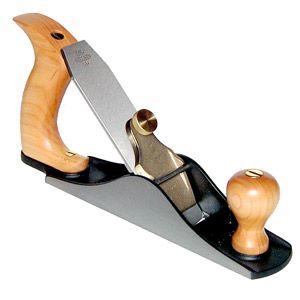
The scrub plane is also known as a model 40 1/2. It has similarities to other hand planes, but some distinct differences as well. This tool is used primarily for quick gross stock removal, as opposed to many planes that are usually set for fine finish work. With this in mind, the mouth has a very wide opening, to make certain the thick shavings will not jam. This plane can be used both on the face of boards as well as for edges. Normally the scrub plane is used between 45 degrees and 90 degrees to the grain direction. With the heavy cut of this tool, it can be problematic to use this plane with the grain. Unless the grain is extremely well behaved, significant tear-out is often a result.

I’ve had customers ask why they should buy yet another plane when they already have a Jack plane or a Fore plane set up with a nice wide mouth. When you look at the difference in the irons, I think it will become more obvious why the Scrub plane is an excellent addition to the regular kit. The iron on the Scrub plane is 1 1/2” wide, versus 2” on the #5 Jack or 2 3/8” on the #6 Fore. When working with such a heavily exposed blade, the amount of wood ultimately fighting against the user can be significant. The Scrub plane’s narrower iron allows a deep cut while not overwhelming the user. If you set the blade of the #5 or #6 for the same depth of cut, the width and ultimately the amount of wood removed will make it much harder to handle the cut.

One of the notable differences in the scrub plane is the fact that it does not have any mechanical adjustment for depth of cut. In this way it may seem more similar to wooden planes than most metal planes. There is a cap iron, with thumbscrew, that applies pressure to keep the blade at the desired depth of cut. When first learning this plane’s idiosyncrasies, a good starting point for the depth of cut is to place the plane on a flat surface, referencing the cutting iron with the sole. Starting more shallow is my preference, then apply light taps to the back of the iron to advance the blade in a controlled fashion. Once you become more comfortable with the plane’s behavior, you can sight down the sole to set a reasonable starting point for the depth of cut. Obviously, the less (as in less blade out) is more idea can still be a useful guideline even for the initiated.

The cutting edge of the iron is ground with a 3” radius, which takes a very scalloped cut. The means are different, but the end result surface can be similar to that left from carving gouges. There are a couple of ways to sharpen the iron for the scrub plane (see the youtube video on this subject). If you prefer to hand sharpen, it is easy enough to reference the bevel on your sharpening media, while essentially working the blade both across and pulling it towards your body. This will allow the full radius to make contact with the sharpening equipment. Just remember that a burr is the sign you’ve worked enough on the bevel side. The burr should be removed, after the bevel is sharp, by working the back of the iron on the sharpening media. The Charlesworth ruler trick is again a time saver. The iron is wide enough that it can also be held in many side-clamping honing guides. The guides with narrow wheels will accommodate the range of motion needed to sharpen the complete radius, while providing a good reference.

Using a scrub plane can allow extremely rapid stock removal, allowing efficient progress towards a defined dimension or reference surface. This is especially useful when moving from rough timber, working through other categories of planes (Jack, Jointer, Smoother..) to a final finished piece of lumber, or when dealing with the removal of large amounts of waste wood.

Come give one a test drive at one of our events. You might just be surprised at how useful a scrub plane can be, and how you’ve gotten by without one in your kit. I hope to see some of you at one of our upcoming events, listed on the Lie-Nielsen website.

To take a closer look at the scrub plane, click here.

To see Highland Woodworking’s entire selection of Lie-Nielsen hand tools, click here.


Lee Laird has enjoyed woodworking for over 20 years. He is retired from the U.S.P.S. and works for Lie-Nielsen Toolworks as a show staff member, demonstrating tools and training customers.
May 272011
 

One of our local woodworking stores asked me to do a hand plane demonstration the other day. Since they have a decent stock of products, I just brought a few personal pieces from home. These items were those I did not expect the store would have, but I believed would help add to my audience’s overall experience. I brought an old, not so great shape metal plane, a couple of wooden hand planes I made, some of my sharpening kit (angle setting jig and honing guide), and a small light hammer for adjusting the blade in the wooden planes, as well as the lateral adjustment of the blade in the metal planes.

I arrived at the setting about 30 minutes early, basically so I could take my time setting up before the demonstration started. The employees were kind enough to set me up on a large wooden workbench, which provided plenty of room to spread out the planes and my gear. After they found me some wood to use, I noticed there were no dogs in the workbench. Store management pulled a brass pair from inventory for me to use. After opening the set, it was readily apparent they were the wrong size. The dogs were the standard 3/4” round dogs, but this workbench had massive 1” dog holes. The face vise was still functional, even though all vise handles for the bench were missing.

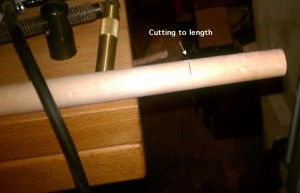
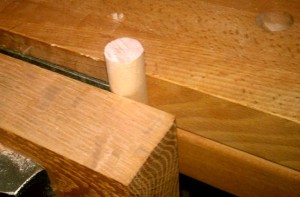
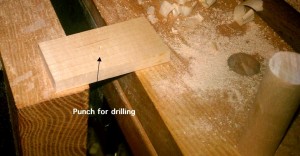
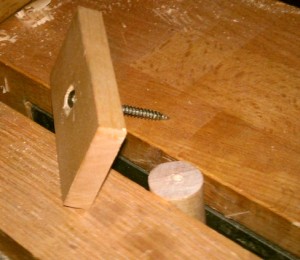
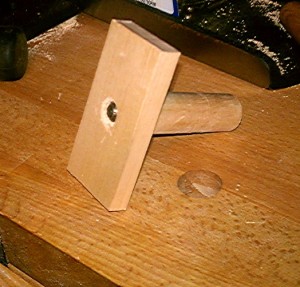
Since I intended to use the hand planes to make shavings, and to allow my audience to do the same, I needed to come up with a couple of solutions on the fly. I asked one of the employees to cut some 1” diameter hardwood dowel into a 3” length. Along with that, I asked for a small rectangular piece (about 2” x 3”) of thin plywood. The two were screwed together, making sure to slightly sink the head of the screw, so the plane wouldn’t hit it. This was sufficient to use as a stop, against which we planed the face side of the wood.

Dowel to length

Dowel in vise

Dog top

Dog almost together

Completed Dog

That took care of one of the two issues. The vise handle was even easier. The remaining section of hard wood dowel, which was about 2 1/2’ long, became a temp vise handle. Since they had no plan for long term use, I didn’t even worry about attaching knobs to the ends of the dowel, nor cut it down to a more manageable length. Whenever I needed to either tighten or loosen the vise, I just slid the dowel into the opening and rotated the mechanism.

Just remember to keep an open mind when dealing with adversity, and many times you’ll find a quick easy solution to your problem.

I hope to see some of you at our upcoming events, listed on the Lie-Nielsen website.


Lee Laird has enjoyed woodworking for over 20 years. He is retired from the U.S.P.S. and works for Lie-Nielsen Toolworks as a show staff member, demonstrating tools and training customers.

May 242011
 

Sometimes I worry about us woodworkers.  We tend to go off to our shops and isolate ourselves from the world.  (Did you hear about the guy who always stayed at home because he didn’t want to have to kiss his wife goodbye?)  As a follow-up to our safety week and as a public service, I call attention to a bulletin issued last week by the nationoal Center for Disease Control and Prevention in Atlanta.  Use this information to stay safe and keep buying and using your woodworking tools.
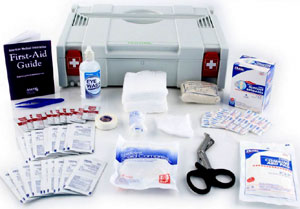
The Festool Contractor’s first aid kit may not have zombie antidote, but it’s got everything else you might need!

The CDC issued guidelines to follow in case of a Zombie Apocalypse.  (You may think I am making this up, so here is the actual real link). This warning really hit home with me since my shop is in the back yard in the deep woods so to speak, and it can get really spooky out there at night.  After dark with the lights on in the shop, you cannot see what is going on outside, and when you get absorbed in a delicate little dovetail joint, the whole world could end around you and you would hardly know it until it was too late to do anything about it (as if you could).

Until now I had not worried about what steps I would need to take in case zombies (the technical term for the condition is Ataxic Neurodegenerative Satiety Deficiency Syndrome) showed up at the shop.  For instance, the CDC recommends that you set up a meeting place outside the home so your family can rendezvous and escape together to a zombie-free refugee camp.  They post a list of supplies to take with you including water and food and a first aid kit, though they do admit that once bitten the first aid kit will not be of much use.

We agree with the CDC.

What the CDC has left out though, are defensive tools to protect yourself during a zombie attack.  Generally woodworkers are particularly well-equipped to protect themselves with devices that are already found in nearly every woodworking shop.  My lathe skew chisel (properly sharpened), for instance, with its slanted blade and sharp point would be very effective as a zombie defense.  My battery powered drill (I will need to keep the batteries charged better than I normally do) with a two inch spade bit would also be helpful.  Oh wait, how about the drill mounted three inch hole saw – I think that would be better.  The battery powered reciprocating saw is an awesome tool, effective in many situations where no other tool will work. And if you have ever caught your finger in one of those Japanese cut-off saws, you will recognize what damage that thing could do when properly applied to larger fleshy appendages.  (As in most woodworking operations, having this saw cutting on the pull stroke makes it much easier to use when you are in a rush to finish a project.)  Last but not least, is my chain saw.  I prefer a 20 inch blade to give me a little more depth of cut, and you don’t need a really big saw – too heavy to lift to shoulder height on a continuing basis.  Just make sure it has the proper gas and oil mix so you can get it started easily.  When you need it, you need it quick.

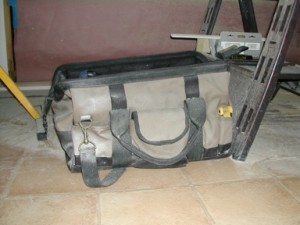
Get your zombie apocalpyse ‘Go Bag’ ready!

I am going to recommend to the store that we put together a Highland Zombie Apocalypse Preparedness Kit.  It should include all the materials recommended by the CDC, plus the things I have suggested here.  I think we will put  it in a big tool bag so you can grab it and go on short notice.  The problem with that is you will not be able to use the tools from the Kit without taking a chance on missing some of them when you have to leave in a rush.  Just use them and  put them back in the Kit as soon as you are done.  We are open to suggestions here people.  Send us your ideas and perhaps you will see them incorporated into our Kit.  Now go fuel up the chain saw.  Be prepared!!  Stay safe.  Keep your brain.