Highland Staff

May 182011
 

I am a wood turning snob. I admit it. It took me ten years to get reasonably good at turning and I still am disheartened when I see someone who turns better than I can (think Mike Mahoney, Peter Galbert). I took all the classes. I worked at it long and hard. I bought all the books. I still buy the books, and I am still hoping to get better at my craft. Anyone who wants to call themselves a wood turner should have to go through what I went through – there are no shortcuts and there should not be.

All that said, I resent it when someone calls their tools “easy”. It is not easy – let everybody else pay the price as I did. Buy the books, take the classes, practice for hours and hours. It is not supposed to be easy – if it were easy, than everybody could do it.

With all that in mind, you can imagine my thoughts when I came across the Easy Wood Tool turning tools at the High a few weeks ago. These are new turning tools sold as easy to learn and easy to use. Yeah, right!! Snobbery kicked in.

Nonetheless, I got my hands on four of them to try out for a few days. Skeptical and snobby as ever, I set up a big round piece of tough walnut crotch on the Oneway. I pulled the large roughing tool out of its case and very carefully and delicately eased it up to the walnut. Every tool says right on the label to use the tool level and parallel to the floor and stick it straight into the wood. That is exactly what I did. I put it up there and stuck it right in the wood fully expecting some catch or kickback. Nothing happened. At least nothing bad happened. Small cuts at first and then as I gained confidence more and deeper cuts and pretty soon there were chips everywhere. I’m convinced. I must say that was the “easiest” bit of turning I have ever done.

Large Rougher

There is a whole group of Easy Wood Tools. The one I used for this review was the large roughing tool. It comes from the factory with a solid steel shaft and a substantial beautifully shaped and finished wooden handle. The cutting edge on the large rougher is a square piece of carbide sharpened on all four edges and mounted to the end of the shaft with a set screw. When one edge dulls, simply rotate the cutter to a new sharp side and continue working. When all four sides of the cutter are dull, the cutter is replaced.

Note Replacable Tip

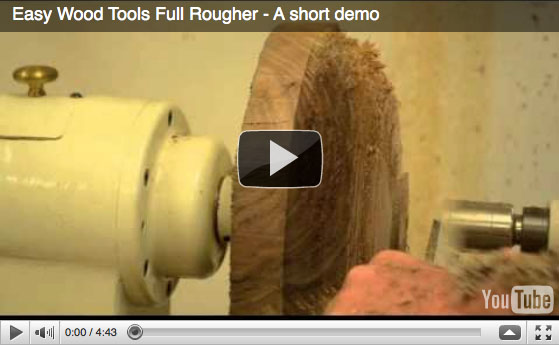
I am impressed with these tools so far. Take a look at the video below and also go to the Easy Wood Tools website to see how to use the tools. If you are a beginning wood turner and don’t want to spend a large amount of time learning the other traditional methods, then these are the tools for you. If you are a traditional turner with many hours of experience, you will still like these tools for their extremely easy (there, I said it) use. You can throw some chips fast and easy with these tools. Give them a try. And be sure to take a look at the video below if you still aren’t convinced.
May 032011
 

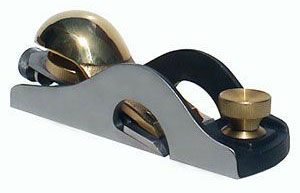
Many of my customers have come to me, wanting advice on which of our many block planes they should buy. Often this is prefaced by the fact they want to know this plane will provide a great deal of functionality, as this may be the only plane they purchase. With that in mind, I often suggest our Low Angle Rabbet Block Plane. When you first see this plane, you’ll notice it looks a little bit different from the majority of our other block planes. Just in front of the bronze cap, there is metal (on both sides) in the shape of what almost looks like a half circle. Since the blade on a rabbet plane reaches the full width of the plane (plus about .005”), this unique structure is the most efficient way to attach the front section of the plane.

This block plane will obviously perform admirably in most of the “normal” uses, such as taking wispy thin shavings from long grain or applying a quick chamfer. With the low bedding angle, it can also handle end grain quite well, too. Now since the blade reaches all the way to the edge of the plane body, you can also use it to clean up rabbets and tenons. (A rabbet is a groove cut at the edge of a board, often so another piece of wood will fit into the removed section.) When working on rabbets or tenons, the blade should be set exactly flush with whichever side of the plane will be doing the work. This is so the plane will remove material all the way up to the mating edge, without scoring the connecting face. A quick and easy setup method for this is to lay the plane on the side which will be used. Slightly loosen the spin wheel and gently press the opposite edge of the blade, while keeping the side of the plane flat, so the side of the plane and the blade line up together.  Don’t forget to re-tighten the spin wheel before using the plane.

Always remember to sharpen the blade on any newly purchased tool. We grind the blades to 400 grit at the factory, but a quick honing to 8000 grit will make your tools work so much better. Feel free to take a look at our sharpening demonstration on Youtube, or stop by any of our events, and we’ll be glad to show you in person.

One caveat I like to bring up, especially for those who may not have any other planes. Do not use a rabbet plane on a shooting board. The small band of metal on both sides of the blade on regular planes is what prevents those planes from continually cutting into the shooting board. Since the rabbet plane’s blade is full width, it would destroy the shooting board.

I hope to see some of you at our upcoming events, listed on the Lie-Nielsen website.


Lee Laird has enjoyed woodworking for over 20 years. He is retired from the U.S.P.S. and works for Lie-Nielsen Toolworks as a show staff member, demonstrating tools and training customers.

Apr 282011
 

Beginning woodworkers can take the flat smooth surfaces on our hand planes and other metal tools for granted. And sometimes the seasoned woodworker can as well. Even with the highly accurate grinding and surfacing that occurs at our factory, it can still seem like a bit of a battle pushing some planes across the wood. At least when compared with the same settings, but adding just a quick swipe of paraffin on the sole. I always advise everyone who is trying the paraffin for the first time to make sure they don’t let the tool get away. The first time I used some paraffin, I thought I was going to send the tool flying off the end of the bench. Friction is the enemy. To this end, prevention of friction, or additional friction, is worth the effort. One thing that can certainly add friction is rust. I’m sure most of you have felt a piece of metal that has rusted. It is usually quite rough.

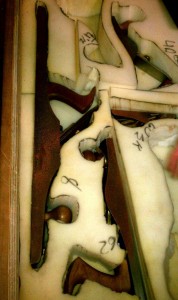
Most people know whether or not they live in an area where rust forms quickly. Many times the areas with elevated rust are near a body of water (ocean, lake, pond…), but high humidity alone will facilitate the formation of Mr. Rust. Obviously (or not so obviously), the bodies of planes made from bronze do not rust, even though the blade is still a potential target for rust. This is because rust is iron oxide. The metals used in most non-bronze planes, however,  are subject to rust. This includes the blade, which is made from steel. Woodworkers will try a multitude of procedures to ward off rust. In our show kits, we will put Jojoba oil onto a rag (Ed. note: camellia oil also works extremely well), and wipe a liberal amount onto all at-risk surfaces. This usually does an excellent job preventing rust formation.  Unfortunately, there can be the rare occasion where even this level of attention is lacking. When we opened up our show kit in Santa Ana California, the tools in the top-most crate were completely covered in rust, but only on the surface facing the lid. And I’m not talking about a few little specs of rust. It looked like the tools had been left out in the rain for weeks, if not months. This kit was in use in Santa Rosa just a week and three days earlier, with no rust. This can be scary, just how fast the heavy rust occurred. Initially we were in shock.
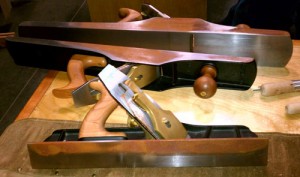
When we finally closed our gaping mouths, we got out our ultra-flat granite plate and a couple of maroon Scotch-brite pads. This combination provides enough abrasive to remove the rust quickly, while limiting the hard metal removal. We made sure to retract the blades, but leave them in the planes, under the same tension as when in use.  Next we applied controlled elbow grease.  I say controlled, since we made sure to keep consistent centralized pressure on whichever side of the plane we were working. If we put pressure onto one edge of plane’s side, there is good chance the flatness of that side would change. This is very similar to the procedure used when sharpening a blade in our honing guide. Centralized pressure results in a square shaped blade, while pressure towards the corners will conversely result in a camber. Strangely enough, even though the rust was covering complete sides of planes, since we’d applied the oil liberally, some of the rust would release when rubbed with a finger.
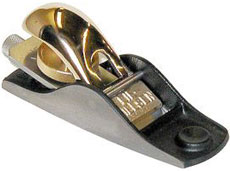
We worked all of the affected planes, until there was no active rust left. A by-product of rusting is metal staining. Even after the brownish-red active rust is gone, usually there will be some signs that rust was there. If the rust is on a surface long enough, it will also cause pitting in the metal. When the metal pits, it also tends to have rough edges around each pit. These rough areas have a tendency to abrade the wood, so it is unlikely a plane in this condition would provide a useful surface. Luckily, we only had one plane that showed any minimal signs of pitting. The lack of more widespread pitting is likely due to both the diligence shown when applying the oil when packing in Santa Rosa, as well as the short duration since the rust began.

So what can be learned from this? Most tools made from iron or an iron compound are at risk of rusting. Another thing, which in my mind is a bit more distressing, is just how quickly the rust formed. And this was on intentionally protected surfaces. If you live in an area, or take your tools to an area that is prime for rusting, elevate your protection measures. This could include wrapping the oiled tools in Ferro-wrap paper, which is treated with a compound inhibiting rust, or using a paste wax directly on the metal surfaces, or buying a dehumidifier for your tool storage area. Additionally some include desiccant packs in with their tools, to absorb moisture. (Ed. Note: We have found Zerust products are also a great solution: check out the drawer liner and the vapor capsules.)

Try some of these techniques to see what works best for you and your area and also check with some of the local long-time woodworkers, to see what they use.  Do whatever it takes to keep the tool’s surfaces smooth and rust free. You’ll see the difference.

I hope to see some of you at our upcoming events, listed on the Lie-Nielsen website.


Lee Laird has enjoyed woodworking for over 20 years. He is retired from the U.S.P.S. and works for Lie-Nielsen Toolworks as a show staff member, demonstrating tools and training customers.

Apr 152011
 

So what is it about Lie-Nielsen planes that ISN’T Earth “shattering”?

Many of you know the designs we pattern our Lie-Nielsen planes after are primarily the Stanley Bedrock series. The originals were made well and were easier to adjust than most others at the time. When customers either stop by our showroom or one of our events, many will, at the minimum, pick up and check out some of our planes. It’s relatively easy to compare the majority of features, from the thickness of both our cutting irons and plane bodies to the level of fit and finish. But not surprisingly, there are probably aspects of design that go unnoticed.

Most customers who own, or have used an old Stanley, will notice how much heavier our planes are compared to the Stanley brethren. This is due to the difference in the thickness of the castings. Besides being thicker, one of the critical aspects is the material we use for the body of our planes (except for those made of bronze). We use a ductile cast iron. What is this material and how does this compare to the old Stanley planes, as well as other plane makers? Ductile cast iron is a cast iron that has added materials that incorporate with the original materials and provide the ability for flexibility and elasticity, versus the tendency to shatter. Basically, the graphite in ductile cast iron is in the shape of spherical nodules rather than the flakes one would find in grey iron. The spherical nodules can slip past each other more easily, allowing for this flexibility. Designing the perfect blend was accomplished by spending a great deal of time via trial and error. Ultimately, the goal, which we achieved, was to make our Lie-Nielsen plane bodies so they would withstand the stresses the everyday woodworker would apply, and beyond. While I wouldn’t want to do this to my personal planes, our ductile cast iron plane bodies can withstand a drop from 15 feet, without shattering. There will likely be a bent corner, or something similar, but no shattering.

If you would like to know, rather see what happens when similar forces are brought to bear on a plane body using the old cast iron, take a look at the video created by Popular Woodworking Editor Christopher Schwarz. This is assuming you don’t want to destroy an old plane in your own collection. (Besides, it is a bit dangerous, with the flying shrapnel!) I still feel like I ought to at least wear safety glasses while watching this video.

I hope to see some of you at our upcoming events, listed on the Lie-Nielsen website.


Lee Laird has enjoyed woodworking for over 20 years. He is retired from the U.S.P.S. and works for Lie-Nielsen Toolworks as a show staff member, demonstrating tools and training customers.

Apr 112011
 

Just Starting Out

I hesitate to say I have tamed the skew, but at least I can live in the same house with it now.

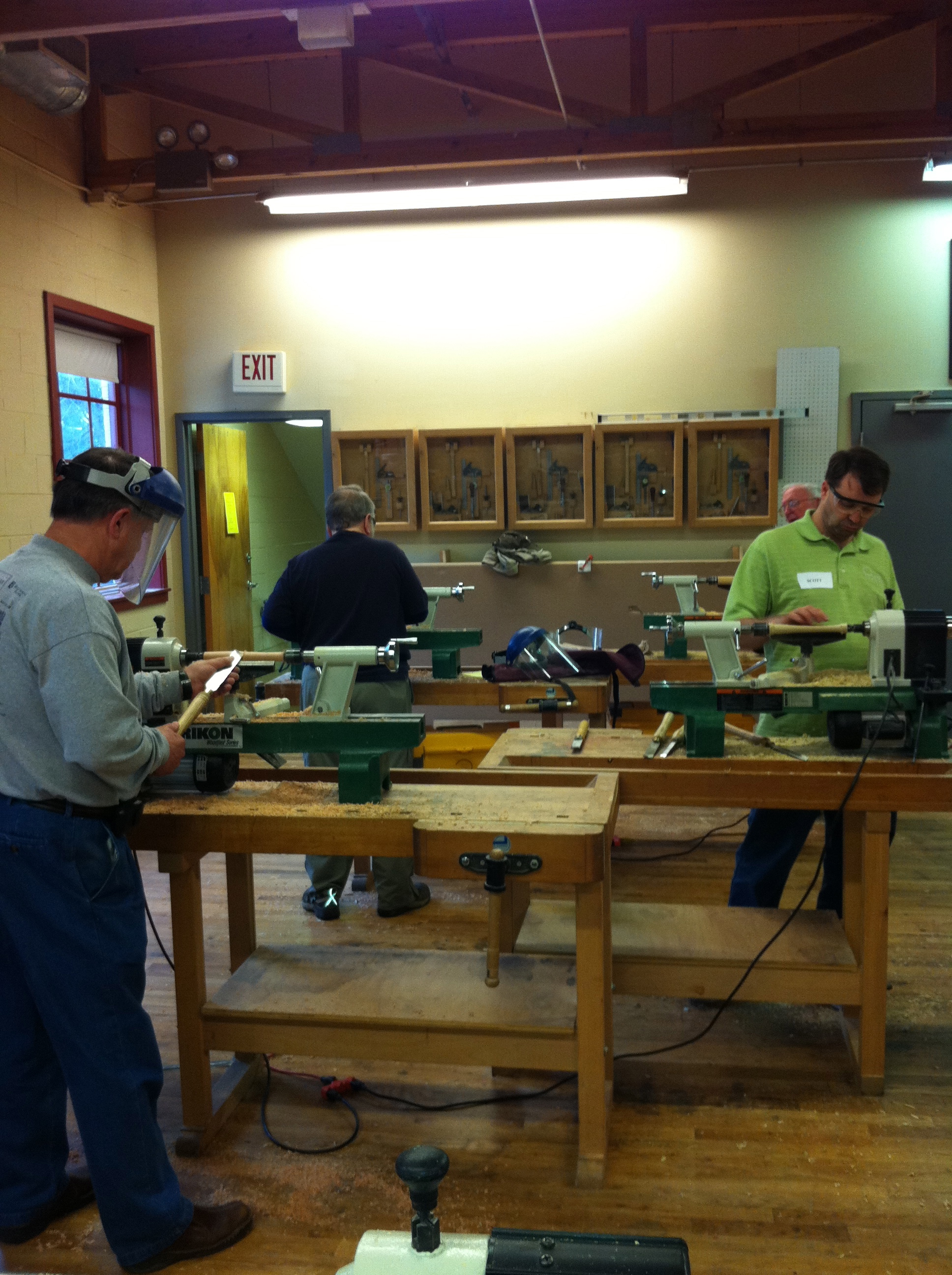
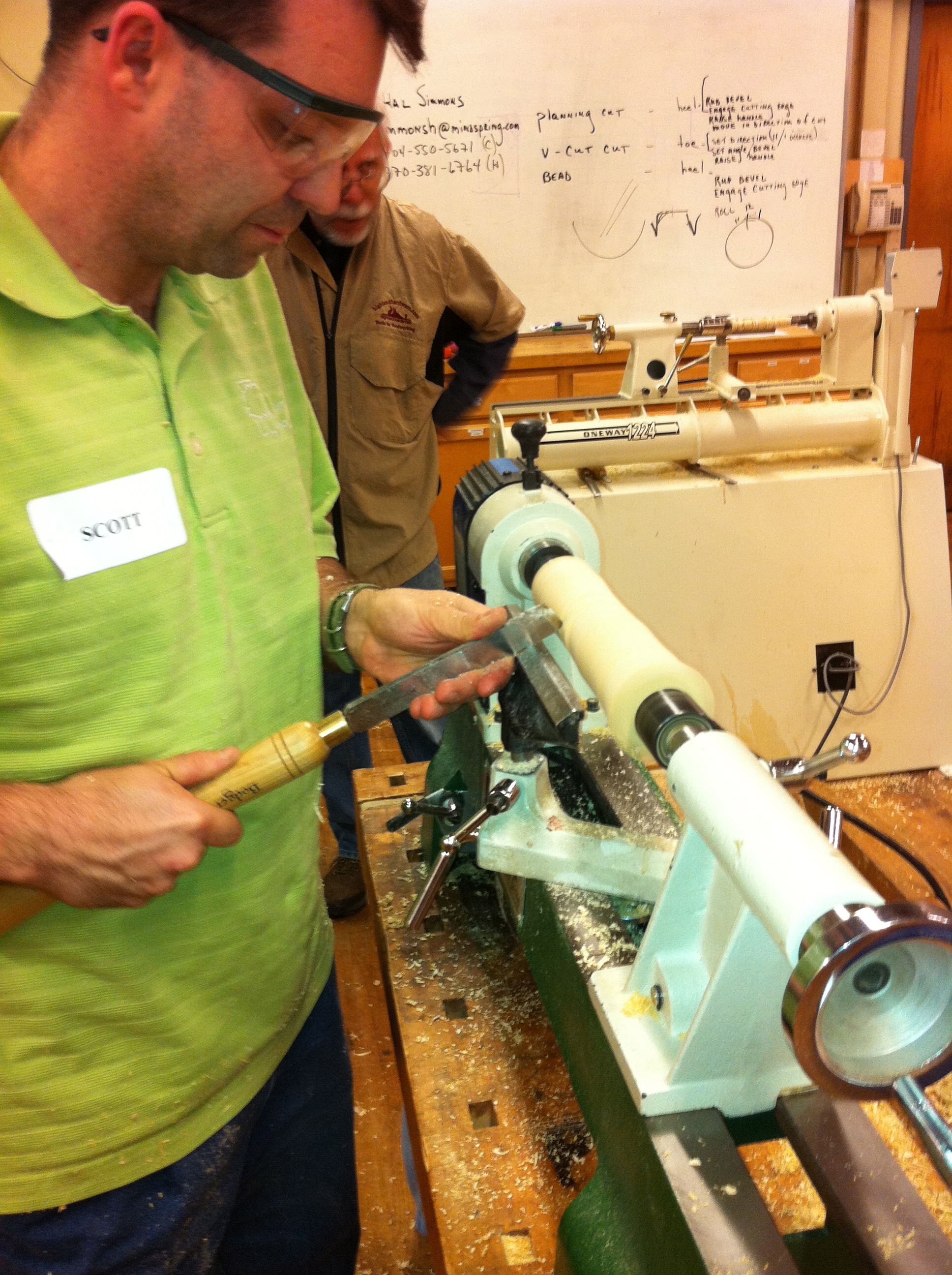
I went to the “Taming of the Skew” class at Highland last week and we spent three good hours with Hal Simmons, a professional turner, to try to solve some of the problems many people have trying to use a skew chisel.

We started out by learning how to sharpen the thing, first on a grinding wheel and then to a flat stone. As with almost any woodworking operation, having a sharp tool is a good thing. Hal asked each of us in turn what experience we had and what our issues were with the skew. After some discussion we moved to the fun part and we all got a good laugh. When Hal had a square piece of wood set up in the demonstration lathe, he turned the lathe up to very high speed and prepared to stick the skew into the wood. The whole class scattered like a flock of buzzards when a car comes along and Hal was standing there by himself. Apparently we all shared the same fear of the skew.

Trying to Tame It

Once he calmed us all down and got us back to the demo lathe, he demonstrated how to use the skew to round off a work piece. He was standing there rounding that wood and not even looking at it, and we were all standing around with our mouths open and pleading with him to watch the work, because we were absolutely positive we knew what was going to happen and it was not going to be pretty.

On The Way to Carnegie Hall

After we learned the basic planing cut, we moved into cutting a groove and then to widening that groove into all those beautiful shapes found on candle holders and chair legs and balusters. The cuts are simple in theory when explained well, but as with most skills, take a while to develop the proper motions. It’s the same answer you get in New York City when you ask someone how to get to Carnegie Hall. Practice, Practice, Practice!

At least I am not afraid of the tool anymore, and with a lot of practice I should be able to make some nice stuff. What a great class and it is offered every few months at the High. It runs from 5:30 to 8:30 in the evening and only costs $75. Go ahead, tame that skew!!

Apr 012011
 

Many of us have a picture of a certain spokeshave in the back of our mind. You know the one I’m talking about. Somewhat beat up with a mouth that’s open so wide you’d swear it was a big mouth Bass. I personally own two old second-hand shaves that so exemplify this statement. I can get lucky, on occasion, and get a decent cut without the grain tearing out, but it’s not a tool in which I’ve had a lot of faith.

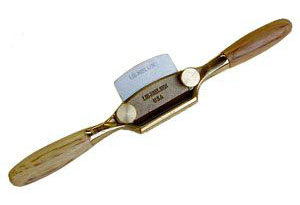
Now cue the cameras to zoom in on the Lie-Nielsen/Brian Boggs collaboration of shaves; specifically, the curved bottom shave. It has decent mass (12 oz), nice Hickory handles, and a to-die-for tight mouth. The sole on this shave has a 5” radius, which provides access to inside curves. You can modify it if you need to work curves with a tighter radius, within reason.

Setting up the shave is very easy. The first thing to remember is a sharp tool is a must. Even though the iron is somewhat sharp from our factory, it should be honed to 8000 grit. The iron comes with a bevel of 25 degrees and the honing is done with a five degree micro bevel, raising the angle to 30 degrees. Since the iron is very short, the honing can be accomplished by holding the iron by hand, or with any of the honing guides geared towards short irons. If you aren’t comfortable with sharpening, you can read one of my previous articles on this blog where I focus on that skill. With a sharp iron, set the shave sole down, so the mouth is on a flat surface. Slightly loosen the thumbscrews, until the iron can move forward to the point of touching the flat surface you are using. Snug up the thumbscrews, and test the cut. This should provide a thin shaving, but it is easy to adjust from this point if it doesn’t. To advance the iron, you can either use light taps with a light weight hammer, or while holding the shave with the mouth facing down, hold one handle and tap the other on a firm surface. If the shaving is too thick, flip the shave over so the mouth is facing towards the ceiling and again, holding one handle, tap the other handle on a firm surface. If the iron doesn’t want to move, very slightly loosen the thumbscrews. If you loosen them too much, the iron will advance/retract in movements larger than optimal. Remember to again snug the thumbscrews down if you made any changes. With these techniques, it is very easy to make small adjustments.

One last adjustment is completely optional, but a good idea. When you are setting your depth of cut, a slight skew in the iron will allow a heavier cut on one side and a lighter cut on the other (e.g. left side heavy and right side light, or vice versa). With this, you can remove material quickly on one side, then follow up with a finishing cut on the other side, without going back to change the setup. This certainly helps save time.

Now that the shave is set up, usage is similar to many wood cutting tools. The wood grain will dictate the direction that cuts the cleanest. I find that holding the wood I’m working, in a vise or shave horse, allows me to use both hands on the shave which provides greater control. I’ve seen some folks use the shave by holding the wood in one hand and the shave in the other. For me, this is a recipe for disaster, whether it be a poor surface or possible injury. Just remember that a shave is a finesse tool, and with that, small changes in pressure will make a difference in your results. Find the wood holding device that works best for you, and start making some shavings.

I hope to see some of you at our upcoming events, listed on the Lie-Nielsen website. Stop by and say hi.


Lee Laird has enjoyed woodworking for over 20 years. He is retired from the U.S.P.S. and works for Lie-Nielsen Toolworks as a show staff member, demonstrating tools and training customers.

Mar 312011
 

This article is a continuation of a two part post. To read part one, click here.

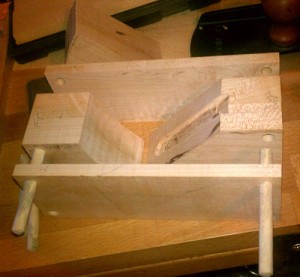
Now it’s time to glue the pieces back together. I use standard yellow glue for my planes, and it works great.  Before applying glue, I use the dowels to line up the heel and toe on one of the side-pieces. I then draw a line against the core pieces, so I know where not to apply glue. Repeat the process on the opposite side. Get all of your clamps together, so you’re not scrambling around at crunch time. Now it’s time to apply the glue.  Apply a very thin layer of glue on all mating surfaces, making sure not to get into the non-glue area.  Remember, if you put too much glue on the pieces, you’ll struggle with all of the squeeze-out.  After applying the glue, push the dowels into place, so everything is aligned properly. It’s a good idea to remove the squeeze-out in the throat opening before it hardens. I use a small putty knife that I’ve ground to a point on one side, so it gets right into the corner. After applying your clamps, let it cure for a couple of hours, or even overnight. That way you’ll come back to it good and rested.

When the glue is cured, cut the dowels off flush with the body.  Now it’s time to drill the hole for the cross bar. I bought some 3/8” mild iron rod at the local big box store to use for my cross bar. It’s easy enough to cut and work with, using either a hack saw or a jig saw.  I use a scrap piece of hard wood when determining which drill bit matches best for the cross bar. After finding the right bit, I go to the drill press so I can drill the hole for the cross bar. To determine where to drill, find the intersection of the sole and the bed. Draw a light line up approx 1-25/32”, then approx 23/32” towards the bed. This is a decent approximation, which can be modified on future builds, if desired. Make sure you clamp the plane body to your drill press table. You don’t want it spinning around and either hurting you or damaging your project. On my planes,  I want the cross bar to slide into place with very slight friction. This is so I can remove it, and re-install it while working on the final build, so I can cut the body to shape without worrying about hitting the cross bar.  I drill completely through the first side (with the leftover triangular piece stuffed into its original opening) and about half way into the other side.  This method allows me to “hide” the cross bar entry point, if I wish, by plugging the entry hole.

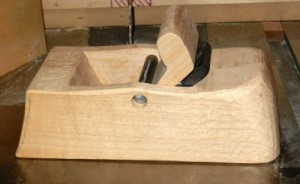
Now it’s time to cut your plane into your desired shape. Remember, it’s a good idea to have the back of the plane iron at least slightly above the top edge, so it’s easier to set or adjust the iron. After cutting to shape, you can use rasps, files, chisels, sandpaper, and anything else you desire to finish your plane’s surface the way you like. Some prefer a very smooth outer surface, where others like it to have texture so it’s easier to hold onto. This is personal preference. I usually use a chisel to put a bevel on all edges, so they are both stronger and feel better to the hands.  If you don’t feel comfortable with this, sandpaper will knock off the edges, too. Now that the shaping is completed, you’ll need to make a wedge out of the left-over triangular piece.  The fitting process can take a while, but it is another skill learned.  Slide the cross bar into place, put the iron onto the bed and then put the wedge between the cross bar and the iron.  Tap the wedge with a little force, so the cross bar marks the wedge where it makes contact.  This will show you which portion is making contact, and which area is too low.  Use your preferred method to remove material from the area on the wedge where it made contact. Reinsert the wedge, and repeat until the wedge is showing signs of contact with the cross bar, all the way across, or at least on both edges. (If it is making contact on both edges, it will apply equal pressure across the iron) It’s a good idea to work the fitting until the wedge reaches down past the cross bar about an inch or an inch and a half. Remember to take the fitting process slowly, as you can always remove more, but it’s more difficult to add material to the wedge.
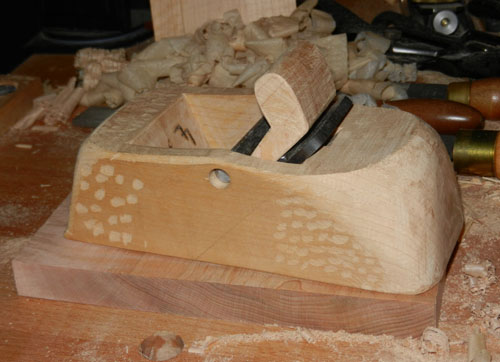
If all things have gone well, your iron will not show through the sole of your plane.  This may sound like a problem, but in actuality, it allows you to slowly work the plane until you have an extremely tight mouth. This is important, if you intend to take extremely fine shavings and work figured woods. To remove the excess wood, you can take fine shavings on a powered jointer, use a jointer plane, or even tape sandpaper down on a flat surface. Whichever way you choose, just work gradually, so you can sneak up on it.  When you get close, you can also use a small file to open up the mouth, so you are removing less material and don’t end up with too large of a mouth.

Now that you’ve completed all of the build and setup, there is one last thing to remember. Sharpen the iron so it is razor sharp.  Dull irons just don’t ever give good results. If you aren’t comfortable with sharpening, this video provides some great tips.

I hope to see some of you at our events across the country.  Feel free to come up and say hello.


Lee Laird has enjoyed woodworking for over 20 years. He is retired from the U.S.P.S. and works for Lie-Nielsen Toolworks as a show staff member, demonstrating tools and training customers.