Highland Staff

Mar 162012
 

I have been thinking about dipping into spoon making (Wow, did anybody not see that one coming?) for a long time. A couple of months ago, I finally did it and I think I like it.

Several things got me started — Peter Galbert on his website shows how he makes spoons during those long cold winter nights by the fireplace up there in far north Massachusetts. Then he sells them to benefit a favorite charity. Go to http://chairnotes.blogspot.com and search for spoons in the list at the bottom right or click “Spoons for Hunger” at the top right of his page. His spoons are beautiful and painful to me as I am reminded of how far I have to go.

Another source for spoon making ideas is Robin Wood in England.  Go to http://www.robin-wood.co.uk/ and see what he has to offer. If I lived in England and did wood working, I would call myself Robin Wood. I love his bowls, too. He uses a foot-powered lathe to make bowls and you saw them in that recent Robin Hood movie with Russell Crowe, the one with the medieval wooden Higgins boats the French used to invade England. I laughed out loud. Robin gives classes and next time you cross the pond, you can sign up. He does beautiful work which is also painful to me.

Try Roy Underhill’s “The Woodwright’s Shop” for show #3108 with Peter Follansbee on carving Swedish spoons. The main thing I learned from this one is to use green wood (duh!). I mean I did not get that when I started. I was picking up old chunks of wood from around the shop and then dust was flying everywhere and I never got it done, and my admiration for spoon carving was rising all the time. I was about to give it up as too hard and too much trouble when I watched Roy and Peter and they set me on the green wood path.

The fourth source is Drew Langsner over at Country Workshops in North Carolina. Go to countryworkshops.org and check out his videos and maybe you can sign up for a class.

When I first started looking and learning, all the instructors used traditional tools to carve spoons. You start out with an axe and then move to a carving knife and a curved hook knife, a spoke shave and anything else with a edge that will remove wood. Took me about three days of effort before I discarded some of that junk. I finally went to the band saw, a hand grinder and the spindle sander — anything to get that wood off there. If I could make the chain saw do it, I would.
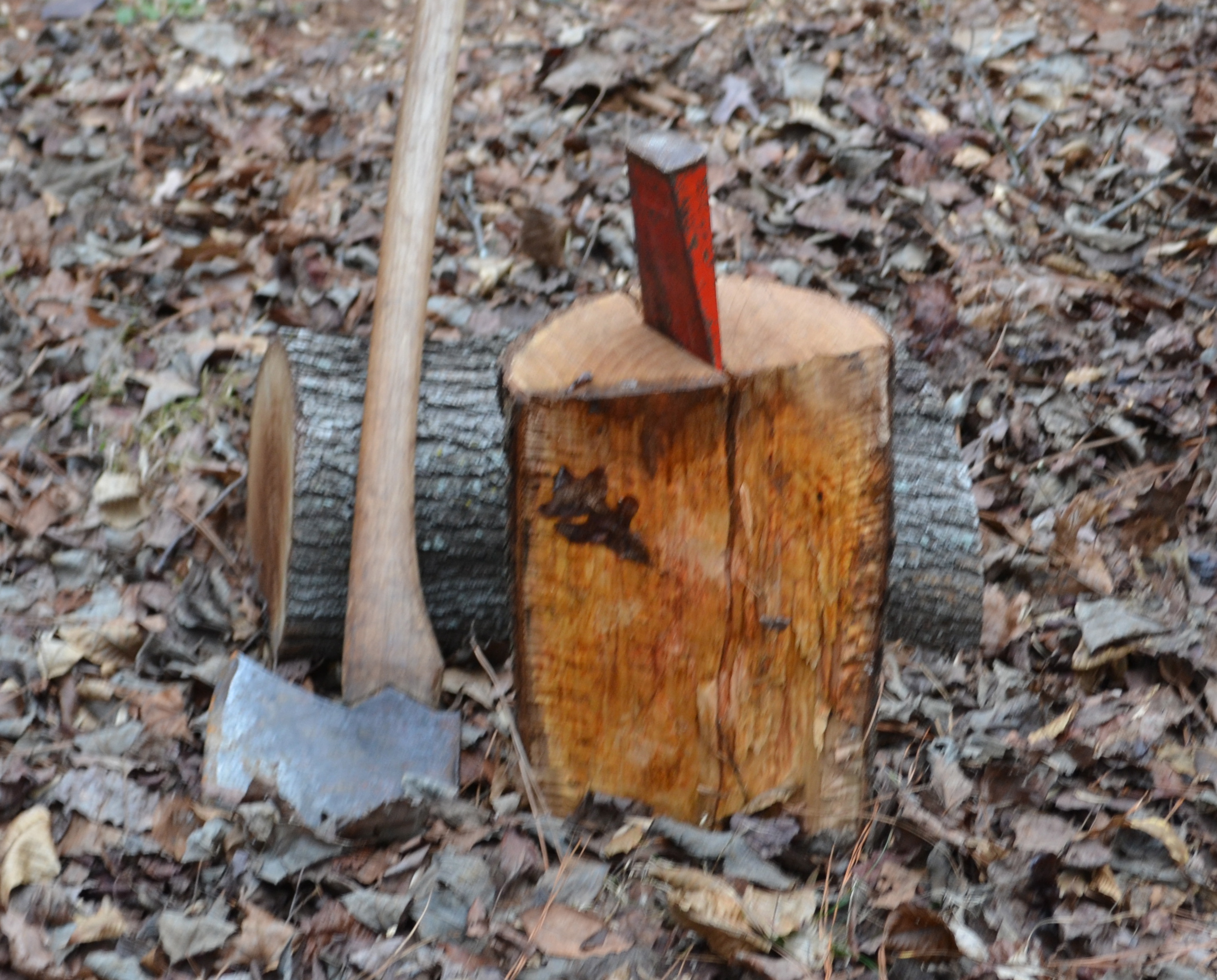
Splitting the spoon blank.

I had some green Bradford pear wood that I got when a tree blew over at the office. I split it out to a suitable blank and sketched a shape I liked from one side and then from the top and put it on the band saw to get the basic shape. I moved to the axe (from Highland) and a stump (from the yard) and started hacking away. Surprising how much wood (or fingers) you can take off with an axe while still maintaining control of the work. I found the trick to a good spoon is getting it thin enough to make it look delicate while leaving it thick enough to be strong. I like a shape which is wide horizontally at the handle and tall vertically near the bowl. The transition between the two is lovely when done right.
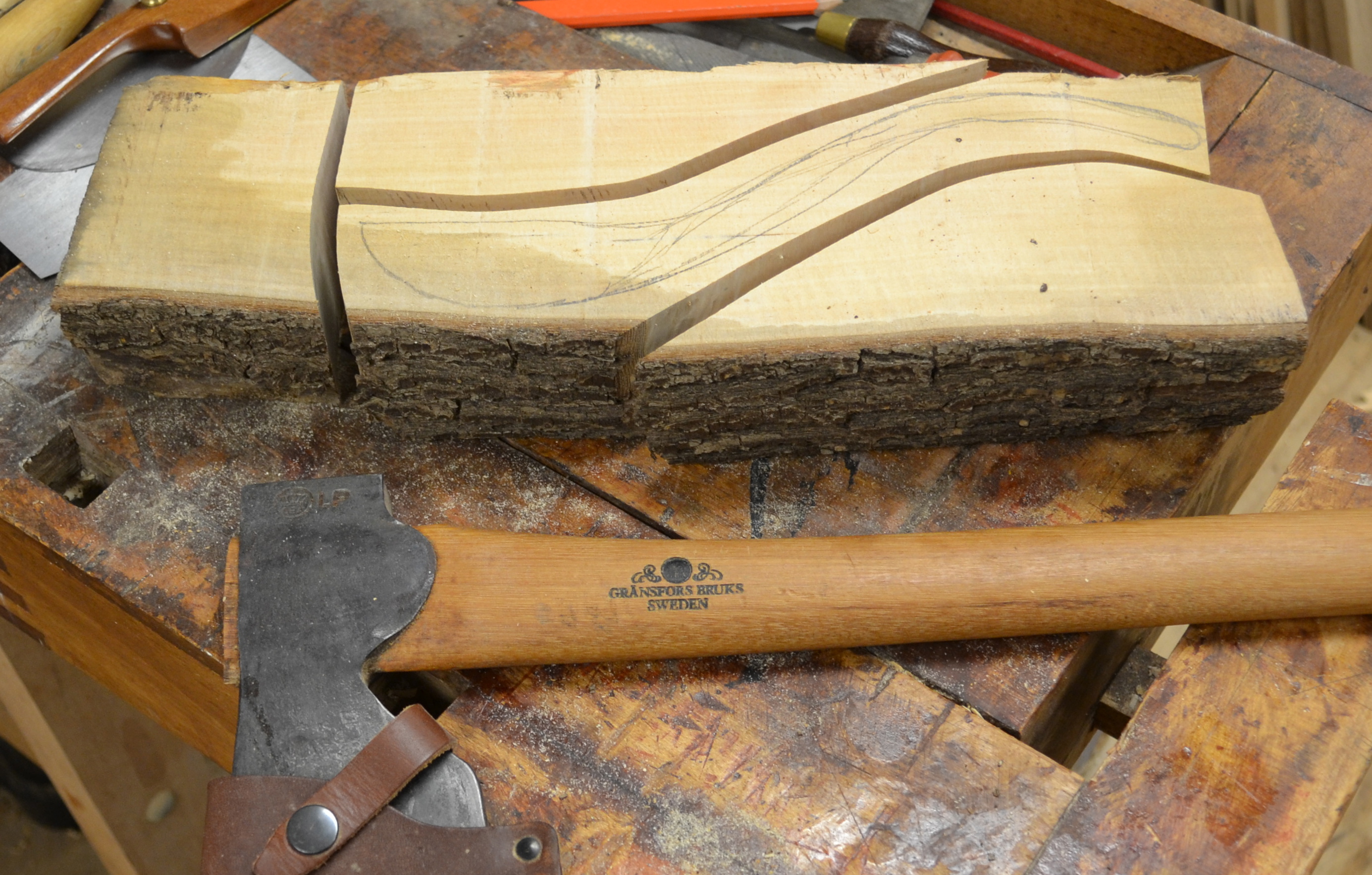
Roughed out on bandsaw

The tools I used are some I already had around the shop including the short axe, and a spoke shave. The other odd group of tools is a set of Exacto hobby tools which are small and very sharp, and include a small spoke shave which is marvelous for final shaping, and a round head cutter sharpened on one side. I went to Highland and bought two new tools which are really nice for the work. One is a small carving knife which came very sharp with no need for honing. It works like a champ. The other is a curved hook knife which is used for hollowing out the bowl of the spoon. I was surprised at how well that little knife worked. You can see all the tools in the picture.

The single biggest problem is holding the work so you can carve on it. Roy Underhill showed how you actually carve the bowl first since it is the hardest to shape. Plus you can clamp the square handle in the bench vise so you can work the bowl. I found there is a delicate balance between holding and carving, and eventually you end up holding the whole thing against your chest while you carve. One of these days I will have to make a shaving horse which I think will work better without breaking the spoon.
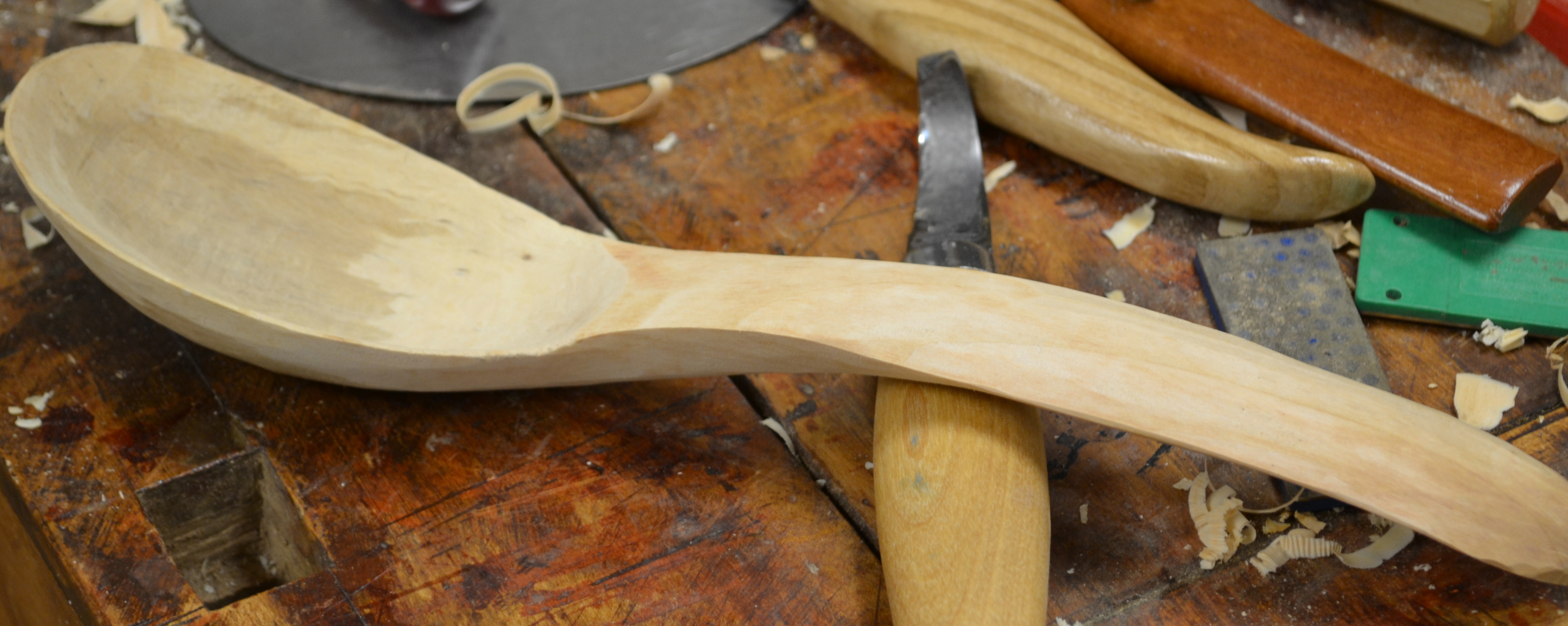
Almost ready to go.

As I said, I am not proud and I will use any power tools I have to get the wood off. I did learn to wrap the unfinished piece in kitchen plastic wrap to keep it from drying out until I get back to it the next day. So far it takes me about four or five hours over a couple of day to get one done, but I think I will get faster. I have done about four spoons so far and the last one was pretty good. I had a bowl out of cherry that looked really nice and I noticed the spoon matched the bowl, even though they are different species. It made a really nice bridal gift.
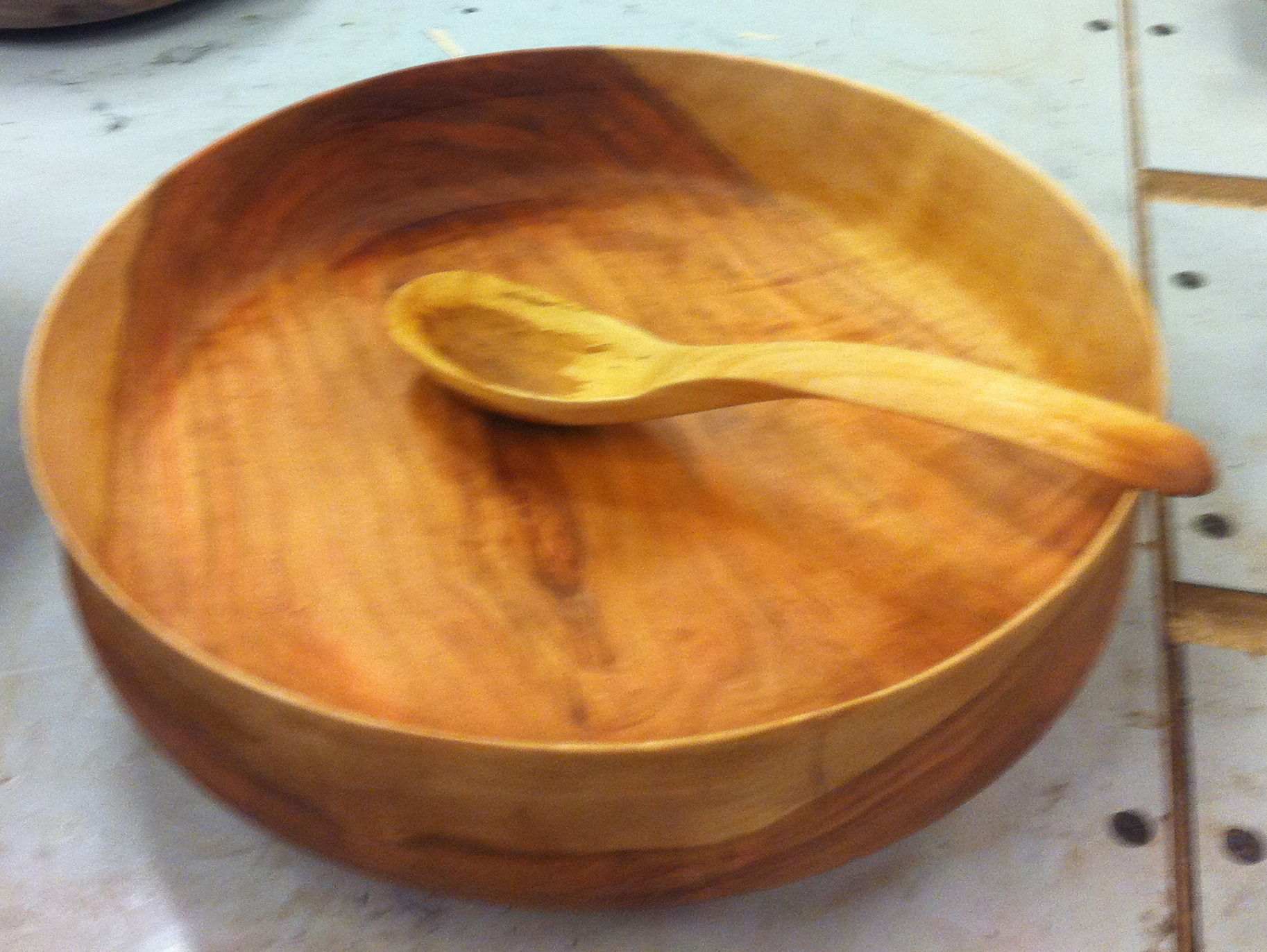
The bridal gift.

Think you might like to make a spoon one day?
Mar 072012
 

For those of you whom are not already familiar with the router plane, I’m sure the name could easily paint a picture of a tool with a spinning bit, possibly propelled by a hand crank. In actuality, the router plane is a tool with a flat base and a fixed blade. The blade extends down below the base, so it can remove material at a chosen depth, which is ultimately parallel to the surface of the wood.

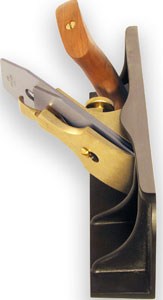
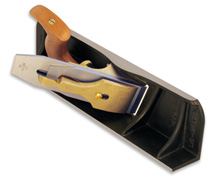
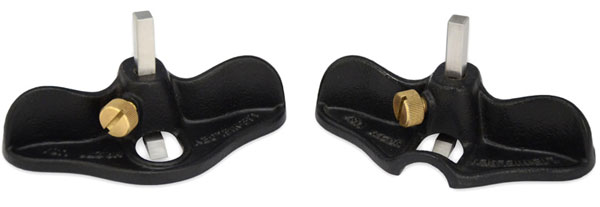
Lie-Nielsen #271 small router planes

Until recently, Lie-Nielsen offered a single small router plane, the #271 (above right). There is now an additional version in their arsenal, the #271-CT (above left). The difference between the original design and this new addition is in the base shape, in front of the cutting side of the blade. The original design has a section of the base that raises up in an arch shape on the “open throat” version, from one side to the other, providing additional view of the intended cutting area. The new addition, which augments the lineup, has the base continuing from side to side, without the arch, which is considered a “closed throat” design.

Pointed blades

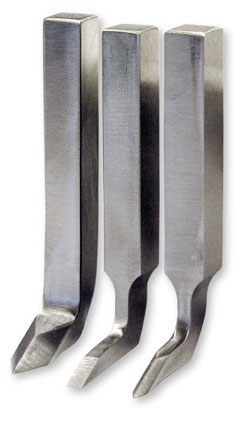
The router planes, with smaller footprints, are very useful in smaller scale work, both in small joinery or inlays. There are a variety of blades available for the smaller router planes. From the factory, the #271 and #271-CT each come with a 1/4” square blade, but you can also purchase a 1/4” pointed blade (left), a 3/32” square blade (center) and a 3/32” pointed blade (right). All of these blades are made from O-1 steel, and are hardened to RC 60-62. If you still need a different sized blade, as long as it is not wider than 1/4”, you can buy a stock sized blade to modify. For instance, if you are working an area for some banding, that is narrower than 3/32”, I’d suggest removing a little material from each side of the blade, until the required size is reached. I would only remove steel from the portion of the blade below the bend, leaving the shank original sized. It is easy enough to modify one into a needed shape, or size, for a job. While it’s certainly not hard to do, I would suggest working carefully, and taking you time, so the temper of the steel isn’t accidentally lost. If you need help sharpening these blades, please look back at the article relating to the Large Router Plane setup.

Setting the depth of cut, on the small router planes, can be a bit more touch sensitive. They are not equipped with any mechanical advancement on the blade, like is used on the larger versions, so a different approach is needed. I personally like to start with the blade out a little less than my final needed depth of cut, for each pass. I set the adjustment knob firm enough to keep the blade from moving on it’s own, but not so tight that gentle hammer taps have no effect. This allows me to advance the blade in very small increments, using a very light hammer, and controlled tapping. When I have the blade advanced to the needed depth, I tighten up the knob with a screwdriver, so the blade won’t drift in or out. Another method of setting the blade depth, is to use shims under the plane body, on both right and left sides. With the body resting on the shims, loosen the adjustment knob and let the blade gently slide down until it contacts the surface. Again tighten the knob with a screwdriver and very rapidly, you have an accurate depth setting. No matter what method is used, it’s really pretty easy.

The hardest question may be which of the two styles of the #271 to get, which can ultimately come down to personal taste. Some prefer the open throat version, feeling they can more readily see in front of the blade, while they work. Personally, I find the closed throat version has enough viewable area in front of the blade, so I don’t feel like I’m working blindly. If you are working an area, on the edge of a thin board, the closed throat version would seem to excel. This is due to the extra material in front of the blade, allowing the plane to rest on the board, both in front and behind the blade. This makes it simple to keep the plane level, and the depth of cut consistent. When using the open throat version in this same scenario, I clamp an extra piece of wood on each side of the thin board, and level with the project board. This makes it so the body of the plane will ride on the two outside-boards, acting like an out-rigger, preventing the plane from accidentally tipping forward. Either way works fine, so it just depends on the users preferences.

Stay safe, keep making shavings and enjoy your woodworking. I hope to see some of you at our upcoming events, all listed on the Lie-Nielsen website. Feel free to contact me at lee@lie-nielsen.com if you have any questions or suggestions for future articles you would like to see.

Lee Laird


To take a closer look at the #271 small router planes, click here.

To see Highland Woodworking’s entire selection of Lie-Nielsen hand tools, click here.


Lee Laird has enjoyed woodworking for over 20 years. He is retired from the U.S.P.S. and works for Lie-Nielsen Toolworks as a show staff member, demonstrating tools and training customers.

Feb 172012
 

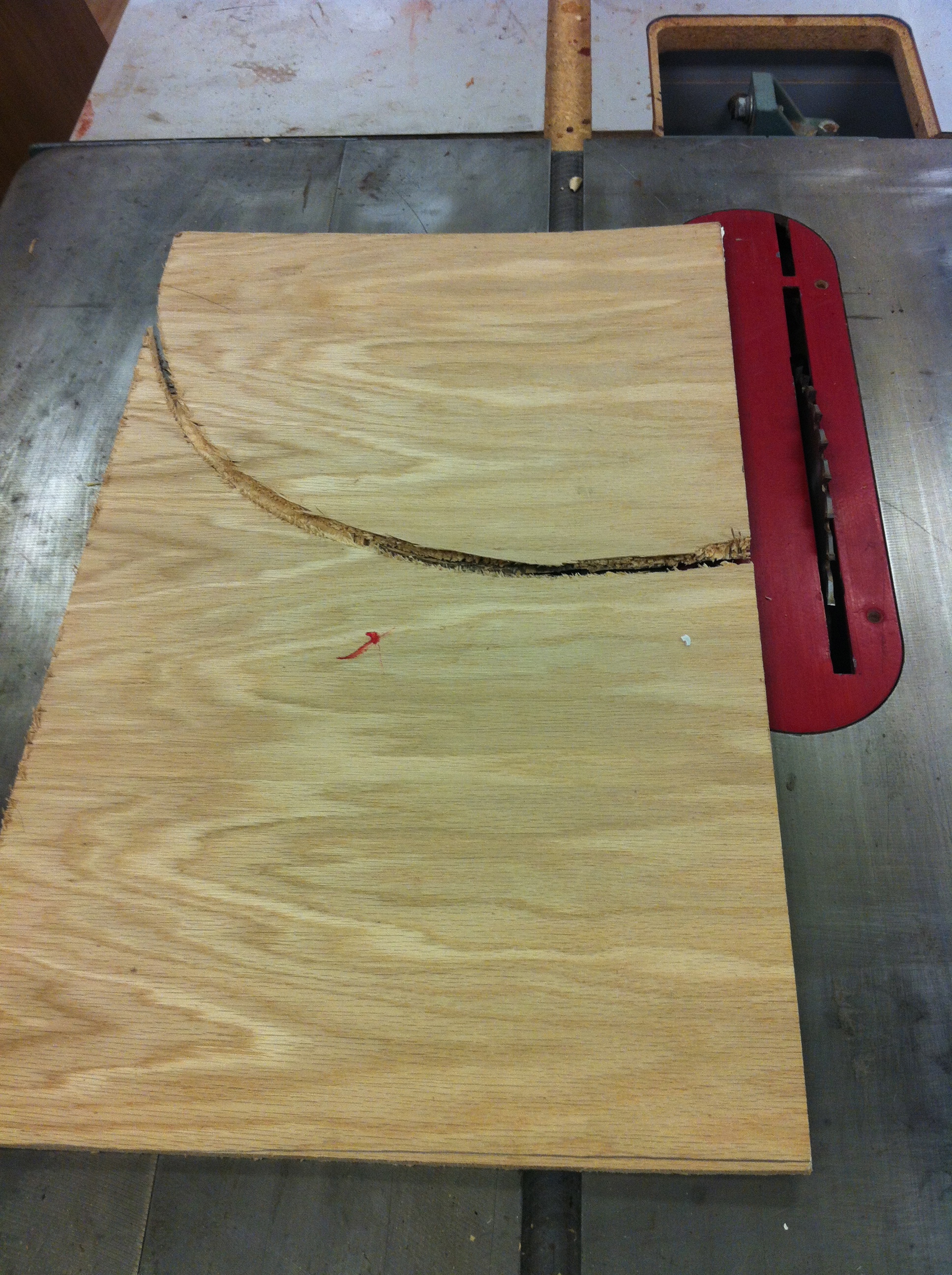
Bet’cha can’t do this. Not many people can cut a perfect arc on a table saw in a thin piece of plywood. Notice how the cut is just the right depth to keep the ply together. Notice how the cut starts in from the side perfectly tangential to the arc. Notice how the cut continues all the way across the workpiece in a perfect arc. Notice the small blood stain in the center of the piece.

Perfect Arc on the Table Saw

Maybe you have guessed by now this is a terrible mistake and a big screwup. I was cutting some pieces of plywood for our annual family gingerbread house construction and I failed to pay sufficient attention near the end of the cut. It got away from me in about one tenth of one second and the next thing I knew it was bouncing off the back wall of the shop about 15 feet behind me. Thank goodness I was wearing a face shield and standing to the side as I always do. The only damage, besides my ego, was a broken fingernail and a pretty good scrape to my ring finger from the flying plywood. That thing took off like a helicopter, flew just past my head, all the way across the room and banged into the wall near the ceiling behind me. It was brutal and scary and reminded me all over again how potentially devastating a moment of carelessness can be in the shop.

I am sure that many of you out there are looking at my saw and noting the lack of a guard and splitter at the blade. You are right and I deserve that. But for all you beginners out there, note this. I am an experienced woodworker who has used a table saw for years and I know how this kind of kickback happens. It happens because I took off the splitter behind the blade and the piece twisted and the back portion of the saw caught the wood and threw it back at me. But you see, I was just going to use the saw for thirty seconds to make a base for a gingerbread house and it was not a real project, and I know all about this stuff cause I write for Highland and I don’t need any advice from you. That kind of thinking is what gets you hurt. Leave the guard on your saw or at the very least, get an aftermarket splitter behind the blade. And be careful out there.

By the way, the way you know you are pretty far gone is when something bad happens, all you can think is “Oh wow, that’s a great blog entry”.
Feb 082012
 

When I mention using a plane to shoot wood, during our events, I usually have at least a couple of customers whose eyes and facial expressions tell me it’s not a familiar term. So just in case, I’ll offer a brief history of this plane, so everyone reading is comfortable.

Lie-Nielsen No. 51 Shoot Board PlaneUsing a plane to shoot wood is usually accomplished by laying a plane on its side, so the cutting iron is presented on the left-hand sole that is now vertical (this is for a right hander, but would be opposite for a left hander). The wood is usually held up against a fence, to support the work piece, but also to support the fibers on the out-feed side of the cut. Most woodworkers either make or buy a shooting board that has both a “shoot” area and a fence, that are around 1/2” or so different in height. To better describe, the shoot is lower than the surface where the work piece and fence reside. I made my shooting board with three pieces of 3/4” Baltic Birch plywood, which is historically very flat, and doesn’t have much tendency to move. The bottom piece is approx 12” x 12”. The next piece is approx 12” long x 9” wide and is attached on top of and flush to the first piece on three sides, leaving the extra 3” of material on the bottom piece on the right side of my board. This is where my planes ride, or in other words, its shoot. The third piece is about 1” x 9”, and is used as my fence. If you think about this shoot board, and the area to the right is my plane’s shoot, then my fence is at the top of this setup.

Now that everyone is hopefully up to speed, lets talk about the planes we use to shoot. I’ve seen woodworkers use just about any plane in their arsenal in a shooting configuration. One really critical aspect of any plane used to shoot, is that the side of the plane must be 90 degrees with its sole. Beyond this, in the past, it’s mostly come down to what feels the best, but mass also helps. The 9 Iron (or just 9I) was the plane that many saw as the best shoot plane, since it has such a large bearing surface. This made the plane easy to use since it didn’t require much extra attention in keeping the plane flat, while moving through the cut. The other plane with a fairly large number of users was the #62 Low Angle Jack. The #62 has a great accessory available, called a hot dog, that allows you to comfortably grasp the plane while shooting. The hot dog’s looks don’t give it the credit it is due, in my opinion. It’s hard to tell the hot dog is solid aluminum, and turned on a lathe, before milling out the material that allows it to slip over the side of a plane. Much more high tech than it initially appears.


Lie-Nielsen no. 51 Shoot Board Plane
Woodworkers have been using both of these planes for many years, with good results, but the recent #51 plane from Lie-Nielsen will likely lead to large numbers of ship-jumpers. Stanley originally made a #51, but they are extremely rare. The #51 is a purpose-made shoot plane, and in my opinion, the best ever. I know what many of you are probably thinking: “What can possibly make this plane that much better than the 9I and #62”?  Well, since the #51’s sole purpose is to be used as a shoot plane, certain aspects could be modified without any negative consequence to any other functions. The #51’s body shape is that of a long “L”, which provides a super stable platform and an equally good bearing surface where the iron is presented. Unlike the other multi-purpose planes, the #51 has a wooden handle oriented with the intended function of this plane, and is comfortable enough to use for hours. And for me, the difference that really MAKES this plane, is the skewed orientation of the iron. Now this may make some wince, worrying how they’ll sharpen this bad boy, but worry not. The iron is our normal 2 3/8” straight iron, but the manner in which the frog is oriented creates the skew. This skewing does a couple of things. The iron enters the wood by slicing down through the fibers, starting with just a small section of the iron and working down across the remaining iron. It may not sound like a lot of difference, but when using the other planes, the portion of iron that will cut all makes contact with the full width of the wood. Basically, a lot more surface area making contact with the wood on the other planes, which feels like an impact of sorts. On the #51, since the contact area is initially so small, it doesn’t require as much force to enter the wood, and ultimately the impact isn’t felt. This is yet another feather in the #51’s cap, for those with lots of end grain to shoot.

Stanley also made a #52 shoot board, that was a perfect fit for their original #51. Stanley’s #52 was made of metal, had a track that fit the #51 perfectly, and had a fence that could move from 90 degrees to 45 degrees. These original 52s are quite hard to find, but just in case you have one, the Lie-Nielsen #51 will fit it, too. For those that don’t have an original #52, Lie-Nielsen is working on their own #52, for future release. The #51 will still work just fine in a home made shoot board, but in conjunction with the #52, it makes one heck of a combination. The #51 is presently available, but supplies can at times be limited. Let the end-grain shavings amass!

I hope to see some of you at our upcoming events, all listed on the Lie-Nielsen website. Feel free to contact me at lee@lie-nielsen.com if you have any questions or suggestions for future articles you would like to see.

To take a closer look at the #51 shoot board plane, click here.

To see Highland Woodworking’s entire selection of Lie-Nielsen hand tools, click here.


Lee Laird has enjoyed woodworking for over 20 years. He is retired from the U.S.P.S. and works for Lie-Nielsen Toolworks as a show staff member, demonstrating tools and training customers.

Jan 052012
 

*
I remember using some rasps that my grandfather had in his shop, back when I was a young kid. I’d always wonder when I’d use such coarse tools, as they just seemed to mess up my wood, rather than really seeming useful. Through the years, I’ve tried quite a few different brands, and even bought a few, but they still lived in the deepest, darkest places of my tool area.

What happened next is still not completely clear, but it somewhat reminded me of mad dash purchasing events from the past. (One specific instance involved a little toy called the Furby, when suddenly everyone with kids seemed to be on a crazed mission to obtain them for Christmas presents. Everyone who had kids back then likely gets this.)

So, all of sudden in late 2007, I was reading how a French company named Auriou was likely going out of business, and after the current supply, these wonderful Auriou rasps might never again be available. I had read many woodworkers describing how these rasps were like no other, and the resultant surface was truly amazing. Even with my previous negative rasp experiences, I decided to jump in. I was scouring any and all websites; both those in English and foreign languages. I felt quite lucky, after numerous rejected orders, to finally obtain a couple of different sized/grain Auriou rasps. I figured I’d put them to the test, and if they didn’t work for me, I could sell them to another woodworker. Well, they turned out to work just as well as others had described. I was (and am) stoked to have these great tools.
Auriou cabinet rasps
Fast forward close to a year, and as luck would have it, Michel Auriou was able to find a way to again make rasps. They are now made under the company name of Forge-de-Saint-Juery. Not all styles of Auriou rasps that were made in the past, are available at this time. Michel continues to assess the marketplace and woodworker’s needs, and has plans to add other styles as his company can tolerate, which is always a balancing act. The new rasps are made exactly the same as those before, which will likely keep all the craftsmen continuing to work as they have for years. The new rasps are works of art, just like their predecessors.

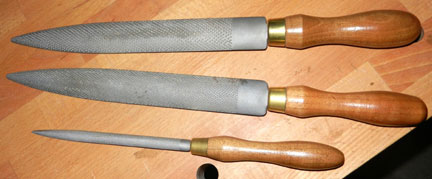
After the “re-opening” I was able to fill in a couple of gaps in the sizes of rasps I owned, which brought me to four. Three of the Auriou rasps I purchased, are each flat on one side and curved across the width on the other, which are called Cabinet Makers (except for the smallest, which is called a modelers).These have stiched teeth on both flat and curved sides. The rasps are available from Grain 1 to Grain 15, with 1 being the most aggressive and geared more for stone work, and 15 the most fine. My first is a Grain 5 for initial hogging off of wood, second a Grain 9 for getting close to the final shaping, and then a Grain 15 that cleans up many signs of any rasp usage. I love the control these rasps afford, and with the range of aggressiveness, I can determine where in my process I want to put them to work.
Auriou curved rasp
Now I did say I bought four, didn’t I? Well, the fourth is a bit more specialized, but one that I’m glad to have. This one is Grain 13 and used when making handles, like those on a handsaw. Oddly enough, this rasp didn’t come with a handle, so I turned one out of some wood that came from bushes that died in front of my house. The wood had been sitting for about 6 months or so, but still decided to check dramatically, after some of the turning. Luckily, I had ample amounts of super glue around, so I could keep it together. Even with the checks, this wood seems to add extra character to my rasp, but I could always replace it with a store made handle, if it doesn’t last the test of time. This rasp has teeth on one side, while the opposite is completely smooth, with the toothed side similar in shape to the curved side of the Cabinet Makers rasps. It also has a curve at the tip of the rasp, along the length of the rasp, so it makes it easier to get to areas on the piece you are working, while the lack of teeth on the opposing side limits any damage from accidental contact.

The Auriou rasps are hand stitched, which is to say a skilled craftsman takes a blank of metal, held down on a very special work bench, and using a special barleycorn pick and a heavy hammer, work their way across and down the blank. It is truly amazing to watch their skill in this process. I was lucky enough to have Michel Auriou give me a demonstration at our Open House in July 2010. If there had been a little bell sound, at the end of each line, I might have mistaken the tap-tap-tap sound of the stiching process as that of an old manual typewriter.

With this method, the raised rasp teeth from each line don’t form a straight line with the teeth above and below, as they will in most machine made rasps. With this, there is little chance to find a spot where the rasp leaves behind multiple parallel lines, rather than the intended complete consistent coverage. The teeth are stiched all the way to the tip, and across to both edges. Auriou rasps are available in both right and left-handed versions, and with the orientation of the stiched teeth, work best when the correct version is used. This is due to the teeth being stiched at a small angle relative to the length of the rasp. On right-handed versions, the rasp is held with the handle to the right and the tip to the left. This engages the teeth properly and most effectively. Left-handed versions are exactly opposite. All Auriou rasps come with a hardwood handle, except for the smallish carving type examples.

I hope to see some of you at our upcoming Lie-Nielsen hand tool events, as listed on the Lie-Nielsen website. Stop by and say hi. You can reach me via email at LeeLairdWoodworking@gmail.com .

Lee Laird

CLICK HERE to see all the Auriou Rasps available at Highland Woodworking

Dec 282011
 

My trusty shooting board, perhaps the great-great-great-grandson of my first shooting board, was getting a little “long in the tooth.” Giving birth to a new one would typically involve about fifteen minutes of labor. But, I decided to prolong the gestation period over a cup of coffee and think about whether the laughably simple “classic” design could be improved.

What’s unique about the design Steve came up with? Read his full article HERE!

BONUS! Are you interested in making a Down to Earth Shooting Board like this one? Here’s a list of must-have materials and the video demonstrating its use after it has been built:

Building the Universal Ambidextrous Shooting Board does not require any special tools — it is mostly cutting and gluing. But in order to achieve the accuracy needed, it is important to mark out and make cuts carefully. For accuracy, I depend on my Starrett Combination Square, an angle gage, and a perfectly flat and true straight edge. All cuts were made on the table saw with a Forrest Woodworker II thin kerf blade. This blade works particularly well on the ¾” plywood used in the project. My “AngleCube” is indispensable for setting tablesaw angles precisely, and really came in handy with the shooting board. I used Titebond III glue for all the joints, not because there was a real need for waterproof glue, but because I like the short “open” time for a project like this.

Veritas Steel Straightedge 24″ | Measuring Straightedge

Starrett Combination Square | Starrett Squares

True Angle 12″

Forrest Woodworker II: 10″ x 40 Tooth, 3/32″ Kerf | Forrest Saw Blades

AngleCube Digital Angle Gauge

Titebond III Ultimate Wood Glue 32 oz | Titebond Wood Glue

Check out the full archives of The Down To Earth Woodworker monthly column.

Dec 272011
 

When I’m working at our Lie-Nielsen events, we are asked a wide range of questions about hand planes. Most are somewhat typical, like: “Can you show me how to sharpen a plane blade?” One question that does seem to resonate with a fairly large number of woodworkers, and perhaps even more for those just starting out, is which are the first three planes one should buy for their toolkit. There is no hard and fast rule which three are best, but I’ll share my thoughts on this question.

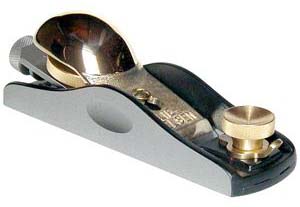
I lean towards a #60 1/2 Low Angle Block Plane (swapping out for a 60 1/2RN if the customer is planning to do a lot of mortise and tenon work), a #62 Low Angle Jack Plane, and a #8 Jointer Plane. These three planes together provide a good base for working wood.

So why did these make my top three? Well first, I think every shop should have at least one really good Block Plane, as they are go-to tools for such a wide range of applications. From a quick chamfer, to breaking the edges on a project, to touch-up smoothing a small area on a project that may not be quite as flat as you’d like. And with the short body length, you just might get away with a few passes with this plane instead of coming back in with a large smoother, and ultimately having to flatten the piece quite a bit for the smoother to “reach” the problem spot. A couple of nice things about the #60 1/2 is the heft of the tool, which equates to mass that helps in planing operations, and the adjustable mouth that only requires a spin of a knob to modify. If I’m changing from some easy-to-work wood like Walnut, over to some tougher curly Maple, I’ll usually close the mouth down to the point where the shaving just has room to pass through. This is much more critical on woods prone to tear out. If on the other hand, I need to take a bit heavier shaving, I’ll just open the mouth as required. I also use this quick adjustability every time I sharpen the blade. After sharpening the blade, I’ll open the mouth up all the way, so I can reduce the chance I’m going to accidentally bump my fresh blade into something that would damage it while positioning it in the plane.

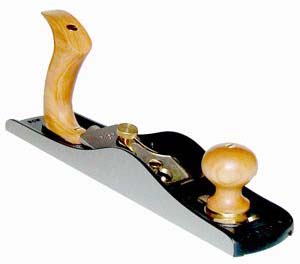
My next plane could be seen as a compromise, but I really think it has so much going for it, it makes more sense to think of it as a multiplier. I’m talking about the Low Angle Jack Plane. This sized plane can play a range of roles, from smoothing, to more traditional Jack Plane duties, shooting plane duties, and if you are working small scale work, even as a short Jointer. This plane has the blade bedded at 12 degrees, and the bevel is facing up. With this setup, it is easy to modify the honing angle of the blade to accommodate straight grained woods all the way to super figured hard woods. Since the bevel is up, the honing angle directly affects what the wood “sees”. When using this plane for smoothing or jointing, I’ll adjust the mouth so the shaving will just fit through, and use either a slightly cambered blade or one with the corners relieved. When used for shooting, I use a blade honed straight across, as I’m always working on boards that are thin enough so the blade’s reach is higher than the top edge of the board. For more traditional jack plane duties, I prefer a blade with more camber than I use for smoothing. Since I’m removing more wood with each pass, I open the mouth to provide sufficient clearance for the expected thicker shavings.

Lastly, the full sized #8 Jointer Plane is a tool that is not easily replaced. The level of flatness a Jointer plane can provide is limited by the length of its sole. A Jointer plane ultimately rides across the tops of any undulations, much like you might imagine a large ship spanning across multiple waves. A longer sole will span wider undulations, and obtain a flatter surface. With its 24” length, it is capable of handling flattening duties on relatively short pieces as well as lengths that include the largest most woodworkers would consider working. I recently used my #8 to flatten the top of my workbench, which it handled easily. The #8 Jointer Plane weighs in at 10 lbs, which sounds like it would be difficult to handle. Surprisingly, the weight and mass of this tool works in your favor. It’s not hard to initiate movement on this plane, and once moving, even easier to keep moving through the cut. I usually keep a small block of paraffin near my bench, and that facilitates an even easier time using the Jointer Plane. A very light swipe of paraffin along the sole of the plane body makes all the difference. A tip I regularly provide at our events is to make sure you are certain that you are holding onto the plane tightly when using paraffin for the first time. Initially, it can truly feel as if the plane will race away from the user.

These three planes are a great place to start, and can handle many of the tasks that woodworkers need for their projects. I suggest adding specialty planes to your core kit as projects dictate. With this strategy, none of your planes should gather dust for long, as they are all truly users.

I hope to see some of you at our upcoming events, listed on the Lie-Nielsen website. Feel free to contact me at lee@lie-nielsen.com if you have any questions, or if you have suggestions for future articles you would like to see.

Click to see Highland Woodworking’s entire selection of Lie-Nielsen hand tools.


Lee Laird has enjoyed woodworking for over 20 years. He is retired from the U.S.P.S. and works for Lie-Nielsen Toolworks as a show staff member, demonstrating tools and training customers.