Highland Staff

Nov 052010
 

For many years, I worked with mallets that I’d either made or purchased. I had a tendency to use them just as they were when they were first made. After a while, I decided I might be able to make slight alterations that would positively affect the comfort and potentially the usefulness of the mallet.  One mallet I made in 1990 and used for about 5 years before the light came on.  Ultimately I took the mallet and held it in my hand, the way I do when using it.  I did a little ambidextrous drawing with a pencil, around each of my fingers and also my thumb, so I could make sure when I removed material, it would fit my hand. Turned out to be a great decision.


More recently I turned some old oak into a nice smallish mallet.  The piece of wood was fairly short, so it didn’t lend itself to making the handle portion as long as I’d have liked to fit my hand.  Again, I decided there was some modifications I could do to ultimately make the mallet more user friendly. This time I decided I’d carve a notch where my thumb will sit, to make it more comfortable and hopefully more usable.  I snapped a picture of the mallet from it’s opposite side, to show what it looked like prior to “surgery”.

I started off by holding the mallet a couple of different ways to find what felt the best.  After I was sure of my decision, I again drew in pencil around the location of my thumb, while I was holding the mallet.

I used a couple of carving gouges, a #7 20mm and a #9 20mm.  I was able to hold the mallet securely with a hand screw, and held the hand screw in my bench vise.  I used my #9 gouge starting in the center of my marked area and making sure to work the correct direction for the grain of the wood. I didn’t want to pop off any chunks outside of my intended area.  I used my old square mallet to drive the gouge, especially at the beginning since I was working in Oak, which is fairly tough.  After I had a fair amount roughed out, I moved over to my #7.  For me, this gave me a little more control as it didn’t take as big of a bite with each strike.  After I had the shape I liked, I then stopped using the mallet and used the gouges more like paring chisels. I was able to take light cuts to smooth out the area where my thumb will ride on the mallet.  After all of that area was feeling good, I used the #7 very lightly again, on the edges of the carved section. I blended this section with the surrounding areas totally with the gouges. I didn’t use any sand paper, and the thumb recess feels great.  The key to using these tools is exactly the same as using regular chisels or hand planes.  Sharp tools are much more predictable and because of this are also much more safe to use.

Remember, even though the two mallets I modified were some that I made, you can still modify those that you buy.  Ultimately it’s all about making your woodworking experience better.

Until next time, keep woodworking.


Lee Laird has enjoyed woodworking for over 20 years. He is retired from the U.S.P.S. and works for Lie-Nielsen Toolworks as a show staff member, demonstrating tools and training customers.
Nov 022010
 

I once heard Norm Abram say that nothing upsets him more than someone suggesting that the only reason he can build all those things is all the tools he has.

Well, having a well-equipped shop is indeed a wonderful thing, but Norm is right. How much woodworking you can do is not solely dependent on how many tools you have.

Listen to me Goober when I tell you, it ain’t how many tools you have. Now go make something.

Oct 302010
 

Piedmont Hospital in Atlanta is one of the biggest and best in the city and they have a wonderful tradition.  There in the middle of all the living and dying that goes on in a big city hospital, they play Brahms’ Lullaby over the intercom throughout the hospital whenever a baby is born.  Everyone who knows of the tradition stops and smiles and listens to the whole thing in celebration and thanksgiving.

I tell you all this in celebration of the birth of six new Child’s Windsor Chairs.

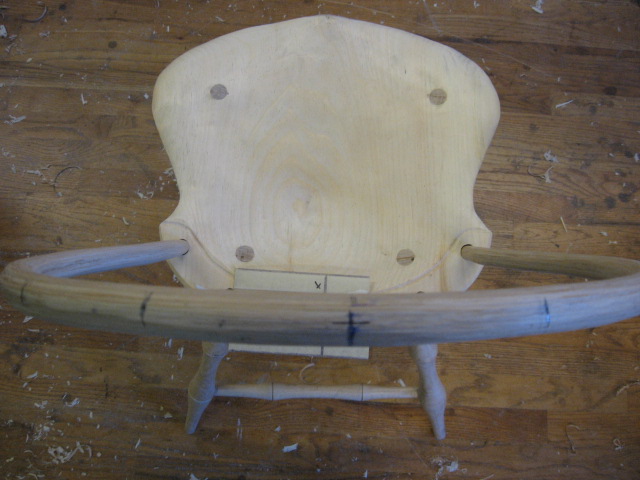
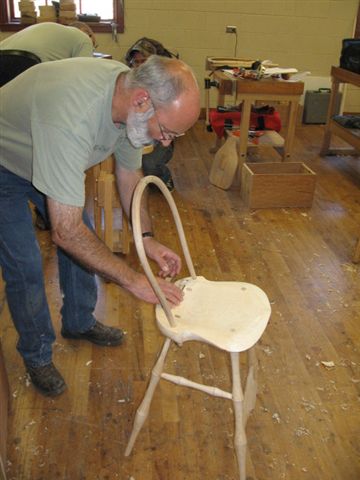
Bow on the Seat

I told Peter this afternoon that we should stop and sing something or do a little dance or stop and shout “Chair” with our hands in the air so everyone would stop and smile and celebrate with us.

This morning we started out by cleaning up the seats and scraping them smooth.

Ready to Drill the Bow

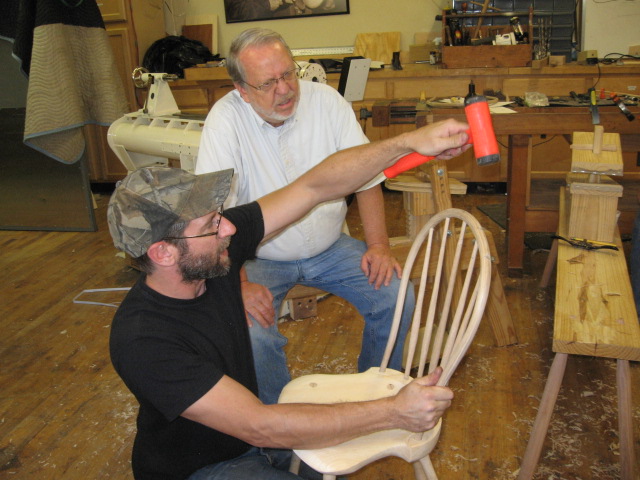
We trimmed off the leg tops and made ‘em look real pretty.  After we pulled our bows out of the heated closet we had left them in all week, we cleaned them up and got them ready to install in the seat.  We trimmed the ends to fit and then got the back spindles ready to plug into the seats.  After a long lesson on how to drill the holes in the bow so the spindles will fit correctly, we drilled the holes and fitted the spindles and finally glued and wedged the bow back into the seat.  A new chair entered the world.  Each of us took particular pride and joy in sitting down on our chair for the first time.

A Chair is Born — Everybody Shout “Chair”

It is done and all the guys have left town.  It will certainly be different going to my shop by myself next week.  This was a great class and Peter Galbert is a fine chair maker, wood turner and woodworking teacher.  My new Windsor chair is beautiful, if I do say so myself.

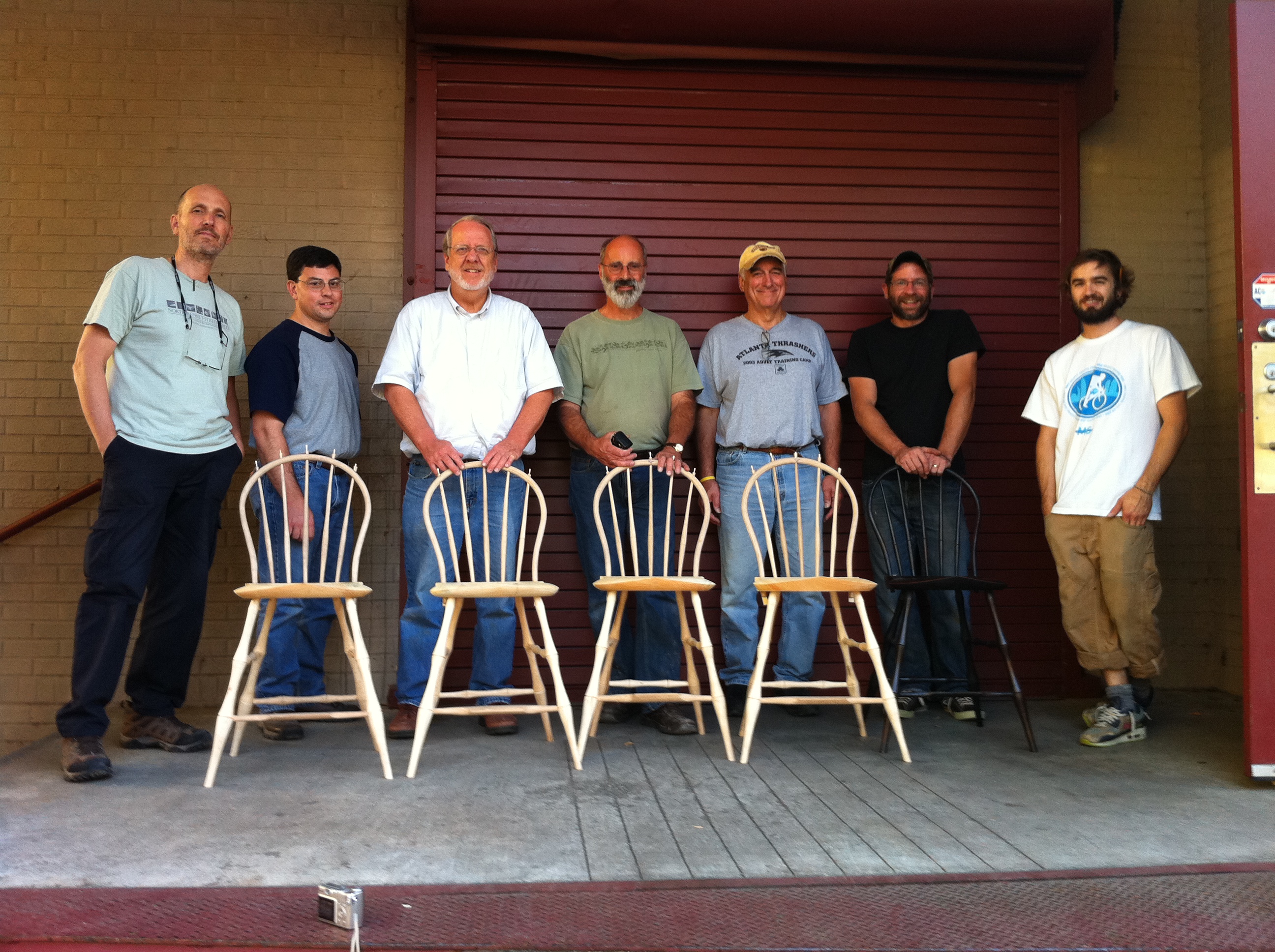
Want to see our graduation picture?  From left to right there is Daniel, Corey, Terry, Dana, Rich, Peter and Andy.

Peter Galbert’s Chair Class–Highland Woodworking — October 2010

Photos for the last two days are by Ed Scent, a staffer at Highland Woodworking.

Want to read the rest of this series? Start at the beginning with Day 1 of Peter Galbert’s Windsor Chair class.

Oct 282010
 

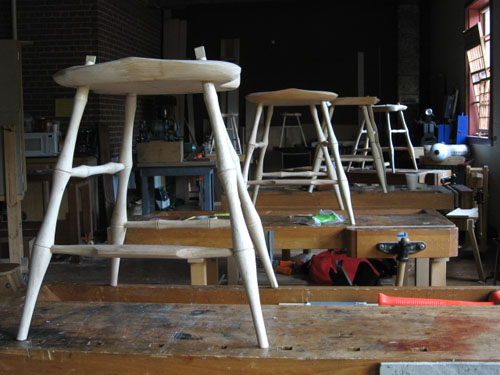
We are almost there. It is the end of Day Six at the Galbert Windsor Chair Class and today we legged ‘em up. All of us have been looking forward to this day all week.

“R” ing the Spindles

The way these chairs are made is with a “box” configuration in the stretchers and if you get an angle wrong or drill a hole wrong, then it will not fit into the bottom of the chair. I was a little worried once I put the four connected legs on the floor for the first time. The set was holding one leg up off the floor at a funny angle, kinda like a dog with a hurt foot. We rescued it and plugged it into the seat and it went right where it was supposed to fit.

Getting There

One thing that is striking is the stretchers are never test fitted into the legs. They fit so tightly that you will never get them out.

They are driven home with substantial blows from a steel hammer and then a dead blow hammer from the other side and with a thin coating of hide glue; they are good for the next two hundred years. It really makes you want to do it right and then put your name on it.

Another thing we did this morning was shape the front foot rest for our chairs. That is the first time this week that Peter turned us loose to do our own thing. It was great! You see we have not even been able to say the “r” word all week much less change the shape of our spindles from octagonal to “r” . Being able to shape that footrest however we wanted was terrifically liberating.

Tomorrow we will add the back bow and spindles to finish our chairs and then go our separate ways. I am afraid it will be sad. Look how lonely the legged up seats looked after we all left today.

Click here to read about Day 7 of Peter Galbert’s Build a Windsor Chair class.

Or, start at the beginning with Day 1 of Peter Galbert’s Windsor Chair class.

Oct 272010
 

Drawknife on Three Days of Work

Why would we talk about “Fortune Favors the Bold” in a chairmaking class? Next time you spend three days working on a piece of soft pine trying to make a Windsor chair seat out of it and the instructor tells you to take a drawknife and make big honking cuts on the edge of the seat with it, you will know what I mean. It took a lot of guts to cut that seat.

Scorping It Out

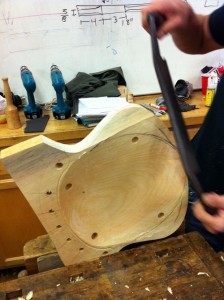
We spent the morning of the fifth day carving out the seat to our chairs. We started with the scorp and carved a round portion near the back of the seat. Peter did one as a demo in about 45 seconds and then we spent about 45 minutes trying to make ours look like his. After that, we worked on another part of the seat and then tried to look at the whole thing to make it symmetrical and even and not have something people will not sit on. It is harder than you think. The travisher came next to smooth it out some more. Next we moved to the bottom edge and cut a bevel which runs up to the top edge and if you mess that up everyone will come along and run their fingers along the edge and say, what fool did this? That’s the part that needed boldness.

We spent the rest of the day smoothing the seat, shaping the spindles for the back and getting ready to attach the legs tomorrow. I surely do hope this chair comes together since we only have two days left to finish it. Wouldn’t want the one-eyed guy on the horse to laugh at me.

Needs Some More Smoothing and Scraping

Click here to read about Day 6 of Peter Galbert’s Build a Windsor Chair class.

Or, start at the beginning with Day 1 of Peter Galbert’s Windsor Chair class

Oct 262010
 

Day Four is done.  I think we may have figured out who is Grumpy and who is Sleepy today.  I don’t believe you have met our crew.  There is Corey from Kentucky, Dana from Virginia, Daniel from Israel (that’s right, all the way from Israel), and Jim and I are from Atlanta.  Peter and his assistant, Andy complete the crew.  We are already good friends.

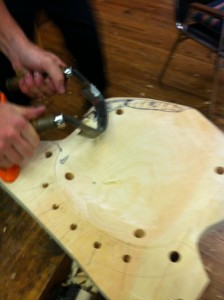
Drilling Seat Holes

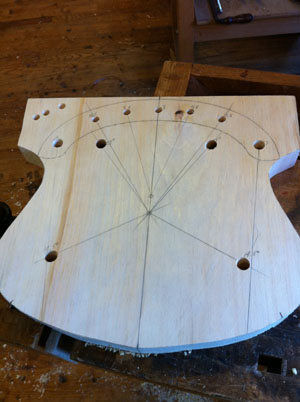
We spent the morning doing nothing but drilling holes in the seat.  That may not sound like much, but there are eleven holes drilled at precise compound angles at very particular locations.   If you want a good chair, you have to be very careful making these holes.

After a lunch break, we started working on getting the legs into the seats.  The legs are fitted in tapered holes for strength and they must be set at the correct angles so that when you look at the chair from the front or from the side, the legs line up.  It is a fact of making things like Windsor chairs that the eye goes directly to things which are out of line or uneven.  If the legs are not lined up, a one-eyed man on a fast horse would ride by and see it and chuckle a little at your ineptitude.  You certainly don’t want that so you need to be careful.

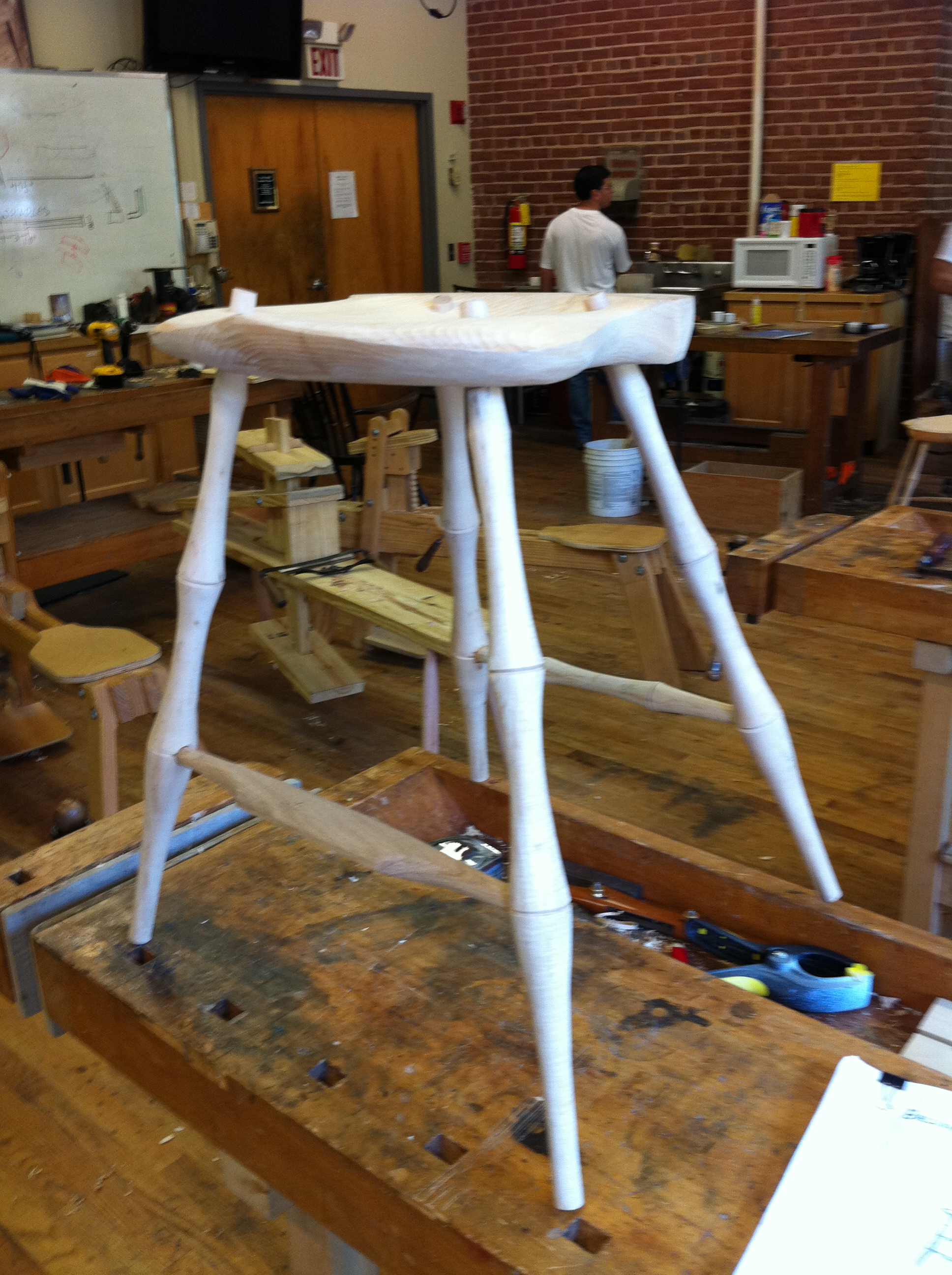
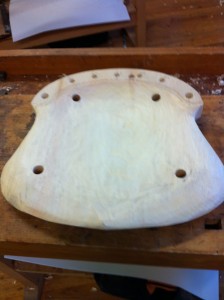
When we had the legs fitted, we started measuring for the side and front stretchers – a delicate operation.  Since this is a “box” stretcher configuration, there is little room for error.  If you mess it up, then your work on the legs and stretchers will have been in vain and you might as well give the whole works to the man on the horse.  We got all the stretchers cut to size and we will be ready to start drilling holes in the legs in the morning.  We will also start carving the seats and shaping them to that beautiful delicate shape you can see in all the pictures.

Seat with holes drilled

Seat with Legs

We made another full day today and expect to do so again tomorrow.  Don’t you wish you had signed up?  Go look at the schedule of classes on the Highland Woodworking web site and see what you would like to learn.  We look forward to seeing you in Atlanta. Maybe I will see you there and put you on the Blog too.

Click here to read about Day 5 of Peter Galbert’s Build a Windsor Chair class.

Or, start at the beginning with Day 1 of Peter Galbert’s Windsor Chair class.

Oct 252010
 

Working in the Mine at the High

Remember in Disney’s Snow White and the Seven Dwarfs where the dwarfs come marching home at the end of a long hard day in the diamond mine? Well there are seven of us (do not even ask me which one of us is Grumpy or Dopey) and we were glad to march out of the High after six o’clock tonight. There is zero chance we will not get these Windsor chairs built.

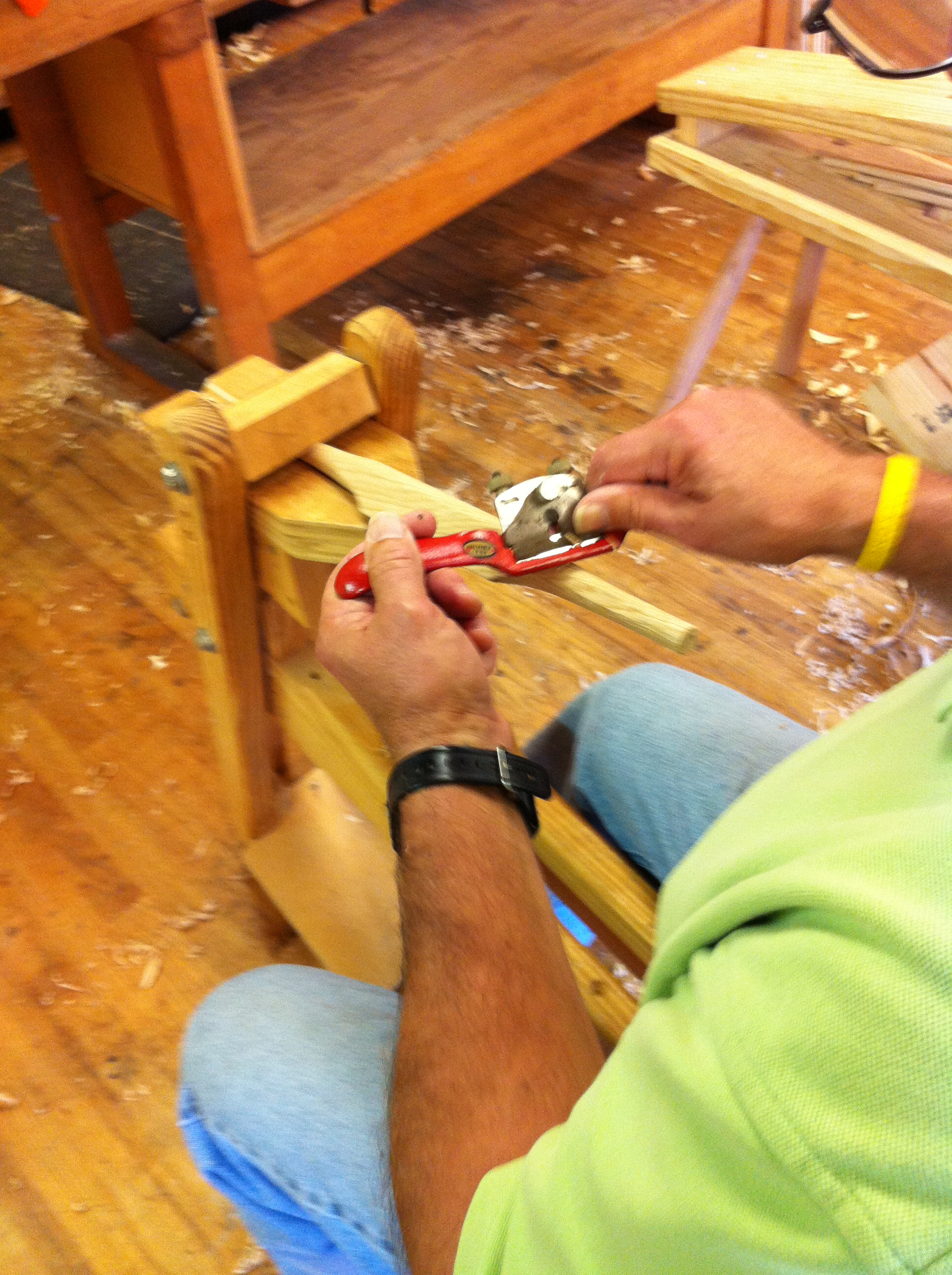
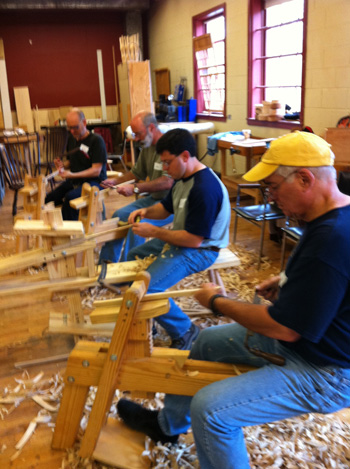
We started out this morning on the shaving horses making spindles with drawknives. By the time we finished making spindles and shaping the blank for the back bow, I can tell you that my bottom was heartily sick of the hard seat on that shaving horse. I can also tell you in detail what makes a good drawknife, and what makes a good shaving horse. (Start with a cushioned seat!)

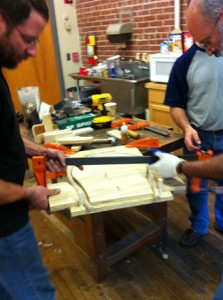
Clamping it up

A drawknife is a wonderful tool and will do impressivework, but when you are not used to it, most of a day driving one gets to be quite a task. I think all of us were glad when we finished. We cranked up the steam box late in the afternoon and cooked the back bows for about 40 minutes. We pulled the bows out one at a time and bent them quickly and easily around prepared forms and set them aside to cool and dry.

We will continue digging tomorrow and work some more on the spindles, and then we will start the seat. Four days to go.

Click here to read about Day 4 of Peter Galbert’s Build a Windsor Chair class.

Or, start at the beginning with Day 1 of Peter Galbert’s Windsor Chair class.