Highland Staff

Sep 132010
 

A few years ago I wrote a little rant about using plans to make projects.  Because of my training and background, for a long time I thought the only way to build a project was by using a set of plans. Listen to the recording below and see how it was a Windsor chair class which changed my life. Come to the Windsor Chair Making Class at the High in October and change your life!

Man with the Plan (click here for audio!)

By the way, in case you have not seen them, there are a couple of hundred tips and articles on all sorts of woodworking stuff on the Highland web site. Some fascinating stuff in there.

Sep 072010
 

I don’t know about you, but I enjoy breathing new life into an older tool.

That’s exactly what I did with this older Japanese hammer I purchased off of eBay.  The old handle was nicked, burned and just overall rough.  I decided the cool hammer’s head deserved a new handle for the next segment of its life.

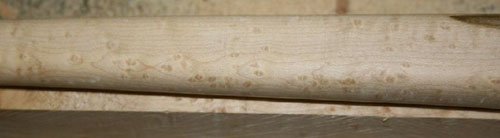
I didn’t need a large piece of wood, since the original was fairly slim. Luckily I had a piece of Birds Eye Maple, that was an off-cut from a previous build, and I wasn’t sure I’d find any other use for it. The old handle had a shape that felt right in my hand and fit the size of the hammer’s head.  I decided the new handle should mimic the old handle’s design.

My Birds Eye Maple

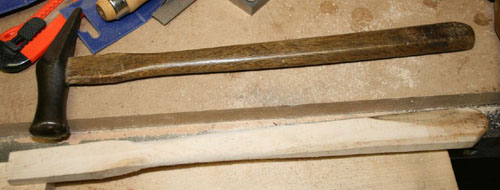
I simply traced the old handle’s shape onto my Maple blank, which was already similar in width and thickness.  I cut it just slightly outside the lines on my band saw, and then used my rasps to shape and bring the size down to final dimensions, including the chamfers on the lower section of the handle.  After I had the handle feeling the right size, I followed the rasps with sand paper, ranging from 100 grit up to 600 grit.

Old handle, meet New handle

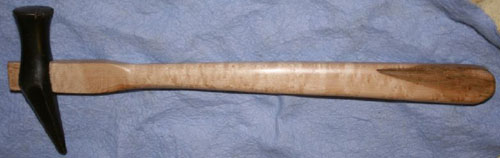
After I finished sanding it, I applied a couple of coats of Tung Oil, followed by some Black Bison wax.  On tools like this, I prefer to actually feel the wood, rather than using a heavy film where it almost feels like plastic.

The final piece of the puzzle was to fit the handle to the hammer’s head.  Since the inside of the hammer’s head had a small ridge inside the opening all the way around, I left the top of the handle just slightly thicker than the width between the ridges. I didn’t need a wedge since the ridges do such a good job of keeping the handle in place I was able to drive the head of the hammer onto the new handle using a wooden mallet.

I’m very happy with my rejuvenated hammer, which now looks as good as it works.


Lee Laird has enjoyed woodworking for over 20 years.  He is retired from the U.S.P.S. and works for Lie-Nielsen Toolworks as a show staff member, demonstrating tools and training customers.

Aug 252010
 

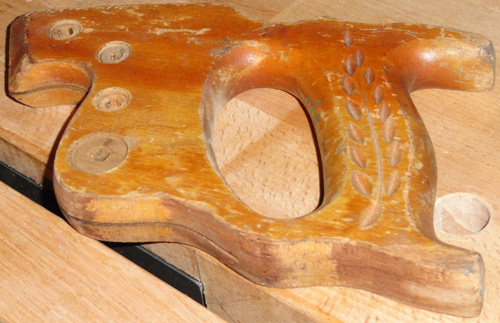
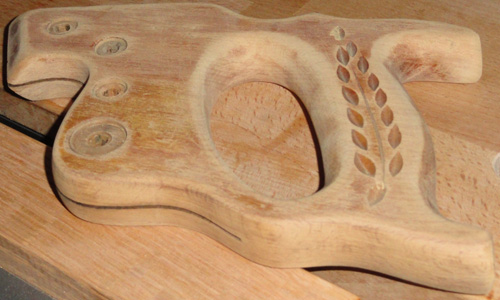
Here’s the story of an old saw handle that I restored.  It was actually a pretty lame handle, with the hard lines in the gripping area, which is pretty indicative of a low $$ saw.

The original saw handle

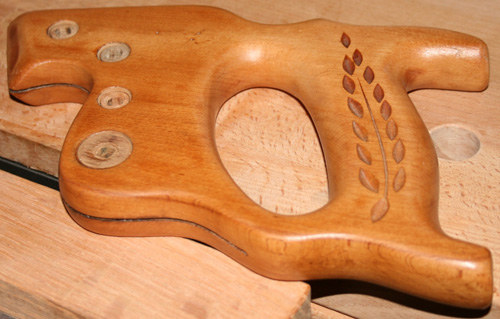
The saw plate was in decent condition, so I thought I’d see what I might be able to do to make the handle more friendly.  Actually turned out better than I anticipated.  Now it’s calling to me, wanting me to re-sharpen it. I guess I’ll do that to see if it ends up as a decent user.  At least now it won’t hurt and leave blisters when used.

To restore the handle, I used sand paper from 100 grit to 320 grit for the shaping and then smoothing.

Partially sanded

After sanding, I applied about three coats of Tung Oil and when dried, a coat of some good paste wax.  Buffed it out and voila!

Saw handle: refreshed

Thought this might be a good technique to log away, in case you pick up a decent saw with an unfriendly handle.  There are quite a few decent old saws out there, that you can buy for just a little $. Always good to know how easy it is to modify and/or restore a handle. Hope you can use this some time in the future.


Lee Laird has enjoyed woodworking for over 20 years.  He is retired from the U.S.P.S. and works for Lie-Nielsen Toolworks as a show staff member, demonstrating tools and training customers.

Aug 182010
 

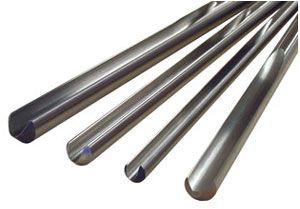
I just went down to the shop and counted my turning tools. I have 19. Most of them I never touch. Some of them I don’t use well and some of them are so bad that I will not use them, and some I have yet to learn how to use. I have one favorite and I use it for 95% of the turning I do and I recommend it to you highly. I really like the Oneway brand lathes and tools and the one bowl gouge I love is the Oneway Mastercut 5/8″ Bowl Gouge available at Highland. Now it is not cheap – the single ended gouge without a handle is $87.99. Then you will have to buy a handle for another $57.99. But once you put the two together it is a real gem and in my opinion, the best bowl gouge I have ever used.

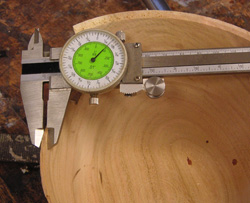
I particularly like the weight of it. The tool and the handle have the heft and the length to damp out vibration in the cut and I just turn better with it. But wait, you say, how can you do delicate work with a 5/8″ gouge. The answer is that tool control is so positive that delicate work is even easier with this tool than with a smaller one. Case in point, last week I thinned out a bowl to a measured 3/32″ thickness. Now I know there are those who can beat that, but that’s pretty good for me and every bit of it was done with this one tool.

(All right, go ahead and say it shattered on me, but I am going to say that I opened it up for you to see how thin it was. (Actually, it had a small crack and I took it apart before it flung a piece in my face.))

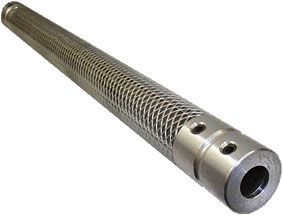
Oneway makes two different handles, and I like the 17-1/2″ Sure Grip Hosaluk.Plus for all you people north of the Mason-Dixon line, the handle does not get so cold in the winter in an unheated shop. It looks but does not feel like one of those braided steel sink connection pipes you might use in your home. This tool is just the best and if you don’t have one for your bowl turning efforts, you are missing out.

In my land surveying career, I went to a real estate closing one time and the seller (a woman, OK) came in wearing a beautiful fur coat. The agent, admiring the coat, asked what it cost. The seller thought about it a moment and said “Oh, about an acre.” Go ahead and get one of these tools, and if you do some decent work, it will only cost about a bowl and a half.

Aug 102010
 

Call me Ishmael! Whenever I find myself growing grim about the mouth; whenever it is a damp, drizzly November in my soul; then I account it high time to take a class. With a philosophical flourish Cato throws himself upon his sword; I quietly sign up for schooling. (Sorry ‘bout that, Mr. Melville.)

A few weeks ago in order to clear the skies of my soul a little, I decided to get out of town for a short trip. I signed up for a class in Windsor chair making with Michael Dunbar up in New Hampshire (they actually had a sign on the freeway leaving the airport “Caution – Moose Crossing”) at the Windsor Institute. Let me tell you how much fun I had and then you need to look seriously at taking the chair making class being offered in October at Highland.

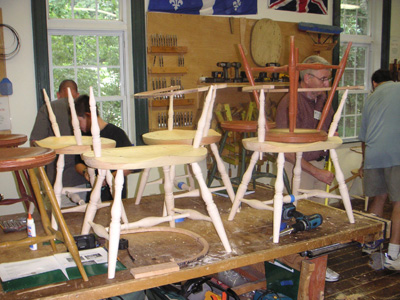
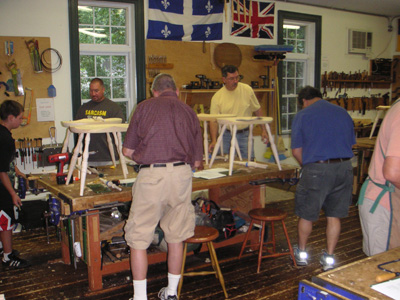
Mike offers a five day “sack-back” class where students end up with a completed chair pretty much made by hand. Working out of a lovely barn purpose built for chair building, Mike offers a wonderful class. We started with split pieces of green red oak for the arm rest, bow back and the spindles, and a slab of dry white pine for the seat. We spent the first day getting those pieces ready with hand tools. I was surprised at how physical the whole thing was and found muscles I had not used in a long time. We worked from 8:30 to 5:30 every day with a twenty minute lunch. The instructors would demonstrate the next thing we were to do and then we would take twice as long to try to do it ourselves.
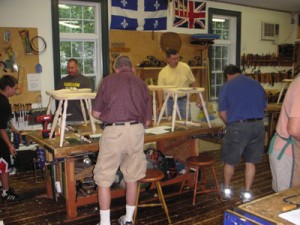
It was so funny. Somewhere along the way I missed one of the main points of this class. I had shipped a bag full of tools north the week before and had some new tools I purchased shipped directly to the school. Being the twenty first century woodworker that I am, I had sent my dust mask, my face shield, and my hearing protection.
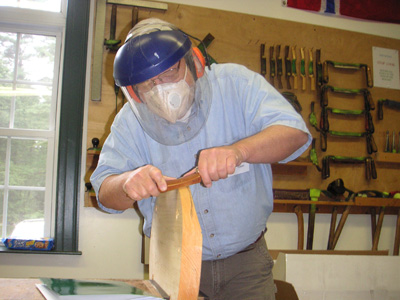
Spoke shave, Dust mask, Face Shield, Ear Muffs

I was about two centuries out of phase. We spent the whole week using spoke shaves, draw knives, travishers, compass planes and chisels and we bent wood from the steam box. Shavings and chips from green red oak and dried white pine floated gently to the floor. There was no dust; there was no noise, no whirling whining blades searching for digits to devour. There was only a huge amount of chips and long narrow shavings, and we usually swept the floor more than once each day. We used methods from two hundred years ago and it was a great joy and revelation to me and all my classmates.

Here’s what I learned: a tapered peg in a tapered hole will hold ten times what I thought it would hold; the proper hand tool, properly sharpened, and applied to the proper task will do a beautiful job, even in my partially skilled hands; minimal glue will hold a chair together for many, many years; and I can build a chair.
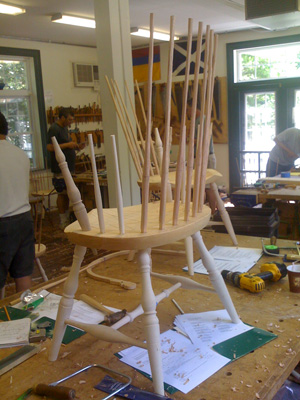
My Windsor Chair

Now in October this year, Highland is offering a class on Windsor Chair building taught by chair maker Peter Galbert. There will be two seminar days on Saturday and Sunday and then five days to make the chair. You will go home with a lovely child’s Windsor chair. Be sure and sign and date it, because your great grandchildren will turn it over to show it to people who come to visit and brag about great grandpa (or ma) building this chair by hand. They will not likely remember much else about you, so here is a chance for a bit of immortality in wood.

By the way, I stopped by Mystic Seaport, Connecticut, for a little side trip on the way home. If you have been looking for Noah’s Ark, I think they have it there under repair.

And just in case you missed it earlier, here’s the link to Highland’s chairbuilding class with Peter Galbert this October. Should be a fantastic class.

Jul 212010
 

Time Magazine a few weeks ago had a very good article on “recommendation engines”. In case you are not familiar with them, it is the bit of software which tracks what you look at on a Web site, and then recommends other things you might like based on what you look at. It is that little paragraph down at the bottom of your Amazon page which says people who looked at the things you looked at, also bought these things.

I tried Netflix a few months ago, and they drive their engine by asking you to rank your interest in about a hundred movies. Based on your answers they start sending you a list of movies they think you might like. It worked some, about a five out of ten in my humble opinion. In fact, the Time Magazine article said that Netflix offered a prize of a million dollars cash to anybody who could improve efficiency of their engine by I believe ten per cent. That is a pretty good indication of how important that kind of thing is to internet sales. Somebody won the prize by the way.

Before I bought my Triton Router at the High, I checked reviews on Amazon to see if anybody had a bad thing to say about it. People get pretty frank in the reviews so if there is something that doesn’t work, you will find out about it. I suppose I looked at two or three alternatives while I was there and the recommendation engine caught on and now about twice a week I get an email from them giving me a list of the best routers available on Amazon. That confirms Time’s conclusion that once you look at something you tend to get categorized and you never get other good recommendations. Too bad they don’t have a way for me to tell them I already bought one. The engines are not very good at extrapolating outside the interest you actually demonstrate. That is why Netflix was so anxious to improve theirs and exactly the same reason your Mama didn’t want you going steady too early in high school. And if you think about it, when is the last time you tried something different in your woodworking skills? We all get in a rut and recommendation engines do not help us.

All but one, of course. Highland has a recommendation engine which is better than any I have run into. The name of it is:

www.MeandChrisandBlairandBenandTerryandSidneyandPhilandMikeand SharonandBillandSabihaandSamandGeorgeandEd.com.

(Bet nobody has used that site name before.)

Call the store and ask somebody on the staff – there are years of woodworking experience and background easily available to you. And if you like our recommendation engine, send a note to the Boss – we’re going for the improvement bonus.

Jul 202010
 

Ok people, this is a woodworking crossword puzzle. Personally I do not like crosswords, but I know some people just eat them up. Here are some hints because I think you may need them. Heck, I made it up a couple of months ago and when it got cold, I couldn’t get them all. Get the Highland catalog, the Highland web site, and some of the better blogs on woodworking and all those will help. It’s kinda fun and there are prizes available. Second prize is (with a tip of the hat to NPR and “Wait, Wait, Don’t Tell Me”) my voice on your home answering machine. First prize is me not doing that. Send your solutions to the store or put it in the comments section.

One other hint, when you click the check puzzle solution button, it will check your answers so far, but it will also throw you out of the puzzle. You can’t solve it with that button. Good luck, send in your answers to win the wonderful prizes!!

**UPDATE** For those of you who like to skip to the last page of the book before you finish reading it (or if you just want to check your work), here is a link to the answers!