blair

Nov 272018
 

I am a woodworking hobbyist, having worked with wood the past ten years. I enjoy making large and small furniture items as well as cutting boards for home, family and friends.

I recently purchased a Festool ETS 125 REQ 5 inch Random Orbit Sander. I have another 5 inch random orbit sander and a 6 inch random orbit sander, both from manufacturers other than Festool. While I have been pleased with the results from the already-owned sanders, I decided to take the Festool plunge and purchase the 125 orbital sander along with a CT Mini Dust Extractor for my small workshop.
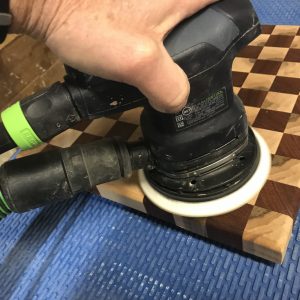
I had grown weary of duct taping various vacuum hose adapters to my shopvac and existing sanders, and wanted to have a cleaner work environment. The Festool 125 Sander, when used with the CT Mini Dust Extractor, provided me with a cleaner work environment along with a pleasant surprise in efficiency.
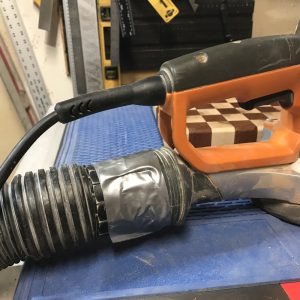
The duct tape only works so well!

My reticence in purchasing the Festool sander and dust extractor was primarily due to cost. After purchasing and using the sander and extractor I can strongly recommend them – they were definitely worth the cost when considering their advantages. The biggest advantage is the reduction of sawdust filling the air and my lungs. The two work well in tandem; when the sander is plugged directly to the extractor it has the advantage of starting up the dust extractor a second or so afterward and shuts the extractor down automatically when turned off. There is almost no discernible dust coming from my work pieces.

Although I had read about the longer life provided by Festool Sanding Discs, I was skeptical. Again, the comparably higher cost of such discs contributed to my reticence to invest in these Festool products. However after using the Festool sanding discs on several projects, I was totally impressed by how much longer they lasted in comparison to ones used with the other manufacturers’ sanders. I would say on average that I used one Festool sanding disc for every 3-4 used with the other manufacturers’ sanders. It’s a testament to the quality of those sanding discs as well as to the quality of the Festool 125 sander. I used the sander with 80, 100, 120, and 180 grit Granat discs and was totally pleased with the results.
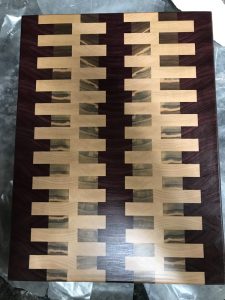
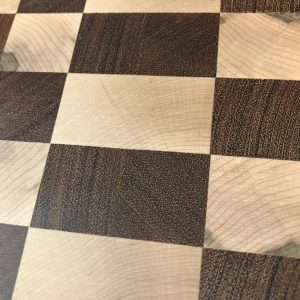
The Festool 125 sander is lightweight and can be held and controlled using one hand. Its orbiting motion speed is adjustable. The finish produced was excellent as long as I followed standard recommendations for progressing from lower to higher grits, with no visible scratches noticed.

The Festool 125 sander came in a Systainer case and included a small dust bag (that I’ve never used the dust bag since I have the CT dust extractor), power cord, and edge protector. Now the Festool 125 is my go-to sander for finishing work!

Sep 142017
 

As an Atlanta resident and associate at Highland Woodworking, I have the privilege of meeting a lot of woodworker-customer-friends, both hobbyist and professional alike, who are making wonderful things. I’m pleased to introduce you to some of our fellow enthusiasts through this semi-regular dispatch of who’s who in the Highland community. -AH

I met Char in the store when she was signing up for Sabiha Mujtaba’s Fundamentals of Woodworking class, a perennial favorite among woodworkers of all stripes. She told me about some of the projects she had finished for her family and fitting in her woodworking into an already full schedule. She invited me to check out her blog, the Wooden Maven, where I encountered not only an avid woodworker, but an inspiration.
How did you get into woodworking?
I began woodworking soon after undergrad when I moved into my first apartment. There was a platform bed I was interested in purchasing, at the time I could not afford it. I thought, perhaps I could build it. I didn’t have much direction to go on, YouTube was still in its developmental stage. After a few trips back to the furniture store to further inspect the bed, I drew my own plans, borrowed a drill, and purchased a ten dollar battery-powered screwdriver. It took me approximately three months to complete the bed… I believe that experience was the beginning of my love for building furniture. The gratification that came from producing something with my own hands was invigorating. That was back in 2003, since then I’ve been learning everything I can about my hobby-turned-passion.

What are you working on now?
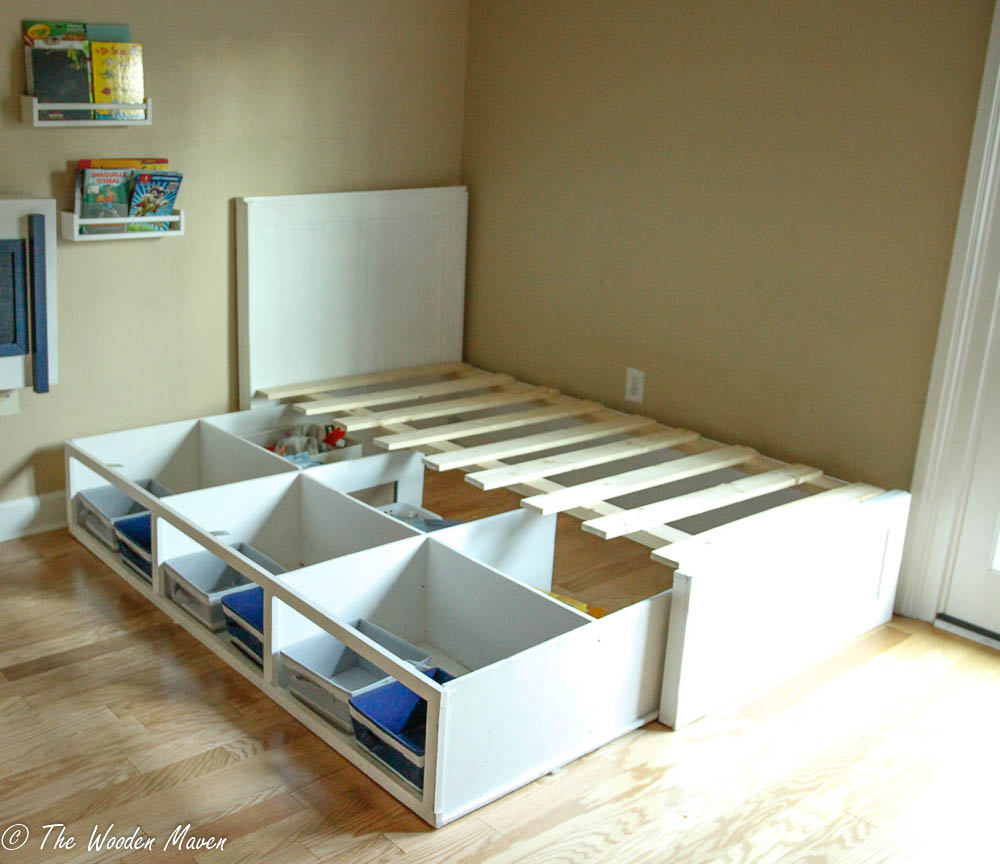
I always like to keep a few projects going at once. Right now I am working on two identical beds. They are twin beds that extend to king size beds. In addition [they have] accessible storage and non-accessible storage underneath. I needed the beds to serve several purposes: a place for my children, room for guests, toy storage, and of course storage for toys that shouldn’t be brought out every day. This was the largest project I constructed from only plywood. I used three-quarter inch PureBond plywood and a Kreg circular saw jig for rip and cross cuts. To give the bed a modern look, I used beadboard wallpaper on the headboard and footboard. To keep the beds as low as possible, I opted for furniture movers strategically placed on the bottom for easy gliding.
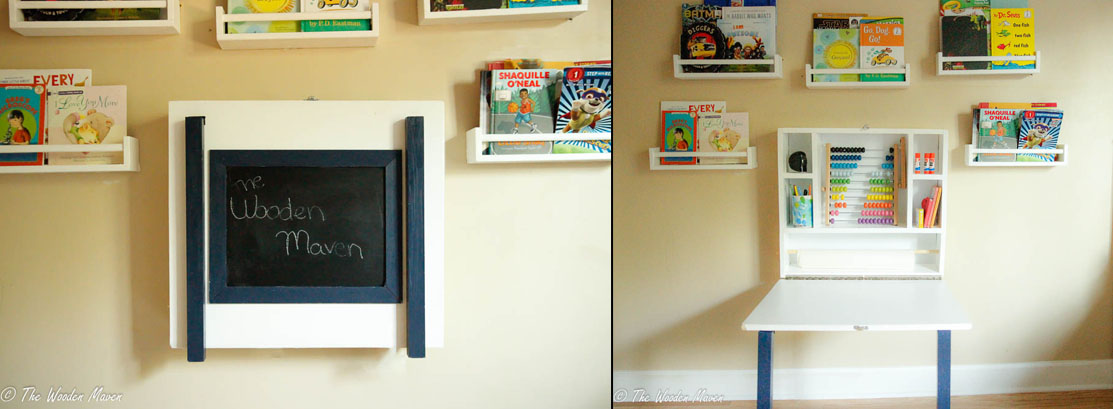
Along with the beds, I am putting the finishing touches on a matching children’s fold down desk. I chose pine for this project since it is lighter in weight and an affordable option for a place that will see a lot of use. The tabletop of the desk is covered with a thin polyethylene sheet to make for easy clean-up of paint, markers, or pencil marks. Both projects are paint sprayed with semi-gloss paint and a coat of polyacrylic, a touch of blue paint is used to accent the desk and tie in the bedding colors.

Lastly, I am working on a display case, in which I am using all the skills I learned in Sabiha’s woodworking fundamentals class. The case includes dadoes and the use of an ogee bit. It is made from oak and instead of glass to enclose any special object, I am using plexiglass. It will sit nicely on a mantle for many years to come.

What are your favorite tools? (do you prefer hand tools over power tools, or Japanese saws vs. Western style saws, or an old drill that has been passed down, or a brad nailer that’s just super handy)

I know that I truly enjoy woodworking because I fall in love with almost every new tool I experience. The versatility of each of them and the possibilities are all endless. I recently took a hand plane class at Highland after purchasing my first block plane. I never knew that hand tools could be so involved, it was an eye-opening experience. Hand tools allow you to interact with the wood and have a closeness to it, that you don’t get with power tools. I have to say that hand planes are my favorite for now.

Recently, I started turning and for someone who wants a finished project quickly, turning pens [is] the perfect answer. I do enjoy working with lathes and hope to get more involved in the world of woodturning.

For sentiment’s sake, I still have the little Black+Decker screwdriver I built my very first project with, it no longer works. It is a small reminder from whence I came and a nod to staying humble in my craft.


Amy received her MFA in Creative Writing from San Francisco State University. She is the staff writer at Highland Woodworking. In 2015 she and her dad co-founded Coywolf Woodworks, their hobby shop in North Florida.

Aug 292017
 

In the August 2017 issue of The Highland Woodturner, Curtis addresses a regular topic of discussion among his woodturning students: What kind of finish should they use?

As a new woodturner, I gravitated to products marketed to turners. These were generally shellac and wax based products blended with other chemicals to aid with application and drying. These were very easy to apply with almost instant results. The sheen or polish was dazzling to my eye. I soon learned these were not the best finishes for everything.

Click to read more of Curtis’s thoughts on finishing options for woodturners.

Jul 262017


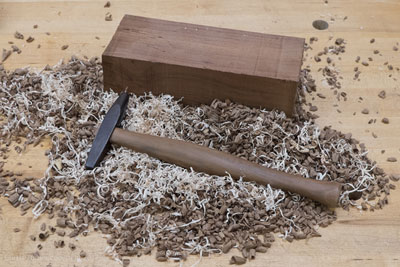
Off center turning can be fun and exciting but it can also be a bit wild or scary. The principles in this article can be used to turn off centered goblets, candle sticks, handles and other items.

Click here to read how to use the technique of off center turning to turn a replacement handle for a small tack hammer.

Click here to read the rest of the July issue of The Highland Woodturner.

Jun 302017
 
Making Things Work, Nancy R. Hiller (Putchamin Press, 2017)
Hilarious, engaging, and relatable, Hiller shares her philosophy of work with anecdotes drawn from her life about what constitutes success and the bumps in the road getting there. For some, her coarse language and tendency to call a tool a tool might irk a bad conscience. But for others, her dry wit and tenacity offer a refreshingly honest look at life and work on her own terms.


Good Clean Fun, Nick Offerman (Penguin, 2016)
We had the pleasure of seeing Offerman in the store at the outset of his book tour, and it was doubly a pleasure to read his book. It’s a conglomeration of fun, from projects to anecdotes to offbeat asides. Open it to any page and find something charming or inspirational. Learn to properly gauge your manliness. Build a stool. Have a cookout. Meditate on the process of giving new life to a once-living tree. Just don’t stop having a good time.


Woodland Craft, Ben Law (GMC Distribution, 2016)
An inspired glimpse at permaculture in the UK, Law’s book brings an ancient craft into modern day. From coppicing and woodland management to furniture and yurt building, this book spans from heritage to sustainability. If only there were such a book suited to North American conservation and resource management—dare to dream.


Where We Lived, Jack Larkin (Taunton Press, 2006)
Using data from the 1930s HABS (Historic American Buildings Survey) and first-hand journal entries and letters, Larkin looks at the oldest surviving habitations in the United States (mostly from the 1700 and 1800s) to discover how our colonizing ancestors lived. Bounded in this way by the progression of colonization, Cincinnati is considered “the West” and Florida does not exist. We delve into regional peculiarities, roads and commodes, the atrocity of slavery, and the effect of all, large and small, on the living arrangements of our unwashed if industrious ancestors. Fascinating.

Amy received her MFA in Creative Writing from San Francisco State University. She is the staff writer at Highland Woodworking. In 2015 she and her dad co-founded Coywolf Woodworks, their hobby shop in North Florida.

Jun 212017
 

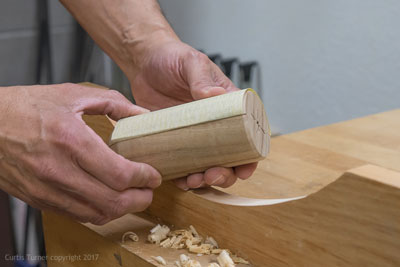
The technique of split turning is most commonly associated with furniture from the 16th and 17th centuries but can be used for any project that requires a half round column. Curtis Turner recently used split turning to turn a curved sanding block, and he wrote about it in the June issue of The Highland Woodturner. This is a great project for practicing this technique while also creating a useful tool for your sanding needs.

Click here to read how to use split turning to make a curved sanding block

May 252017
 

In the May 2017 issue of The Highland Woodturner, Curtis Turner answers a question many new woodturners ask – what types of turning tools should I buy?

My students often ask what type of tools they should buy. Specifically, should they buy inexpensive tools or go straight for the expensive ones? I think this question deserves a bit of discussion and does not have a single best answer that fits everyone, but this does not mean one should sink into analysis paralysis.

Click to read Curtis’s thoughts on the tools a woodturner should purchase for their own woodturning shop.