blair

Mar 212017
 

Amy Herschleb attend Jim Dillon’s Hand Tool Sharpening class at Highland and came away with a new appreciation of working with sharp tools. In this series she will go into thoughtful detail on the 3 methods of sharpening Jim Dillon taught. Today she covers Method 3, The Tormek System.
CLICK HERE to read Part 3

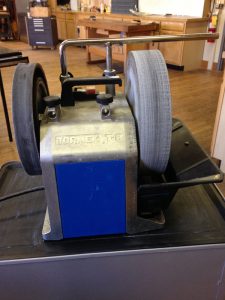
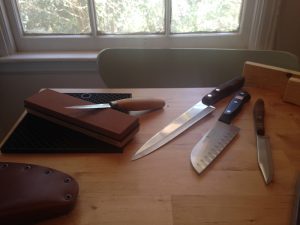
The final technique covered in class was the Tormek sharpening system, specifically we used the T-8. The slow speed wet grinder put a new edge on a worn-out tool while the leather wheel, with abrasive paste added, polished the tool. It can be fitted with a wide array of jigs for different shapes of blades from knives to scissors to chisels to axes. A plastic gauge that rests against the grinding stone sets the angle at which you are removing material. In class I watched the principles of the operation, then put them to good use while in Florida, putting a new edge on my kitchen knives (a couple of them older than me) that had probably never been sharpened in their entire culinary careers.

Even with a jig, the process demands a great deal of attention, especially with long knives or those that end in a curve. In this instance, the use of a Sharpie is vital. By coloring the cutting bevel black, you may see where and where you are not wasting material. Often areas near the heel or the tip are ground away unevenly, because so much depends on consistent movement of the blade across the stone. By paying attention to the markings, the sharpener may check for inconsistency along the edge.

The Tormek system allows you to grind either toward or away from the bevel, toward for most knives and away for small knives. I ground the knives toward the bevel with the universal tool rest set up horizontally, keeping one hand on the jig and the other on the handle, floating the blades back and forth, keeping the jig resting on the tool rest bar.

Due to the shape of the wheel, sharpening on a this surface creates a concave bevel, that is, a slightly hollow shape. This makes for a narrower sharpening edge, and faster sharpening times. Over time, the sharpening bevel gets bigger as the blade gets shorter from sharpening. When sharpening takes too long, it’s time to regrind.

Beyond a couple false starts involving a flying carving knife (no one was hurt) and a gouge I tried to put into the leather stropping wheel and the part where I ignored Jim’s advice to test a blade on the arm hairs instead of a thumb tip (I wasn’t sure I’d done that good a job. Spoiler–I had) this went off without a hitch. For once, my kitchen is equipped with a selection of sharp and useful knives, and vegetables and meat may be cut down efficiently without gratuitous sawing and strong-arming.

After experimenting (in a supervised environment and then free range) with a variety of methods, I am most satisfied with the Tormek system. Sandpaper, though easy to come by and easy to replace, is absolutely repulsive to me in a tactile sense and will destroy a manicure. Knowing where there are two Tormeks at my disposal certainly helps things, as I can re-grind worn down tools, then keep them sharp at home with a 1000/6000 wet stone.


Amy received her MFA in Creative Writing from San Francisco State University. She is the staff writer at Highland Woodworking. In 2015 she and her dad co-founded Coywolf Woodworks, their hobby shop in North Florida.
Mar 202017
 

Amy Herschleb attended Jim Dillon’s Hand Tool Sharpening class at Highland Woodworking and came away with a new appreciation of working with sharp tools. In this series she will go into thoughtful detail on the 3 methods of sharpening Jim Dillon taught. Today she covers Method 2, Using Waterstones.

CLICK HERE to read Part 2

The next technique we practiced was with Japanese waterstones. Jim recommends Ian Kirby’s book Sharpening With Waterstones, which covers far more material than the title suggests. We began with 800 grit and worked up to 8000. A simple setup for waterstones Jim suggested was to make a wooden rack for the stone that will sit atop a 5-gallon bucket, so that the stone may be rinsed efficiently and the mess contained. In lieu of this in the classroom setting, after the initial soak, we wet ours constantly with a plastic squirt bottle and kept the stones on plastic sheeting.
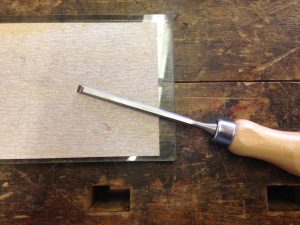
The Japanese stone (specifically the 1000/6000 combination stone) is a great tool for touching up blades after using them, such as in the kitchen, before they can wear down far enough to warrant grinding a new edge.

Several weeks later, when I had the chance to visit the shop in Florida, I tried Dad’s DMT Duo-Sharp diamond stone. This one also had a plastic base and was reversible, with a grinding grit on one side and a polishing grit on the other (Dad’s is Fine/Extra-Fine). This I simply kept on the counter near the sink to rinse, then thoroughly dried the stone and base after use to protect the nickel from corrosion.

I found this technique to work very well, when I had the angle set by a guide. Without it, I managed to dull a kitchen knife significantly, simply by sharpening at the incorrect–or even an inconsistent–angle. This episode in the kitchen particularly emphasized the importance of careful setup and attention to detail in what risks being considered (by the uninitiated) the least vital of tasks. Meticulous preparation does indeed save you time down the road, as our buddy Young Thomas learned 178 years ago.

CLICK HERE to read Part 4 – Amy’s thoughts about the last of the three basic systems of sharpening she learned.


Amy received her MFA in Creative Writing from San Francisco State University. She is the staff writer at Highland Woodworking. In 2015 she and her dad co-founded Coywolf Woodworks, their hobby shop in North Florida.

Mar 172017
 

Amy Herschleb attend Jim Dillon’s Hand Tool Sharpening class at Highland and came away with a new appreciation of working with sharp tools. In this series she will go into thoughtful detail on the 3 methods of sharpening Jim Dillon taught. Today she covers Method 1, Sandpaper on Glass.

CLICK HERE to read Part 1

The first technique we learned was sandpaper on glass, the simplest and cheapest way to get started, though the most expensive method when used over time. The price of sandpaper eventually will exceed the short-term savings of a quick setup. We used wet-dry sandpaper (dry to minimize the mess in the workshop) beginning with 180 grit.
The first directive was to flatten the back of the blade. By drawing the blade at an angle in a single direction, a diagonal hatching is achieved. When the entire back is thus marked, we move on to 220 and change the angle of the blade so that the scratch marks now make a cross-hatching. When the back of the blade is entirely changed to this opposing diagonal, we move up a grade of sandpaper, and so on until we reached 2400 grit.

At 2400 we achieved a mirror-like surface, from which no further refinement was necessary. All that remained was to remove the burr left on the front of the blade by dragging the front of the edge, ever so lightly, against the sandpaper, then gently wiping the back on it. This technique, called “backing off”, prevents the edge from being crushed or otherwise deformed by being pushed against the burr, which is barely detectable.

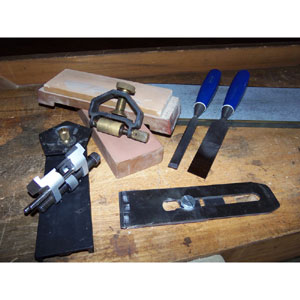
For the beveled edge we tried two different honing guides: a side clamp honing guide and the Veritas MK II standard honing guide. These guides support the blade at a consistent angle against the sharpening medium and require a simple measurement to set up (side clamp) or have predetermined settings (Veritas). Chris Schwarz recommends sharpening everything to 35° in his blog, Jim Dillon 30°, and both have made a wooden gauge set to their angle of choice.

CLICK HERE to read Part 3 – Amy’s thoughts about the second of the three basic systems of sharpening she learned.


Amy received her MFA in Creative Writing from San Francisco State University. She is the staff writer at Highland Woodworking. In 2015 she and her dad co-founded Coywolf Woodworks, their hobby shop in North Florida.

Mar 162017
 

With the constant jokes circulating the woodworking workplace, there ought to be an award for who gets to be “the sharpest tool in the shed.” And as a newcomer to the field, until lately I would rank a non-starter.

I have been catching up on my reading, and being drawn to the attractively-bound volume, recently picked up The Joiner and Cabinet Maker, reissued and expanded by Lost Art Press. It contains not only the original 1839 text, but also an historical analysis of the techniques and tools, and then the process of building the three projects contained in the text by the apprentice cabinet maker “Young Thomas.” In one passage, the young apprentice is tasked with making a packing box, and finds the tools common to the apprentices to be in poor shape, befouled by shavings, edges dulled and dinged by nails, and the hone dry and hollowed. Instead of regrinding all three planes he needs, he is helped by his journeyman friend Robert, who lends him a hone to sharpen one plane and a second plane of his own to complete the commission. The protagonist immediately recognizes the necessity of beginning a task with tools prepared to do their job, rather than risking the outcome with poorly cared for tools.

I am not the person to teach you to sharpen. I am perhaps more an object lesson for the maxim “anyone may learn to sharpen,” just as Katy, age 8, is in Schwarz’s reworking of the Joiner and Cabinet Maker. Katy can sharpen, I can sharpen, you can sharpen.

Unlike Katy, I spend my childhood rigorously sheltered from the shop where straightforward carpentry and house-building occurred, and sharp objects in general. At the age of 13, my grandad gifted me a buck knife, I imagine, to the horror of my parents. But I grew up in the grip of that horror, and never did anything interesting with the knife, or anything else sharp, beyond slicing open my knuckle and never telling anyone (… oh).

And so I have carried on into adulthood. I never attempted nor considered it within the realm of possibility that I could sharpen until recently, when I took Jim Dillon’s sharpening class.

As I was not in the habit of bringing an assortment of tools to work every day, I chose a couple bench chisels from our workshop that needed a little TLC (tender loving care, not the 90s girl group. Though woodworking would definitely benefit from an infusion of feminist R&B).
Jim’s philosophy on sharpening grew out of taking classes with Drew Langsner at Country Workshops (or, we could say, was honed by). Langsner proved to be so particular in his sharpening that he would prepare all the tools himself before the class began, but when asked about the angle of a particular tool would answer, “oh… about 30 degrees.” Jim’s takeaway was that “sharpness is crucial, and the way you get there matters, but the precise angle (within a certain range) isn’t nearly important as the edge formed by two highly polished surfaces intersecting.”

In Jim’s class we covered three basic systems of sharpening, from low-tech to high-tech, on which I’ll elaborate: sandpaper, water stones, and the Tormek grinder. I had the opportunity to both learn about these in the classroom, and later, to try them out in the wild, unsupervised and at my own peril. The good news is everyone survived. The better news is that my forays into woodworking are safer and more effective because of learning this vital skill.

CLICK HERE to read Part 2 – Amy’s thoughts about the first of the three basic systems of sharpening she learned.


Amy received her MFA in Creative Writing from San Francisco State University. She is the staff writer at Highland Woodworking. In 2015 she and her dad co-founded Coywolf Woodworks, their hobby shop in North Florida.

Jan 182017
 

The tree had been down for years. I have a hard time identifying trees, but I knew this was a cherry tree by the look of its bark. Scattered along this otherwise flawless limb were several unsightly growths—the burls I had been searching for.

Years earlier I had attempted to use my chainsaw but it wouldn’t start. I practically yanked my shoulder out of its socket trying to get it going, but no luck. What I wouldn’t find out until almost a year after this current cherry tree episode is that the typically fluorescent green fuel line in the chain saw went to a gummy brown, and then to about a dozen brown-black bits of hard plastic which in no way resembled a functioning gas line. All I knew at the time was that it did not work. I grabbed my bow saw.

This downed cherry tree was only about six inches at its widest diameter and I could see at least four burls in it of various sizes. I began cutting. A couple of minutes later, I took off my hat. A couple of minutes after that I took off my sweatshirt. A few minutes after that my arm fell off—and I wasn’t even through the first cut. I switched to my left arm, but this was proving useless, so I just rested a bit.

Alternating between resting, sawing, cussing, and contemplating just how out of shape I really was, I managed to get five logs cut—three with burls, and two straight grained. I moved the logs into my shed and painted the end grain with leftover latex paint—I have no idea where this pink paint came from, but it looked like the logs had polished “fingernails.” I then locked the shed and went in the house. I felt I earned a beer.

My intention was to let the wood dry out over a year or more, but curiosity wouldn’t allow that. A month after giving the logs pink fingernails I found myself cutting a bowl blank out of one of the cherry burls. I took a small piece of wood from the leftover scraps after cutting the bowl blank and sanded it smooth through a succession of finer grit sandpaper. I then dabbed a little linseed oil onto the scrap and rubbed it in with my thumb. I was amazed! This little scrap of wood—about four inches long by two inches wide and only a quarter of an inch thick—had incredibly beautiful grain! Only an inch of its length had straight grain, but then the burl kicked in with its many random swirls. It was visually stunning—and only a piece of scrap!

Like a faithful dog tail-waggingly bringing a well-moistened tennis ball back to its master, I ran into the house to show my wife. I held it up in front of her cradled gently in both hands as if I was Indiana Jones holding an ancient gold relic. I waited for her to share her excitement with me.

“That’s nice,” she said the same way she would describe a shirt I was wearing that she didn’t like.

I was stunned for the second time that day—I could hear my bubble burst. “That’s nice? That’s all?”

“It’s nice, yes.”

“This is cherry burl! I have three logs of it in the shed for bowls!”

“That doesn’t look like a bowl.”

“It’s not, this is just a scrap leftover from cutting a bowl blank.”

“That’s nice. Punch a hole through it, add some string, and you can wear it around your neck.”

Okay, she didn’t say that last bit, but that is what I heard. I realize that people view things differently, but where did I get this almost absurd love for something as simple as an interesting wood grain pattern? In an effort to find out, I proudly took my scrap of wood over to show my father. He took it from me and stared silently for a few moments before responding.

“Wow!” He said softly. “Look at this grain—this is beautiful!”

Okay, I thought to myself, this explains it; it must be genetics—this not only explains my reaction but also my wife’s. Then my father told me something that reinforced this and revealed a lot about our family and who I am.

“My father,” he began, “kept a piece of wood in his pocket that he thought was pretty. I don’t remember what kind of wood it was, but it was an oval piece, only about a quarter of an inch thick, and he told me he added several coats of linseed oil to it, each one rubbed in by hand. He got a kick out of showing people. I guess that’s where I get my appreciation for such things.”

And I guess that’s where I get my appreciation for such things. And I do remember my grandfather showing me that scrap of wood. I remember him taking it out of his pocket and reverently showing it to me as if it were a fine piece of heirloom furniture that not only had value but that I would likely someday inherit. I was very young at the time so I don’t remember my exact reaction, but I’m guessing I thought he was crazy—just like my wife thought I was crazy when I showed her my little piece of scrap! I suddenly not only knew exactly how she felt, I understood it. I don’t blame her for her reaction—this silly love of interesting wood grain patterns is in my blood, not hers.

I would later turn a bowl out of one of the larger pieces of burl from this downed cherry tree and give it to my father—I knew he would appreciate it.

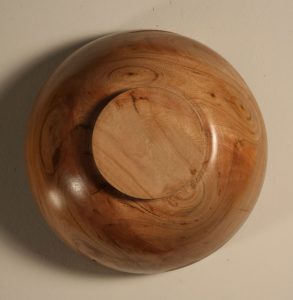
This shows the bottom of the natural edge cherry bowl where you can see six knots.

This shows the bottom of the natural edge cherry bowl where you can see six knots.

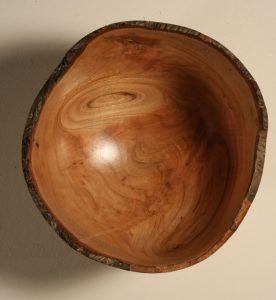
This shows the interior of the natural edge cherry bowl showing the interesting grain patterns caused by two of the larger knots.

This shows the interior of the natural edge cherry bowl showing the interesting grain patterns caused by two of the larger knots.

And this is why I love turning bowls so much. The reason is simple—it is what you can’t see—what’s inside—that makes bowls special. I have made chairs and other small pieces of furniture, turned tool handles and carving mallets, and built the obligate birdhouses, but by far, my favorite woodworking hobby is bowl turning. You can use a board in construction of furniture and, even after finishing, you see the grain pretty much as it was before you started. But in bowls, you really can’t tell how the finished piece is going to look until after it is turned. I have “accidentally” discovered interesting insect damage in walnut, spalt in maple, half a dozen interesting knots in a busy crotch of cherry, and a glorious red stain in box elder. And with burls, the unknown is much greater—you really never know what the grain is going to look like or what inclusions figure the wood.

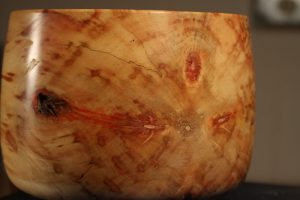
Close-up of box elder bowl showing detail of spalt and red coloration.

Close-up of box elder bowl showing detail of spalt and red coloration.

I truly love this “discovery of the unknown” aspect of bowl turning; anxiously excited to see what’s inside.


Return to the January 2017 issue of The Highland Woodturner

Jan 022017
 

As a beginner woodworker, I have accomplished few enough things that I have a staggering amount to discover in any direction I turn. The reasons I was drawn to the craft in the first place included the joy of making things with my hands, a wish to share a hobby with my dad, and an all-encompassing love of trees (climbing trees, pecan pie, fires, writing paper, et al).

With these in mind, I’ve come up with a few resolutions for the New Year:

  1. Practice the skills I’ve learned: dovetails, sharpening, planing, sanding
  2. Keep learning new skills and writing about them: carving (the Ogham alphabet, a spoon), mortise & tenon
  3. Finish projects I’ve already committed to: block plane, pencil box, silk screen frames, a loft for the puppy, a carved spoon wedding present (I have a year for this, right?)
  4. Continue to build a thoughtful hand tool home shop based on the principles of The Minimalist Woodworker, KonMari, and Malta Kano.
Dec 292016
 

I wanted to start my resolutions first with a review of 2016 goals.

One of my resolutions was to work more with milk paint and build a Dutch Tool Chest. I am happy to report both of those objectives were achieved. It was tremendous experience to work with my 10 year old son to complete his tool chest. I am proud of his involvement and dedication to complete this project.

My intentions were to use milk paint on more turnings. I am bit behind on that component. In addition, I have yet to incorporate any metal into my turnings. However, I did learn to MIG weld. I recently completed welding a metal base for a small table that will receive a natural edge slab of spalted pecan.

My resolutions for next year are as follows:

1. Add a metal component to a turning. This could be wire, flat stock and/or welding. I do not have anything specific in mind.

2. Turn a large diameter bowl. I would like this bowl to be in 14-16” range. This bowl should be large but not massive. The intention will be to make something that can be passed down through the family.

curtis1sm3. Make a few more lidded boxes. I completed one recently and it reminded me how much fun they can be to turn.

4. Finish the Windsor stool that keeps staring at me every time I walk by!

5. I have a few handsaws that need to be sharpened. I tend to sharpen my chainsaw frequently. However, it been awhile since I needed to sharpen a handsaw. This will be an opportunity to brush up on that skill.

I wish the best to you and your family in the coming year. Please remember to be safe while at the lathe.