Chris Bagby

Chris Bagby, Owner & CEO A 1973 graduate of Georgia Tech, Chris co-founded Highland Woodworking in 1978 with Sharon Bagby. He originally provided custom millwork services before focusing mainly on marketing. His other interests include photography, tennis, snowboarding and thru-hiking backcountry trails, including the Appalachian Trail, Pacific Crest Trail and Continental Divide Trail. He's also a registered yoga teacher, and his oldest yoga student is 93 years old!

Mar 182009
 

From the latest issue of Wood News:

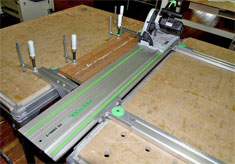
Festool parallel guide system
 
Festool parallel guide system

New Parallel Guides Take Guided Rail Cutting to a Whole New Level


Text & photos by Jerry Work
©2009 The Dovetail Joint
 

Those familiar with the Festool guided rail cutting and routing system know just how
useful it is to be able to move a circular saw, jig saw or router across a stationary work
piece in a perfectly straight line. In my studio I use guide rails daily to make all kinds of
cuts. Festool’s new Parallel Guide system also makes an
excellent squaring cut guide as well, turning the guide rail and plunge saw into a fast and
efficient substitute for a table saw for most cutting operations.
Yup, with Festool’s clever new Parallel Guide System you can virtually eliminate the need for a bulky and dangerous table saw.

Feb 162009
 

royshop.jpg
Roy Underhill, the master woodworker and historian famous for his long-running PBS television show “The Woodwright’s Shop,” has announced the opening of his new woodworking school, “The Woodwright’s School” in Pittsboro, NC. HIs first one-day classes will begin Feb. 28, 2009.
Roy has equipped the fully functional shop with traditional woodworking workbenches and hand tools for use by up to 10 students at a time. For the shop he has chosen full-size Hoffman & Hammer premium German workbenches which are available in the U.S. only through Highland Woodworking in Atlanta, or via their website at www.highlandwoodworking.com .
The first class on February 28 will be a busy day of hand tool joinery. Under Roy’s tutelage, students will learn to cut dovetail joints as well as mortise and tenon joints using traditional hand tool methods. This same one-day class will be repeated on March 1, March 7 and March 8. Cost for each of these introductory classes is only $95.00 for those signing up in advance.
Anyone interested in receiving more information about events at the Woodwright’s School should email Roy at woodwrightroy@gmail.com .

Feb 102009
 

woodworking toolsHighland Woodworking will host chairmaker Charles Brock of Columbus, GA for a seminar in Atlanta February 28-March 1, 2009. During the two-day event, Mr. Brock will demonstrate the intricacies of replicating the style of rocking chair made famous by woodworking legend Sam Maloof.
Mr. Maloof, who recently celebrated his 93rd birthday at his home in Alta Loma, California, is widely regarded as the most respected furniture maker alive today. His elegant chair designs are admired and sought after by artists, world government and business leaders, as well as craftsmen of every skill level. His signature walnut rocking chairs are on display at the Smithsonian and in use at the White House.
Charles Brock combines his skill as a craftsman with outstanding teaching and communication skills to make this challenging project approachable for the amateur woodworker. A Maloof-inspired chair combines the rich beauty of walnut lumber with the subtle grace of line and curve, using joinery techniques perfected long ago by Mr. Maloof.
Students attending Mr. Brock’s weekend demonstration will learn how to sculpt the saddle of the chair, how to attach the legs utilizing Mr. Maloof’s unique visible joinery techniques, and how to carve the hard and soft lines of the legs, arms, headrest and back spindles using bandsaw, spokeshave, rasp and scrapers. Mr. Brock will take the mystery out of creating the signature cyma curved laminated rockers with ebony and maple highlights, and will demonstrate preparing surfaces for an extraordinary oil and hand rubbed beeswax finish.
A separate Friday evening design lecture, “Form Follows Function” precedes the weekend seminar, and is included for those enrolled in the weekend event. Registration information for both the Friday lecture and weekend seminar is available at highlandwoodworking.com, or by calling 800-241-6748.

Feb 062009
 

Fein Multimaster

Fein Multimaster FREE Demonstration
Saturday, February 7, 2009 at 10:00am

You’ve probably seen the Fein Multimaster infomercial on late-night TV. Come see the real thing in action at Highland Woodworking this Saturday, Feb. 7. FEIN’s engineers have added almost every conceivable function to this safe, vibration-free power tool. The Fein Multimaster is truly one of those rare tools that earns the undisputed title of “the best there is”. It’s a great sander, bringing fast, high-quality finishing into places that no full-size sander can reach. Fein’s industrial-quality 2.3 amp motor (variable speed) drives the machine spindle at speeds from 11,000 to 20,000 opm, making this far and away the most efficient and smoothest-running tool in its class. With accessories, it’s a saw that cuts wood and metal, scrapes paint, performs precision sanding, and much more. It can save you both time and money on a wide variety of home improvement and repair jobs. Come see it in action. We think you’ll be impressed. Join us for a fun and educational visit to Highland Woodworking’s unique Atlanta store.
All Saturday morning demonstrations take place in Highland Woodworking’s retail store in Atlanta, Georgia and begin at 10:00am Eastern Time.
Map and Directions to Highland Woodworking
1045 N. Highland Ave, Atlanta, GA 30306.

Jan 162009
 

theworkbench.jpgOur thanks to Taunton Press for giving us permission to reprint in Wood News, our monthly online magazine, Lon Schleining’s introduction to his excellent book, The Workbench: A Complete Guide to Creating Your Perfect Bench, NOW ON SALE FOR 25% OFF.
Introduction
In its simplest form, a woodworking bench is nothing more than some sort of raised platform so you can work standing up. Even a piece of plywood on sawhorses would fit this definition. Such a bench would certainly be inexpensive, fast to build, and very portable. If it got rained on, or stained by spilled coffee, no big deal. Though less than ideal, this may be all the bench some woodworkers would really need. But what they really yearn for is another matter entirely.
Woodworkers’ notions of the ultimate bench are as diverse as their activities. What’s ideal for one woodworker is wholly impractical for another. A great bench for a furniture maker may not work for a carver and vise versa. A boatbuilder’s bench is utterly different from a violin maker’s, yet they all work wood and they all need benches.
Much as woodworking pundits might like to say their particular workbench is the only proper configuration, many of the choices in design are simply a combination of familiarity and personal taste. If there is a common thread, it’s a tendency to think the bench you learned on is the best bench. A shoulder vise, for example, is a device some woodworkers simply could not get along without. For others, it’s a somewhat fragile appendage of little use in a modern wood shop. Such is the subjective and very personal nature of the workbench.
The “classic” workbench originated centuries before the invention of the equipment modern woodworkers take for granted. These days, rare indeed is the woodworker who does not use an electric drill or surface planer. A perfectly suitable bench for the type of work people did 300 or 400 years ago may not be the best one today.
Some things haven’t changed. Virtually every woodworking tool, power or otherwise, requires two hands to operate safely. Holding the board securely is, if anything, more important with power tools than with hand tools since the consequences of a slip could be more serious. Woodworkers who think a traditional bench has no place in a modern shop need only consider how difficult it is to hold a furniture part with one hand while belt sanding it with the other.
Woodworkers of today do work differently. We often work with large panels and sheet goods and so need to clamp our work somewhat differently. We have access to hardware that can speed construction. Modern materials like Melamine and laminates are better than solid wood for some applications. Vacuum pressing makes building large torsion boxes easier. Throughout this book, I have tried to point out how modern methods and materials can be applied to workbench design and construction.
For some people, building their own bench is almost a woodworking rite of passage. Their bench is an expression of the pride they take in their work, an opportunity to demonstrate their skills and to show off a little. These folks probably envision a solid-maple behemoth with intricately constructed vises, a gleaming finish, lots of accessories and cool hardware. Sure, it cost a bundle and took months to build. Yes, there may be just a bit of reluctance about actually using the bench for fear of getting that first scratch or dent. But for those bench builders, the satisfaction of having built it is justification enough.
Then there are the folks who sit down and do the math. They figure the cost of lumber and hardware, then estimate (or should I say underestimate) the time it wll take to build the bench. They compare their figures with the cost of having a finished bench shipped to their doorstep. It slowly sinks in that it’s entirely irrational to build a bench from scratch. For these practical souls, the only logical choice is to buy a finished bench outright.
The bottom line is that however you get your hands on it, you need a good bench to do your work safely. You need some vises and holddowns for joinery, fitting pieces, and finish work like installing hinges. At the very least you need a true flat surface for gluing.
This book is intended as a guide for asking the right questions and then making the right decisions about what you really need and what you really want. A workbench is a very personal choice. Your opinions and personal preferences are the most important. Take your time pondering the questions. And remember, only you can provide the answers.

Jan 102009
 

jan10.jpgThere’s usually a woodworking class or two going on in our Atlanta store on any given weekend. Today we had THREE events happening at the same time. Hal Simmons was teaching beginning turning to 8 guys in our woodworking seminar room upstairs. Sabiha Mujtaba was teaching power tool basics to 8 women in our woodworking demo shop, and Terry Chumbler was demonstrating the Tormek T-3 power sharpening system to an ongoing drop-in crowd at a workbench on our sales floor.
Next weekend, Frank Bowers will teach two bowl turning classes, Jane Burke will teach a Saturday class on marquetry, and Ben Arthur will give a lively FREE demonstration of the CarveWright benchtop CNC routing machine.
Sign up for any one of our woodworking classes at our website, or just drop in on the free Carvewright demo that runs 10 AM to 11:30 AM on Saturday.

CLICK HERE to see our complete woodworking class schedule

Jan 092009
 

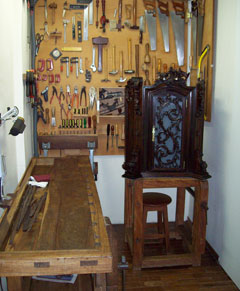
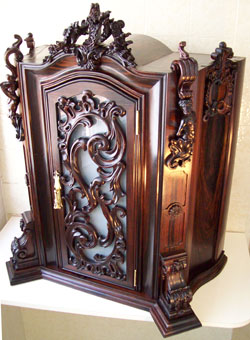
The article briefly excerpted below (click to see the entire article) was submitted to us and published this week in our monthly online magazine, Wood News. Within a few hours, the author’s email box was overflowing with heartfelt responses from kindred spirits everywhere. Dilo Fernandino’s story is indeed an inspiring one, demonstrating how someone who is truly passionate about woodworking can “carve out” a remarkably satisfying pastime in a very small space.

My Unusually Small Workshop
By Dilo Marcio Fernandino
Belo Horizonte, MG, Brazil

My first workshop was the kitchen of my rented apartment. I purchased a small carving bench (23″ x 23″ top) and sharpened my few old chisels. My first adult-age project was a double bed with matching side tables. A few years later we moved into our own apartment where my wife granted me the exclusive use of a 7 ft x 6 ft service closet where I have now been working for over 30 years. Despite its lack of elbow room and my wife’s prohibition against dust and noise, this space became my “paradise” where I have managed to build a few very nice pieces.