blair

Aug 172011
 

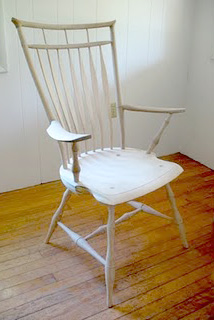
Peter Galbert’s chairs are unique. They are a mixture of time-honored methods & materials blended with Peter’s desire to bring forth a range of aesthetics in his finished work.  Some of these are quite tangible, as in the way his chairs envelope and support the sitter into an almost dream-like state of comfort, while others are less so, like the interplay of light and shadow on a sculpted component that lingers as a pleasant after-taste in the mind’s eye.

Peter’s ability to take the best of the past that works and partner it with fresh ways of seeing form and function are what make him such an exciting chairmaker and craftsman.  Add to this Peter’s extraordinary ability to convey information as a teacher and you know why we’re incredibly pleased for Peter to conduct chairmaking classes at Highland Woodworking.  Peter returns this fall to Highland Woodworking for a week long chair making class to Build a continuous arm Windsor chair. Space is limited so confirm your seat in the class soon.

Discover more about the Windsor chair “design mind” of Peter Galbert in his article, linked below.

Windsor Chairs: Why It All Adds Up, by Peter Galbert


Jun 082011
 

Are They Any Good?

So, I’ve spent the last week using Stanley’s reissue 750 socket chisels in sizes 1/8″, 1/4″, and 3/4″. I didn’t set up any arbitrary test criteria or elaborate measuring devices to determine who knows what. All I did is what I normally do with chisels during a workday in my cabinet shop. You know, pare chamfers, clean out glue glops, chop joints and open paint cans. I’m kidding about the paints cans. For that I use a pocketknife.

Over the years I’ve decided I want 4 things in a new bench chisel. It has to be well machined from the factory – I can’t afford to spend the entire day tuning it up. It must stay sharp for a reasonable amount of time – The edge can’t deform every time I hit it with a mallet. The handles have to be comfortable and not prone to splitting or breaking. I’d like the tool to look nice as well. I think a little care in form and design adds to the innate pleasure of using a fine tool.

As I mentioned above, I found these new 750s to be well machined out of the box. I got the backs flat quickly. You’d expect this from a premium tool. Were they as perfect in form as, say, the Lie-Nielsen’s? No, but the lower price of the Stanley’s adequately reflects this. After the initial sharpening, I only had to touch up each edge on either a strop charged with honing compound or my 8000 grit water stone during this evaluation. This seems right to me based on my experience with other premium chisels. They definitely held up better edgewise than any of the economy line chisels I own. Now all this is purely anecdotal on my part of course, but I feel I’ve gained a good grasp over the years on how long a chisel edge should last. As for the handles not splitting, only time will tell. Hornbeam is pretty tough stuff after all. In my opinion, nothing beats a socket chisel for looks and longevity. Socket chisels are definitely worth the extra money compared to say a tang fitted handle.

Bottom line? I’m enjoying Stanley’s new 750s. I feel the price to quality ratio is certainly there. They are a great option if you’ve always wanted a set of socket chisels and either couldn’t find the originals or afford the ones on the used market. You’ll have to spend a little more time on these to get them pretty if that’s important to you, but you’ll save money. I, for one, look forward to rounding out my collection with some fill-in sizes soon.

Here’s a parting tip a friend suggested. While the handles are off, why not make a pattern by tracing around one of the handles on a piece of scrap. Label the pattern and store it in case you ever need to turn a replacement.


Chris Black makes cabinets, sharpens hand saws and sells old woodworking tools. Send him an email at redscabinet@gmail.com and follow him on twitter @chrislblack.

To see our full selection of Stanley Sweetheart chisels, CLICK HERE:

Jun 072011
 

New Chisel Preparation
In my last post, I discussed Stanley’s reissue of their famous 750 socket chisel.  In today’s post, I’ll go over how I prepped them for use in my cabinet shop, and I’ll give you my first impressions of them.

After I got the chisels out of the box, I visually inspected them. The machining, although not as refined as the Lie-Nielsen version, is certainly clean with tight milling marks as opposed to the haphazard sanding swirls you find on economy tools. More on that later. I found the hornbeam handles nicely turned and defect free.

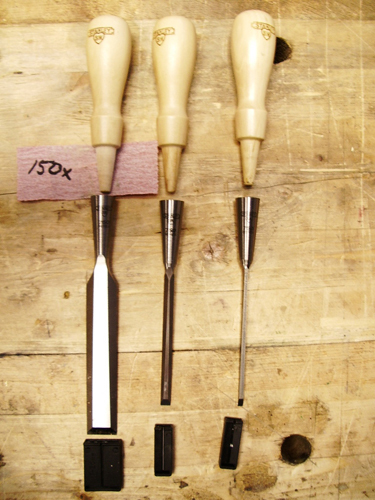
Because socket chisels are prone to loose handles, I removed the handles to sand their tapers for more friction in the sockets. Handle removal is easy. With the edge protector on, firmly grip the blade and lightly rap the handle on a piece of soft wood. It should come off with little effort. Some light sanding with some 150x paper removed the factory finish from the taper ensuring enough tooth to grip the interior of the socket once the handle was driven home.
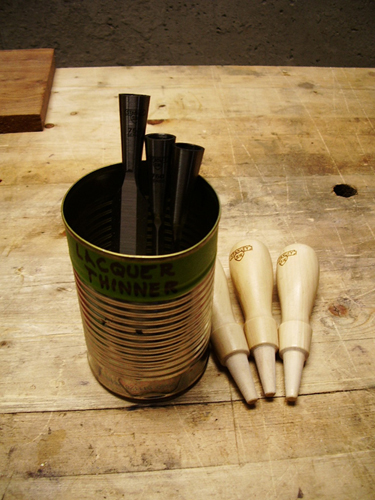
 

With the handles still off, I removed the shipping lacquer from the chisels by soaking them in a soup can full of lacquer thinner. Five minutes was all it took to dissolve the film. A quick go with a Scotch-Brite pad buffed away the last bit of residue.
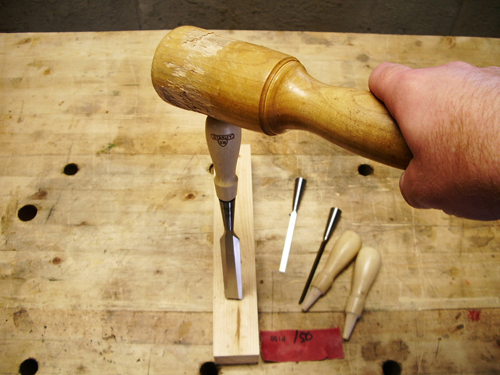


There are many ways to reseat a socket chisel handle. My technique is simply to place the cutting edge of the chisel on a piece of softwood and give the top of the handle a good bash with a wooden mallet. No more to it than that.
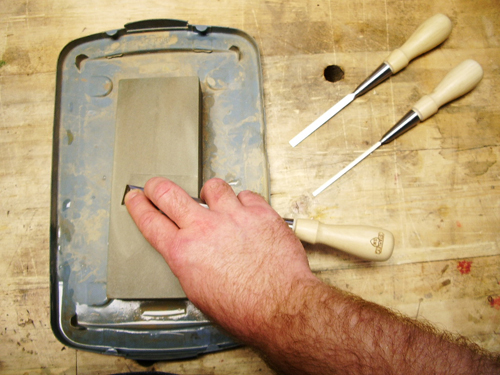
 

I chose to flatten the back of these chisels with my 200 grit Japanese waterstone. Of course you could use sandpaper on glass, a diamond stone or any other abrasive you like. I was pleased to find that the 3/4″ chisel only took 2-3 minutes to remove the factories milling marks and to get the tool’s back flat to my satisfaction. The small sizes took slightly less time. Nice.
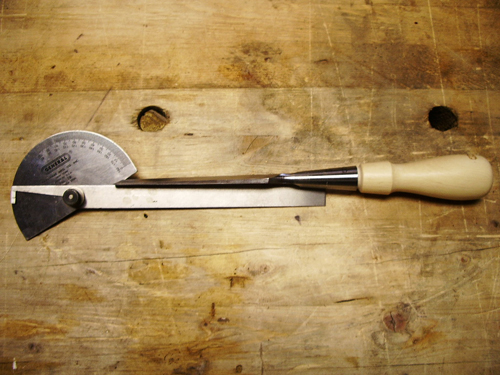
As for coarse sharpening and bevel shaping, I like a slow speed grinder (around 1750-2000 rpm’s) with a 60 grit aluminum-oxide wheel. The wheel pictured happens to be a Norton Blue wheel. The bevel angle from the factory came in at 30 degrees. Right where I like it.
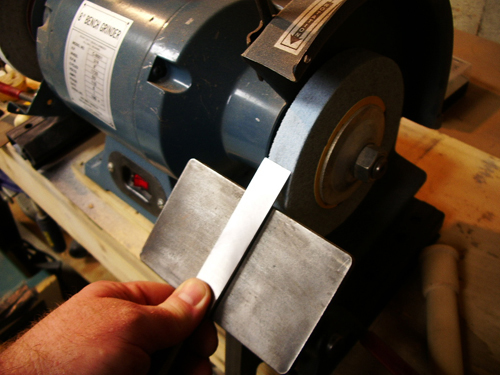
 

So, I eyeballed my Wolverine Jig to set the center of the bevel tangent to the wheel, and started to grind. Now, let me say here that it is not necessary to do any power grinding. A good honing guide and a coarse diamond stone, water stone or sandpaper will certainly do the same thing. The point is to remove the factory milling marks, quickly adjust the bevel angle and move on to the next finer abrasive. I promise the woodworking police will not come knocking if you have another method.
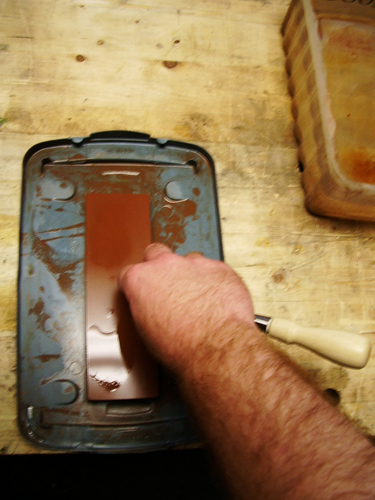
I removed the grinding marks from the bevel and the 200 grit waterstone scratches from the back with a 1000 grit water stone. I honed the bevel and polished the back with an 8000 grit waterstone. That’s it. I found these chisels tuned up much faster than all but the most expensive brands I’ve come across. I spent no more than an hour preparing all three chisels. Now my standards are purely practical. I didn’t bother to make them pretty only functional. I need to get to work and push some product out the door after all. You may choose to spend more time fettling your chisels. This may include but is not limited to grinding the side bevels closer to the back (called stoning) and polishing out the factory machining marks from the top and sides. By the way, these chisels took a fine edge as you’d expect. Check back tomorrow and I’ll tell you how that edge held up in the final post of this series.

Jun 062011
 

New Tool Joy

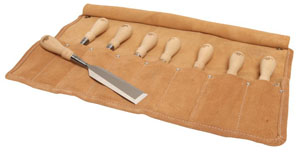
Good news! Stanley UK has reissued the 750 socket chisel. What’s the big deal you say? Ask any woodworking tool collector what the most sought-after bench chisels are and chances are many will say the Stanley 750 series. The popularity of these chisels stems from several reasons. They are Stanley products after all. Old Stanley tools have always been collectable, generally at reasonable prices. Good publicity in the trade journals and blogosphere has also added to the mystique of the 750s lately. Lastly they are just good looking and good quality tools. As a result, Stanley’s 750 socket chisels were the inspiration for Lie-Nielsen’s excellent line of bevel edge chisels.

Currently the only drawback to used 750s is the price. The high prices are a result of increased demand from all the good press these chisels get. On the used market an individual Stanley 750 in useable shape can run $50 plus. What’s left in the affordable range are beat-up, rusted tools with missing handles. I always find the sockets mushroomed from repeated hammer blows when the handles are missing. Given these facts, the Lie-Nielsen version looks like a deal starting at $55. But as well made as the Lie-Nielsen chisels are, they are outside the budget of many woodworkers. So, when I found out the new Stanley 750s (sold under the Sweetheart label) were going to sell at a starting price of $30, I wanted to give them a go.

Let me tell you, I was pretty happy when I received 3 brand new Stanley 750s in the mail, sized 1/8″, 1/4″ & 3/4″. These are the widths I use most during the workday for joinery and general paring jobs.

In my next two entries of this three part post, I’ll tell you how I prepared the new chisels for use, and what I thought of them as I used them.

Oct 212010
 

Do you enjoy woodworking but would like to be “green” about it? Would you love to create nice looking pieces with a minimal number of tools? Would you like the lumber yard to be your back yard? A “yes” to any of these questions could mean a look into the usage of bamboo. “The Craft and Art of Bamboo” by Carol Stangler, available at Highland Woodworking, proves this sturdy, fast growing plant can make more than just a fancy fence or décor in a tiki-themed resturant. While primarily associated with Asian craft, bamboo grows equally well in North as well as South and Central America, and has been used for everything from drinking vessels and flower vases to counter tops and fishing boats!

Stangler’s self admitted love of bamboo comes through with the care and depth found in each section, beginning with a brief overview of how the plant is grown and used throughout the world before moving on to practical harvesting practices and the tools required to cut and work the material. A number of modern furniture designers were pulled in for input on some of the larger projects, which brings a variety and a stylishness to the pieces. While many are understandably Eastern in inspiration, that is certainly not the case with all of the projects, and the novice woodworker is not left out with simple designs like drinking cups, snack trays, or a doormat that are still attractive and eco-friendly while requiring only a few tools.

Aug 302010
 

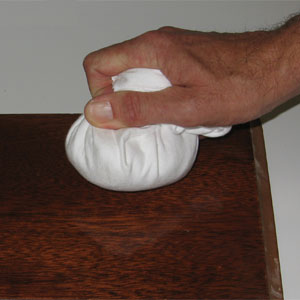
The number of finishing choices available today for protecting your woodworking projects is almost dizzying.  Some options are simple like wipe on/wipe off finishes, while others may require special equipment to apply, like a spray gun system, in order to achieve satisfactory results.   One finishing choice often overlooked is called French polish.  French polish is not a product, but rather the name given to a technique for applying shellac.

Shellac is sometimes referred to as an “old world finish”.  It has been around for hundreds of years and is still often the finish of choice for fine furniture. A properly applied French polish has amazing depth, clarity and warmth that many of today’s high tech coatings simply cannot match.

Professional furniture restorer Alan Noel, with over 30 years of experience, will introduce you to the technique of French polishing and will share some of the subtle nuances in “padding” the shellac onto the surface of the wood.

With a little practice (we don’t recommend attempting to French polish for the first time on your mother-in-law’s piano bench) you’ll come to discover the wonderful properties and look of a French polish, welcoming it as a valuable finish option for your woodworking projects.

To sign up for Alan’s class on September 11, go to the Highland Woodworking website or click here.

Can’t make it for the September class? Don’t worry! Alan is offering the class again in October and November. Sign up now before classes are full!

Aug 202010
 

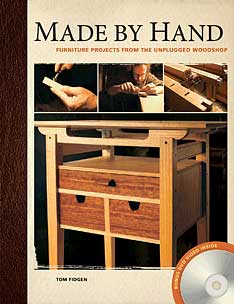
Many woodworking books fall under two distinct categories, the inspirational, giving us food for thought or highlights of a particular vein of woodworking, or the the more practical, providing hands-on step by step guidance.  A book that straddles that line is Made By Hand by Tom Fidgen, published by Popular Woodworking Books.  Fidgen belongs to the class of woodworker that eschews the realm of power tools to focus exclusively on hand tools.  Rather than try and convince readers that his method is best for all, Fidgen writes of how the decision to work with hand tools was first a practical one followed then by a sense that they allowed him greater freedom to express his ideas.

His work, as displayed in several cabinets detailed throughout the book, shows a design aesthetic informed by the simplicity of Japanese cabinetry as well as the work of renowned woodworker James Krenov.  With an easy to read writing style, Fidgen describes his work, not as a retrospect from decades of experience, but rather as “recent adventures” detailing the trials and tribulations of a burgeoning woodworker.

Spurred on by concerns of shop space and a need to feel more “natural” in the process of working with wood, Fidgen writes at length about the setting up of a comfortable shop space, not just in terms of size requirements, but also in putting thought to the flow of work.  He also goes into detail about the various tools that he feels are indispensable.  Stalwarts such as various hand planes, hand drills, and marking gauges are discussed, both in terms of the importance of acquiring good tools to start with, and the uses that may or may not be obvious to the beginning woodworker.

Moving past the tools themselves, the discussion moves to the selection and preparation of wood as well as various ways of marking and measuring the selected wood for the task at hand. From there the topic moves to  joinery methods he prefers, such as the dovetail joint, and the use of mortise and tenons.  The practical application of these methods are featured in six well designed cabinets of various size and function, with detailed text and pictures outlining their construction.

While recognizing the practicality of the skill of woodworking, Fidgen writes freely about the peace of mind he gets from his craft, giving voice to the concern of  “why” woodworking traditions continue, not just the “how-to” aspect.  While one could reproduce any of these cabinets from the text and pictures provided, one feels the real meaning behind this book is to inspire other woodworkers to find their “voice” in their craft. Made By Hand belongs in the library of any woodworking school, and on the shelf of anyone wishing a bit of inspiration, and a lot of practical know-how.

Available at Highland Woodworking.